August 20, 2026
The Hidden Architecture Beneath Every Major Gold Discovery
Most people who follow the gold mining sector focus on drill results, resource estimates, and commodity prices. Far fewer pause to ask a more fundamental question: what determines whether gold exists in a particular patch of ground in the first place? The answer has nothing to do with luck, and everything to do with the deep structural architecture of the Earth's crust. Structural controls on gold deposits represent one of the most technically demanding yet intellectually rewarding frontiers in modern exploration geology, and understanding them separates systematic discovery programs from expensive guesswork.
The physics and chemistry responsible for concentrating gold into mineable ore bodies operate over geological timescales and at depths that are impossible to observe directly. Yet the fingerprints of these processes are readable at surface and near-surface levels, encoded in fault patterns, alteration halos, vein geometries, and geophysical anomalies. Decoding this fingerprint is the central challenge of structural gold exploration.
When big ASX news breaks, our subscribers know first
Why Tectonic Architecture Predetermines Where Gold Concentrates
Gold mineralisation is not distributed randomly across the Earth's crust. Its occurrence follows predictable patterns that are governed by the large-scale tectonic framework of a region. At the broadest scale, gold provinces cluster along convergent plate boundaries, ancient suture zones, and deep crustal lineament systems that served as fluid conduits during periods of intense crustal deformation.
The logic behind this distribution is straightforward once the mechanics are understood. During periods of regional compression, crustal rocks are subjected to intense folding, faulting, and metamorphism. These processes simultaneously generate hydrothermal fluids through metamorphic dehydration reactions and create the fracture networks through which those fluids migrate. The result is a system in which fluid generation, migration, and deposition are all spatially linked to the same structural architecture.
Furthermore, understanding gold exploration trends confirms that structurally informed targeting is increasingly central to modern discovery programs. Three broad tectonic regimes each produce distinct styles of gold mineralisation:
-
Compressional regimes: Crustal shortening drives the development of thrust faults and fold-thrust belts. Major detachment surfaces and deep-seated shear zones serve as first-order fluid migration corridors, channelling mineralising fluids upward from metamorphic sources. Orogenic gold deposits, which include some of the largest known gold systems globally, are characteristically products of compressional environments.
-
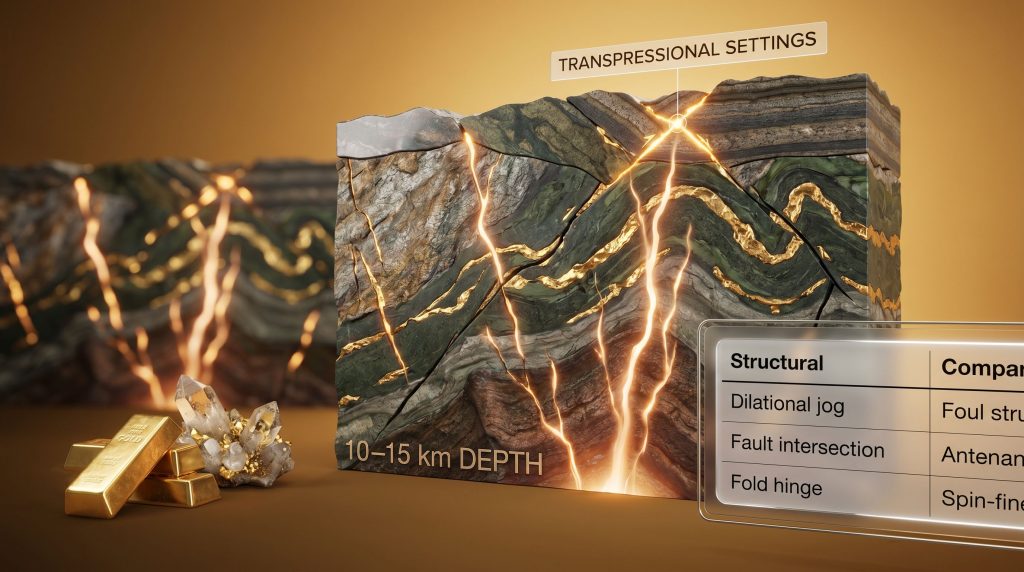
Transpressional regimes: These settings combine both compressional and strike-slip stress components, generating particularly complex structural networks. Strike-slip fault systems develop alongside compressional structures, creating arrays of dilational zones where localised extension within a broadly contractional setting focuses fluid flow. The repeated fracturing and sealing cycles inherent to transpressional environments are widely regarded as optimal conditions for progressive gold concentration.
-
Extensional regimes: Crustal stretching produces normal faults and extensional fractures that allow hydrothermal fluids to ascend rapidly toward surface. Epithermal gold systems, which form at comparatively shallow crustal levels, are the characteristic product of extensional environments, particularly where magmatic activity provides heat and fluid input.
Transpressional tectonic settings are consistently associated with the most structurally complex and economically significant gold deposits. Their capacity to generate repeated fracture-seal cycles allows gold to be progressively concentrated over geological time in ways that simpler tectonic settings cannot replicate.
How Deep Crustal Lineaments Shape Gold Province Architecture
At the largest observable scale, the distribution of gold districts is controlled by crustal-scale structural lineaments. These are long, linear features, sometimes extending for hundreds of kilometres, that are visible in geological maps, geophysical datasets, and satellite imagery. They represent deep crustal fault zones or ancient shear systems that have influenced fluid migration and crustal architecture across multiple tectonic cycles.
The significance of these lineaments lies in their role as conduits linking deep fluid source regions to upper crustal depositional environments. Hydrothermal fluids generated through metamorphic dehydration at depths of 10 to 15 kilometres or more require a continuous, interconnected fracture pathway to reach the shallower brittle zones where depositional conditions exist. Crustal-scale lineaments provide exactly this infrastructure.
The table below illustrates the hierarchical structural controls operating across different scales in gold systems:
| Structural Feature | Scale | Primary Role in Gold System | Example Setting |
|---|---|---|---|
| Crustal-scale lineaments | Hundreds of km | Deep fluid conduit network | Western Australian greenstone belts |
| First-order fault zones | Tens of km | District-scale fluid focusing | Bardoc Tectonic Zone, WA |
| Dilational jogs and stepovers | Metres to km | Deposit-scale pressure reduction traps | Carlin-type systems, Nevada |
| Fold hinges (anticlinal) | Metres to km | Pressure fluctuation and stagnation | Orogenic fold belts globally |
| Lithological contacts | Variable | Competency contrast and strain localisation | Volcanic-sedimentary boundaries |
An important and often underappreciated factor within this hierarchy is the concept of competency contrast. When rocks with different mechanical properties are deformed together, strain localises preferentially at their boundaries. Rigid, competent lithologies such as massive igneous intrusions deform differently from more ductile sedimentary sequences, and this mechanical mismatch focuses both fracturing and fluid flow along their shared contacts.
Many ore shoots in structurally hosted gold systems are positioned precisely at such lithological boundaries, regardless of which specific fault zone hosts the broader mineralised corridor. Consequently, mineral exploration importance is magnified considerably when structural mapping is integrated with lithological analysis from the earliest stages of a programme.
Fault Zones as Dynamic Hydrothermal Highways
Is a Fault Zone Simply a Break in Rock?
It is a common misconception to think of fault zones as simple planar breaks in rock. In reality, fault zones are internally complex, multi-component structures with highly variable hydraulic properties. Their architecture typically includes a central fault core, dominated by finely crushed gouge material with low intrinsic permeability, surrounded by an extensive damage zone where intense fracturing has created secondary permeability far in excess of the surrounding intact rock.
This internal structure gives fault zones a dual hydraulic character. The damage zone functions as the primary conduit for upward fluid migration, while the fault core can act intermittently as a hydraulic seal, trapping fluid under increasing pressure until the threshold for renewed fracturing is reached. This pressure accumulation and episodic release cycle is one of the most important mechanisms in gold-forming hydrothermal systems.
The cycle operates as follows:
-
Tectonic stress drives fluid accumulation within sealed fault segments, progressively increasing pore fluid pressure.
-
When fluid pressure exceeds the tensile strength of the surrounding rock, hydraulic fracturing occurs and sealed pathways reopen.
-
A pulse of hydrothermal fluid is released, migrating rapidly upward through the newly opened fracture network.
-
Mineral precipitation from the cooling, depressurising fluid gradually reseals the fracture system, beginning the cycle again.
This episodic rather than continuous fluid flow pattern is critical to understanding why gold concentrations build up within structurally confined zones. Each fluid pulse introduces a new increment of gold that precipitates at the same structural trap, and over geological time these increments accumulate into economically significant ore bodies. Research into deposit-scale structural controls on orogenic gold systems confirms this episodic model as a defining characteristic of world-class mineralised corridors.
What Structural Geometries Create the Most Efficient Gold Traps?
Not all points along a fault zone are equally effective at trapping gold. The geometry of the fault system determines where fluid flow is focused, where pressure gradients are steepest, and where the thermodynamic conditions for gold precipitation are met. Several geometric configurations stand out as particularly efficient traps:
Dilational jogs and stepovers in strike-slip fault systems create localised zones of extension within a broader fault array. As fluid is forced to expand into these open spaces, it experiences rapid pressure reduction, which destabilises the gold-bearing complexes in solution and drives precipitation. Research on Carlin-type gold systems in Nevada has documented the importance of fault intersection geometries in controlling ore distribution, with NW- and NE-striking fault arrays creating high-permeability nodes at their crossing points.
Fold hinges trap mineralising fluids through a different mechanism. As anticlinal folds tighten, pore pressures fluctuate at the fold crest, and uplift combined with cooling reduces gold solubility. Tight apical fold angles are often associated with thrust fault interactions that further enhance structural complexity and fluid focusing at these sites.
Fault intersections represent the highest-permeability nodes in any structural network. Where two or more fault systems cross, the combined fracture density is dramatically elevated and fluid from multiple source directions converges into a single high-flux zone.
| Trap Type | Primary Mechanism | Fluid Behaviour | Associated Deposit Style |
|---|---|---|---|
| Dilational jog | Extensional void creation | Rapid decompression | Lode and orogenic gold |
| Fold hinge | Pressure fluctuation and uplift | Stagnation and cooling | Orogenic fold belt gold |
| Fault intersection | Permeability node amplification | Convergent fluid focusing | Carlin-type and lode gold |
| Lithological contact | Competency contrast strain | Chemical reactivity | Contact metasomatic systems |
| Relay ramp and stepover | Distributed extension | Fluid dispersion and focusing | Strike-slip hosted gold |
The Physical and Chemical Triggers of Gold Precipitation
What Actually Causes Gold to Drop Out of Solution?
Understanding where gold precipitates requires understanding both the physical environment and the chemical behaviour of gold in hydrothermal solution. Gold is transported primarily as bisulfide or chloride complexes, both of which are stable only within specific windows of temperature, pressure, and redox conditions. When those conditions change, the complexes break down and gold precipitates.
Three primary triggers drive this breakdown:
Pressure drop is the most mechanically direct trigger. As fluids ascend from lithostatic pressure environments at depth into hydrostatic pressure conditions at shallower levels, rapid decompression destabilises gold complexes. Dilational structural traps maximise this pressure gradient and are therefore the most efficient precipitation sites in orogenic gold systems.
Fluid-rock chemical interaction is equally important. When hot, metal-bearing fluids interact with iron-rich host rocks, sulphur is consumed by reactions with iron minerals, removing the ligand that keeps gold in solution. Changes in oxidation state triggered by these reactions also directly reduce gold solubility. This is why certain rock types, particularly iron-rich volcanic sequences or carbonate-bearing sedimentary packages, are disproportionately represented as ore hosts in structurally controlled gold systems.
Fluid mixing introduces a third and often underappreciated pathway to precipitation. When deep metamorphic fluids carrying dissolved gold mix with shallower meteoric waters or cooler groundwater systems within a structural trap, the resulting fluid chemistry may fall entirely outside the stability window for gold complexes. pH shifts, redox changes, and dilution of ligand availability can all independently drive gold supersaturation in the mixing zone. Furthermore, detailed gold deposit analysis from geologically diverse settings consistently highlights fluid mixing as a key driver of high-grade ore shoots.
The most economically significant ore shoots tend to occur where multiple precipitation triggers operate simultaneously. Where pressure drop, temperature decrease, and fluid mixing converge within the same structural trap, the efficiency of gold concentration is maximised.
Temperature decrease amplifies all of these effects. As fluids cool during ascent, gold solubility declines progressively. Structurally controlled rapid ascent along fractures can compress this cooling pathway into a very short vertical distance, dramatically increasing the rate of precipitation and the grade of the resulting ore.
The next major ASX story will hit our subscribers first
The Timing Dimension: When Structural Gold Deposits Form
The temporal relationship between deformation events and gold mineralisation is not incidental. Gold deposits characteristically form during specific windows of tectonic evolution, and understanding this timing is critical to interpreting the structural setting of any given deposit.
One of the most important temporal controls is the ductile-to-brittle transition. In the early stages of tectonic deformation, strain is distributed broadly through the crust in a ductile manner, without creating the discrete fracture networks required for focused fluid flow. As deformation progresses and the crust evolves toward more brittle behaviour at upper crustal levels, strain becomes localised into discrete fault zones. This transition marks the onset of fault-controlled fluid pathways and is widely recognised as the critical window for gold mineralisation in orogenic systems.
| Gold Deposit Type | Structural Timing | Key Kinematic Feature | Global Examples |
|---|---|---|---|
| Orogenic and lode gold | D2/D3 deformation events | Veins kinematically linked to active shear | Bardoc Tectonic Zone, WA; Manitoba greenstone belts |
| Carlin-type | Post-compressional extension | Tertiary normal faults reactivating older reverse faults | Gold Bar District, Nevada |
| Intrusion-related | Pre-regional deformation | Early veins predating cleavage, later sheared | Renabie, Côté Gold, Canada |
Importantly, many large gold deposits record multiple generations of mineralisation, with successive deformation events reactivating and extending earlier structural traps. Complex vein networks with cross-cutting and overprinting relationships are a common observation in high-grade ore shoots, reflecting the episodic nature of fluid flow and the progressive concentration of gold through repeated tectonic reactivation. Research from lithospheric structural controls demonstrates that multilevel structural hierarchies govern how these reactivation events translate into economically viable mineralised corridors.
Applying Structural Principles to Exploration Targeting
The practical value of understanding structural controls on gold deposits lies in its ability to transform exploration targeting from a probabilistic exercise into a geometrically predictable framework. Rather than drilling on geochemical anomalies alone, structurally informed exploration programmes identify the specific geometric conditions under which gold concentration is most likely, then test those geometries systematically.
Tier 1 structural targets, those with the highest theoretical prospectivity, include:
-
Dilational jogs along regional-scale strike-slip fault systems with documented fluid alteration
-
Anticlinal fold hinges within active thrust corridors showing competency contrast between adjacent lithologies
-
Intersections of cross-cutting fault arrays where geophysical anomalies and surface geochemistry converge
Tier 2 structural targets, offering moderate prospectivity, include:
-
Lithological contacts between competent and ductile rock packages within broader structural corridors
-
Structural lineaments identified through geophysical datasets with coincident geochemical anomalies
-
Fault relay ramps within extensional fault arrays showing silicification or carbonate alteration
Alteration patterns serve as powerful proxies for past fluid flow within structural systems. Decalcification, silicification, and jasperoid development all indicate the passage of hydrothermal fluids through a structural corridor. However, a critical point that is frequently misunderstood in early-stage exploration is that economic gold ore rarely resides within jasperoid zones themselves.
The structural context surrounding alteration, specifically the trap geometry that focused the fluids creating the alteration, is what determines whether economic grade mineralisation is present. Interpreting gold drill results within this structural framework is therefore essential to avoid misreading promising alteration as confirmation of a viable ore body.
Multi-scale structural analysis, integrating crustal lineaments identified through regional geophysics with deposit-scale fracture mapping and oriented drill core analysis, provides the most reliable foundation for systematic gold discovery. Each scale of observation informs targeting at the next scale down, from identifying prospective structural corridors to pinpointing the specific geometric traps within those corridors where gold should be concentrated.
Frequently Asked Questions: Structural Controls on Gold Deposits
What Are Structural Controls on Gold Deposits?
Structural controls are the geological features — including fault zones, shear zones, fold hinges, and fracture intersections — that govern where hydrothermal fluids travel and where gold precipitates within the crust. They operate at scales from regional tectonic belts down to individual ore shoots within a single fault zone.
Why Do Gold Deposits Form Along Fault Zones?
Fault zones create high-permeability pathways that channel hydrothermal fluids carrying dissolved gold. Their internal architecture generates localised pressure drops and chemical instability that trigger gold precipitation, making them disproportionately important as ore hosts relative to their volumetric abundance in the crust.
What Tectonic Setting Produces the Most Gold?
Convergent plate boundaries, particularly transpressional settings that combine compressional and strike-slip stress components, are globally the most productive tectonic environments for gold formation. These settings generate the complex structural networks and repeated deformation cycles that concentrate gold into economic deposits.
How Deep Do Gold-Forming Hydrothermal Fluids Originate?
In orogenic gold systems, fluids are commonly sourced from metamorphic dehydration reactions at depths of 10 to 15 kilometres or more. These fluids migrate upward along fault-controlled pathways to shallower crustal levels where depositional conditions are met.
What Causes Gold to Precipitate From Hydrothermal Fluids?
Gold precipitation is triggered by rapid pressure drops, temperature decreases, fluid-rock chemical reactions, and mixing between chemically distinct fluid sources. These conditions destabilise bisulfide or chloride complexes that keep gold in solution, causing it to deposit within structurally defined traps. Interpreting drill results in light of these triggers allows investors and geologists alike to assess whether a given intercept reflects a genuine structural trap.
Key Principles for Structurally Informed Gold Exploration
The core takeaways from structural geology as applied to gold exploration can be summarised as a set of principles that should inform every stage of a discovery programme:
-
Regional tectonic stress regimes determine the style, orientation, and distribution of gold-hosting structures at the district scale
-
Fault zones are not passive features but dynamic hydraulic systems whose behaviour changes through time as fracturing, sealing, and reactivation cycles repeat
-
The most efficient structural traps integrate multiple gold precipitation mechanisms simultaneously, including pressure drop, cooling, and fluid mixing
-
Episodic fluid flow driven by tectonic reactivation progressively concentrates gold over geological time, explaining why complex multi-generation vein systems host the highest grade ore
-
Effective targeting requires multi-scale structural analysis, beginning at the crustal lineament scale and progressively refining to deposit-scale fracture geometry before drilling commitments are made
Structural geology is not simply one input among many in modern gold exploration. It is the foundation upon which all other datasets — geochemistry, geophysics, and drilling — must be interpreted. Programmes that invest in understanding the structural architecture of their tenements before committing to systematic drilling consistently outperform those that rely on geochemical anomalism alone. The Earth has already done the engineering work of concentrating gold. The task of exploration is to read the structural record it has left behind.
This article is intended for informational and educational purposes only. It does not constitute financial advice or a recommendation to invest in any specific company or mineral project. Readers should conduct their own due diligence and consult qualified financial and geological advisors before making investment decisions.
Want to Know When the Next Major Gold Discovery Hits the ASX?
Discovery Alert's proprietary Discovery IQ model scans ASX announcements in real time, instantly identifying significant mineral discoveries — including structurally hosted gold systems — and translating complex geological data into actionable investment insights for traders and long-term investors alike. Explore how historic mineral discoveries have generated extraordinary returns and begin your 14-day free trial at Discovery Alert to position yourself ahead of the broader market.