
August 25, 2026
The Hidden Critical Mineral Flowing Through Every Copper Refinery
Roughly 20 to 50 percent of all energy generated worldwide disappears before it does useful work, escaping as waste heat from engines, electronics, industrial processes, and server banks. That staggering loss is driving researchers and engineers toward an unlikely solution: a metalloid so scarce it barely registers in Earth's upper crust, yet one that flows continuously through the global copper supply chain as tellurium in copper slime, in concentrations that are finally becoming economically worth capturing.
Tellurium occupies an unusual position in the periodic table and an even more unusual position in the critical minerals demand conversation. Silicon dominates the semiconductor narrative. Lithium commands energy storage headlines. However, tellurium, occurring at only approximately three parts per billion in Earth's upper crust, has been quietly accumulating inside copper refineries for over a century, waiting for technology and economics to catch up with its potential.
When big ASX news breaks, our subscribers know first
What Is Copper Anode Slime and Why Does It Contain Tellurium?
The Electrorefining Process: Where Tellurium Accumulates
Understanding why tellurium concentrates in copper anode slime requires a brief detour into electrometallurgy. During copper electrorefining, impure copper anodes are suspended in a sulfuric acid electrolyte bath alongside pure copper cathodes. An electrical current drives copper ions to dissolve from the anode and redeposit selectively onto the cathode, building up highly pure copper metal.
Most base metals in the anode follow copper into solution. Tellurium does not behave this way. Its electrochemical properties place it squarely in the category of elements that fall out of solution rather than migrate through it, settling as part of a dense residue that accumulates beneath the anode as refining progresses.
Why Tellurium Refuses to Dissolve Into the Electrolyte
The key factor is electrochemical nobility. Tellurium's standard electrode potential means it is thermodynamically unfavourable for it to remain in the sulfuric acid electrolyte under the conditions maintained during electrorefining. Instead, it forms stable compounds with silver, copper, and other noble metals that precipitate directly into the slime layer.
This same stubbornness that makes tellurium difficult to remove from the electrolyte makes the slime an extraordinarily concentrated repository of multiple critical materials simultaneously. Furthermore, the copper leaching process used in upstream stages also influences the trace element composition arriving at the refinery.
The Chemical Composition of Copper Anode Slime
Key Insight: Copper anode slime is not a waste product. It is a concentrated repository of critical minerals including tellurium, selenium, silver, and gold, all accumulating in a single recoverable stream during electrolytic copper refining.
Typical composition of copper anode slime (indicative ranges):
| Component | Typical Range in Raw Slime |
|---|---|
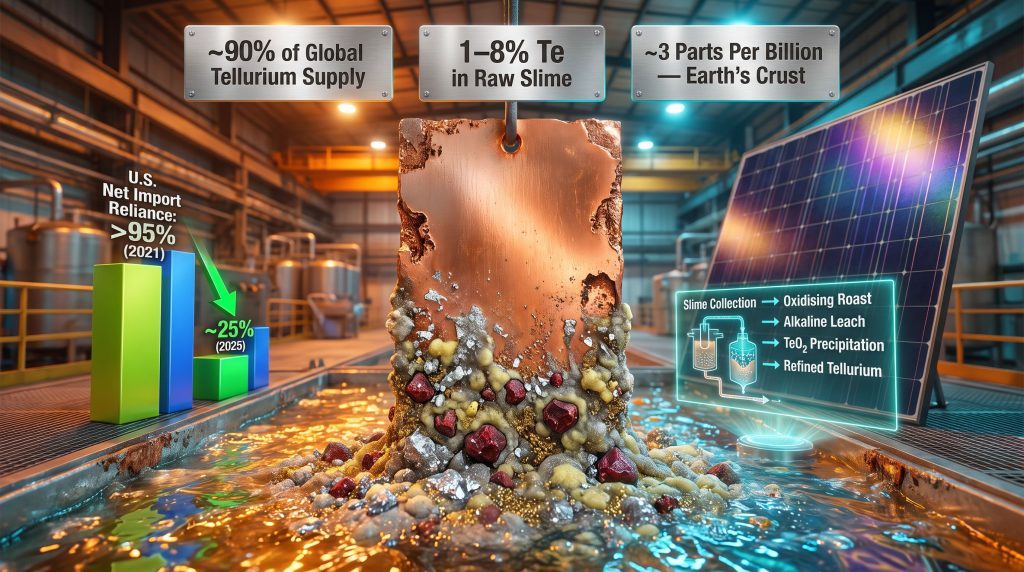
| Tellurium (Te) | 1–8% (trace to high) |
| Selenium (Se) | Variable, often co-present |
| Silver (Ag) | Significant concentrations |
| Gold (Au) | Minor but economically relevant |
| Copper (Cu) | Residual copper content |
Note: Slime composition varies significantly by ore body and refinery operation. Figures are indicative only and should not be relied upon for investment purposes.
How Rare Is Tellurium and Why Does Copper Slime Matter So Much?
Tellurium's Crustal Scarcity: Three Parts Per Billion
Tellurium's rarity is genuinely extreme. At approximately three parts per billion in Earth's upper crust, it is rarer than platinum group metals by most crustal abundance measures. This is not a marketing figure used to generate excitement about a commodity. It reflects the fundamental geochemical reality that tellurium almost never concentrates in economically mineable primary deposits on its own terms.
Why Copper Refining Accounts for Over 90% of Global Tellurium Supply
Because tellurium naturally co-occurs with copper mineralisation in porphyry and epithermal systems, every tonne of copper refined through electrolytic processes brings a small quantity of tellurium into a recoverable position. Aggregate that across global copper production and the numbers become meaningful.
According to industry estimates, tellurium in copper slime supplies over 90% of global tellurium production worldwide, making it functionally the only viable source at commercial scale.
Featured Snippet: Tellurium is one of the rarest stable elements in Earth's upper crust, occurring at approximately three parts per billion. Because it naturally co-occurs with copper mineralisation, copper anode slime generated during electrolytic refining has become the dominant global source, supplying an estimated 90% or more of total tellurium production worldwide.
The Geological Relationship Between Copper Deposits and Tellurium Occurrence
The geochemical affinity between copper and tellurium is rooted in their shared sulfide mineralogy. Tellurium concentrates in the same late-stage hydrothermal fluids that deposit copper sulfides, meaning porphyry copper deposits, which account for the majority of global copper production, are also the world's most important indirect tellurium resource.
This geological relationship is not coincidental. It is a function of chalcophile geochemistry, the tendency of certain elements to bond preferentially with sulfur during magmatic differentiation.
What Are the Chemical Forms of Tellurium Found in Copper Slime?
TeO₂, Ag₂Te, and Cu₂Te: The Primary Tellurium Phases
The specific mineralogy of tellurium within copper anode slime is more complex than the bulk grade numbers suggest. Tellurium does not arrive in the slime as a single uniform compound. It exists across several distinct phases, each requiring different processing conditions to liberate and recover efficiently.
Common tellurium-bearing phases in copper anode slime:
- TeO₂ (Tellurium dioxide) – Oxide phase, amenable to alkaline leaching
- Ag₂Te (Hessite) – Silver telluride, common in silver-rich slimes
- Cu₂Te (Rickardite) – Copper telluride, the intermediate product of initial recovery circuits
- Mixed oxide phases – Complex multi-element compounds requiring tailored processing
How Mineralogy Influences Downstream Recovery Efficiency
The phase distribution within a specific refinery's slime stream directly determines which processing route will deliver the highest tellurium recovery at the lowest reagent cost. A slime dominated by TeO₂ responds well to alkaline leaching. A sulfide-dominant slime with significant Ag₂Te requires a different approach.
This variability is one reason tellurium recovery circuits are not generic installations. They must be engineered around the specific geochemical fingerprint of the copper ore body feeding the refinery upstream.
Why Slime Chemistry Varies Between Refineries
Each copper ore body carries its own trace element signature, shaped by the temperature, pressure, and fluid chemistry of the hydrothermal systems that deposited it. A porphyry copper deposit in Utah will generate a meaningfully different anode slime than a copper deposit from Chile or the Democratic Republic of Congo, even when refined using identical electrometallurgical parameters.
This heterogeneity is a practical reality that any tellurium recovery operation must account for during engineering design. In addition, shifting copper market trends are influencing which ore bodies are prioritised for processing, consequently affecting the volume and grade of slime entering recovery circuits.
How Is Tellurium Extracted from Copper Anode Slime? A Step-by-Step Process Breakdown
Stage 1: Slime Collection and Dewatering
Slime accumulates continuously at the base of electrorefining cells throughout normal copper production. Periodically, cells are taken offline and the slime is physically removed, filtered, and dewatered to reduce its volume before being transferred to a dedicated treatment circuit.
Stage 2: Pretreatment Through Oxidising Roasting or Pressure Leaching
Raw slime contains residual copper and sulfur compounds that must be removed before selective tellurium leaching can proceed effectively. Oxidative roasting converts sulfide phases to oxides while driving off sulfur dioxide, preparing the material for subsequent hydrometallurgical steps. Pressure leaching in an autoclave offers an alternative where roasting presents operational constraints.
Stage 3: Alkaline Leaching to Selectively Dissolve Tellurium
Following pretreatment, the slime is contacted with a sodium hydroxide solution under controlled temperature and pressure conditions. Tellurium dioxide dissolves preferentially into the alkaline solution as sodium tellurite, while silver, gold, and platinum group metals largely remain in the leach residue for separate recovery.
Stage 4: Precipitation or Reduction to Produce TeO₂ or Elemental Tellurium
The tellurium-bearing leach solution is processed further by adjusting pH or applying reducing agents such as sulfur dioxide gas or electrochemical reduction. These treatments precipitate either crude tellurium dioxide or elemental tellurium, depending on the purity and product specification required by the downstream customer.
Stage 5: Refining to High-Purity Tellurium Products
Crude tellurium from precipitation contains residual impurities that must be removed before the material can be sold into semiconductor-grade or solar-grade markets. Further pyrometallurgical or hydrometallurgical refining produces high-purity tellurium metal, typically at 99.99% purity or higher, suitable for cadmium-telluride solar manufacturing and other precision applications.
Technical Note: Multiple processing routes exist depending on slime mineralogy. The most established pathway involves alkaline leaching following oxidative pretreatment, producing tellurium dioxide as an intermediate. Alternative methods include sulfuric acid pressure leaching, sodium sulfide leaching, and electrochemical cementation, each suited to different slime compositions.
Comparative recovery pathways:
| Process Route | Best Suited For | Key Output |
|---|---|---|
| Alkaline leaching (post-roast) | High-oxide slimes | TeO₂ → refined Te |
| Sulfuric acid pressure leaching | Mixed-phase slimes | Tellurium solution |
| Sodium sulfide leaching | Sulfide-dominant slimes | Sodium tellurite |
| Cementation / precipitation | Low-grade liquors | Crude tellurium |
From Refinery Byproduct to Commercial Product: The Industrial Recovery Journey
How Rio Tinto's Kennecott Operation Built a Tellurium Recovery Circuit
Tellurium has been present in Kennecott's copper stream for well over a century, yet for the vast majority of that time it was not recovered as a commercial product. The economics simply did not support the investment required to build and operate a dedicated recovery circuit.
That changed in 2019, when Rio Tinto began constructing a circuit to recover tellurium from anode slimes at its Kennecott facility in Utah. The circuit produces copper telluride filter cake, an intermediate product shipped to third-party processors for further refinement into high-purity tellurium and tellurium compounds. According to the U.S. Geological Survey, this domestic recovery operation played a meaningful role in transforming the U.S. tellurium supply position over the following years.
The Economics of Byproduct Recovery: When Does It Become Viable?
The Kennecott case illustrates a dynamic that runs through critical mineral supply chains more broadly. Byproduct recovery of trace elements is always technically possible at some cost. The question is whether the market will pay enough for the recovered material to justify that cost over a long enough period to recoup capital investment.
Key economic considerations for tellurium recovery from copper slime:
- Capital cost of building a dedicated recovery circuit
- Slime throughput volume and tellurium grade at the specific refinery
- Market price stability for tellurium and downstream products
- Co-product value from silver, selenium, and gold recovered simultaneously
- Processing agreements with third-party refiners for intermediate products
Industry Context: For most of copper refining's industrial history, tellurium recovery was economically marginal. The commercial viability threshold shifted significantly as downstream demand, particularly from solar manufacturing, created a durable price signal sufficient to justify dedicated recovery infrastructure.
Rio Tinto's Kennecott management has expressed the view that innovation in waste reduction and value extraction from processed material is a core operational priority, reflecting an industry-wide shift toward treating metallurgical byproduct streams as potential revenue sources rather than disposal problems. The company is also investigating bismuth properties and uses to assess recovery potential from Kennecott slimes, and produces scandium from its aluminium operations in Canada, signalling a broader multi-metal byproduct strategy.
The next major ASX story will hit our subscribers first
What Is Driving Demand for Tellurium Recovered from Copper Slime?
Cadmium-Telluride Solar: The Primary Demand Engine
The single factor most responsible for converting Kennecott's tellurium from an unrecovered curiosity into a commercial product is the growth of cadmium-telluride thin-film photovoltaic technology. CdTe solar panels use a thin semiconductor layer containing tellurium to convert sunlight into electricity with competitive efficiency characteristics and a manufacturing cost structure that has allowed them to capture substantial market share in utility-scale applications.
According to the U.S. Manufacturing of Advanced Cadmium Telluride Photovoltaics Consortium, CdTe technology accounted for approximately 40% of utility-scale photovoltaic installations in the United States as of 2025, representing the single largest driver of tellurium demand globally. First Solar, the dominant domestic producer of CdTe panels, manufactures its products in the United States, creating a direct link between domestic tellurium recovery and domestic solar manufacturing.
How U.S. Import Reliance Transformed Between 2021 and 2025
The combination of new domestic recovery capacity and growing commercial demand produced a dramatic shift in U.S. tellurium supply dependency over a relatively short period.
U.S. tellurium supply chain transformation:
| Metric | 2021 | 2025 |
|---|---|---|
| Net import reliance | >95% | ~25% |
| Domestic recovery source | Minimal | Copper anode slime circuits |
| Primary domestic producer | None at scale | Kennecott-linked operations (Utah) |
| Primary end-use driver | Specialty applications | CdTe solar manufacturing |
AI Data Centres as an Emerging Application Frontier
Beyond solar, a second and potentially transformative demand driver is beginning to emerge at the intersection of thermoelectric technology and artificial intelligence infrastructure. The scale of the opportunity is illustrated by data centre electricity consumption figures. The International Energy Agency estimated global data centre power demand at approximately 415 terawatt-hours in 2024, with projections suggesting this figure could approach 945 TWh by 2030, nearly doubling within six years.
Tellurium demand drivers by sector:
| Sector | Application | Demand Trajectory |
|---|---|---|
| Solar energy | CdTe thin-film photovoltaics | Strong and growing |
| Thermoelectrics | Waste heat-to-electricity conversion | Emerging |
| AI infrastructure | Data centre energy recovery | Early-stage, high potential |
| Specialty alloys | Steel and copper alloying | Stable, mature |
| Metallurgy | Machining improvement additives | Stable |
How Does Tellurium Enable Clean Energy Beyond Solar Panels?
The Physics of Thermoelectric Generation
Thermoelectric generators operate on the Seebeck effect, a physical phenomenon in which a temperature differential across a semiconductor material generates a voltage. Tellurium-based compounds, particularly bismuth telluride and lead telluride, are among the most efficient known thermoelectric materials across the temperature ranges relevant to industrial and computational waste heat recovery.
Featured Snippet: Thermoelectric generators are solid-state devices that produce electricity from a temperature differential between two surfaces. Tellurium-based semiconductor materials are among the most efficient known thermoelectric compounds, making them candidates for recovering usable electricity from industrial and computational waste heat streams.
Historical Uses: From Deep-Space Probes to Industrial Applications
Thermoelectric generators have a proven heritage in extreme environments. NASA's deep-space probes, including the Voyager spacecraft, relied on radioisotope thermoelectric generators using tellurium-based materials to convert heat from plutonium decay into the electrical power needed to operate instruments billions of kilometres from the Sun.
Industrial waste heat recovery from steel mills and glass manufacturing has also used thermoelectric principles, though efficiency constraints previously limited widespread commercial adoption. Consequently, the energy transition mining sector is now looking seriously at how to accelerate deployment of these technologies.
Applying Thermoelectric Devices to AI Data Centre Cooling Challenges
PyroDelta Energy Inc. is among the companies developing tellurium-enabled thermoelectric technology specifically targeted at data centre applications. The company has developed a prototype designed to capture waste heat generated by server banks and convert a portion of that thermal energy into usable electricity, simultaneously reducing the thermal load that cooling systems must manage.
PyroDelta's chief engineer has described AI data centres as environments that not only consume enormous quantities of electricity but also produce substantial heat loads, making them natural candidates for waste heat recovery technology. The company's thermoelectric approach draws on design concepts originally developed for capturing heat from internal combustion engine radiator systems and adapts them to the very different thermal profile of computing infrastructure.
The technology has attracted interest from organisations including the Pentagon, the Canadian government, Microsoft, and the National Science Foundation, reflecting the breadth of sectors that recognise data centre energy efficiency as a pressing challenge. Testing at an operating data centre facility is described as the next step toward real-world validation.
Why 20 to 50% of Global Energy Is Lost as Waste Heat
Scale of the Problem: Estimates suggest that between 20 and 50 percent of all energy consumed globally is ultimately lost as waste heat before it performs any useful work. Tellurium-based thermoelectric systems represent one technically credible approach to recovering a fraction of that loss across data centres, industrial facilities, and transportation systems.
What Other Critical Minerals Are Co-Recovered from Copper Refinery Slimes?
Selenium, Bismuth, and the Polymetallic Recovery Opportunity
Tellurium is the element attracting the most strategic attention within copper anode slime streams, but it is far from the only critical material present. Selenium, tellurium's chemical cousin in Group 16 of the periodic table, co-occurs consistently in copper slime and has its own established market in glass manufacturing, agricultural chemicals, and electronics.
Bismuth recovery from Kennecott slimes is currently under active study. Bismuth is classified as a critical mineral with applications in pharmaceuticals, cosmetics, and low-melting-point alloys, and its supply chain is also heavily concentrated geographically.
Strategic Lens: Copper anode slime represents a polymetallic critical mineral opportunity. Refineries capable of extracting tellurium, selenium, bismuth, silver, and gold from a single sludge stream can dramatically improve the economics of each individual recovery operation through shared infrastructure and processing costs.
Why Multi-Metal Recovery Is the Future of Critical Mineral Supply
The economic logic of treating copper slime as a polymetallic resource rather than a single-element opportunity is compelling. Fixed capital costs, including leaching tanks, filtration systems, and reagent handling, are shared across multiple revenue streams. The margin available from gold and silver recovery subsidises the cost of recovering smaller quantities of tellurium and selenium.
As critical mineral markets develop further and price signals strengthen, the business case for adding additional recovery circuits for bismuth and other trace elements improves progressively. Furthermore, research into tellurium recovery from complex slime streams continues to yield improvements in selectivity and yield that benefit the full suite of co-recovered elements.
Comparing Tellurium Recovery Methods: Which Process Delivers the Best Results?
Alkaline Leaching vs. Acid Pressure Leaching: A Technical Comparison
No single processing route universally outperforms the others when it comes to tellurium extraction from copper anode slime. The optimal choice depends on mineralogy, scale, capital availability, and the specific purity specification of the intended market.
Process comparison summary:
| Criteria | Alkaline Leaching | Acid Pressure Leaching | Sodium Sulfide Leaching |
|---|---|---|---|
| Selectivity for Te | High | Moderate | Moderate-High |
| Capital intensity | Moderate | High | Moderate |
| Reagent cost | Low-Moderate | Moderate | Moderate |
| Environmental profile | Manageable | Requires pressure vessel | Sulfide handling required |
| Output purity | High (with refining) | Variable | Variable |
Environmental Considerations in Slime Processing
All hydrometallurgical processing of copper anode slime generates reagent waste streams that require careful management. Alkaline leach solutions require neutralisation before discharge or reuse. Pressure leaching systems generate acidic effluents. Sodium sulfide leaching introduces sulfide species that must be oxidised before environmental release.
These factors influence both the operating cost and the regulatory approval timeline for new tellurium recovery circuits, and they represent genuine barriers to rapid capacity expansion even when the economic case is clear.
The Strategic Outlook: Why Tellurium in Copper Slime Matters to the Energy Transition
Connecting Existing Copper Infrastructure to Clean Energy Supply Chains
One of the most underappreciated aspects of the tellurium supply story is that it does not require new mines, new exploration programmes, or new infrastructure in remote locations. The raw material source is already operating, already processing ore, and already generating the slime stream from which tellurium can be recovered.
The investment required is in downstream processing capability within existing refinery footprints, a significantly lower barrier than greenfield mine development.
What Needs to Happen for Thermoelectric Applications to Scale
The thermoelectric pathway for tellurium demand faces meaningful technical and commercial hurdles before it can be considered a reliable demand driver at the scale of CdTe solar. Efficiency improvements in thermoelectric conversion, cost reductions in device manufacturing, and demonstrated performance in real-world data centre environments are all prerequisites for widespread adoption.
PyroDelta's work represents early-stage progress on this pathway, not a near-term certainty.
Closing Framework: Tellurium's trajectory from a metallurgical footnote to a strategically classified critical mineral illustrates a broader principle in resource economics: the most important materials for the energy transition are not always extracted from new discoveries. Sometimes, they are already flowing through industrial processes that have operated for generations, waiting for the convergence of technology, demand, and economics to make their recovery worthwhile.
Key Takeaways: Tellurium in Copper Slime at a Glance
| Theme | Key Data Point |
|---|---|
| Crustal abundance | ~3 parts per billion |
| Share of global supply from copper slime | ~90%+ |
| Typical tellurium grade in slime | 1–8% |
| U.S. import reliance (2021) | >95% |
| U.S. import reliance (2025) | ~25% |
| CdTe share of U.S. utility solar (2025) | ~40% |
| Global data centre power demand (2024) | ~415 TWh |
| Projected data centre power demand (2030) | ~945 TWh |
| Estimated global energy lost as waste heat | 20–50% |
Disclaimer: Data points drawn from publicly available USGS, IEA, and industry consortium sources. Forward-looking figures represent projections and are subject to material uncertainty. This article does not constitute financial or investment advice.
Frequently Asked Questions: Tellurium in Copper Slime
What percentage of global tellurium comes from copper anode slime?
Copper anode slime is estimated to supply over 90% of global tellurium production. Because tellurium does not concentrate sufficiently in any primary ore deposit to be mined economically on its own, the copper refining stream remains its overwhelmingly dominant commercial source.
How much tellurium is typically found in copper anode slime?
Tellurium concentrations in raw copper anode slime typically range from trace amounts to approximately 8%, with many commercial slimes falling in the 1 to 4% range. Concentration levels vary depending on the copper ore body's geochemical profile and the refinery's operating conditions.
What is copper telluride and how is it different from refined tellurium?
Copper telluride (Cu₂Te) is an intermediate product produced during initial tellurium recovery from anode slime. It must undergo further hydrometallurgical or pyrometallurgical processing to yield high-purity elemental tellurium or tellurium compounds suitable for end-use applications such as CdTe solar panels.
Why did U.S. tellurium import reliance drop so dramatically between 2021 and 2025?
The commissioning of dedicated tellurium recovery circuits at domestic copper refineries, enabled by the growing commercial demand signal from the CdTe solar industry, made domestic production economically viable for the first time at meaningful scale, reducing the need for imported material.
Can tellurium from copper slime help power AI data centres?
Not directly. However, tellurium-based thermoelectric materials can be incorporated into solid-state generators that convert waste heat from data centre server banks into usable electricity. This application is currently in prototype and early testing phases, with the potential to improve data centre energy efficiency if successfully commercialised.
Is tellurium classified as a critical mineral?
Yes. Tellurium is classified as a critical mineral by the U.S. Geological Survey due to its economic importance, supply chain concentration risks, and essential role in clean energy technologies including solar photovoltaics and thermoelectric systems.
For further reading on tellurium's role in critical mineral supply chains and clean energy technology, Metal Tech News provides ongoing coverage of tech metals, mining technology, and critical minerals developments across North America and beyond at metaltechnews.com.
Want to Track the Next Major Critical Mineral Discovery Before the Market Does?
Discovery Alert's proprietary Discovery IQ model scans ASX announcements in real time, instantly identifying significant mineral discoveries across tellurium, copper, and more than 30 other commodities — turning complex geological data into clear, actionable opportunities. Explore why historic mineral discoveries have generated extraordinary returns for early investors, and begin your 14-day free trial at Discovery Alert to position yourself ahead of the market.