June 5, 2026
Understanding Thermoelectric Material Processing in Modern Energy Systems
The global transition toward sustainable energy solutions has accelerated demand for technologies that capture and convert waste heat into usable electricity. Furthermore, this fundamental shift in energy utilization patterns creates unprecedented opportunities for advanced materials that can bridge the gap between thermal energy loss and electrical generation. Traditional power systems waste approximately 60-70% of generated energy as heat, representing billions of dollars in lost efficiency across industrial, commercial, and residential applications.
Within this context, specialized semiconductor materials capable of direct thermal-to-electrical conversion have emerged as critical components in next-generation energy recovery systems. In addition, these materials operate on well-established thermoelectric principles but require precise manufacturing processes to achieve the crystal alignment and conductivity levels necessary for commercial viability.
When big ASX news breaks, our subscribers know first
What Defines High-Performance Thermoelectric Crystal Production
Chemical Structure and Electronic Properties
Bismuth telluride crystal manufacturing centers on producing Bi₂Te₃, a binary compound formed by combining bismuth and tellurium in a precise 2:3 atomic ratio. This stoichiometric relationship creates a narrow-bandgap semiconductor exhibiting inherent thermoelectric characteristics essential for energy conversion applications.
The material's effectiveness stems from its unique electronic band structure, which enables efficient charge carrier transport while maintaining relatively low thermal conductivity. Moreover, commercial-grade Bi₂Te₃ crystals typically achieve dimensionless figure of merit (ZT) values between 0.8 and 1.0 at room temperature, while research-grade specimens can exceed 1.2 under optimized conditions.
Key performance characteristics include:
• Seebeck coefficient: -200 to +200 μV/K depending on doping type
• Electrical resistivity: Target specifications below 500 μΩ·m for commercial applications
• Thermal conductivity: Optimised range of 1.0-1.5 W/m·K
• Operating temperature range: Most efficient between -40°C and 200°C
Primary Applications in Energy Recovery Systems
Bismuth telluride crystal manufacturing serves multiple high-value sectors requiring efficient thermal management and energy recovery capabilities. Data centres representing the fastest-growing electricity demand segment, particularly facilities supporting artificial intelligence training and cryptocurrency mining operations, generate substantial heat loads requiring active cooling while simultaneously offering opportunities for waste heat capture.
Solar photovoltaic installations benefit from thermoelectric supplementation during periods of reduced sunlight availability or when panel temperatures exceed optimal efficiency ranges. Consequently, the technology enables electricity generation from temperature differentials even when panels are covered with ice or operating in extreme weather conditions.
Defense and aerospace applications demand lightweight, durable thermoelectric systems for high-payload drone operations and remote power generation. These specialised requirements drive demand for premium crystal grades capable of maintaining performance under extreme environmental stresses.
Current Manufacturing Methodologies and Limitations
Traditional Powder Processing Techniques
The conventional approach to bismuth telluride crystal manufacturing relies primarily on Bridgman-Stockbarger directional solidification processes. This method involves sealing high-purity elemental bismuth and tellurium powders within evacuated quartz crucibles, then heating the mixture to approximately 800°C to achieve complete melting and homogenisation.
The directional solidification process requires carefully controlled temperature gradients as the molten material slowly cools, promoting crystal growth along preferred crystallographic orientations. However, maintaining uniform thermal conditions across large crucible diameters presents significant technical challenges that result in polycrystalline structures with multiple grain boundaries.
Manufacturing constraints include:
• Raw material purity requirements: Both bismuth and tellurium must exceed 99.99% purity
• Vacuum processing necessities: Contamination prevention during high-temperature operations
• Thermal gradient control difficulties: Achieving uniform cooling rates across crucible sections
• Post-processing complexity: Cutting, polishing, and alignment operations introduce additional defects
Global Supply Chain Concentration Risks
Current bismuth telluride crystal manufacturing exhibits extreme geographic concentration, with Chinese facilities supplying over 90% of global production. This concentration creates multiple vulnerabilities including supply chain disruption risks, quality consistency challenges, and geopolitical dependencies that affect pricing and availability.
The reliance on conventional Bridgman processing methods across these facilities results in inherent crystal alignment defects that manufacturers have historically accepted as unavoidable constraints. Furthermore, these defects manifest as increased electrical resistivity, reduced thermal conductivity efficiency, and compromised mechanical durability in finished thermoelectric modules.
Manufacturing cost analysis reveals significant disparities between production methods:
| Production Method | Cost Range ($/gram) | Quality Grade | Defect Rate | Production Speed |
|---|---|---|---|---|
| Bridgman Process | $12-18 | Commercial | 15-25% | High |
| Epitaxial Growth | $45-80 | Research | <5% | Low |
| Advanced Casting | $20-30 | Industrial | <8% | Medium |
| Electrolytic Formation | $25-35 | Specialised | <10% | Medium |
However, the energy transition challenges continue to drive demand for more efficient manufacturing processes that can deliver superior crystal quality at scale.
Emerging Technologies Disrupting Traditional Manufacturing
Capillary Casting Process Innovations
Recent developments in bismuth telluride crystal manufacturing have introduced casting methodologies that address fundamental limitations of conventional processing. These approaches produce crystals moulded directly into required geometries, eliminating secondary machining operations that introduce alignment defects and material waste.
For instance, the process delivers measurable performance improvements including enhanced electrical conductivity, improved mechanical flexibility, and superior durability compared to traditionally manufactured crystals. Manufacturing efficiency gains result from reduced processing steps and eliminated cutting and soldering requirements in downstream device assembly.
Technical advantages include:
• Direct geometry production: Eliminates cutting and alignment operations
• Reduced resistivity: Achieves lower electrical resistance than conventional crystals
• Enhanced conductivity: Improved charge carrier transport efficiency
• Material waste reduction: Minimised losses from machining operations
Advanced Epitaxial Growth Applications
Molecular beam epitaxy (MBE) and metal-organic chemical vapour deposition (MOCVD) represent precision manufacturing alternatives for high-performance bismuth telluride crystal manufacturing. These techniques enable atomic-level control over crystal growth, resulting in minimal structural defects and exceptional electrical properties.
MBE processing involves directing precisely controlled atomic beams onto heated substrates under ultrahigh vacuum conditions. Layer-by-layer growth enables exact composition control and crystal orientation, producing materials with defect rates below 5% compared to 15-25% for conventional Bridgman processing.
Nevertheless, epitaxial methods require substantial equipment investments and operate at significantly slower production rates than bulk crystal growth techniques. Cost premiums range from $45-80 per gram compared to $12-18 per gram for standard Bridgman-processed materials.
What Makes Electrolytic Crystal Formation a Game-Changer?
Electrochemical breakthrough techniques represent emerging approaches to bismuth telluride crystal manufacturing that offer precise control over crystal dimensions and electrical properties. These processes apply controlled electrical potential across bismuth and tellurium precursor solutions to drive reduction and precipitation onto cathode substrates.
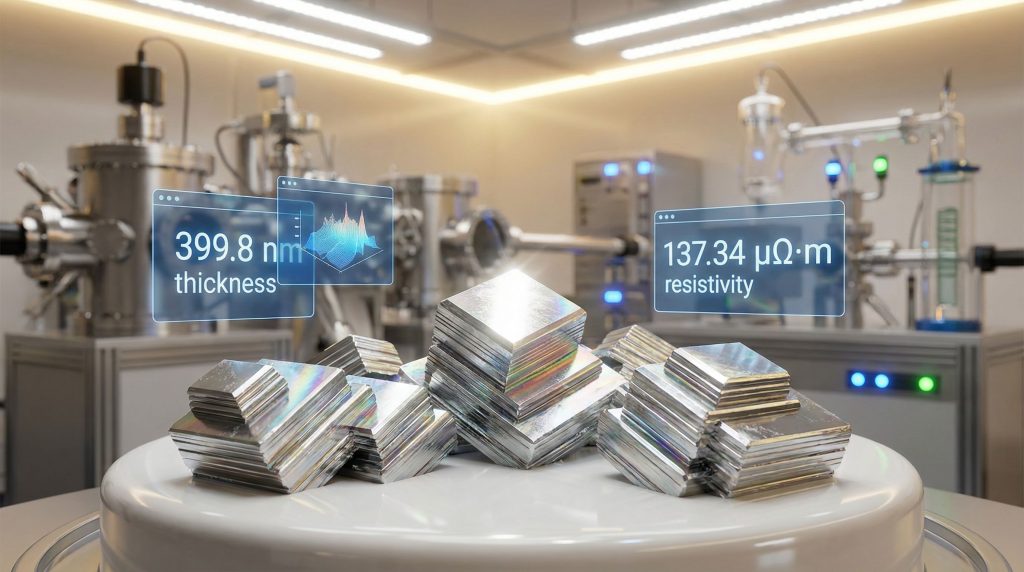
Advanced electrolytic techniques have demonstrated production of nanosheet arrays achieving 399.8 nm thickness with 137.34 μΩ·m resistivity, representing exceptional electrical conductivity performance. The process enables bias application and duration control for optimising inter-layer spacing and crystallographic orientation.
Key technical parameters include:
• Precise thickness control: Nanometre-scale dimensional accuracy
• Ultra-low resistivity: Exceptional electrical conductivity characteristics
• Controlled spacing optimisation: Engineered crystal structure parameters
• Scalable production potential: Adaptable to various substrate geometries
Quality Control Standards and Performance Optimisation
Electrical Performance Specifications
Bismuth telluride crystal manufacturing requires rigorous quality control protocols to ensure consistent thermoelectric performance across production batches. Critical measurements include Seebeck coefficient verification for both n-type (electron-doped) and p-type (hole-doped) materials used in complementary pairs within thermoelectric modules.
Thermal conductivity measurements employ laser flash analysis to determine heat transport properties, while electrical resistivity testing verifies charge carrier mobility and conductivity levels. Similarly, figure of merit (ZT) optimisation focuses on maximising the ratio of electrical conductivity squared times Seebeck coefficient squared, divided by thermal conductivity.
Standard testing protocols encompass:
• Seebeck coefficient measurement: Temperature differential voltage response
• Thermal conductivity analysis: Heat transport efficiency characterisation
• Electrical resistivity testing: Charge carrier mobility verification
• Mechanical stress evaluation: Thermal cycling durability assessment
Structural Integrity and Contamination Prevention
X-ray diffraction analysis confirms crystal phase purity and detects unwanted secondary phases that compromise thermoelectric performance. Scanning electron microscopy provides surface defect identification and grain boundary characterisation essential for quality assessment.
Contamination prevention measures during bismuth telluride crystal manufacturing include inert atmosphere requirements for high-temperature processing, stringent purity standards for elemental starting materials, and clean room protocols for sensitive growth operations.
Critical quality parameters:
• Phase purity verification: Single-phase crystal structure confirmation
• Surface defect quantification: Microscopic structural assessment
• Contamination control: Inert processing atmosphere maintenance
• Raw material purity: >99.99% elemental bismuth and tellurium specifications
Industrial Applications and Market Development
Data Centre Waste Heat Recovery Implementation
The rapid expansion of artificial intelligence computing and cryptocurrency mining operations has created unprecedented heat generation in data centre facilities. These installations represent ideal applications for bismuth telluride crystal manufacturing products, offering substantial thermal gradients and continuous operation requirements.
Modern data centres consume 1-3% of global electricity production while generating equivalent thermal energy that typically requires energy-intensive cooling systems. Consequently, thermoelectric recovery systems can capture this waste heat and convert it to supplemental electricity, simultaneously reducing cooling requirements and improving overall facility efficiency.
Implementation considerations include:
• Thermal gradient optimisation: Maximising temperature differentials for enhanced conversion
• System integration challenges: Retrofitting existing cooling infrastructure
• Scalability requirements: Modular deployment across facility sections
• Economic payback analysis: Balancing system costs against energy recovery value
Solar Panel Efficiency Enhancement Systems
Photovoltaic installations offer multiple opportunities for thermoelectric supplementation beyond traditional solar electricity generation. Temperature differential exploitation during low-sunlight periods enables continuous power production when solar panels operate below optimal efficiency levels.
Ice-covered panels create advantageous conditions for thermoelectric systems, as the temperature differential between ambient air and ice-covered surfaces generates electricity through thermal gradient exploitation. Furthermore, overheated panels that experience reduced photovoltaic efficiency can benefit from thermoelectric cooling that simultaneously generates supplemental power.
Application scenarios include:
• Low-sunlight period supplementation: Continuous electricity generation capability
• Ice-covered panel energy recovery: Cold weather performance enhancement
• Hot panel inefficiency mitigation: Temperature regulation with power generation
• Grid stability contribution: Distributed generation resource integration
Defense and Aerospace Integration Opportunities
Military and aerospace applications demand specialised bismuth telluride crystal manufacturing products capable of maintaining performance under extreme environmental conditions. High-payload drone operations require lightweight, efficient power supplementation systems that enhance carrying capacity and operational range.
Defense Advanced Research Projects Agency (DARPA) competitions establish performance benchmarks for thermoelectric systems, requiring technologies that demonstrate superior power-to-weight ratios and operational reliability. These specifications drive demand for premium crystal grades with exceptional electrical and mechanical properties.
Military-grade requirements encompass:
• Extreme environment durability: Temperature cycling and shock resistance
• Weight-to-power optimisation: Maximum electrical output per unit mass
• Operational reliability standards: Consistent performance under stress conditions
• Supply chain security: Domestic production capability requirements
The next major ASX story will hit our subscribers first
Economic Analysis and Investment Implications
Manufacturing Cost Structure Evolution
Bismuth telluride crystal manufacturing costs reflect complex interactions between raw material pricing, energy consumption requirements, and production method selection. Tellurium pricing typically ranges from $40-60 per kilogram, while bismuth costs approximately $8-12 per kilogram, creating material cost foundations that significantly impact final product pricing.
Energy consumption varies substantially across manufacturing approaches, with traditional high-temperature Bridgman processing requiring sustained heating at 800°C compared to room-temperature electrochemical methods. Labour intensity differences between automated epitaxial systems and manual crystal handling operations further influence production economics.
Cost optimisation strategies include:
• Raw material sourcing diversification: Reducing dependence on concentrated suppliers
• Energy efficiency improvements: Process optimisation for reduced thermal requirements
• Automation implementation: Labour cost reduction through mechanisation
• Yield enhancement: Defect rate reduction for improved material utilisation
Market Growth Projections and Opportunities
Global thermoelectric market expansion projections indicate growth to $1.2 billion by 2028, driven by increasing waste heat recovery adoption and solid-state cooling applications. This growth creates substantial opportunities for bismuth telluride crystal manufacturing companies that can deliver improved quality and reduced supply chain risks.
Investment considerations focus on technology differentiation, manufacturing scalability, and market positioning relative to established suppliers. Premium pricing opportunities exist for defect-free crystals that enable enhanced device performance in high-value applications.
Market dynamics include:
• Demand growth acceleration: Expanding application sectors and adoption rates
• Quality premium recognition: Willingness to pay for superior performance materials
• Supply chain diversification: Geographic distribution requirements for strategic materials
• Technology licensing potential: Intellectual property monetisation opportunities
How is North America Developing Manufacturing Capacity?
Domestic Supply Chain Strategic Initiatives
Recent developments in North American bismuth telluride crystal manufacturing capacity represent strategic responses to supply chain concentration risks and quality consistency challenges. Florida-based production facilities offer alternatives to Chinese-manufactured crystals while providing geographic proximity to major North American device manufacturers.
Domestic sourcing of raw materials including high-purity tellurium and bismuth reduces import dependencies and transportation costs while enabling closer quality control relationships with suppliers. These initiatives align with broader strategic supply reserves objectives across multiple industrial sectors.
Strategic advantages include:
• Supply chain risk mitigation: Reduced dependence on geographically concentrated sources
• Quality control proximity: Direct oversight of manufacturing processes and standards
• Transportation cost reduction: Shorter shipping distances to end users
• Regulatory compliance: Alignment with domestic content and security requirements
Technology Transfer and Scaling Challenges
Scaling advanced bismuth telluride crystal manufacturing techniques requires substantial investments in specialised equipment and technical expertise. Proprietary process development must balance intellectual property protection with capacity expansion needs to meet growing market demand.
Equipment manufacturing for precision crystal growth systems involves complex engineering requirements and limited supplier availability. Workforce development initiatives must address specialised skills requirements for advanced materials processing operations.
Implementation considerations encompass:
• Capital investment requirements: Equipment acquisition and facility development costs
• Technical expertise acquisition: Specialised workforce recruitment and training programmes
• Process optimisation: Scaling laboratory techniques to production volumes
• Quality assurance protocols: Maintaining performance standards during capacity expansion
Future Technology Developments and Industry Evolution
Emerging Applications Driving Innovation
Next-generation bismuth telluride crystal manufacturing developments focus on enabling new application categories including flexible thermoelectric devices for wearable electronics and tubular generators for liquid waste heat capture. These applications require crystal forms and properties beyond traditional rigid module configurations.
Integration with renewable energy storage systems creates opportunities for thermoelectric materials to enhance overall system efficiency by capturing and converting thermal losses during charging and discharging cycles. Advanced battery thermal management applications represent substantial market opportunities.
Innovation directions include:
• Flexible device integration: Bendable and conformable thermoelectric materials
• Tubular geometry optimisation: Liquid heat exchanger integration capabilities
• Storage system enhancement: Battery thermal management and efficiency improvement
• Miniaturisation advancement: Microscale device application development
Research Frontiers in Crystal Engineering
Advanced bismuth telluride crystal manufacturing research focuses on quantum dot incorporation for enhanced thermoelectric properties and nanostructuring approaches for thermal conductivity reduction without compromising electrical performance. These developments target ZT value improvements that could dramatically expand commercial viability.
Machine learning optimisation of growth parameters offers potential for automated process control that consistently produces high-quality crystals with minimal human intervention. However, pattern recognition algorithms can identify optimal temperature profiles, cooling rates, and compositional parameters for specific performance targets.
Research priorities encompass:
• Quantum enhancement techniques: Nanoscale structure modification for improved properties
• Thermal conductivity reduction: Phonon scattering optimisation without electrical penalty
• Automated process control: Machine learning integration for consistent quality production
• Performance prediction modelling: Computational design tools for crystal optimisation
This research approach aligns with broader industry innovation trends that emphasise technological advancement and process optimisation across mining and materials sectors.
Strategic Investment Implications and Market Positioning
Technology Differentiation Opportunities
Bismuth telluride crystal manufacturing companies that successfully develop and scale advanced production methods can achieve significant competitive advantages through superior product performance and reduced supply chain vulnerabilities. Premium pricing opportunities exist for materials that enable substantial efficiency improvements in end-use applications.
Vertical integration strategies offer potential for device manufacturers to capture additional value while ensuring crystal quality and availability. Technology licensing represents alternative monetisation approaches for companies with proprietary manufacturing processes.
Competitive positioning factors include:
• Performance superiority: Quantifiable advantages in electrical and thermal properties
• Manufacturing cost efficiency: Competitive pricing while maintaining quality standards
• Supply reliability: Consistent availability and delivery performance
• Technical support capabilities: Application engineering and optimisation assistance
Risk Assessment and Mitigation Strategies
Investment risks in bismuth telluride crystal manufacturing include raw material price volatility, technology obsolescence potential, and market adoption rates for thermoelectric applications. Diversification strategies across multiple application sectors reduce dependence on any single market segment.
The broader sustainability transformation of materials manufacturing processes also presents both opportunities and challenges for companies operating in this space.
Disclaimer: This analysis contains forward-looking statements regarding market projections, technology development, and investment opportunities. Actual results may vary significantly based on technological developments, market conditions, regulatory changes, and competitive dynamics. Investment decisions should consider comprehensive due diligence and risk assessment beyond the scope of this technical overview.
Long-term industry evolution depends on continued improvements in crystal quality, manufacturing cost reduction, and expansion of viable application markets. Success in this sector requires sustained investment in research and development, manufacturing capability, and market development initiatives that may require extended timeframes to achieve profitability.
According to recent research on thermoelectric crystals, companies are achieving breakthrough manufacturing capabilities that could dramatically reshape the industry. Additionally, extensive studies on bismuth telluride properties continue to reveal new optimisation pathways for enhanced crystal performance.
Ready to Invest in the Next Breakthrough Materials Discovery?
Discovery Alert's proprietary Discovery IQ model delivers real-time alerts on significant ASX mineral discoveries, instantly empowering subscribers to identify actionable opportunities in advanced materials and critical minerals ahead of the broader market. Explore Discovery Alert's discoveries page to understand how major materials breakthroughs can generate substantial returns, then begin your 14-day free trial today to position yourself ahead of the market.