
August 8, 2026
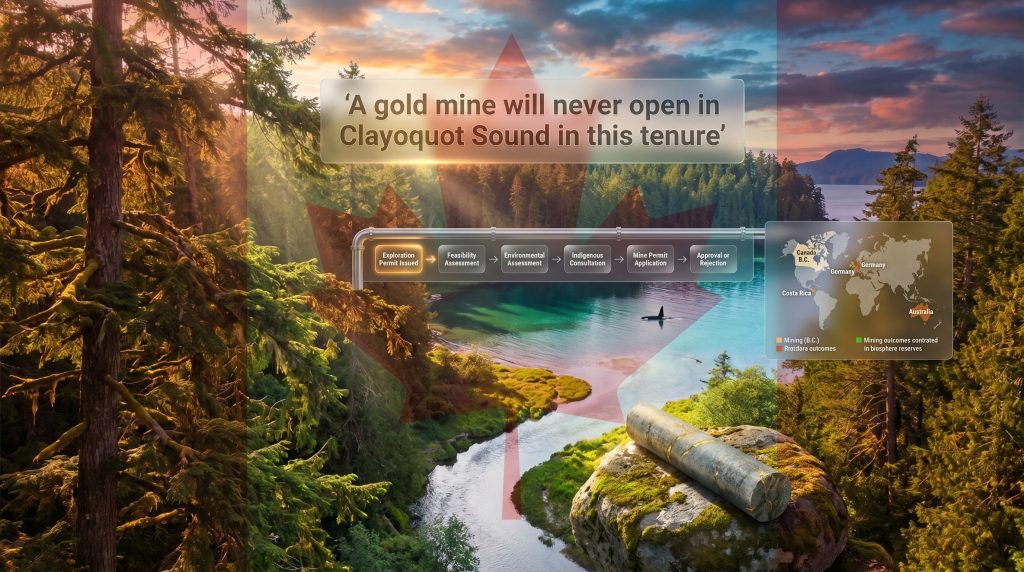
The Ecological Cost of Canada's Gold Rush: What Clayoquot Sound Reveals About a Nation at a Crossroads
Imagine a landscape where old-growth temperate rainforest meets the Pacific Ocean, where Chinook salmon thread through cold freshwater creeks, and where pods of orca forage along a coastline largely unchanged for thousands of years. Now imagine a mining exploration permit quietly issued within that landscape, authorising trenching operations, soil sampling, and drilling programs that could consume thousands of litres of water per operation. This is not a hypothetical scenario. It is happening right now in Clayoquot Sound, British Columbia, and the questions it raises extend well beyond one contested permit near Tofino.
The Tofino gold mine Clayoquot Sound debate sits at the intersection of three forces simultaneously reshaping Canada in 2026: a national push to reduce economic reliance on the United States by accelerating domestic resource extraction, a constitutional framework that guarantees Indigenous peoples the right to be consulted before activities affect their territories, and an ecological inheritance that, once damaged, cannot be restored. How these forces resolve at Clayoquot Sound may well establish the template for dozens of similar conflicts across the country.
When big ASX news breaks, our subscribers know first
What Is the Fandora Gold Property, and Why Does It Matter Now?
The Fandora gold property sits on the west side of Tranquil Creek, roughly 62 kilometres west of Port Alberni near the head of Tranquil Inlet, deep within the Clayoquot Sound UNESCO Biosphere Region on Vancouver Island's west coast. Its history stretches back to the late 1930s, when prospectors first staked claims in the area hoping to capitalise on gold deposits in the surrounding geology.
In 1947, the site was consolidated into the Tofino Gold Mining Company, and some underground development took place. However, the operation never became a commercially significant producer. The geological reality of the deposit, combined with the logistical challenges of operating in such a remote and ecologically complex environment, meant the site was eventually abandoned and remained dormant for decades.
What has changed is the company now holding the exploration permit. Imperial Metals, the Vancouver-based mining firm best known as the former owner of the Mount Polley Mine, holds the current provincial permit authorising exploration activities at the Fandora site. That corporate history carries considerable weight in how communities, Indigenous nations, and environmental advocates interpret the renewed interest in the property. Concerns about the mine reclamation challenges associated with Imperial Metals' track record are central to this unease.
The Mechanics of Exploration: What the Permit Actually Authorises
It is essential to distinguish between an exploration permit and a mine development approval, because the gap between them is where much of the public misunderstanding sits. The current permit does not authorise active mining or ore extraction. What it does authorise is a suite of investigative activities designed to determine whether a commercially viable deposit exists.
Documents obtained through on-the-ground reporting reveal that the scope of these activities is far from trivial:
- Trenching operations that in scale are equivalent to two full-sized football fields
- Soil composition sampling and subsurface geological surveying
- Proposed drilling programs requiring thousands of litres of water per operation
- Potential environmental baseline studies to support any future development application
The water use dimension is particularly significant. The Tranquil Creek watershed is not just a geographic feature; it is a functioning ecological system that supports multiple salmon species and feeds into the sensitive marine environment of Tranquil Inlet. Introducing large-scale water extraction and drilling activity into this watershed carries risks that extend well beyond the footprint of the immediate exploration site. Furthermore, the mineral exploration process itself, even at early stages, can trigger lasting hydrological disruption.
The Regulatory Gap That Made This Permit Possible
British Columbia's mineral tenure system operates under a framework that critics argue is structurally misaligned with modern environmental and Indigenous rights standards. Under the current system, exploration permits can be issued without requiring the same depth of prior consultation that would be mandatory for a full mine development approval.
This creates a regulatory gap in which early-stage exploration, which itself carries real ecological risk, can proceed with limited community or Indigenous nation input. Rights advocates argue this is fundamentally incompatible with the constitutional duty to consult.
The duty to consult is not a procedural courtesy. It derives from Section 35 of the Constitution Act, 1982, which protects Aboriginal rights and title. The Supreme Court of Canada has repeatedly affirmed that the Crown must consult meaningfully with Indigenous peoples before taking actions that could adversely affect those rights. Whether the issuance of the Fandora exploration permit met that standard is a question that has not been resolved, and it is one that Tla-o-qui-aht First Nation is actively contesting. The broader issues around British Columbia mining claims and Indigenous rights remain deeply unresolved at a systemic level.
How a Mineral Exploration Permit Progresses Toward a Mine
Understanding where the Fandora property currently sits in the regulatory sequence helps clarify what community members and Indigenous leaders are fighting to prevent before the process advances further:
- Exploration permit issued — geological surveying, trenching, and initial drilling authorised by the province
- Feasibility assessment — resource estimation and environmental baseline studies conducted by the permit holder
- Environmental Assessment trigger — required if the project meets or exceeds defined regulatory thresholds
- Indigenous consultation and accommodation — formal duty-to-consult process initiated at this stage in the standard process
- Mine permit application — full regulatory review including public comment periods and technical assessments
- Approval or rejection — based on cumulative environmental, social, legal, and economic assessment
As of mid-2026, the Fandora property remains at step one. No active mining has commenced. However, Indigenous leaders and environmental advocates are acutely aware that each step completed makes the next step easier to justify, creating a momentum problem that is well documented in Canadian resource regulation. Those unfamiliar with the full sequence can consult mining permitting basics to better understand what each stage entails.
Tla-o-qui-aht First Nation: Jurisdiction, Stewardship, and a Clear Boundary
The Clayoquot Sound region falls within the traditional territory of the Tla-o-qui-aht First Nation, a people with deep cultural, spiritual, and material connections to the land and water. For Tla-o-qui-aht leadership, the question of whether a gold mine should open in Clayoquot Sound is not a matter of negotiation or economic analysis. Their position is unequivocal: the Nation will not accept a mine on their territory during this period.
Saya Masso, the Nation's Natural Resources Manager, expressed this position in terms that leave no interpretive ambiguity. According to reporting by The Narwhal, Masso conveyed that a gold mine would never open in Clayoquot Sound during the current tenure, framing the issue not merely as environmental opposition but as a fundamental assertion of Indigenous sovereignty and cultural stewardship.
Tattuuskulth (Tatt) Charlie, the Nation's lead guardian, has been actively involved in monitoring the Tranquil Creek site. The existence of a dedicated guardian programme reflects a broader Indigenous land stewardship model, one in which cultural obligation and practical environmental oversight are inseparable.
This is not the first time Clayoquot Sound has been the site of Indigenous-led environmental resistance. The region has a documented history of organised opposition to resource extraction, with some of the most significant protests in Canadian environmental history taking place in the early 1990s when logging plans for the old-growth forests of Clayoquot Sound prompted mass civil disobedience.
What Clayoquot Sound's Ecology Actually Represents
UNESCO Biosphere Reserve designation is widely misunderstood. Many people assume it confers the same legal protection as a national park or a federal protected area. It does not. In Canada, UNESCO Biosphere status does not automatically override provincial mineral tenure laws. Exploration permits can be, and in this case have been, issued within biosphere zones unless specific legislative exclusions are enacted.
This distinction is crucial for understanding why the Fandora situation is legally possible, even as it seems ecologically unconscionable to many observers.
| Ecological Feature | Significance in Clayoquot Sound |
|---|---|
| Old-growth temperate rainforest | Among the largest remaining stands on Vancouver Island |
| Pacific salmon runs | Critical habitat for Chinook, Coho, and other species |
| Orca populations | Coastal foraging territory for resident and transient pods |
| Marine and freshwater connectivity | Tranquil Creek watershed feeds directly into sensitive inlet ecosystems |
| Biodiversity index | Designated as one of the most biologically rich coastal zones in Canada |
The Tranquil Creek watershed is particularly vulnerable because it functions as connective tissue between the terrestrial and marine environments. Sediment disturbance from trenching, changes to hydrological flow patterns from drilling water extraction, and potential contamination events could have cascading effects on salmon populations that extend far beyond the immediate exploration footprint.
Imperial Metals' Track Record and the Trust Deficit
Any evaluation of Imperial Metals' proposed activities at Fandora must grapple with the company's corporate history, specifically its ownership of the Mount Polley Mine at the time of Canada's largest recorded mining waste disaster.
| Event | Detail |
|---|---|
| Incident | Tailings dam breach at Mount Polley Mine, central British Columbia |
| Classification | Largest mining waste disaster in Canadian history |
| Environmental impact | Millions of cubic metres of tailings and wastewater released into Polley Lake and Hazeltine Creek |
| Regulatory consequence | Triggered extensive review of B.C.'s mine oversight and tailings dam safety standards |
Imperial Metals' CEO Brian Kynoch stated publicly, in comments reported by the Indigenous media outlet Ha-Shilth-Sa, that the company intends to engage respectfully with First Nations and local communities as the project progresses. The company did not respond to multiple requests for comment from The Narwhal's reporting team.
The gap between stated corporate commitments and community experience of those commitments is a recurring pattern in Canadian resource development. For communities living downstream and downwind of proposed projects, corporate assurances carry weight only when backed by demonstrated regulatory compliance and transparent consultation — neither of which Imperial Metals has been able to establish to the satisfaction of Tla-o-qui-aht leaders.
The next major ASX story will hit our subscribers first
The Local Economy Argument: What Tofino Has to Lose
Tofino's identity as a destination is inseparable from the ecological integrity of the surrounding landscape. The town's economy is built on surfing, wildlife watching, ecotourism, and the cultural draw of one of North America's most spectacular wild coastlines. The Mayor of Tofino has characterised a mine in Clayoquot Sound as a clear non-starter, reflecting not just environmental values but a sober economic calculation.
The contrast between conservation-based and extraction-based economic models is particularly stark in this context. A producing mine carries finite timelines, legacy contamination risks, and infrastructure demands that are difficult to reverse. A functioning wild ecosystem, by contrast, generates ongoing economic value through tourism, fisheries, and cultural heritage in perpetuity — provided it remains intact.
This is not an abstract comparison. Tofino attracts visitors from across Canada and internationally precisely because Clayoquot Sound retains the qualities that development elsewhere on the coast has permanently eroded. The Kennedy River and Clayoquot Sound area illustrates just how interwoven the region's ecological and economic identities have become.
How Canada's International Peers Protect Biosphere Reserves From Mining
The comparison between Canada's approach and that of other nations with UNESCO-designated areas is instructive.
| Country/Region | Biosphere Reserve | Mining Outcome | Protective Mechanism |
|---|---|---|---|
| Canada (B.C.) | Clayoquot Sound | Active exploration permit issued | Provincial mineral tenure system allows it |
| Australia | Adjacent zones near Kakadu | Mining restricted | EPBC Act and World Heritage legislative provisions |
| Costa Rica | La Amistad | Mining prohibited | Constitutional environmental protections |
| Germany | Bliesgau | Strict land use controls | State-level spatial planning law with exclusion zones |
The pattern is clear. Countries with stronger legislative frameworks connecting UNESCO designation to enforceable land use restrictions produce different outcomes. Canada's reliance on provincial mineral tenure systems to govern activities within biosphere reserves leaves a structural gap that other jurisdictions have chosen to close through statute.
Frequently Asked Questions: Tofino Gold Mine and Clayoquot Sound
Is there currently an active gold mine near Tofino?
No. As of 2026, the Fandora property near Tranquil Creek is operating under an exploration permit only. No active mining or ore extraction has commenced. Any transition to mine development would require a substantially more rigorous and separate approval process.
What is the Fandora property's historical production record?
The site was first staked in the late 1930s and consolidated under the Tofino Gold Mining Company in 1947. Some underground development occurred, but the property never achieved meaningful commercial production and was subsequently dormant for many decades.
Does UNESCO Biosphere Reserve status legally prevent mining in Clayoquot Sound?
Not automatically. In Canada, UNESCO Biosphere Reserve designation does not carry the same legislative force as a national park or federally protected area. Provincial mineral tenure laws continue to apply within biosphere zones unless specific exclusions are legislated.
What rights does Tla-o-qui-aht First Nation hold over this territory?
The Nation holds constitutionally protected Aboriginal rights and title interests across their traditional territory, which encompasses the Clayoquot Sound region. The Crown bears a legal duty to consult and, where appropriate, accommodate the Nation before authorising activities that could adversely affect those rights.
How much water would exploratory drilling require at Fandora?
Documents obtained through on-the-ground reporting indicate that proposed drilling programmes at the site would require thousands of litres of water per operation. This volume raises significant concerns given the ecological sensitivity of the Tranquil Creek watershed and its role in sustaining salmon habitat.
What the Fandora Conflict Signals for Canada's Broader Resource Strategy
The political context of 2026 makes the Fandora dispute something more than a local planning disagreement. Gold has rapidly become one of Canada's most strategically significant export commodities, and at both federal and provincial levels there are strong signals that resource development timelines will be compressed in the name of economic sovereignty. Consequently, this creates a direct collision between the acceleration agenda and the legal and moral commitments that underpin reconciliation with Indigenous peoples.
The tension at Clayoquot Sound functions as a stress test for Canada's capacity to pursue economic sovereignty, genuine reconciliation, and credible environmental governance simultaneously. How this particular case resolves will likely reverberate across dozens of contested resource projects from British Columbia to Ontario.
The Tofino gold mine Clayoquot Sound conflict does not yet have an ending. However, the questions it forces into the open — about who has the authority to decide what happens to irreplaceable landscapes, about whether provincial permit systems are fit for purpose in a post-reconciliation era, and about the real costs of fast-tracking extraction through ecologically sensitive territories — are questions that Canada's mining sector will need to answer, one way or another.
| Theme | Core Finding |
|---|---|
| Property history | Fandora claim dates to the late 1930s; consolidated 1947; historically negligible production |
| Current status | Exploration permit held by Imperial Metals; no active mining as of mid-2026 |
| Location | West side of Tranquil Creek, approximately 62 km west of Port Alberni, within Clayoquot Sound |
| Ecological context | UNESCO Biosphere Reserve; old-growth forest, salmon runs, and orca habitat |
| Indigenous opposition | Tla-o-qui-aht First Nation formally opposes any mine development on their territory |
| Regulatory concern | B.C.'s mineral tenure system permits exploration permits without full prior consultation |
| National significance | Case reflects core tension between Canada's resource acceleration agenda and reconciliation commitments |
This article draws on on-the-ground reporting by Zoë Yunker and Jillian Wilkes published by The Narwhal. Readers seeking primary source documentation, documentary footage from the Tranquil Creek watershed, and multimedia journalism from the site can access the full feature at thenarwhal.ca. This article contains forward-looking assessments and analytical perspectives that reflect conditions as of mid-2026 and should not be construed as legal or investment advice.
Want to Stay Ahead of Significant Mineral Discoveries as They Happen on the ASX?
While the Fandora conflict highlights the complex interplay between resource extraction, ecological stewardship, and Indigenous rights, Discovery Alert's proprietary Discovery IQ model cuts through the complexity of ASX mineral announcements in real time — instantly identifying high-potential discoveries across gold and 30+ other commodities before the broader market reacts. Explore historic discoveries and the substantial returns they have generated, then start your 14-day free trial to secure a genuine market-leading edge.