July 28, 2026
What Makes the Tomago Renewable Energy Partnership a Blueprint for Heavy Industry Decarbonisation?
Australia's industrial energy transition represents more than isolated facility upgrades. The transformation occurring across energy-intensive manufacturing sectors demonstrates how systematic policy intervention can preserve industrial capacity while advancing decarbonisation objectives. Heavy industries consuming massive electricity loads face unprecedented challenges as traditional coal-fired generation infrastructure approaches systematic decommissioning.
The partnership model emerging around large-scale industrial facilities combines risk-sharing mechanisms with long-term energy procurement strategies. This collaborative approach addresses the fundamental challenge facing energy-intensive operations: securing reliable, cost-competitive power sources during grid transformation periods. Manufacturing facilities requiring continuous high-capacity electricity supply cannot easily adjust operations to accommodate variable renewable generation without substantial supporting infrastructure.
Strategic Framework Components
| Partnership Element | Government Role | Industry Commitment | Market Impact |
|---|---|---|---|
| Concessional Financing | Risk reduction through subsidised capital | A$1bn+ investment pledge | Accelerated renewable deployment |
| Fixed-Price PPA Structure | Long-term price stability guarantee | Operational certainty beyond 2028 | Market confidence in industrial renewables |
| Regional Economic Protection | Job security assurance | Manufacturing capability retention | Industrial base preservation |
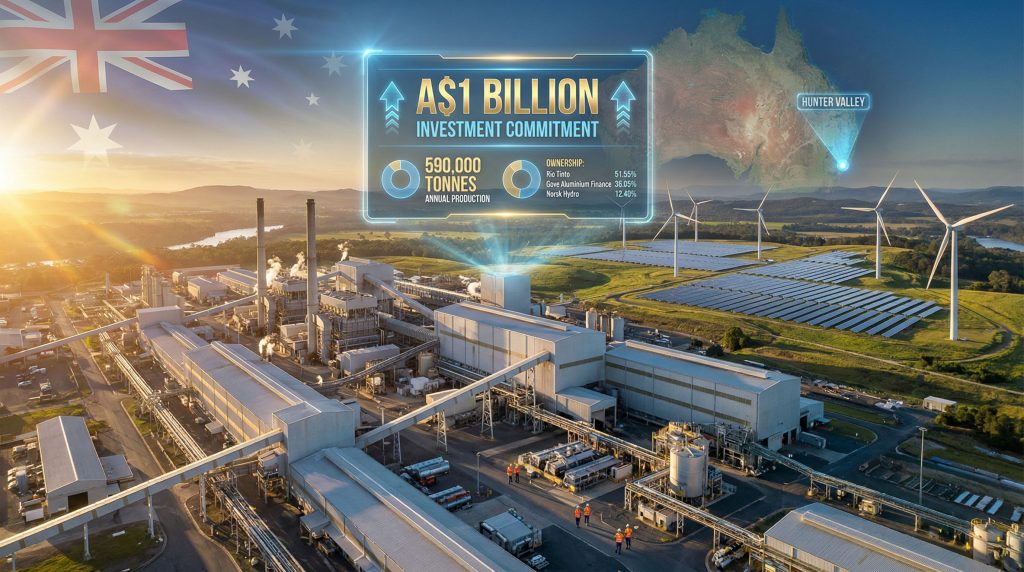
The Tomago Aluminium smelter renewable energy agreement establishes precedents for how public-private partnerships can navigate energy transition challenges. With annual production capacity of 590,000 tonnes, representing 40% of Australia's aluminium output, this facility's energy transition carries implications extending far beyond single-facility operations.
Government intervention through concessional financing mechanisms enables private sector investment in renewable energy infrastructure while distributing financial risk across multiple stakeholders. Furthermore, the partnership structure provides operational certainty for manufacturing facilities while advancing national decarbonisation objectives through market-driven renewable energy deployment.
When big ASX news breaks, our subscribers know first
Why Are Energy-Intensive Industries Critical to Australia's Economic Security Strategy?
Manufacturing sovereignty concerns intensify as global supply chains face increasing disruption from geopolitical tensions, trade disputes, and pandemic-related bottlenecks. Australia's domestic production capability in critical materials like aluminium provides strategic resilience against supply chain vulnerabilities that could otherwise compromise national economic security.
The systematic closure of coal-fired power infrastructure creates existential challenges for energy-intensive industries. With 24 of Australia's 28 coal plants announcing closure schedules, manufacturing facilities must secure alternative energy sources or face operational shutdowns that would permanently eliminate domestic production capacity.
Industrial Energy Vulnerability Assessment
The scale of Australia's industrial energy challenge extends beyond individual facilities. However, understanding these vulnerabilities requires examining multiple interconnected factors:
• National Production Concentration: Single facilities often represent substantial portions of domestic output
• Employment Multiplier Effects: Manufacturing operations support thousands of direct and indirect jobs
• Regional Economic Dependencies: Entire communities rely on continuous industrial operations
• Strategic Asset Value: Domestic production capability provides import substitution and export competitiveness
Energy supply disruptions create cascading effects throughout regional economies. Consequently, when large manufacturing facilities face uncertainty regarding power procurement, investment decisions, workforce retention, and supply chain relationships all become compromised. The Hunter Valley region exemplifies these dependencies, where industrial operations anchor broader economic activity.
The 2028 contract expiration deadline creates a natural experiment in how governments can intervene to prevent industrial asset stranding during energy transitions.
Coal-fired power station closures eliminate dispatchable generation sources that historically provided consistent, high-capacity electricity supply suitable for energy-intensive manufacturing. In addition, replacing this infrastructure with renewable energy solutions requires substantial supporting systems including energy storage, grid stabilisation, and demand management technologies.
Manufacturing facilities consuming hundreds of megawatts continuously cannot simply adjust operations to accommodate variable renewable generation without fundamental infrastructure investments. For instance, this creates a coordination challenge requiring government intervention to align private sector investment timelines with public infrastructure development.
How Does Joint Venture Ownership Structure Influence Renewable Energy Adoption?
Complex ownership arrangements create unique dynamics for capital investment decisions, particularly regarding renewable energy infrastructure deployment. The Tomago facility's ownership structure involves three distinct stakeholders with different strategic priorities, risk tolerances, and capital allocation frameworks.
Rio Tinto's Strategic Position (51.55% ownership):
Rio Tinto's majority stake provides operational decision-making authority while distributing financial exposure across multiple entities. The company's global net-zero emissions commitments create strategic alignment with renewable energy investment, while international experience with similar transitions provides operational expertise. Moreover, their recent green steelmaking advances demonstrate commitment to industrial decarbonisation across their global portfolio.
Norsk Hydro's Nordic Perspective (12.40% ownership):
Despite representing the smallest ownership stake, Norsk Hydro contributes advanced European experience with renewable aluminium production. Nordic operations utilise predominantly hydroelectric power, providing technology transfer opportunities and regulatory familiarity with carbon pricing mechanisms.
Gove Aluminium Finance's Financial Focus (36.05% ownership):
The intermediate ownership position suggests emphasis on operational cost optimisation and long-term energy price stability. This stakeholder likely prioritises financial return optimisation through diversified energy sourcing strategies.
Governance and Investment Decision-Making
Three-party ownership structures require consensus-building for major capital investments, potentially creating both opportunities and constraints. Furthermore, these arrangements influence decision-making processes:
• Risk Distribution: Multi-party ownership spreads financial exposure across entities with different capital availability
• Expertise Aggregation: Combined international experience enhances technology selection and implementation strategies
• Decision Complexity: Major investments require negotiated approval processes across stakeholders with varying priorities
• Timeline Coordination: Investment schedules must accommodate multiple corporate capital allocation cycles
Joint venture structures can accelerate renewable energy adoption when stakeholders align strategically, but may create implementation delays when priorities diverge. The A$1 billion capital commitment over ten years suggests successful alignment around long-term decarbonisation objectives.
What Investment Scenarios Could Emerge from the A$1 Billion Capital Commitment?
Large-scale industrial renewable energy transitions require comprehensive capital deployment across multiple infrastructure categories. The announced investment programme extends beyond energy procurement to encompass facility modernisation, process optimisation, and future technology integration.
Capital Allocation Scenario Modelling
| Investment Category | Estimated Range | Strategic Objective | Timeline |
|---|---|---|---|
| Renewable Energy Infrastructure | A$300-400m | Grid-scale solar/wind development | 2025-2027 |
| Energy Storage Systems | A$150-250m | Load balancing and grid stability | 2026-2028 |
| Process Efficiency Upgrades | A$200-300m | Reduced energy intensity per tonne | 2025-2030 |
| Hydrogen Integration Pilots | A$100-150m | Future fuel source diversification | 2027-2032 |
| Grid Connection Enhancement | A$50-100m | Transmission capacity optimisation | 2025-2026 |
Renewable Energy Infrastructure Development:
Grid-scale renewable generation requires substantial land acquisition, transmission connections, and grid integration systems. Solar and wind projects supporting industrial loads typically require capacity factors accounting for intermittency, necessitating overcapacity installation to ensure consistent supply availability.
Energy Storage System Integration:
Industrial facilities requiring continuous high-capacity power supply depend on storage systems for load balancing during low renewable generation periods. However, battery storage, compressed air systems, or hydrogen production facilities provide grid stability while enabling renewable energy integration.
Process Efficiency and Modernisation:
Reducing energy intensity per tonne of production decreases total power requirements while maintaining output capacity. Modern smelting technologies, waste heat recovery systems, and process optimisation can substantially improve energy efficiency metrics.
The ten-year investment timeline aligns with renewable energy infrastructure development cycles while providing flexibility for technology evolution and cost reductions. Consequently, phased implementation enables learning curve benefits and risk mitigation through staged deployment.
How Will This Model Influence Global Aluminium Market Dynamics?
Australia's renewable energy transition for aluminium production occurs within broader global industry transformation. Carbon pricing mechanisms, supply chain reconfiguration, and trade policy evolution reshape competitive dynamics across producing regions.
Competitive Positioning Analysis
Australia's Strategic Advantages:
The nation's electrification and decarbonisation efforts build on several fundamental strengths:
• Renewable Energy Resources: Exceptional solar and wind potential across multiple geographic regions
• Infrastructure Foundation: Established aluminium production facilities with existing skilled workforce
• Political Stability: Predictable regulatory environment supporting long-term investment planning
• Market Proximity: Geographic advantages for Asian demand centres requiring reliable supply sources
Global Market Implications:
The transition creates opportunities for premium pricing in carbon-conscious markets where buyers increasingly recognise emissions intensity differentials. Low-carbon aluminium products command pricing premiums in specialty applications, particularly in automotive, aerospace, and construction sectors prioritising sustainability metrics.
Supply chain resilience through domestic production capability provides strategic advantages during international trade disruptions. For instance, regional production capacity reduces dependency on global supply chains subject to geopolitical tensions, shipping constraints, and trade policy changes.
Carbon Intensity Differentiation
Traditional coal-powered aluminium production generates approximately 12-15 tonnes CO2 per tonne of aluminium, while renewable-powered operations achieve 4-6 tonnes CO2 per tonne when accounting for lifecycle emissions from infrastructure development.
This differential creates competitive advantages in markets implementing carbon border adjustments or corporate sustainability requirements. Furthermore, European Union carbon pricing mechanisms increase costs for high-carbon imports, creating market opportunities for low-carbon Australian production.
Australia's position in green metals leadership demonstrates how the Tomago Aluminium smelter renewable energy agreement contributes to broader strategic objectives.
Disclaimer: Carbon intensity figures represent industry estimates and may vary based on specific operational parameters, measurement methodologies, and lifecycle analysis boundaries.
What Regulatory and Policy Frameworks Enable This Transition Model?
The partnership leverages multiple policy instruments to de-risk private sector renewable energy investment. Understanding these mechanisms provides insights for replicating similar transitions across other energy-intensive industries facing comparable challenges.
Policy Architecture Components
Federal Government Contributions:
The Commonwealth approach aligns with broader energy transition policy frameworks through several mechanisms:
• Concessional Financing: Clean energy investment vehicles providing below-market financing rates
• Regulatory Certainty: Stable policy frameworks regarding carbon pricing trajectory and renewable energy targets
• Trade Policy Support: Export promotion for low-carbon industrial products in international markets
• Infrastructure Coordination: National electricity market planning to accommodate large industrial loads
State Government Enablers:
• Renewable Energy Zones: Coordinated development of transmission infrastructure supporting renewable generation
• Planning Approvals: Streamlined regulatory processes for renewable energy projects and grid connections
• Regional Development: Economic incentives supporting industrial facility retention and modernisation
• Workforce Transition: Skills development programmes for renewable energy sector employment
Market Mechanism Integration:
The Australian Energy Market Operator provides grid stability services enabling high industrial demand integration with variable renewable generation. However, Renewable Energy Target mechanisms create compliance pathways while Safeguard Mechanism frameworks generate emission reduction credits for participating facilities.
Long-term Power Purchase Agreement structures provide price certainty enabling private sector investment in renewable infrastructure. In addition, fixed-price arrangements transfer market risk from industrial facilities to energy suppliers while guaranteeing revenue streams supporting project financing.
The next major ASX story will hit our subscribers first
What Are the Long-Term Implications for Australia's Industrial Strategy?
This partnership model establishes precedents influencing how Australia maintains manufacturing competitiveness during global energy transition periods. Success or failure will determine whether similar approaches expand across other energy-intensive industries facing comparable challenges.
Strategic Scenario Outcomes
Success Scenario Benefits:
• Proven Partnership Model: Replicable framework for industrial decarbonisation across manufacturing sectors
• Manufacturing Capability Retention: Maintained domestic production capacity with reduced emissions intensity
• Export Competitiveness: Enhanced market positioning in carbon-conscious international markets
• Regional Economic Stability: Preserved employment and economic activity during energy infrastructure transition
Risk Mitigation Requirements:
Renewable energy intermittency management requires sophisticated forecasting and storage systems ensuring consistent supply availability. Furthermore, grid stability maintenance during high industrial demand periods necessitates backup systems and load management protocols.
Cost competitiveness preservation versus international producers requires careful balance between decarbonisation investments and operational efficiency. However, technology integration challenges with existing infrastructure may create temporary productivity impacts during transition periods.
Technology Demonstration Effects
Successful large-scale industrial renewable energy integration provides demonstration effects encouraging similar transitions across manufacturing sectors. Consequently, proven operational models reduce perceived risks for other facilities considering renewable energy procurement agreements.
Innovation ecosystem development through industrial renewable energy projects creates knowledge spillovers benefiting broader clean technology sectors. In addition, workforce skills development, supply chain capabilities, and technical expertise generate economic multiplier effects extending beyond individual facility transitions.
How Does This Compare to International Industrial Decarbonisation Approaches?
Global aluminium producers pursue various strategies for reducing carbon intensity, from renewable energy procurement to revolutionary smelting technologies. The Tomago Aluminium smelter renewable energy agreement partnership approach represents one pathway among several emerging internationally.
International Benchmark Analysis
| Region | Approach | Government Role | Industry Response |
|---|---|---|---|
| European Union | Carbon pricing + regulation | Market mechanism design | Technology investment acceleration |
| United States | Tax incentives + subsidies | Direct financial support | Manufacturing reshoring initiatives |
| China | State-directed investment | Comprehensive planning | Rapid renewable deployment |
| Australia | Public-private partnerships | Risk sharing + financing | Collaborative transition planning |
European Union Carbon Pricing Model:
The EU Emissions Trading System creates market-based incentives for industrial decarbonisation through carbon price signals. High carbon costs drive technology investment while carbon border adjustments protect domestic industry from high-carbon imports.
United States Incentive-Based Approach:
Federal tax credits and state-level subsidies provide direct financial support for renewable energy projects and clean technology deployment. For instance, the Inflation Reduction Act significantly expanded available incentives for industrial decarbonisation initiatives.
Chinese State-Led Planning:
Comprehensive government planning coordinates renewable energy deployment with industrial policy objectives. State-directed investment enables rapid infrastructure development while industrial policy ensures domestic manufacturing capability retention.
Australian Collaborative Partnership Model:
Risk-sharing between government and private sector enables industrial transitions without requiring comprehensive state planning or direct subsidies. Furthermore, concessional financing and long-term power purchase agreements provide market-based solutions with public sector risk mitigation.
What Success Metrics Will Determine the Model's Viability?
Evaluating partnership effectiveness requires comprehensive metrics spanning economic, environmental, and social outcomes. These indicators will influence whether similar approaches are adopted across Australia's industrial base and internationally.
Performance Measurement Framework
Economic Indicators:
• Energy Cost Competitiveness: Renewable energy costs compared to fossil fuel alternatives and international benchmarks
• Employment Retention: Direct and indirect job preservation during energy transition implementation
• Return on Investment: Financial performance for public and private capital deployment across partnership
• Export Market Performance: Market share maintenance or growth in international aluminium markets
• Regional Economic Impact: Broader community economic resilience and multiplier effects
Environmental Outcomes:
• Emission Reductions: Absolute and intensity-based carbon footprint improvements versus baseline operations
• Renewable Energy Integration: Percentage of total energy consumption from renewable sources
• Grid Stability Metrics: Power quality and reliability during renewable energy integration
• Technology Scalability: Demonstration effects enabling broader industrial sector adoption
Social and Regional Impacts:
• Workforce Development: Skills transition programmes and employment quality improvements
• Community Resilience: Regional economic diversification and stability during energy infrastructure changes
• Industrial Capability: Manufacturing capacity retention and technological advancement
• Innovation Ecosystem: Knowledge spillovers and clean technology sector development
Long-Term Monitoring Framework
Success measurement requires multi-year evaluation periods accommodating renewable energy infrastructure development timelines and market adjustment periods. Short-term disruptions during transition implementation should be balanced against long-term sustainability and competitiveness outcomes.
Government officials recently announced the formal partnership agreement structure, while industry analysts suggest broader implications for Australia's manufacturing competitiveness.
International benchmarking provides context for performance evaluation, comparing Australian results against similar industrial decarbonisation initiatives globally. However, continuous monitoring enables adaptive management and policy refinement based on emerging challenges and opportunities.
Disclaimer: Performance projections involve inherent uncertainties regarding renewable energy technology costs, global market conditions, and policy framework evolution. Actual outcomes may vary significantly from projected scenarios based on technological developments, market dynamics, and regulatory changes.
The partnership model's ultimate viability depends on demonstrating that collaborative public-private approaches can preserve industrial competitiveness while advancing decarbonisation objectives. Success will encourage broader adoption across Australia's manufacturing sectors, while challenges may necessitate policy framework adjustments or alternative transition strategies.
Ready to Invest in the Next Major Mineral Discovery?
Discovery Alert instantly alerts investors to significant ASX mineral discoveries using its proprietary Discovery IQ model, turning complex mineral data into actionable insights. Begin your 30-day free trial today and gain the market-leading advantage needed to capitalise on Australia's evolving energy transition and critical minerals sector.