
June 12, 2026
Why the TotalEnergies Kazakhstan wind project matters far beyond one wind farm
Large renewable projects in emerging markets rarely succeed on engineering alone. They rise or fall on a more complicated mix of grid readiness, contract design, financing discipline, local partnerships, and investor tolerance for country risk. That is why the TotalEnergies Kazakhstan wind project has drawn such close attention from energy analysts and infrastructure investors.
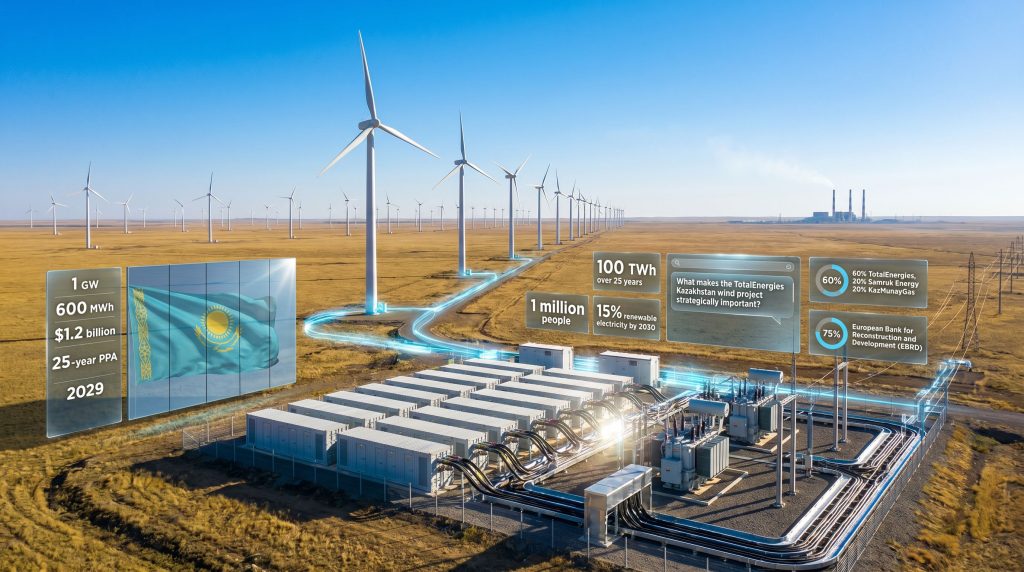
At its core, the project is a utility-scale hybrid development in Kazakhstan that combines 1 gigawatt of onshore wind capacity with 600 megawatt-hours of battery storage under a 25-year power purchase agreement, with full operations targeted by 2029. Its reported value is $1.2 billion, and it is expected to generate roughly 100 terawatt-hours over 25 years, enough to serve around 1 million people.
Rather than viewing it as a single asset, it is more useful to see it as a live test of three big questions:
- Can large renewables scale in markets still shaped by coal, legacy hydrocarbons, and uneven grid infrastructure?
- Can a global energy major expand low-carbon power while still managing legal and sovereign-risk exposure in the same jurisdiction?
- Can hybrid design, meaning wind plus storage from the outset, improve the bankability and operational value of new power projects in emerging systems?
The ownership structure also matters. The project has been presented with a 60% stake held by TotalEnergies, with 20% each held by Samruk Energy and KazMunayGas. Around 75% of project cost is expected to come from external financing sources, a notable signal for lender confidence and due diligence intensity.
When big ASX news breaks, our subscribers know first
How the Mirny project fits Kazakhstan’s energy-transition pathways
Kazakhstan’s power system remains heavily dependent on fossil fuels, especially coal. According to International Energy Agency country data and public transition documents, this creates a paradox: the country has strong wind and solar resource potential, but also a system architecture built around older thermal generation and transmission networks.
That backdrop makes the project strategically important in several possible scenarios. Furthermore, it aligns with broader discussions around renewable energy solutions in resource-heavy economies seeking more resilient power systems.
Scenario 1: Grid modernisation gathers pace
If Kazakhstan can expand transmission capacity, improve dispatch systems, and integrate more variable generation, the project could help support the country’s target of 15% renewable electricity by 2030. In that case, a 1 GW wind asset with storage offers more than new megawatts.
It contributes to:
- diversification away from coal-dominant generation
- stronger peak balancing capability through battery discharge
- a higher comfort level for foreign infrastructure capital
- proof that long-duration contracted renewables can be developed at scale in Central Asia
Scenario 2: Renewable buildout outpaces grid readiness
This is often the harder reality in emerging markets. Capacity can be announced faster than networks can absorb it. If transmission upgrades lag, several frictions can emerge:
- curtailment during high-wind periods
- balancing challenges for system operators
- congestion between resource-rich regions and demand centres
- lower realised value than headline capacity suggests
In this scenario, the battery becomes particularly important because it can shift part of the output away from moments of oversupply and improve short-term grid stability.
Scenario 3: Policy ambition runs ahead of execution
Targets alone do not guarantee delivery. If permitting, dispatch rules, tariff frameworks, or currency protections fail to keep pace, investor appetite can weaken quickly.
Key questions include:
- Whether market design can support more dispatchable clean power
- Whether future projects will require stronger offtake protection or credit enhancement
- Whether lenders will demand tighter safeguards around tariff, convertibility, and counterparty risk
The strategic value of the project lies not just in its size, but in whether it can function reliably inside a system still adapting to large-scale renewables.
Why battery storage is central to the project’s investment case
Wind farms produce electricity when the wind blows, not necessarily when the grid most needs it. That is the basic reason storage changes the economics and system value of utility-scale renewables.
For this project, the 600 MWh battery energy storage system is designed to:
- absorb excess electricity during stronger wind periods
- discharge when demand is higher or wind speeds ease
- help smooth short-term variability
- support dispatchability and grid stability
In plain language, pairing a battery with a 1 GW wind farm can make the power more usable, not just more abundant.
Standalone wind vs hybrid wind-plus-storage
| Feature | Standalone wind | Wind plus battery storage |
|---|---|---|
| Output profile | Variable and weather-dependent | More flexible and partially shiftable |
| Curtailment risk | Higher in constrained grids | Potentially lower |
| Peak demand alignment | Limited | Improved |
| Grid support value | Lower | Higher |
| Bankability under long-term contracts | Depends heavily on grid conditions | Often strengthened by flexibility |
A practical methodology for understanding project economics
When evaluating projects like this, several distinctions matter.
First, installed capacity is not annual generation. A 1 GW wind farm does not run at full output all year. Actual production depends on wind resource quality, turbine performance, downtime, and curtailment.
Second, battery size does not simply add generation. A 600 MWh battery stores and shifts electricity. Its value often comes from timing, balancing, and avoided losses rather than creating new energy on its own.
Third, grid conditions drive storage value. In a constrained system, storage can be worth more because it helps reduce congestion and variability costs.
Finally, contracts matter as much as hardware. A long-term PPA can heavily influence lender confidence, cash flow visibility, and sponsor returns.
Financing structure and why it matters for investors
Mega-scale renewables are rarely funded only by sponsor equity. The reported structure for this project suggests roughly 75% of total capital cost may come from external lenders, including development finance and commercial banking participants.
That matters for three reasons:
- it reduces the upfront equity burden on the sponsors
- it introduces third-party diligence on technical, legal, environmental, and social issues
- it can improve governance discipline through milestone-based drawdowns and covenant structures
The presence of institutions such as the European Bank for Reconstruction and Development has significance as a financing credibility marker, though that should be understood as lender involvement rather than project-specific state support. In addition, investors often weigh such deals against the wider geopolitical risk landscape surrounding major energy and infrastructure projects.
Common de-risking tools in large wind projects
| Tool | Why it matters |
|---|---|
| 25-year PPA | Improves revenue visibility |
| Multilateral lender participation | Adds diligence and financing confidence |
| State-linked local partners | Helps with local interface and alignment |
| Battery integration | Improves operational flexibility |
| Phased construction milestones | Creates accountability during buildout |
| Environmental and social review | Important for lender compliance and risk control |
For policymakers, this capital stack is also informative. It shows that attracting large pools of infrastructure finance usually requires a combination of contractual certainty, bankable risk allocation, and credible local counterparties.
What the ownership split says about execution risk
A 60/20/20 ownership model can be more than a financial arrangement. It can also function as a risk-sharing architecture.
- TotalEnergies brings global project development experience, balance-sheet capacity, and integrated power expertise.
- Samruk Energy adds domestic power-sector linkage.
- KazMunayGas adds local institutional weight and strategic alignment inside Kazakhstan’s energy system.
This mix may improve legitimacy and coordination. However, joint ventures can also introduce friction. Analysts will likely watch governance speed, capital-call timing, procurement accountability, and alignment between commercial returns and public-sector priorities.
Three execution pathways
| Pathway | Characteristics | Likely outcome |
|---|---|---|
| Aligned delivery | Financing closes smoothly, grid interface is managed, partners stay coordinated | Higher chance of 2029 target being met |
| Moderate delay | Approvals, procurement, or interconnection sequencing slows progress | Slippage but project remains viable |
| Pressure case | Inflation, logistics, regulatory shifts, or lender caution increase costs | Lower returns and delayed commissioning |
How Kazakhstan’s wider legal backdrop can influence investor sentiment
It is important to separate this renewable asset from unrelated disputes while still acknowledging that investors do not evaluate projects in isolation. Perceptions of jurisdictional risk often spill across sectors.
In that context, broader concerns around Kazakhstan have included a reported $4.6 billion environmental penalty linked to Kashagan-related context, as well as disagreements over cost recovery and contractual terms in the oil sector. Even if those issues are distinct from the wind project, they can affect how global capital prices risk in the country.
Risk matrix for the project
| Risk type | Why it matters | Likely impact on returns or timeline | Common mitigants |
|---|---|---|---|
| Political and regulatory | Rule changes or slower approvals can alter project economics | Delay, repricing of risk | Strong contracts, lender protections |
| Counterparty | Offtaker performance affects cash flow reliability | Revenue uncertainty | Creditworthy PPA structure |
| Construction | Cost inflation and logistics can pressure budgets | Capex overruns | EPC controls, contingency buffers |
| Grid integration | Transmission limits can reduce effective utilisation | Curtailment, lower output value | Storage, network planning |
| Currency and financing | FX mismatch can weaken debt service resilience | Higher financing stress | Hedging, tariff structuring |
| Reputation and ESG | Scrutiny can affect lender and investor appetite | Slower approvals or stricter conditions | Robust environmental and social standards |
For investors, the main lesson is not simply whether legal disputes exist elsewhere in the country, but whether this project’s contracts and financing structure are strong enough to ring-fence those risks.
The next major ASX story will hit our subscribers first
Where the project sits in TotalEnergies’ broader power strategy
The TotalEnergies Kazakhstan wind project fits within the company’s wider effort to build a larger electricity and integrated power business. Public company targets have included:
- 100 GW of renewable capacity by 2030
- more than 100 TWh of electricity production by 2030
- a renewable portfolio reported at more than 30 GW in operation or development context
That positioning matters because the company is no longer approaching renewables as a side business. Instead, wind, solar, batteries, and power trading increasingly form part of a broader strategy to diversify cash flows beyond upstream hydrocarbons.
Kazakhstan also appears strategically relevant within an Asia-focused expansion effort. For instance, TotalEnergies’ Mirny project overview shows how the development fits into the company’s integrated power pipeline. Likewise, Reuters’ report on the $1.2 billion investment adds context on timing, capital commitment, and market significance.
From a portfolio perspective, Kazakhstan offers:
- large land availability
- strong wind corridors in suitable regions
- visibility in a transition economy
- a useful test case for scaling hybrid infrastructure in a complex market
Kazakhstan’s power system backdrop and why analysts are watching it
Kazakhstan’s electricity story is not only about decarbonisation. It is also about system adequacy, ageing assets, and rising demand. Public energy data has shown sustained dependence on fossil-fuel-based generation, especially coal, even as wind and solar deployment have gradually expanded.
That creates both opportunity and friction. Consequently, the country’s pathway is increasingly tied to wider energy transition demand, especially as cleaner power systems require both infrastructure and supply-chain resilience.
Hidden driver: demand growth
Industrial activity, urban load growth, and pressure on older power infrastructure all strengthen the case for new-build generation. In many emerging markets, demand growth can make renewable economics more attractive because the market is not only replacing old generation, it is also serving incremental load.
Why Central Asia is gaining relevance
Several structural features are drawing more attention to the region:
- extensive land suitable for large projects
- strong wind resource corridors in selected zones
- underbuilt transmission systems in need of modernisation
- increasing involvement from foreign capital and development finance institutions
Furthermore, these developments sit within a wider debate over energy security transition and access to the green transition materials needed for large-scale clean infrastructure.
Could this become a template for future emerging-market clean energy deals?
The project has several features that make it look replicable on paper:
- utility-scale resource quality
- long-duration contracted revenue through a PPA
- domestic state-linked partners
- multilateral and commercial financing potential
- storage integrated from day one rather than added later
But repeatability has limits. Not every market has comparable wind conditions, institutional capability, or lender appetite. In some jurisdictions, the weakest links are transmission planning, currency stability, or land and permitting clarity rather than generation technology itself.
FAQs about the TotalEnergies Kazakhstan wind project
What is the size of the TotalEnergies Kazakhstan wind project?
It combines 1 GW of wind capacity with 600 MWh of battery storage.
What is the estimated cost of the Mirny wind project?
The reported project value is $1.2 billion.
When is full operation expected?
Current public guidance points to a target of 2029 for full operations.
Who owns the project?
The ownership split is reported as 60% TotalEnergies, 20% Samruk Energy, and 20% KazMunayGas.
How long is the power purchase agreement?
The electricity is expected to be sold under a 25-year PPA.
How much electricity is the project expected to generate?
Project materials indicate about 100 TWh over 25 years.
Why is battery storage included?
The battery is intended to shift part of the wind output in time, support grid stability, and improve the practical value of electricity delivered to the system.
Why is the project important for Kazakhstan’s energy transition?
It supports the broader push towards a 15% renewable electricity share by 2030 while also testing whether grid modernisation, financing, and hybrid system design can work together at scale.
Final takeaway
The most important question is not whether Kazakhstan can build one large wind farm. It is whether a complex market can absorb a large wind-plus-storage asset with enough contractual, financial, and operational discipline to make it a repeatable model.
Viewed that way, the TotalEnergies Kazakhstan wind project is a strategic stress test at the intersection of emerging-market finance, grid transition, corporate portfolio change, and sovereign-risk management.
Investors and policymakers should also note a basic caution: forecasts on timeline, output, financing, and system value remain subject to execution risk, regulatory developments, construction conditions, and grid integration outcomes. Any scenario analysis in this article is interpretive, not investment advice, and should be weighed against primary-source disclosures from project sponsors, the IEA, EBRD materials, and official Kazakhstan energy-policy documents.
If the project reaches operation close to plan and performs under its long-term contract, it may become a landmark example of Central Asian clean-power deployment. If it proceeds more slowly, it may still succeed, but as a heavily de-risked case study rather than a seamless breakthrough. If it stalls, the lesson will be equally valuable: in emerging-market power systems, infrastructure quality and institutional execution matter just as much as renewable ambition.
Could The Next Major Energy Transition Discovery Move Markets?
For investors tracking transformative developments across energy, mining and critical materials, Discovery Alert delivers real-time ASX mineral discovery alerts powered by its proprietary Discovery IQ model, turning complex announcements into actionable insights. See how major discoveries have historically driven exceptional market returns on Discovery Alert’s discoveries page and start a 14-day free trial today.