May 18, 2026
Strategic mining alliances across continental boundaries represent a paradigm shift from traditional bilateral resource development approaches. The emergence of integrated regional frameworks reflects growing recognition that critical mineral supply chains require coordinated responses to meet accelerating global demand. This evolution beyond isolated national strategies toward multilateral cooperation creates opportunities for optimized resource allocation, shared infrastructure development, and enhanced supply chain resilience across geologically complementary territories.
Understanding the Strategic Framework of South America's Copper Alliance
The Triángulo del Cobre establishes a trilateral mining framework connecting Chile, Peru, and Argentina through coordinated copper development strategies. This regional alliance leverages each nation's distinct geological advantages while addressing shared infrastructure and regulatory challenges that have historically constrained individual country production expansion.
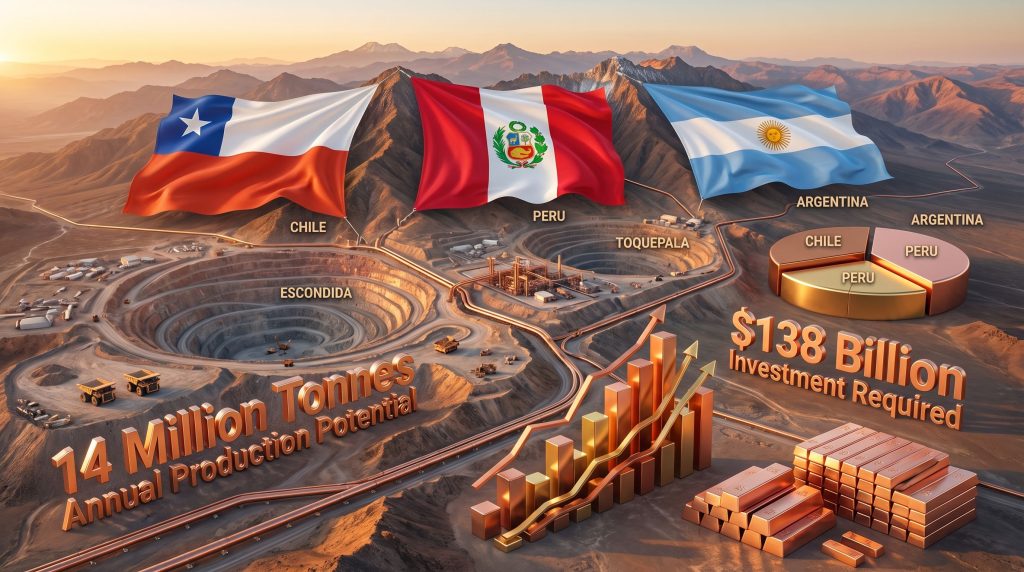
Unlike fragmented national approaches that compete for investment capital and technical expertise, this integrated model recognizes that meeting projected copper demand requires unprecedented coordination across traditional political boundaries. The framework encompasses 42 active copper projects requiring $138 billion in combined investment, with potential to add 6 million tonnes of annual production capacity beyond current regional output.
Current combined production from the three nations totals approximately 8.1 million tonnes annually, positioning the triangle as the dominant global copper-producing region. Conservative expansion scenarios project growth to 11 million tonnes, while peak development potential reaches 14 million tonnes if the complete project pipeline achieves production targets.
Geographic Scope and Geological Advantages
The Triángulo del Cobre spans the Andean Cordillera, encompassing some of the world's largest known copper reserves and highest-grade deposits. This geological corridor extends from Chile's established mining districts through Peru's high-altitude Andean deposits to Argentina copper system.
The framework builds upon successful precedent established by the Lithium Triangle, which demonstrated how regional coordination can accelerate critical mineral development. Furthermore, the lithium Triangle lessons show that Argentina, Bolivia, and Chile collectively control approximately 58% of global lithium reserves through coordinated development strategies, producing roughly 410,000 tonnes lithium carbonate equivalent annually.
When big ASX news breaks, our subscribers know first
Analyzing Production Potential and Investment Requirements
The regional project pipeline presents significant expansion opportunities, though execution risks remain substantial. Investment requirements total $138 billion across 42 projects, distributed among Chile's 18 development initiatives ($65 billion), Peru's 15 projects ($45 billion), and Argentina's 9 projects ($28 billion).
| Development Scenario | Production Target (Mt) | Timeline Estimate | Risk Factors |
|---|---|---|---|
| Current baseline | 8.1 | Established | Grade decline, infrastructure aging |
| Conservative expansion | 11.0 | 2030-2035 | Permitting delays, capital constraints |
| Peak potential | 14.0 | 2035-2040 | Full project pipeline execution |
Industry analysis indicates that transforming geological potential into operational production faces significant execution challenges. Jorge Cantallopts, CEO of CESCO, emphasized that converting investment capital into actual production capacity requires overcoming substantial technical and regulatory hurdles. Recent Chilean investment patterns demonstrate this challenge, with capital increasingly absorbed by sustaining aging operations rather than expanding production capacity.
Capital Allocation and Production Challenges
Chilean mining investment has been predominantly directed toward operational sustainability rather than capacity expansion. Declining ore grades averaging 0.84% copper content in 2023, down from 1.14% in 2010, require increasing capital expenditure to maintain production levels. This trend represents an annual decline rate of approximately 0.5-1.0% per year across major Chilean deposits.
The capital intensity challenge extends beyond grade decline to include:
- Extending project development timelines due to regulatory complexity
- Compensating for aging infrastructure and equipment
- Implementing environmental compliance upgrades
- Developing deeper, more technically challenging deposits
Peru offers more favorable expansion dynamics with average ore grades of 1.2-2.5% copper in high-altitude Andean deposits, significantly above Chilean averages. However, Peru faces distinct challenges including complex indigenous consultation requirements under ILO Convention 169 and extended environmental assessment processes averaging 18-36 months.
Evaluating Country-Specific Competitive Advantages
Chile's Industrial Infrastructure Maturity
Chile contributes established mining infrastructure representing four decades of continuous large-scale copper development. The country operates five integrated smelter complexes with approximately 3.5 million tonnes annual refining capacity, supporting not only domestic production but potentially serving expanded regional output.
Infrastructure Assets:
- Port of Mejillones: 85+ million tonnes annual capacity
- Port of Antofagasta: specialized copper concentrate export facilities
- Combined Chilean port capacity: 200+ million tonnes annually for mineral exports
- Mining technology ecosystem: 500+ specialized companies providing equipment and services
Chilean workforce capabilities represent a critical competitive advantage, with approximately 70,000 direct employees in copper mining possessing the highest average experience levels in the region. This technical expertise base supports optimization of existing operations while providing knowledge transfer potential for regional partners.
Álvaro González, Chile's Subsecretario de Minería, indicated that the country's mining policy emphasises extracting value from existing deposits through engineering innovation rather than major greenfield development. This strategic focus reflects recognition that Chilean mining faces fundamental shifts from expansion-based growth to optimisation-based sustainability.
Peru's Balanced Production and Expansion Profile
Peru combines substantial current production (2.2 million tonnes annually) with significant expansion potential concentrated in high-altitude Andean formations. The country ranks as the world's second-largest copper producer with production growth rates averaging 3% annually from 2015-2023.
Recent major project developments include major copper discoveries such as Quellaveco mine (Anglo American) with 300,000 tonnes annual capacity, operational since early 2023, and confirmed expansion projects at Constancia and Cerro Verde operations. Peru's project pipeline benefits from established regulatory frameworks for large mining investments, though social consultation requirements can extend development timelines.
Regulatory Framework Characteristics:
- Environmental Impact Assessment: 18-36 months average processing
- Social consultation requirements: additional 12-24 months in some cases
- Free, Prior, and Informed Consent (FPIC) protocols under indigenous consultation frameworks
Argentina's High-Grade Potential and Development Challenges
Argentina presents the highest-grade copper deposits within the triangle, concentrated along the Andean corridor with average grades of 1.5-2.8% copper content. This significantly exceeds Chilean averages and compares favourably with Peru's best deposits. Argentine copper reserves total approximately 9.8 million tonnes metal content, representing substantial long-term potential.
However, Argentina's current production remains constrained at 0.2-0.3 million tonnes annually due to infrastructure limitations rather than geological constraints. Luis Lucero, Argentina's Secretario de Minería, has emphasised accelerating project development and improving permitting frameworks as government priorities for unlocking geological potential.
Development Constraints:
- Existing metallurgical processing capacity: <0.5 million tonnes annually
- Limited port access requiring exports via Chilean facilities
- Insufficient rail transport capacity for major production increases
- Macroeconomic instability including peso depreciation exceeding 50% (2020-2023)
Argentina requires an estimated $15-20 billion in Andean mining corridor infrastructure development, including roads, rail networks, and port facilities. Smelting capacity expansion would require additional $5-8 billion investment to support major production increases.
Examining Regional Economic Impact Potential
Current copper sector contribution to combined regional GDP totals approximately $64 billion annually, distributed among Chile ($45-50 billion), Peru ($12-15 billion), and Argentina ($1-2 billion). Expanded production scenarios project this figure could reach $90 billion, with peak development potentially generating $111 billion in annual economic value.
Employment and Industrial Multiplier Effects
Each additional million tonnes of copper production could generate approximately 15,000-20,000 direct and indirect employment opportunities across the triangle region. These positions span mining operations, equipment manufacturing, transportation logistics, and specialised professional services supporting expanded production.
Economic modelling suggests that copper sector expansion creates significant multiplier effects throughout regional economies, particularly in equipment manufacturing, specialised logistics, and technical services that support mining operations.
The employment impact extends beyond direct mining jobs to encompass:
- Advanced metallurgical and processing positions
- Infrastructure construction and maintenance roles
- Transportation and logistics coordination
- Environmental monitoring and compliance specialisations
- Technology and automation system operations
Addressing Regulatory and Investment Framework Challenges
Chile's Modernisation and Simplification Initiatives
Chilean authorities are advancing comprehensive regulatory reforms targeting mining patent systems that have become increasingly complex over recent decades. The proposed Mining Patent Simplification Law aims to restore legal clarity that supported four decades of successful mining development while maintaining environmental and social standards.
González outlined three priority reform areas for Chilean mining policy:
- Investment Promotion and Legal Certainty: Establishing predictable regulatory frameworks that support long-term capital allocation decisions
- Regulatory Modernisation and Project Acceleration: Streamlining environmental permitting without compromising protection standards
- Institutional Strengthening: Enhancing coordination between agencies overseeing mining development
The mining patent reform initiative specifically addresses complications in mineral tenure systems that have developed over recent years. These regulatory complexities have created uncertainty for exploration and development investments, requiring clarification to restore investor confidence.
Cross-Border Coordination Requirements
Successful triangle development requires unprecedented coordination across traditional regulatory boundaries. Priority areas for harmonisation include:
- Standardised environmental impact assessment protocols
- Coordinated infrastructure development planning
- Integrated supply chain optimisation strategies
- Shared technology transfer and workforce development initiatives
Regional coordination mechanisms must address varying national approaches to indigenous consultation, environmental protection standards, and foreign investment regulations while maintaining each country's sovereignty over resource development decisions.
How Will Global Market Timing Impact Development Success?
Global copper demand projections indicate supply deficits emerging by 2028-2030, driven primarily by electrification trends and renewable energy infrastructure expansion. The Triángulo del Cobre's development timeline must align with these demand inflection points to optimise market positioning and capture favourable pricing conditions.
Technology Transition Demand Drivers
Electric vehicle manufacturing represents the fastest-growing copper demand segment, with projected growth of 300% by 2030. This expansion creates unprecedented requirements for copper-intensive components including electric motors, battery systems, and charging infrastructure.
Primary Growth Sectors:
- Electric vehicle production and supporting infrastructure
- Renewable energy grid modernisation and expansion
- Industrial electrification across manufacturing sectors
- Energy storage system deployment for grid stabilisation
Renewable energy infrastructure development requires substantial copper content for wind turbines, solar installations, and grid connectivity systems. Consequently, energy storage deployment for grid stabilisation creates additional demand for copper-intensive battery technologies and power management systems.
The next major ASX story will hit our subscribers first
Infrastructure Investment Requirements for Regional Success
Transportation and Logistics Network Development
Triangle development requires coordinated investment in transportation corridors connecting production areas with processing facilities and export infrastructure. Priority investments include cross-border highway improvements, rail network extensions, and port capacity optimisation.
Argentina's infrastructure requirements present the most significant challenge, with high-altitude Andean deposits requiring specialised transportation solutions. Operating elevations of 3,500-4,500 metres create extreme environmental conditions demanding specialised equipment and expertise.
Infrastructure Investment Priorities:
- High-altitude road construction and maintenance capabilities
- Rail network extensions to Chilean and Peruvian export facilities
- Specialised materials handling equipment for extreme environments
- Power transmission infrastructure for remote mining operations
Technology and Innovation Platform Development
The triangle concept includes establishing regional centres of excellence for mining technology advancement, metallurgical research, and environmental impact mitigation. These platforms would coordinate research and development initiatives across the three countries while promoting technology transfer and workforce development.
Shared innovation priorities include mining automation and digitalisation systems, advanced metallurgical processing techniques, and environmental monitoring technologies adapted to high-altitude Andean conditions. Moreover, copper exploration insights demonstrate how technological advancement accelerates discovery and development processes.
Comparing Regional Mining Initiative Models
The Triángulo del Cobre follows successful precedent established by the Lithium Triangle, which demonstrated effective regional coordination for critical mineral development. However, copper's industrial complexity and infrastructure requirements present distinct challenges compared to lithium extraction and processing.
What Lessons Can Be Learned from Lithium Triangle Implementation?
The Lithium Triangle achieved successful coordination through standardised exploration protocols, shared environmental monitoring systems, and joint infrastructure development initiatives. These elements provide valuable frameworks for copper triangle implementation.
Successful Coordination Elements:
- Harmonised exploration and development standards across participating countries
- Integrated environmental monitoring and reporting protocols
- Coordinated infrastructure investment planning
- Shared supply chain optimisation strategies
Copper development faces greater complexity due to massive infrastructure requirements, extensive processing capabilities, and longer development timelines compared to lithium operations. For instance, projects like the Tamarack copper project illustrate the technical challenges involved in large-scale copper development.
Long-Term Strategic Implications for Global Copper Markets
Triangle development success could fundamentally alter global copper supply concentration, shifting dominance toward South American regional control. This geographic rebalancing may influence international pricing mechanisms, supply chain security considerations, and geopolitical resource relationships.
Market Concentration and Supply Security Considerations
Successful triangle implementation could position South America as the dominant global copper-producing region, potentially controlling 35-40% of world supply by 2035. This concentration presents opportunities for regional economic development while creating challenges for global supply chain diversification.
International consumers and industrial users may need to develop supply security strategies that account for increased regional concentration. This could include strategic stockpiling, alternative material development, or diversified sourcing agreements that reduce dependency on single geographic regions.
The triangle's success would also influence global mining investment patterns, potentially redirecting capital flows toward South American projects while reducing investment incentives in other copper-producing regions with higher costs or greater technical challenges. In addition, understanding copper investment strategies becomes crucial for investors navigating this evolving landscape.
Furthermore, analysts suggest that regional cooperation frameworks represent the future of strategic mineral development, with the Triángulo del Cobre serving as a model for other regions seeking to optimise resource development through cross-border collaboration.
Disclaimer: This analysis is based on industry projections and government policy announcements that may be subject to change. Investment decisions should consider geological, political, and economic risks associated with large-scale mining development projects. Production estimates and economic impact projections represent scenarios rather than guarantees and should be evaluated within broader market and regulatory contexts.
Could Your Investment Portfolio Benefit From Strategic Copper Alliance Insights?
Discovery Alert's proprietary Discovery IQ model delivers real-time alerts on significant copper discoveries across the ASX, instantly empowering subscribers to identify actionable opportunities ahead of the broader market. Understand why major mineral discoveries can lead to significant market returns by exploring Discovery Alert's dedicated discoveries page, showcasing historic examples of exceptional outcomes, and begin your 14-day free trial today to position yourself ahead of the market.