June 19, 2026
The Structural Fragility Beneath America's Industrial Might
Most conversations about US manufacturing competitiveness focus on labour costs, automation, or trade tariffs. Far fewer examine the mineralogical foundations that make advanced production possible in the first place. Tungsten sits at one of those foundations, quietly underpinning everything from precision cutting tools used in automotive plants to the kinetic energy penetrators carried by armoured fighting vehicles. Yet the United States produces zero primary tungsten domestically. Not a modest amount, not a declining amount, but none at all.
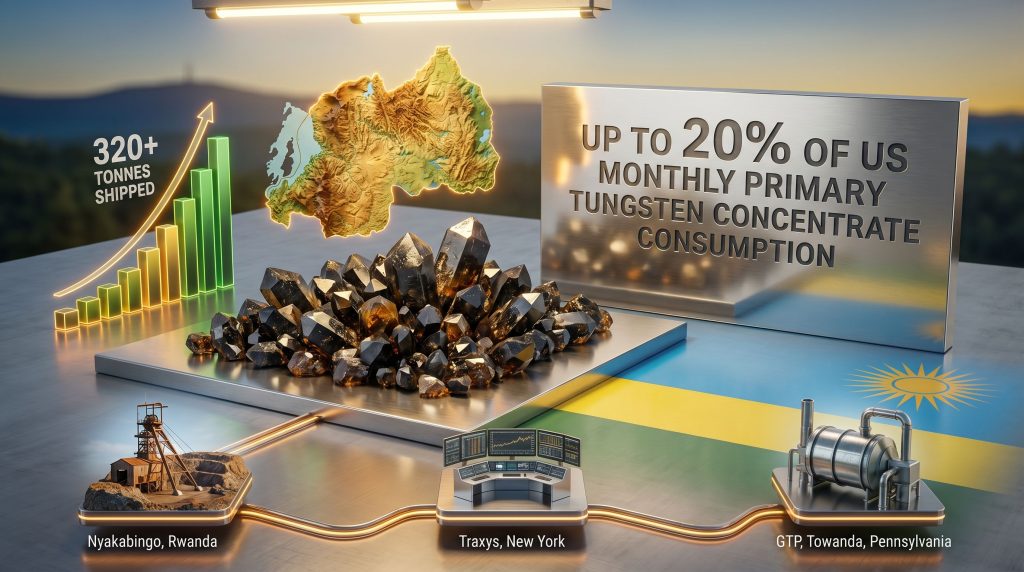
This structural absence has grown more consequential with every passing year, and recent developments in East Africa are reshaping how American industry and defence procurement address the gap. Trinity Metals Rwanda tungsten supply to the US has evolved from a commercial pilot arrangement into a relationship that now accounts for up to 20% of the United States' average monthly primary tungsten concentrate consumption, a figure that carries considerable strategic weight.
When big ASX news breaks, our subscribers know first
Why Zero Domestic Production Is Not an Accident
The United States was once a meaningful tungsten producer. Deposits in California, Colorado, and North Carolina supported domestic output through much of the twentieth century. The erosion of that capacity followed a familiar pattern in Western mining: as Chinese producers flooded global markets with low-cost supply from the 1980s onward, unsubsidised Western mines found it economically irrational to continue operating. Facilities closed, workforces dispersed, and the institutional knowledge required to operate complex tungsten beneficiation circuits faded with them.
Today, the US Geological Survey classifies tungsten as a critical mineral, yet domestic primary production remains at zero. The country relies entirely on imports and secondary recycled supply to meet demand from its industrial and defence sectors. Recycled tungsten, sourced from scrap cutting tools and reclaimed carbide, does supplement primary supply, but it cannot fully substitute for it, particularly when downstream processors require specific concentrate grades and chemistries for defence-specification powder production.
The demand profile driving import requirements includes:
- Defence procurement: kinetic energy penetrators, armour plate, and military-grade tooling
- Industrial manufacturing: cemented carbide inserts used in metalworking, mining drill bits, and oil and gas drilling equipment
- Advanced technology applications: semiconductors, medical imaging equipment, and high-temperature aerospace components
- Emerging uses: radiation shielding and specialised electronic components
China's Export Restrictions and the Supply Chain Reckoning
China controls more than 80% of global tungsten unit supply, a concentration of market power with few parallels in critical minerals. For decades, Western manufacturers tolerated this dependency because Chinese supply remained accessible and competitively priced. That calculation has shifted materially.
China's export controls on tungsten have been applied under dual-use regulatory frameworks, restricting the flow of tungsten products and concentrates that may serve military or strategic manufacturing purposes. These restrictions, tightened progressively since the early 2020s, have introduced a category of supply risk that no amount of commercial negotiation can resolve. When a sovereign nation classifies a mineral export as a matter of national security, buyers in competitor economies cannot simply source their way around the restriction through normal market mechanisms.
The practical effect for US defence contractors and industrial manufacturers is a structural supply ceiling from Chinese sources that cannot be easily lifted, regardless of price signals or contract terms.
This is not a temporary disruption analogous to a mine strike or a logistics bottleneck. It represents a deliberate policy architecture that Western supply chain planners must treat as a permanent constraint in their risk models. Furthermore, the critical minerals demand surge across Western economies makes this constraint more pressing with each passing year.
The Nyakabingo Mine: Africa's Tungsten Heavyweight
Rwanda's Nyakabingo mine occupies a distinctive position among global tungsten producers outside of China. Located in Rwanda's northern mining belt, the deposit hosts wolframite mineralisation, one of the two principal tungsten-bearing mineral species alongside scheelite. Wolframite concentrates are particularly valued by downstream powder processors because of their chemical characteristics and the relative simplicity of converting them into ammonium paratungstate and tungsten metal powder products that industrial and defence customers require.
Trinity Metals operates Nyakabingo as Rwanda's largest mineral producer and exporter, with a production capacity of approximately 120 tonnes of tungsten concentrate per month. That figure translates to roughly 1,440 tonnes per year, placing Nyakabingo among the more significant non-Chinese tungsten producing operations globally.
The quality of the concentrate matters as much as the volume. High-grade wolframite concentrate from Nyakabingo meets the specifications required for defence-application powder production at downstream processing facilities, a bar that lower-grade or mineralogically complex concentrates from other regions sometimes struggle to clear.
Key Metrics at a Glance
| Metric | Detail |
|---|---|
| Mine Location | Nyakabingo, Rwanda |
| Primary Mineral | Wolframite (tungsten concentrate) |
| Monthly Production Capacity | ~120 tonnes of tungsten concentrate |
| US Supply Share | Up to 20% of average monthly primary tungsten concentrate consumption |
| Processing Destination | Global Tungsten & Powders (GTP), Towanda, Pennsylvania |
| Approximate Supply Split | ~50% to the US, ~50% to Europe |
| Cumulative US Shipments (to mid-2026) | Over 320 tonnes |
The Commercial Architecture: How Rwanda's Tungsten Reaches Pennsylvania
Understanding how Nyakabingo concentrate becomes American defence powder requires mapping a three-party commercial structure that became operational in August 2025.
Trinity Metals extracts and processes wolframite ore at Nyakabingo into saleable concentrate. That concentrate is then sold under an offtake arrangement to Traxys, a New York-headquartered commodities trading and marketing firm with deep expertise in specialty metals logistics. Traxys then supplies the material to Global Tungsten & Powders (GTP) at its facility in Towanda, Pennsylvania, where the concentrate undergoes further processing into industrial and defence-grade tungsten powders.
GTP's Towanda facility is one of the most significant tungsten powder production operations in the Western hemisphere. Its role in converting raw concentrate into application-ready powders means that the quality and consistency of incoming feed material directly influences the specifications of the finished product delivered to end customers in aerospace, defence, and precision manufacturing.
The volume trajectory of this arrangement has been notable. Since the commercial agreement's inception in August 2025, more than 320 tonnes of high-grade tungsten concentrate have been shipped from Rwanda to Pennsylvania. Critically, supply volumes doubled in the month preceding June 2026, accelerating Trinity Metals Rwanda tungsten supply to the US to its current level of up to 20% of monthly primary concentrate consumption.
This doubling of monthly supply in a single period is not merely a commercial milestone. It signals that the logistical and operational infrastructure supporting the Rwanda-to-Pennsylvania corridor has scaled to meet increased demand, validating the supply chain's commercial viability at higher throughput levels.
Why This Agreement Matters Strategically
Tungsten's strategic importance extends well beyond its industrial applications. The historic agreement to supply tungsten concentrate from Rwanda to the United States represents a meaningful step in reshaping Western supply chain architecture away from Chinese dependency. For defence critical materials planners in particular, the establishment of a proven, scalable non-Chinese tungsten corridor carries implications that extend far beyond the volume figures alone.
Tungsten's Physical Properties: Why There Is No Substitute
A crucial and often under-appreciated dimension of the tungsten supply security discussion is the mineral's physical irreplaceability in certain high-performance applications. Tungsten holds the highest melting point of any metal, at approximately 3,422 degrees Celsius, combined with exceptional density and hardness. These properties are not replicable by any commercially available alternative material.
In kinetic energy penetrators, tungsten's density is precisely what makes it effective. In cemented carbide cutting tools, tungsten carbide's hardness and wear resistance are what allow modern machining centres to operate at the speeds and tolerances that advanced manufacturing requires. In high-temperature aerospace components, tungsten's thermal stability under conditions that would degrade other metals is the enabling property.
Attempts to develop tungsten substitutes have generally foundered on the same physical reality: the applications that most critically depend on tungsten are those where its unique property profile cannot be approximated by alternative materials at any commercially rational price point.
The next major ASX story will hit our subscribers first
Rwanda Versus Other Non-Chinese Tungsten Sources
Western governments and manufacturers have examined a range of alternative tungsten supply options. Each comes with constraints that contextualise Rwanda's competitive position.
| Country/Source | Approximate Annual Output | US Supply Relevance | Key Constraints |
|---|---|---|---|
| Rwanda (Nyakabingo) | ~1,440 t/year concentrate | Up to 20% of US monthly demand | Landlocked logistics, scaling ceiling |
| Vietnam | Moderate | Limited direct US supply | Processing infrastructure gaps |
| Canada | Emerging projects | Pre-production stage | Long development timelines |
| Portugal | Established | Primarily European supply | Limited US-facing trade infrastructure |
| Bolivia | Significant reserves | Minimal current US supply | Political and infrastructure risk |
Rwanda's advantage is not simply geological. The country's political stability, rule of law framework, and established mining regulatory environment create a risk profile that compares favourably against many resource-rich alternatives. For supply chain planners operating within US defence procurement frameworks, counterparty and sovereign risk assessments matter as much as production volumes.
The landlocked geography of Rwanda does introduce logistical complexity, requiring concentrate to travel overland to East African ports before onward shipment. However, the successful delivery of over 320 tonnes to Pennsylvania demonstrates that this challenge is operationally manageable within the existing supply chain architecture.
The Case for a Formal US-Rwanda Critical Minerals Agreement
The commercial relationship between Trinity Metals, Traxys, and GTP currently operates as a private-sector arrangement without a formal government-to-government dimension. Trinity Metals has publicly identified the potential for a US-Rwanda strategic partnership agreement on critical minerals, pointing to precedents with other African nations as a model.
As of mid-2026, Kenya and the United States were reported to be close to finalising a critical minerals deal, according to Reuters coverage of a statement by Kenyan President William Ruto. This illustrates that bilateral mineral security agreements between the US and African nations are not hypothetical constructs but active diplomatic processes. In addition, the broader alignment between critical minerals and energy security objectives gives these partnerships a dual-purpose strategic value that goes well beyond defence applications alone.
A formalised US-Rwanda minerals agreement could potentially encompass:
- Tungsten supply commitments with volume and quality guarantees
- Tin and tantalum coverage, given Rwanda's status as a significant producer of all three "3T" minerals
- Investment facilitation mechanisms supporting mine development and processing capacity expansion
- Supply chain transparency and traceability standards aligned with US defence procurement requirements
- Infrastructure co-development to reduce logistics costs and improve supply chain resilience
It is important to note that no such agreement has been confirmed as of the time of publication. The commercial supply corridor represents a private-sector achievement, and any characterisation of formal government backing for Trinity Metals' specific operations would be speculative absent official confirmation.
Rwanda's Broader Strategic Position in Western Mineral Supply Chains
The Trinity Metals Rwanda tungsten supply to the US is best understood not as an isolated commercial success but as an early indicator of a structural shift in how Western economies are approaching African mineral resources. The transactional commodity trade model, where African nations export raw materials with limited value-added engagement, is gradually giving way to a more complex framework of strategic supply partnerships.
For Rwanda specifically, its mineral endowment in tungsten, tin, and tantalum positions it as a meaningful participant in the critical minerals competition that is reshaping geopolitical relationships between resource-holding nations and industrial economies. The country's governance reputation, its relatively transparent mining regulatory framework, and its active engagement with international traceability schemes such as the OECD Due Diligence Guidance for Responsible Supply Chains give it credentials that many competing mineral jurisdictions cannot match.
The convergence of US defence demand growth, Chinese export restrictions on tungsten, and Rwanda's proven production capacity has created a rare alignment of commercial incentives and strategic necessity. Whether that alignment is formalised through diplomatic channels or continues to operate through private-sector structures, the practical outcome is already materialising: Rwandan tungsten entering the US defence supply chain is processing into American defence components in Pennsylvania, at volumes that represent a meaningful fraction of US monthly demand.
Frequently Asked Questions
What is tungsten concentrate and why does the US need to import it?
Tungsten concentrate is ore that has been crushed, separated, and processed to a marketable grade of tungsten-bearing mineral, either wolframite or scheelite. The US has no active primary tungsten mining operations, meaning all primary concentrate must be sourced from overseas. Recycled tungsten from scrap provides supplementary supply but cannot fully meet demand, particularly for defence-specification applications requiring specific concentrate grades.
Who are the key companies involved in supplying Rwanda's tungsten to the US?
Three organisations form the supply chain: Trinity Metals operates the Nyakabingo mine in Rwanda; Traxys, headquartered in New York, acts as offtake partner and logistics intermediary; and Global Tungsten & Powders (GTP) processes the concentrate at its Towanda, Pennsylvania facility into industrial and defence-grade tungsten powders.
How does China's tungsten export restriction affect US manufacturers?
China's dual-use export control regime restricts the export of tungsten products and concentrates that could serve military or strategic manufacturing applications. For US defence contractors and industrial manufacturers, this creates a supply ceiling from the dominant global source that cannot be resolved through commercial negotiation, making diversified supply from sources like Rwanda structurally important rather than merely commercially attractive.
What does the 20% US market share figure actually represent?
Trinity Metals' Nyakabingo mine now supplies up to 20% of the United States' average monthly primary tungsten concentrate consumption. This figure reflects primary concentrate only, excluding secondary and recycled tungsten supply. It represents a meaningful diversification of US import sources away from Chinese-origin material and demonstrates that the Rwanda-to-Pennsylvania supply corridor has achieved commercial scale.
Disclaimer: This article contains forward-looking assessments and industry analysis that involve assumptions and projections. Readers should conduct independent research before making any investment or procurement decisions. The potential for a US-Rwanda critical minerals agreement has not been officially confirmed and should be treated as speculative until formally announced by relevant governments.
Want To Stay Ahead Of The Next Major Critical Mineral Discovery?
Discovery Alert's proprietary Discovery IQ model scans ASX announcements in real time, instantly identifying significant mineral discoveries across tungsten, lithium, gold, and more than 30 other commodities — giving subscribers an actionable market edge before the broader investment community reacts. Explore Discovery Alert's discoveries page to see the historic returns major mineral discoveries have delivered, then begin your 14-day free trial at discoveryalert.com.au to position yourself ahead of the market.