
August 14, 2026
The Hidden Architecture of Commodity Dependency: Mongolia's $20 Billion Trade Gamble
Few economic relationships in the Asia-Pacific region illustrate the concept of structural dependency as starkly as the trade corridor between Mongolia and China. While bilateral trade agreements are routinely framed in the language of mutual benefit and partnership, the Mongolia China trade ties operate under a set of geographic and logistical constraints that strip away much of that diplomatic symmetry. Understanding how these forces interact is essential for anyone tracking commodity market dynamics, or the broader question of how landlocked resource economies navigate growth.
When big ASX news breaks, our subscribers know first
Why Geography Is Mongolia's Most Consequential Economic Policy
Before examining trade figures or infrastructure timelines, it helps to understand the physical reality that underpins every dollar of Mongolia-China commerce. Mongolia sits in a geographic position that is, in economic terms, extraordinarily constraining. Bordered by Russia to the north and China to the south, it has no coastline, no access to open sea lanes, and no realistic overland corridor to third-party markets capable of absorbing bulk commodity shipments at scale.
This is not simply a logistical inconvenience. It is the foundational variable in Mongolia's entire economic architecture. Coal and copper concentrate, which together represent the overwhelming majority of Mongolia's export revenues, are low-value-to-weight commodities. The economics of shipping them across vast overland distances to non-Chinese buyers are prohibitive.
China, sharing a long southern border with Mongolia and operating the world's largest manufacturing and energy economy, is not merely Mongolia's preferred trade partner. It is, structurally speaking, the only viable large-scale destination for Mongolian mineral exports at current infrastructure capacity. According to analysis of Sino-Mongolian relations, this dependency has deepened considerably over the past two decades.
The landlocked geography of a nation functions like a silent trade policy written by topography rather than diplomacy. In Mongolia's case, that policy points almost exclusively southward.
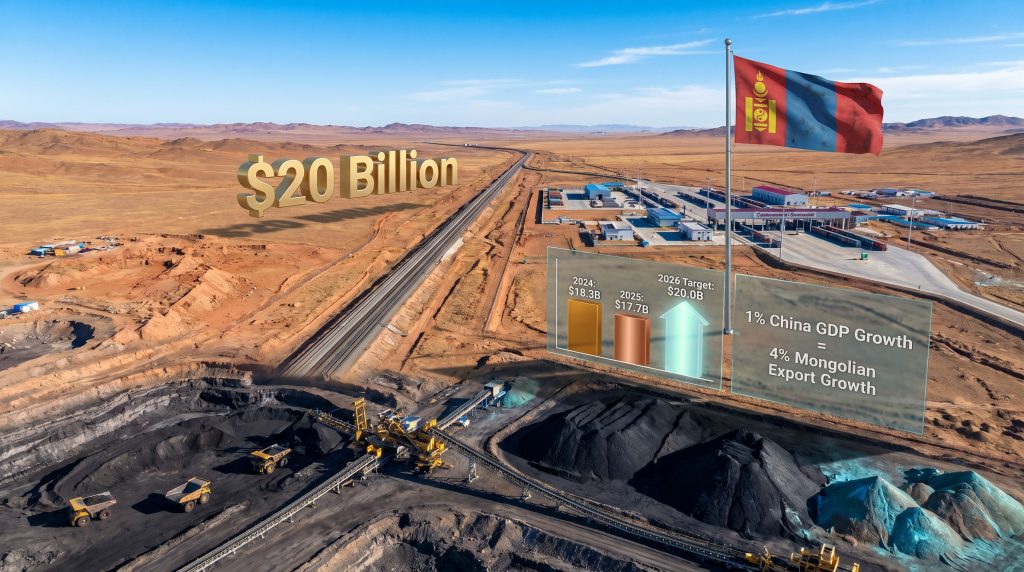
This geographic reality helps explain why international economic bodies have estimated that a 1% increase in China's GDP growth translates into approximately 4% growth in Mongolian exports and roughly 0.6% additional GDP growth for Mongolia itself. These are not the multiplier ratios of a standard bilateral trade relationship. They reflect something closer to a supply chain dependency, where one partner's purchasing decisions determine the fiscal health of the other.
Breaking Down the $20 Billion Trade Target
Two-way trade between Mongolia and China reached $18.3 billion in 2024, before declining to $17.7 billion in 2025, according to Chinese customs data. The contraction reflected a broader softening in Chinese economic activity, weighed down by subdued domestic demand and external geopolitical disruptions including the Iran conflict, which has introduced sustained uncertainty into China's medium-term economic planning.
Against this backdrop, Mongolia has set a target of reaching $20 billion in bilateral trade for 2026. Achieving that figure requires reversing a roughly 3.3% year-on-year contraction and delivering growth of more than 10% within a single year.
| Year | Bilateral Trade Volume | Annual Change |
|---|---|---|
| 2024 | $18.3 billion | Prior baseline |
| 2025 | $17.7 billion | -3.3% decline |
| 2026 (Target) | $20.0 billion | +13% growth required |
Whether this target is achievable depends on a confluence of factors, several of which are already moving in Mongolia's favour.
Coal, Copper, and the Commodity Concentration Problem
Mongolia exported more than 80 million metric tons of coal in the most recent reporting year, with virtually the entire volume absorbed by Chinese buyers. This concentration is not accidental. It reflects decades of infrastructure investment, trade agreement frameworks, and geographic logic all pointing toward the same destination.
The structural risks embedded in this arrangement are significant and compound over time:
- Price-setting leverage shifts decisively toward the buyer when a single customer controls access to market
- Export revenue becomes tightly correlated with Chinese industrial output cycles, exposing Mongolian fiscal planning to external volatility it cannot control
- Any Chinese policy shift in energy, environment, or economic strategy can produce outsized consequences for Mongolian state revenues
- Mongolia's sovereign credit profile and infrastructure investment capacity are indirectly indexed to Chinese demand forecasts
Furthermore, what makes this situation strategically complex rather than simply problematic is that coal remains an essential near-term energy source for China's industrial base. Mongolia's coal is geographically proximate, logistically accessible, and increasingly well-connected through border infrastructure. Demand is not disappearing, but the terms on which that demand is exercised remain asymmetrically favourable to Beijing. The China steel market dynamics compound this further, as steel production shapes Chinese demand for both coal and iron ore.
The Shanxi Shock: An Unplanned Demand Catalyst
A mining disaster in China's Shanxi province claimed 82 lives and placed immediate pressure on domestic coal production capacity in one of China's most important coal-producing regions. The resulting supply gap has created a short-term demand uplift for Mongolian exports, as Chinese buyers seek to compensate for reduced domestic output.
This represents a near-term demand catalyst for Mongolian coal, though one that originates from tragedy rather than structural trade reform. Short-term price and volume benefits for Mongolia must be contextualised within the human cost of the event.
From a commodity market perspective, supply shocks of this kind tend to accelerate procurement decisions that were already underway. Chinese buyers with established relationships with Mongolian coal producers are consequently well-positioned to increase order volumes quickly, given existing logistics infrastructure.
Copper as a Strategic Counterweight
While coal dominates current export volumes, Mongolia's copper sector is in an active growth phase that carries different strategic implications. Unlike thermal coal, whose long-term demand trajectory in China is subject to energy transition pressures, copper occupies a structurally advantaged position in the clean energy economy.
China's grid infrastructure expansion, electric vehicle manufacturing scale-up, and renewable energy deployment all require copper at volumes that are difficult to satisfy domestically. The copper demand drivers underpinning this expansion are well-documented and growing. Mongolia's increasing copper output positions it to benefit from this demand cycle in ways that are longer-duration and more structurally resilient than coal.
Copper also carries meaningfully higher per-tonne value than thermal coal, which means that growing copper export volumes can rebalance Mongolia's revenue mix without requiring equivalent volume growth. In addition, a gradual shift in the export basket toward copper concentrate, and eventually toward further processed copper products, represents one of the more credible pathways toward improving Mongolia's terms of trade over the medium term. Broader copper market trends suggest this transition is well-timed.
As one analyst perspective widely circulated in trade monitoring circles framed it: Mongolia's copper output is rising, and China is positioned to absorb it. That alignment between supply growth and demand readiness creates a window of opportunity that Mongolia's policymakers are working to exploit.
Infrastructure as Destiny: The Railway Question
Two infrastructure developments are central to the 2026 trade growth ambition and the longer-term trajectory of Mongolia China trade ties.
1. Second Cross-Border Railway Link
Currently under construction between Mongolia and China, this project is designed to materially increase bulk commodity transport capacity across the southern border. By reducing reliance on road-based coal haulage, which carries higher per-tonne costs and lower throughput capacity than rail, the new link addresses one of the most persistent bottlenecks in the bilateral trade corridor.
2. Gashuunsukhait-Gantsmod Border Crossing Railway
This project is the single most closely watched infrastructure development in the Mongolia-China relationship. Located in the southern Gobi corridor, it connects two of the most significant coal export and import points on the shared border. When completed, it is expected to eliminate a critical throughput constraint and significantly accelerate mineral export volumes.
The Gashuunsukhait-Gantsmod railway is not merely a transport project. It is a structural commitment that deepens Mongolia's directional integration with the Chinese economy in ways that will persist for decades.
This raises an important and underappreciated dimension of bilateral infrastructure investment. Every railway kilometre built between Mongolia and China delivers genuine economic value in the near term, but simultaneously raises the long-term cost of trade diversification. Physical infrastructure is directionally fixed. A rail line built to carry Mongolian coal southward into China cannot be repurposed to carry that coal westward to European buyers or eastward to Japanese ones. The infrastructure locks in the trade relationship as surely as any treaty.
The Diplomatic Dimension: Third Neighbours and Structural Pledges
Mongolia has pursued a foreign policy framework since the early 1990s that attempts to balance its relationships with China and Russia by cultivating ties with what it terms third neighbours, including the United States, Japan, South Korea, and major European partners. The logic is straightforward: reduce geopolitical vulnerability by ensuring that no single relationship can be used as leverage against Mongolian sovereignty.
In practice, the economic constraints on this strategy are severe:
- No third-neighbour country has the geographic proximity or logistical capacity to absorb 80+ million tonnes of annual Mongolian coal exports
- Overland transport costs to non-Chinese markets render bulk commodity exports economically unviable at scale
- Mongolia's historical rail infrastructure has aligned with Russian gauge standards, creating additional technical complexity for southward export routing that bypasses China
At the highest level of the recent bilateral engagement, Mongolia's President publicly committed that the country would refrain from any actions that could damage Chinese interests, regardless of its relationships with third-party nations. This diplomatic positioning reflects the asymmetric leverage that underlies the entire relationship. It is not primarily a statement of foreign policy preference. It is an acknowledgment of economic reality.
The next major ASX story will hit our subscribers first
Risk and Opportunity: A Structured Assessment
Key Risks for Mongolia
| Risk Category | Description | Severity |
|---|---|---|
| Demand concentration | Near-total reliance on Chinese buyers for coal | High |
| Pricing leverage | China's scale provides significant negotiating power | High |
| Policy exposure | Chinese energy transition could reduce coal import demand | Medium-High |
| Infrastructure lock-in | Rail investment deepens directional dependency | Medium |
| Geopolitical friction | Third-neighbour relationships carry Beijing sensitivity | Low-Medium |
Near-Term Opportunities
| Opportunity | Primary Driver | Timeframe |
|---|---|---|
| Coal demand uplift | Shanxi production disruption | Immediate |
| Railway completion | Gashuunsukhait-Gantsmod link | Near-term |
| Copper export growth | China clean energy infrastructure demand | Near to medium-term |
| $20B trade target | Chinese economic stabilisation | 2026 |
| Commodity value upgrade | Shift toward processed minerals | Long-term |
A Path Toward Strategic Balance
Mongolia's pursuit of deeper trade integration with China is economically rational given current realities. The $20 billion trade target, the railway investments, and the diplomatic commitments reflect a coherent growth strategy built on genuine comparative advantages in mineral endowment and geographic proximity.
However, the structural risks of this approach compound with each passing year. Steps that Mongolia could pursue to reduce vulnerability without abandoning the economic relationship include:
- Accelerating domestic mineral processing capacity to export refined copper rather than raw concentrate, capturing higher value per tonne
- Pursuing investment agreements with third-neighbour nations that include explicit commitments to purchase processed Mongolian minerals
- Developing commodity diversification into critical minerals demand sectors including rare earths, where global demand extends well beyond China
- Building sovereign wealth mechanisms that convert commodity export revenues into long-term fiscal buffers, reducing the impact of Chinese demand cycles on domestic spending capacity
The $20 billion target for 2026 is ambitious but not structurally implausible. A combination of the Shanxi supply shock, rising copper output, and railway capacity expansion creates a genuine foundation for trade volume growth. The supply chain impacts of ongoing global trade tensions, however, add further complexity to Mongolia's planning horizon. Whether Mongolia can use that growth window to build greater strategic resilience, rather than simply deeper dependency, is the more consequential question facing Ulaanbaatar's policymakers.
This article contains analysis of economic forecasts, trade projections, and commodity market dynamics. Forward-looking statements involve inherent uncertainty and should not be interpreted as investment advice. Readers should conduct independent research before making decisions based on any economic or commodity market projections referenced herein.
Want to Track the Next Major Mineral Discovery Before the Broader Market Does?
Discovery Alert's proprietary Discovery IQ model delivers real-time alerts on significant ASX mineral discoveries — instantly turning complex commodity data across 30+ sectors into actionable investment insights, much like the copper and critical minerals opportunities reshaping trade flows analysed above. Explore historic discoveries and their returns or start your 14-day free trial today to position yourself ahead of the market.