
July 27, 2026
The Permitting Bottleneck That Has Long Shadowed Canadian Mining
For decades, one of the most persistent constraints on mining investment in Canada has had nothing to do with geology, commodity prices, or capital availability. It has been time. More specifically, it has been the structural friction created when provincial and federal environmental review processes operate on independent, often misaligned timelines. In a capital-intensive industry where project financing windows open and close with commodity cycles, regulatory delay is not merely an inconvenience. It is a financial risk that shapes investment decisions at the portfolio level.
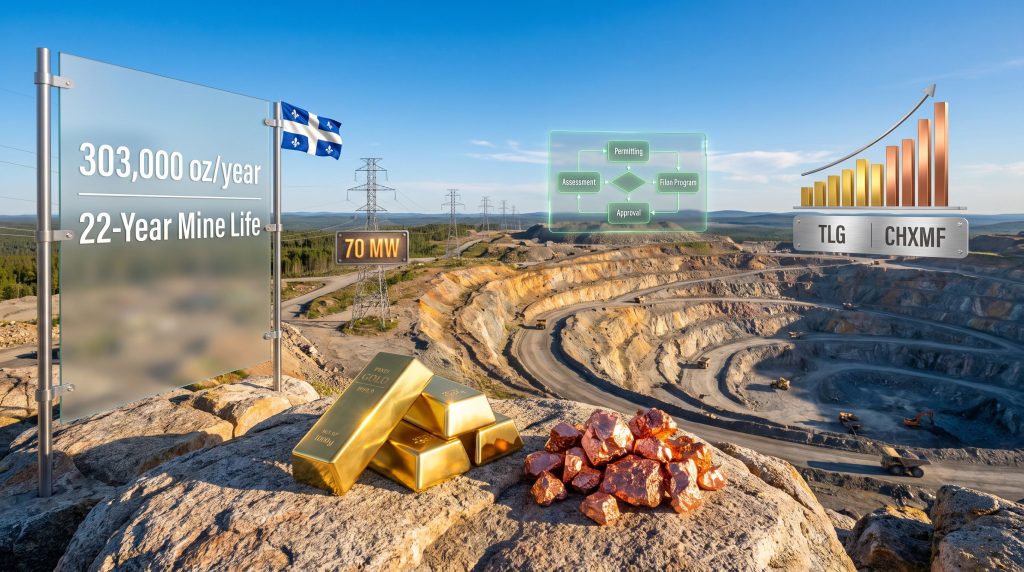
Quebec's answer to this challenge is a programme called Filon. And the Troilus gold-copper project, owned by Toronto-based Troilus Mining Corp. (TSX: TLG; OTCQX: CHXMF), has become one of its first designated participants. Understanding what Quebec selects Troilus for accelerated permitting stream actually means, and what it does not mean, requires looking carefully at both the mechanics of Filon and the characteristics that made Troilus a natural candidate for this kind of coordinated oversight.
When big ASX news breaks, our subscribers know first
What Quebec's Filon Program Actually Does
A Coordination Layer, Not a Regulatory Shortcut
Filon is best understood as a structural intervention in the administrative architecture of mine permitting, not a mechanism to reduce or bypass environmental scrutiny. The programme operates by assigning dedicated permitting specialists to strategically important projects, mapping every required authorisation across provincial ministries and federal agencies, and establishing proactive communication channels before bottlenecks have a chance to materialise.
The distinction matters enormously for investors and observers who might interpret "accelerated permitting" as a reduction in regulatory rigour. The mining permitting realities facing large-scale Canadian projects remain substantive under Filon; the underlying process still requires full completion of both provincial and federal Environmental and Social Impact Assessments (ESIAs). What changes under Filon is the coordination architecture around those assessments, not their substance or standards.
Critical Distinction: Filon does not compress environmental review by reducing requirements. It compresses the administrative gaps between review stages by ensuring that information requests are not duplicated, that provincial and federal timelines are synchronised where possible, and that companies have direct access to specialised expertise rather than navigating bureaucratic channels independently.
In practical terms, the programme works through a structured sequence. A project receives strategic designation based on its alignment with Quebec's critical minerals priorities and its development-stage readiness. Dedicated specialists are then embedded in the process, mapping all required authorisations and identifying potential timeline risks before they cause delays. Structured communication channels between the company, Quebec's natural resources ministry, and federal counterparts at the Impact Assessment Agency of Canada (IAAC) are then formalised.
This is meaningfully different from standard permitting pathways, where companies often manage interagency communication independently and discover administrative misalignments only after delays have already accumulated. The Filon model shifts that dynamic from reactive to proactive, effectively turning the provincial government into a co-pilot of the review process rather than a passive gatekeeper.
How Filon Compares to Other Canadian Permitting Frameworks
Quebec is not alone in recognising that permitting friction is a competitiveness issue. Several Canadian jurisdictions have developed their own coordination mechanisms, though the specific architectures differ considerably.
| Jurisdiction | Key Permitting Feature | Notable Initiative |
|---|---|---|
| Quebec (Filon) | Dedicated coordination specialists, synchronised federal-provincial review | Filon programme (2026) |
| British Columbia | Multi-agency coordination for major mines | Major Mines Permitting Office (MMPO) |
| Ontario | Single-window facilitation under MNDM | Various mine-specific facilitation |
| Federal (Canada-wide) | Statutory review under Impact Assessment Act | Regional assessments, substitution agreements |
British Columbia's Major Mines Permitting Office (MMPO) provides a useful structural comparison. Like Filon, the MMPO assigns project leads and coordinates multi-agency input, though BC's system operates within a different legislative framework and its own Indigenous consultation framework shapes how community engagement is structured and sequenced. What distinguishes Quebec's approach is its explicit integration with federal review timelines under the Impact Assessment Act, which has historically been a source of significant uncertainty for large-scale mine development across Canada.
Why Troilus Was Selected: A Project Fundamentals Analysis
Historical Production Credentials and Restart Logic
The Troilus deposit sits in the Chibougamau-Chapais region of northern Quebec, an established mining belt with existing infrastructure, experienced workforce pools, and proximity to Hydro-Québec's transmission network. The site operated as a producing mine between 1996 and 2010, generating over 2 million ounces of gold and approximately 70,000 tonnes of copper before being placed on care and maintenance.
This legacy production history is more than a biographical footnote. It means the orebody's behaviour under industrial mining conditions is already partially understood, that regional environmental baselines have been documented over decades, and that the social and community relationships underpinning a social licence have an established foundation to build upon. For regulators evaluating a new ESIA, a prior operating history provides a data-rich context that greenfield projects simply cannot offer.
Feasibility Study Findings and Scale Context
The definitive feasibility study completed in May 2024 placed Troilus firmly in the category of large-scale Canadian gold development. The key metrics establish its significance within the national project pipeline:
| Project Milestone | Status or Detail |
|---|---|
| Historical Gold Production | 2+ million oz (1996–2010) |
| Historical Copper Production | ~70,000 tonnes (1996–2010) |
| Feasibility Study Completion | May 2024 |
| Projected Average Annual Gold Output | ~303,000 oz/year |
| Mine Life Projection | 22 years |
| Hydro-Québec Power Allocation | 70 MW (June 2026) |
| ESIA Filing | 2025 (provincial and federal) |
| Expected Permitting Decision | End of 2026 |
| Potential Construction Decision | As early as 2027 |
An average annual output of 303,000 ounces of gold over a 22-year mine life would place Troilus among Canada's largest gold-producing operations by volume if developed. For context, that production profile would represent a material addition to Canada's national gold output, particularly given the current gold price outlook and the fact that several established Canadian mines are moving through the later stages of their reserve lives.
The copper component adds another dimension that is increasingly relevant to the strategic minerals conversation. Furthermore, the evolving copper market trends around electrification and grid expansion have made copper a priority commodity for governments managing industrial policy alongside resource development. Troilus carries both gold and copper at scale, which strengthens its alignment with Quebec's critical minerals classification framework.
The Hydro-Québec Power Allocation: An Underappreciated Signal
One of the less widely discussed but analytically significant milestones in Troilus' recent development history is the 70 MW power allocation secured from Hydro-Québec in June 2026. Power supply is frequently the unspoken constraint in large-scale mine development in remote regions. Securing grid power rather than relying on diesel generation is not simply a cost consideration. It is a prerequisite for obtaining social licence in an era of heightened ESG scrutiny, and it materially affects the project's carbon intensity profile.
Hydro-Québec's generation mix is overwhelmingly hydroelectric, meaning that electrifying Troilus' operations would carry one of the lowest carbon footprints of any comparable mine in the world. This is not a minor competitive detail. As institutional investors increasingly apply emissions-intensity screens to mining assets, the availability of low-carbon power becomes a financing variable in its own right.
Investor Insight: Power allocation from Hydro-Québec at the pre-construction stage removes a critical infrastructure uncertainty from the project's risk register. For project lenders and equity participants evaluating Troilus' financing profile, this allocation functions as a material de-risking event, not merely a logistical footnote.
Development Timeline: What the Filon Designation Changes
Permitting Decisions Targeting End of 2026
With the ESIA under active review at both provincial and federal levels, Troilus has targeted permitting decisions by the end of 2026. The Filon designation is specifically intended to support this timeline by ensuring that the parallel provincial and federal review processes remain synchronised and that any administrative gaps are identified and resolved before they compound into meaningful delays.
Several risk factors remain that could affect this timeline regardless of Filon support. Federal reviews under the Impact Assessment Act have their own statutory timelines and procedural requirements that provincial facilitation cannot override. Indigenous consultation processes, which are embedded within both provincial and federal assessment frameworks under Canadian law, must be conducted thoroughly and cannot be compressed without legal and reputational consequences. Community engagement processes similarly operate on their own dynamics.
What Filon does, however, is reduce the probability that administrative friction, rather than substantive regulatory or community concerns, becomes the primary source of delay. That is a meaningful but not unconditional improvement to the timeline outlook.
Engineering and Financing Running in Parallel
A detail worth noting for capital markets observers is that Troilus' engineering advancement and project financing activities are explicitly running in parallel with the permitting process, rather than sequentially. This parallel-track approach is increasingly standard for large mine developments seeking to compress the time between regulatory approval and first production, but it carries its own risk profile. Capital deployed in pre-construction engineering before permits are granted represents sunk cost exposure if approvals are delayed or modified.
The upside, consequently, is that a formal construction decision in 2027, if permitting proceeds as targeted, could be executed more rapidly because significant engineering and financing groundwork will already be in place. Given that the project's 22-year mine life creates long-horizon visibility for lenders and equity investors, the financing market for a permitted, construction-ready Troilus would likely attract meaningful institutional appetite.
Northern Quebec's Economic and Community Stake
Regional Development and Generational Planning Horizons
The Chibougamau region's economic relationship with the original Troilus mine spans the full operational period from 1996 to 2010. For northern Quebec communities, a 22-year mine life is not simply a financial projection. It is a generational planning horizon that affects municipal infrastructure investment, workforce development, housing, and educational planning in ways that shorter-duration projects do not.
Quebec's Natural Resources Minister Kateri Champagne Jourdain indicated that the project's development would strengthen northern Quebec's economy and create lasting regional benefits, whilst also reinforcing Quebec's standing as a globally significant mining jurisdiction. The explicit reference to lasting benefits signals that community and regional economic outcomes are part of the policy rationale for Filon participation, not merely a byproduct of it.
Indigenous Consultation and Social Licence
For a project of Troilus' scale and duration, social licence is not a secondary consideration to regulatory approval. Under Canadian law, meaningful Indigenous consultation is embedded within both the provincial and federal ESIA processes, and courts have consistently upheld the duty to consult as a substantive legal obligation, not a procedural formality.
Troilus has stated its commitment to advancing permitting without compromising transparency or community engagement standards. For long-duration mining projects, the social licence earned or lost during the development phase has consequences that extend across the entire operational life of the mine. Indigenous and community relationships built during permitting become the foundation for operational partnerships, benefit agreements, and the kind of social stability that underpins long-term project performance.
Frequently Asked Questions: Quebec's Filon Program and Troilus
What Is Quebec's Filon Programme?
Filon is a provincial initiative that assigns dedicated coordination specialists to strategically important mining projects, synchronising provincial and federal environmental review timelines and identifying administrative bottlenecks before they cause delays. It does not reduce or replace the substantive requirements of environmental or social impact assessments.
Does Filon Mean Troilus Already Has Its Permits?
No. Filon is a facilitation mechanism. Troilus' ESIA remains under active review at both provincial and federal regulatory levels. Permitting decisions are targeted for the end of 2026, with a potential construction decision following in 2027.
What Makes Troilus Strategically Significant for Quebec?
The project's dual gold-copper commodity profile, its advanced development stage, its completed feasibility study projecting 303,000 oz/year average gold output over 22 years, and its secured 70 MW Hydro-Québec power allocation all position Troilus as one of the most material mine development opportunities currently at the permitting stage in the province.
How Does Hydro-Québec's Power Allocation Affect the Project's Financing Profile?
Securing low-carbon hydroelectric power removes a significant infrastructure uncertainty from the project's risk register, reduces projected operating costs relative to diesel-powered alternatives, and improves the project's emissions-intensity profile. All of these are increasingly relevant factors for institutional lenders and equity investors applying ESG criteria.
Who Owns the Troilus Project?
The Troilus gold-copper project is owned by Toronto-based Troilus Mining Corp., listed on the TSX under the ticker TLG and on the OTCQX under the symbol CHXMF.
The next major ASX story will hit our subscribers first
Key Takeaways for the Mining Investment Community
Quebec selects Troilus for accelerated permitting stream as a policy action that represents more than an administrative convenience for Troilus Mining Corp. It signals a structural evolution in how Quebec positions itself as a mining jurisdiction, moving from passive regulatory processing toward active governmental co-facilitation of strategically important projects. The implications, furthermore, extend beyond any single project:
- Filon's design offers a replicable model that other Canadian provinces may benchmark as national permitting reform pressure intensifies.
- The convergence of Filon support, a secured Hydro-Québec power allocation, and an active ESIA review positions Troilus as one of the most closely watched mine development stories in Canada heading into 2027.
- The parallel-track approach to engineering and financing advancement, combined with a targeted late-2026 permitting decision, creates a potential compressed timeline from approval to construction commencement that would be unusual by historical Canadian standards.
- For institutional investors, the project's 22-year mine life, dual-commodity profile, low-carbon power supply, and advanced permitting stage represent a risk-return profile that is materially different from earlier-stage development assets.
This article is intended for informational purposes only and does not constitute financial or investment advice. Forward-looking statements regarding permitting timelines, production projections, and construction decisions involve inherent risks and uncertainties. Readers should conduct independent due diligence before making investment decisions.
Want to Stay Ahead of the Next Major ASX Mineral Discovery?
While Troilus represents a compelling large-scale development story, Discovery Alert's proprietary Discovery IQ model scans ASX announcements in real time — instantly identifying significant mineral discoveries across gold, copper, and 30+ other commodities before the broader market reacts. Explore historic examples of what major discoveries can return and begin your 14-day free trial at Discovery Alert to position yourself at the forefront of the next transformative find.