June 5, 2026
The Baseload Bet: Why Washington Is Wagering $800 Million on Coal's Future
The electricity grid has always been a political object as much as a technical one. Every major energy transition in American history, from wood to coal, coal to oil, oil to natural gas, has involved government actors shaping the pace and direction of change. What makes the current moment unusual is not that federal policy is leaning into fossil fuels, but rather the specific mechanism being used to do it, and the surprisingly forward-looking rationale being offered to justify it.
The argument that artificial intelligence data centres represent a national security vulnerability — one that only reliable baseload power can address — is reshaping how some policymakers think about ageing coal infrastructure. Whether that argument holds up under economic and legal scrutiny, however, is a different question entirely.
When big ASX news breaks, our subscribers know first
Breaking Down the $800 Million Federal Coal Commitment
The Trump $800m coal support in the United States is not a single appropriation but a layered intervention drawing from multiple federal mechanisms simultaneously. Understanding each channel matters because the legal durability, implementation timeline, and political exposure of each component differ substantially.
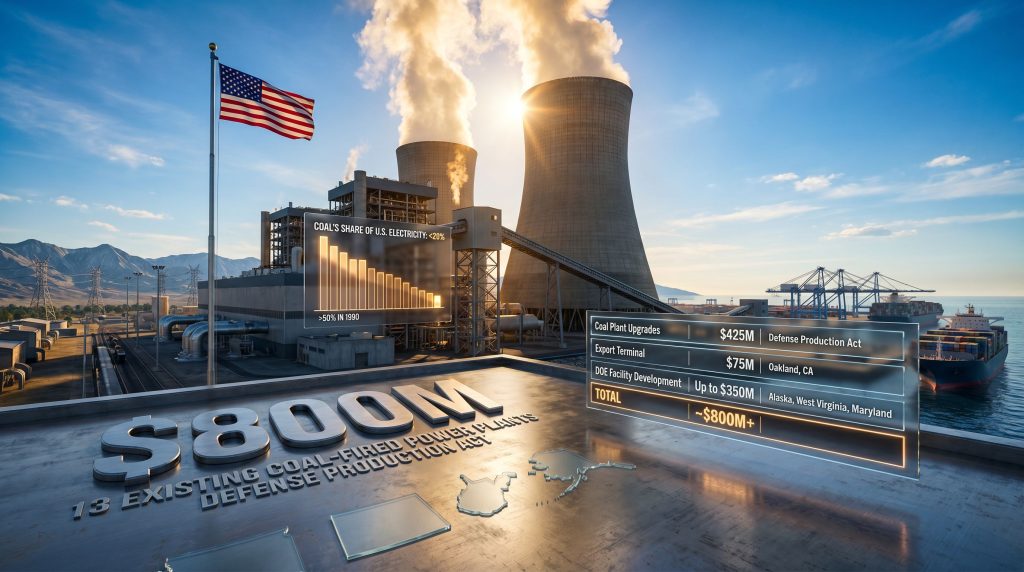
The largest single allocation, $425 million, is directed toward infrastructure upgrades across 13 existing coal-fired power plants, authorised through the Defense Production Act powers. A separate $75 million has been committed to the proposed West Gateway coal export terminal in Oakland, California, also under the same legislative authority. Additionally, the Department of Energy has confirmed it is finalising up to $350 million in previously announced funding for four coal facility development projects, including new generation assets in Alaska and West Virginia.
| Funding Stream | Amount | Authorisation | Target |
|---|---|---|---|
| Existing plant upgrades | $425M | Defense Production Act | 13 coal-fired power plants |
| Pacific export terminal | $75M | Defense Production Act | Oakland, CA (West Gateway) |
| DOE facility development | Up to $350M | DOE finalisation | Alaska, West Virginia, Maryland |
| Combined federal commitment | ~$800M+ | Multiple channels | Domestic + export infrastructure |
The distinction between the DPA-authorised funds and the DOE component is not merely procedural. The Defense Production Act money represents a presidential invocation of emergency industrial powers, while the DOE funding represents the completion of a separate administrative process. Both arrive simultaneously, creating the impression of a coordinated federal push even though the two streams have different legal foundations.
What the Defense Production Act Actually Authorises
The Defense Production Act was enacted in 1950 at the height of Korean War mobilisation. Its original purpose was to give the executive branch authority to direct private industry toward production priorities deemed essential to national defence. Over the following seven decades, it has been invoked during oil embargoes, post-hurricane reconstruction, semiconductor shortages, and pandemic-era medical supply crises.
Applying the DPA to coal infrastructure in 2026 represents a meaningful conceptual expansion of the statute. The administration's position is that electricity reliability for advanced computing infrastructure — particularly AI data centres — qualifies as a national security imperative. Energy Secretary Chris Wright and Interior Secretary Doug Burgum have both publicly advanced this framing, positioning coal not as a legacy fuel in decline but as a grid stability asset with strategic value. This aligns closely with the broader mineral production executive order that has shaped the administration's energy security agenda.
The legal question now being raised by environmental advocates is whether coal export logistics and power plant upgrades genuinely fit within the DPA's statutory definition of national security activities, or whether the statute is being stretched beyond its intended scope.
This is not an abstract debate. The answer will determine whether planned legal challenges by groups including the Sierra Club can succeed in delaying or blocking specific components of the funding package.
The Oakland Terminal: Geography as Strategy
Of all the components in this package, the West Gateway export terminal in Oakland, California is perhaps the most geopolitically significant and the most legally exposed. Wyoming, the largest coal-producing state in the country, has long faced a fundamental logistical problem: its coal reserves are landlocked, and reaching Pacific markets requires either overland transport to existing Gulf Coast terminals or navigating permitting environments in western states that are often hostile to fossil fuel infrastructure.
A functioning West Coast terminal would dramatically compress shipping distances and costs to major Asian coal consumers. Wyoming Governor Mark Gordon, following diplomatic visits to Japan and Taiwan, has indicated that both nations are actively seeking U.S. coal supplies to support baseload electricity demand driven partly by AI infrastructure buildout. Gordon has described the Oakland terminal as essential to the economic survival of Wyoming's coal industry.
The strategic logic, furthermore, is straightforward:
- Wyoming coal reaches Pacific buyers faster and cheaper via an Oakland terminal than via Gulf Coast alternatives
- Japan and Taiwan are established thermal coal importers managing complex energy transitions
- U.S. coal would compete with Australian, Indonesian, and Russian suppliers already embedded in Asian supply chains
- A Pacific terminal gives the U.S. a logistics tool that doubles as diplomatic leverage in Asian energy relationships
California state regulators have not indicated acceptance of the terminal proposal, and the intersection of federal DPA authorisation with California's environmental review processes creates a jurisdictional collision that courts may ultimately need to resolve.
Coal's Structural Position in 2026: Reading the Market Data
Any honest assessment of the Trump $800m coal support in the United States must be placed against the backdrop of coal's long-term structural decline in the domestic electricity market. The numbers tell a story that policy alone has not been able to rewrite.
Coal's share of U.S. electricity generation:
- 1990: Greater than 50% of total U.S. electricity generation
- 2026: Less than 20% of total U.S. electricity generation
- Primary displacement forces: Cheaper natural gas from shale production; rapidly falling levelised costs of wind and solar
U.S. coal workforce trends (St. Louis Federal Reserve data):
- 2017: Approximately 51,500 working coal miners
- 2025 (most recent estimate): Approximately 39,800 working coal miners
- Net decline: Roughly 11,700 jobs over approximately eight years, spanning periods of both regulatory rollback and enforcement
The workforce numbers are particularly instructive. They demonstrate that pro-coal policy, even when sustained over multiple years, has not reversed the underlying employment trajectory. Market economics, not regulatory burden alone, are driving the industry's contraction.
This does not mean federal investment is without effect. Targeted capital infusions into specific plants can extend operational lifespans, improve efficiency, and preserve regional employment in communities where coal remains the dominant economic activity. However, extending operational life is a different outcome from reversing structural decline.
Stakeholder Positions: A Divided Response
The reaction to this federal package has broken along predictable lines, though the arguments on each side contain more nuance than a simple pro-coal versus anti-coal framing suggests.
| Stakeholder | Position | Core Argument |
|---|---|---|
| National Mining Association | Supportive | Energy price stability, rising demand, grid reliability |
| Trump Administration | Strongly supportive | National security, AI electricity demand, export expansion |
| Sierra Club | Opposed | Public health risk, DPA misapplication, legal challenge |
| Wyoming and West Virginia governors | Strongly supportive | State economic lifeline, Asian export market access |
| Environmental legal advocates | Opposed | Regulatory overreach, judicial review of DPA scope |
Rich Nolan, CEO of the National Mining Association, has characterised the federal investment as a mechanism to shield consumers from energy price volatility while addressing rising electricity demand. The industry's position frames coal not as a relic but as a stabilising anchor in a grid that is adding intermittent renewable capacity at scale. Consequently, the Trump mining policy impact extends well beyond coal alone, reshaping how federal resources are directed across the broader extractive sector.
Patrick Drupp, Climate Policy Director at the Sierra Club, has taken the opposite view, arguing that public funds directed toward coal infrastructure represent a subsidy for an industry whose particulate emissions are directly linked to cardiovascular and pulmonary disease. The Sierra Club has signalled it will contest the initiative through litigation, with DPA applicability likely to be a central legal argument.
The next major ASX story will hit our subscribers first
The Public Health Dimension
The health argument against coal expansion is supported by a substantial body of epidemiological research. Fine particulate matter (PM2.5) from coal combustion is associated with increased rates of heart disease, stroke, lung cancer, and chronic respiratory illness. These are not theoretical risks: communities located near coal-fired power plants have documented higher rates of hospital admissions for respiratory and cardiovascular conditions.
Expanding coal plant operations, even through infrastructure upgrades designed to improve efficiency, raises legitimate questions about net emissions outcomes. Modern pollution control technologies can reduce some categories of emissions, but coal combustion at scale continues to generate particulate precursors, sulphur dioxide, nitrogen oxides, and mercury compounds that carry real public health costs.
Environmental advocates argue that federal investment in coal infrastructure effectively shifts those health costs onto communities and public health systems while directing financial benefits to a narrow set of industrial operators. In addition, the Trump coal revival orders that preceded this package have already drawn significant scrutiny from public health researchers monitoring air quality outcomes near affected plant sites.
Three Scenarios for U.S. Coal's Trajectory
The long-term impact of this federal commitment depends heavily on which of several plausible futures materialises over the next five to ten years.
Scenario 1: Policy Stabilisation
Federal capital extends the operational life of targeted plants, export volumes to Asia grow through the Oakland terminal if legal challenges are overcome, and coal holds a 15 to 18 percent share of U.S. electricity generation through the late 2020s before continued market erosion resumes.
Scenario 2: Legal Blockage and Partial Implementation
Court challenges successfully delay or block the Oakland terminal and portions of the DPA-authorised plant funding. The DOE component proceeds independently, resulting in limited new capacity in Alaska and West Virginia but no significant export infrastructure expansion.
Scenario 3: Market Override
Even with full implementation of all funding streams, the economics of natural gas and renewables continue to undercut coal's competitiveness in bilateral utility procurement decisions. Federal assets become stranded investments as plant closures proceed regardless of upgrade spending. Furthermore, the broader context of steel and aluminum tariffs affecting input costs adds further uncertainty to capital-intensive plant upgrade projects.
Most energy economists would assign the highest probability to a hybrid outcome combining elements of Scenarios 1 and 3: partial stabilisation in specific regions, continued national-level decline, and persistent legal friction around the DPA's application.
This represents analytical scenario modelling, not a definitive forecast. Energy markets involve significant uncertainty, and policy outcomes depend on judicial, legislative, and market variables that cannot be predicted with precision.
According to reporting from Virginia Business, the administration's use of emergency powers to support coal has already generated significant debate among legal scholars and energy policy experts who question both the statutory basis and the long-term efficacy of the approach. The Department of Energy has simultaneously been advancing small modular reactor deployment, suggesting a broader federal energy strategy that is not exclusively centred on fossil fuels despite the scale of the coal commitment.
FAQ: Trump's $800M Coal Support Plan
How is the $800 million being distributed across different programmes?
The total includes $425 million via the Defense Production Act for upgrades to 13 existing coal plants, $75 million for the Oakland export terminal under the same authority, and up to $350 million in DOE funding being finalised for new coal facility development in Alaska, West Virginia, and Maryland.
Why is the Defense Production Act significant in this context?
The DPA is a 1950 Cold War statute that grants the executive branch authority to direct industrial production for national security purposes. Using it for coal infrastructure represents a legal argument that reliable electricity supply for AI and advanced computing is a national security matter — a classification that environmental advocates are preparing to challenge in court.
Has federal coal support reversed the industry's employment decline?
No. According to St. Louis Federal Reserve data, working coal miners fell from approximately 51,500 in 2017 to roughly 39,800 in 2025, a decline of nearly 12,000 positions across a period that included significant regulatory rollback. Market forces have outweighed policy support in determining employment outcomes.
What makes the Oakland terminal strategically important?
Wyoming, the largest U.S. coal-producing state, currently lacks direct Pacific coast export access. The West Gateway terminal would open a direct shipping route to Japan, Taiwan, and other Asian coal markets, reducing transit costs and positioning U.S. coal more competitively against Australian and Indonesian suppliers in Pacific trade.
What legal challenges could affect this initiative?
The Sierra Club has confirmed plans to contest the initiative through litigation, with DPA applicability as a likely focal point. California state regulators may independently challenge the Oakland terminal on environmental review and land-use grounds, creating a multi-jurisdictional legal environment with significant uncertainty for project timelines. The Trump $800m coal support in the United States will, in all likelihood, face sustained legal scrutiny before any of its major infrastructure components become operational.
Want to Stay Ahead of the Next Major Resource Discovery?
Discovery Alert's proprietary Discovery IQ model scans ASX announcements in real time, instantly identifying significant mineral discoveries and turning complex data into actionable investment insights — because while Washington debates coal's future, the next transformative resource discovery could be announced any day. Start your 14-day free trial today, or explore Discovery Alert's discoveries page to see how historic finds have delivered extraordinary returns for investors who moved early.