June 5, 2026
Arctic Ambitions on Ice: Can the Oil Industry Finally Commit to ANWR?
Frontier energy investment has always been a game of competing time horizons. Geological potential is measured in decades, capital is committed in cycles, and political mandates shift with every electoral tide. Nowhere is this tension more acutely visible than in Alaska's Arctic National Wildlife Refuge, where the intersection of enormous estimated reserves, formidable logistics, and relentless political volatility has repeatedly frustrated efforts to transform subsurface promise into producing barrels.
The Trump Arctic Refuge lease sale in Alaska drilling circles represents far more than a single federal auction. It is a stress test of whether the current policy environment has meaningfully shifted industry calculus, or whether the structural barriers that have historically kept major operators at arm's length remain as entrenched as the permafrost itself.
When big ASX news breaks, our subscribers know first
The Legislative Architecture Behind the June 2026 Sale
What makes the June 5, 2026 lease auction structurally different from its predecessors is not executive intent alone, but statutory obligation. The One Big Beautiful Bill Act mandates a minimum of four ANWR Coastal Plain lease auctions before 2035, removing the discretionary flexibility that allowed previous administrations to simply decline to schedule sales. This legislative mechanism effectively converts energy policy into a durable pipeline of federal commitments, at least on paper.
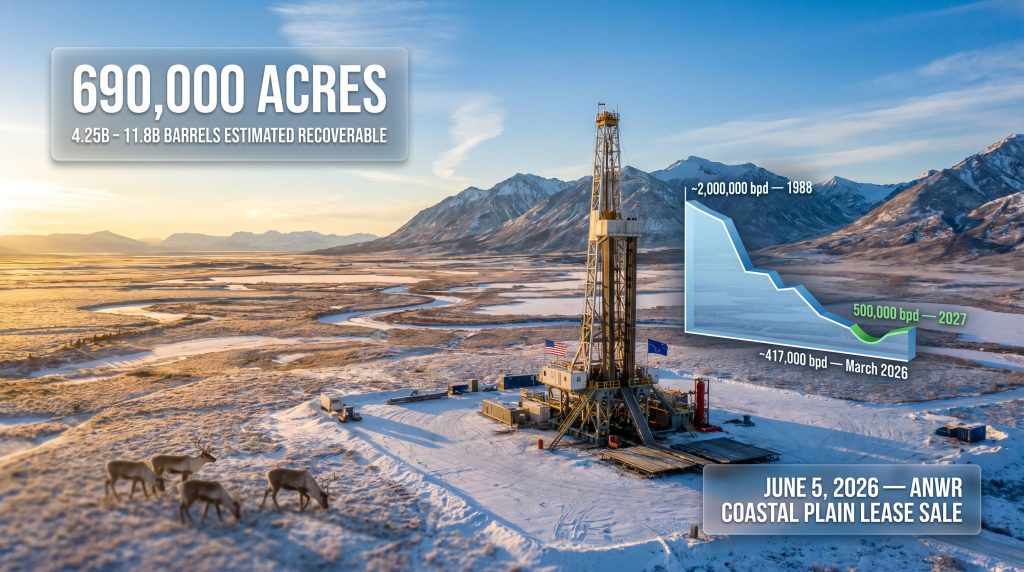
The Bureau of Land Management has offered 58 individual tracts across approximately 690,000 acres within the 1.56-million-acre Coastal Plain for the June auction. This is the first sale conducted after the Biden administration's drilling restrictions were lifted, and it carries the weight of a federal government signalling that the policy reversal is structured, not ad hoc.
However, statutory mandates govern auction scheduling, not lease durability or permit continuity. The historical record demonstrates clearly that leases awarded in one administration can be challenged, suspended, or cancelled in the next, and ANWR has been particularly susceptible to this cycle of political reversal. Furthermore, the Alaska drilling policy shift under the current administration adds another layer of complexity to an already volatile investment landscape.
What Alaska's Production Collapse Reveals About the Stakes
Understanding why the Trump Arctic Refuge lease sale in Alaska drilling matters requires contextualising the state's extraordinary production trajectory. Alaska once anchored American domestic supply, delivering close to 2 million barrels per day at its 1988 peak. By March 2026, that figure had contracted to approximately 417,000 bpd, a decline of nearly 80% over less than four decades.
| Year | Alaska Crude Output | Key Context |
|---|---|---|
| 1988 | ~2,000,000 bpd | Historic peak production |
| March 2026 | ~417,000 bpd | Current baseline |
| 2026 (projected) | ~450,000 bpd | New developments contributing |
| 2027 (projected) | ~500,000 bpd | Incremental growth expected |
Source: U.S. Energy Information Administration (EIA)
The EIA's near-term recovery projections to 500,000 bpd by 2027 are driven entirely by developments already underway, not by any prospective ANWR contribution. This distinction matters enormously: ANWR is not a near-term supply solution. It is a long-cycle strategic asset whose relevance is measured in decades, not quarters. The broader US oil production decline story provides essential context for understanding why federal policymakers are pushing so aggressively on Arctic access.
Critically, the Trans-Alaska Pipeline System underpins the entire economic logic of Alaskan production. TAPS requires sufficient throughput to remain viable, and declining volumes progressively increase per-barrel transportation costs for all producers using the system. Sustained underutilisation of TAPS capacity is not merely an efficiency problem; it is an existential threat to the pipeline's economic rationale and, by extension, to Alaska's continued role as a significant U.S. producing region.
ANWR's long-term significance is therefore less about near-term supply and more about preserving Alaska's role as a major U.S. producing region into the 2040s and beyond, a timeline that complicates traditional capital return models for most operators.
A Track Record That Demands Scrutiny
Any honest assessment of the Trump Arctic Refuge lease sale in Alaska drilling must confront the lease sale history directly.
| Lease Sale | Date | Outcome | Key Participants |
|---|---|---|---|
| First ANWR Sale | January 2021 | Limited bids received | AIDEA, Knik Arm Services LLC, Regenerate Alaska Inc. |
| Second ANWR Sale | January 2025 | Zero bids received | None |
| NPR-A Sale | March 2026 | Record $163 million in bids | ConocoPhillips, ExxonMobil, Shell/Repsol partnership |
| ANWR Coastal Plain Sale | June 5, 2026 | TBD | AIDEA confirmed interest |
The contrast between the zero-bid 2025 ANWR sale and the record-breaking National Petroleum Reserve Alaska auction just months later in March 2026 is analytically revealing. The NPR-A attracted $163 million in bids, drawing ConocoPhillips, ExxonMobil (which had not drilled an exploratory well in Alaska since the early 1990s), and a Shell-Repsol partnership that secured over 40 leases. Shell's re-entry is particularly striking given the company's costly and ultimately fruitless offshore Arctic exploration campaign north of Alaska, which it abandoned after significant capital losses.
The NPR-A's appeal rests on several structural advantages over ANWR. It carries an explicit federal designation for petroleum development, cleaner regulatory pathways, partial existing infrastructure, and substantially lower political reversibility risk. ANWR carries none of these advantages in comparable measure.
Ellen Wald, a senior fellow with the Atlantic Council Global Energy Center and president of Transversal Consulting, has observed that production in the refuge will be challenging and that the prospect of permit cancellations under a future administration functions as a persistent deterrent, given how straightforwardly such cancellations can serve as environmental policy signals for incoming governments.
Reserve Estimates: Understanding the Geological Uncertainty
ANWR's Coastal Plain is estimated to contain between 4.25 billion and 11.8 billion barrels of technically recoverable oil. That nearly threefold variance between the low and high estimates is not a rounding error; it reflects genuine geological uncertainty in a formation that has never been commercially drilled.
Several factors contribute to this uncertainty:
- The Coastal Plain sits within the Brooks Range foothills, where subsurface structural complexity is high and seismic data coverage remains limited relative to more mature basins
- Permafrost conditions affect reservoir characterisation methodologies, introducing additional interpretation uncertainty
- The absence of any production wells means reserve estimates rely entirely on extrapolation from regional analogs and limited exploration data rather than confirmed flow rates
- Hydrocarbon quality, including API gravity and sulphur content, remains poorly constrained without wellbore data, which has implications for refinery compatibility and netback economics
The wide variance in reserve estimates reflects genuine subsurface uncertainty and is a critical factor shaping operator risk appetite for this acreage. An operator committing capital to ANWR exploration is, in part, paying for the right to reduce that uncertainty, not for confirmed reserves.
This distinction between resource potential and commercial reserves is one that investor communications often obscure. Technically recoverable estimates assume future technology and economics, not current drilling costs or market prices. Monitoring crude oil price trends will therefore be as important as any regulatory development in shaping long-term operator appetite for this acreage.
The Operational Realities of Arctic Frontier Drilling
Even setting aside political and legal risk, the physical environment of ANWR's Coastal Plain imposes constraints that have no direct analogue in the Lower 48.
Seasonal drilling windows are among the most consequential. Heavy equipment operations on Arctic tundra are restricted to winter months when permafrost stability is sufficient to support ice roads and drilling pads without causing irreversible surface damage. This typically provides a window of roughly 100 to 120 days per year for intensive surface operations, compressing exploration timelines and inflating per-well costs substantially compared to year-round drilling environments.
The capital commitment sequence for a greenfield Arctic development follows a demanding logic:
- Lease acquisition and baseline environmental studies (Years 1-3)
- Ice road and logistics infrastructure construction for first exploration well (Years 2-4)
- Exploration drilling and seismic confirmation (Years 3-7)
- Appraisal drilling to delineate discovered resources (Years 5-10)
- Development planning, environmental review, and permitting (Years 8-13)
- Production facility construction and pipeline tie-in (Years 12-15+)
From lease award to first commercial production, realistic Arctic frontier timelines span 10 to 15 years under favourable conditions. Under the current political environment, where regulatory reversals have already occurred once, this timeline spans at minimum two full U.S. presidential terms, potentially three.
Scenario: An operator securing leases in June 2026 and commencing exploration drilling by 2028 would face a realistic first-oil scenario no earlier than the mid-to-late 2030s, assuming continuous regulatory clearance. That assumption has never held for ANWR across its entire modern history.
The next major ASX story will hit our subscribers first
The Stakeholder Map: Competing Interests Across Multiple Dimensions
The ANWR debate involves a stakeholder landscape that is considerably more nuanced than the standard industry-versus-environment framing suggests.
| Stakeholder Group | Position | Core Rationale |
|---|---|---|
| Trump Administration | Pro-development | Energy dominance agenda; statutory mandate |
| Alaska Industrial Development and Export Authority (AIDEA) | Pro-development | State economic development mandate; top bidder in 2021 |
| Kaktovik community leadership | Pro-development | Regional economic self-sufficiency |
| Gwich'in Indigenous communities | Anti-development | Coastal plain considered culturally and spiritually sacred |
| Environmental organisations | Anti-development | Wildlife habitat; climate considerations |
| Major international oil companies | Cautious/selective | Political risk; ESG pressure; capital discipline |
One dimension frequently underrepresented in mainstream coverage is the internal division among Alaska Native communities. The Gwich'in people, whose subsistence practices and cultural identity are deeply connected to the Porcupine caribou herd that calves on the Coastal Plain, have consistently and vocally opposed drilling. The Iñupiat community of Kaktovik, the only permanent settlement located within the refuge itself, holds the opposing view, supporting development as integral to the region's economic future and self-determination.
This division means that appeals to Indigenous opposition as a monolithic position misrepresent a more complex reality, one where different communities hold different relationships to the land and different assessments of what resource development means for their futures.
On the environmental side, conservation organisations have documented the Coastal Plain as habitat for polar bears, Arctic foxes, caribou, musk oxen, and numerous migratory bird species. Earthjustice has confirmed that leases issued from the June 2026 sale will face an existing legal challenge contesting the Interior Department's 2025 leasing decision, adding immediate litigation risk to any leases awarded.
Legal Risk as a Structural Investment Variable
The litigation landscape surrounding ANWR is not an external complication; it is a permanent feature of the investment environment that any operator must price into its capital allocation decision. Consequently, the Trump policy volatility that has characterised this administration's broader regulatory agenda only amplifies the uncertainty that Arctic investors must navigate.
The cyclical pattern follows a predictable sequence:
- Congressional authorisation or executive action opens the Coastal Plain to leasing
- Environmental and Indigenous rights organisations file litigation challenging the legal basis for the leasing programme
- Courts issue injunctions or rulings that delay or constrain permitting
- Administrative changes accelerate or reverse the programme depending on the incoming administration's priorities
- Previously awarded leases face cancellation or suspension
This cycle has now repeated across multiple administrations. First-term Trump leases were subsequently cancelled under Biden. Biden-era restrictions have now been reversed under the second Trump term. Each iteration raises the minimum required rate of return necessary to justify capital deployment in this environment, functioning as an implicit tax on long-cycle Arctic investment.
The statutory mandate for four sales by 2035 may provide some legal durability for the leasing schedule itself, but it does not protect individual leases from administrative challenge, judicial injunction, or permit refusal at the exploration and development stages. Alaska Wild has reported extensively on the active legal proceedings that already surround the current leasing programme.
What the June 2026 Sale Will Actually Reveal
The level of participation in Friday's auction will function as a real-time market signal about industry confidence in the durability of the current policy framework. Indeed, the Trump policy impact on extractive industries more broadly will be judged, in part, by whether this auction produces meaningful commercial participation.
Scenario A: Strong Participation
If multiple established operators submit competitive bids, it would suggest that the statutory mandate, combined with the current federal policy posture and the precedent set by the NPR-A record sale, has been sufficient to shift risk tolerance meaningfully. It would also imply that operators believe some threshold of legal protection has improved sufficiently to justify capital commitment.
Scenario B: State Authority Participation Only
If the Alaska Industrial Development and Export Authority again emerges as the primary or sole bidder, the auction would technically proceed but would signal continued reluctance among commercial operators. AIDEA's mandate as a state economic development agency gives it a different risk calculus than a private oil company optimising for shareholder returns.
Scenario C: Minimal or Zero Bids
A repeat of the January 2025 outcome would be a significant data point for federal energy policy, suggesting that structural barriers including political reversibility risk, litigation exposure, long development timelines, and ESG-related investor pressure have not been adequately resolved by the current legislative framework.
Regardless of outcome, the June 5 auction is an inflection point. The Trump Arctic Refuge lease sale in Alaska drilling represents the first real empirical test of whether the energy industry's stated interest in domestic Arctic resources translates into committed capital, or whether that interest remains contingent on a political stability that the history of ANWR has never delivered.
This article contains forward-looking projections and analysis of regulatory, political, and geological factors. Reserve estimates, production forecasts, and development timelines carry inherent uncertainty. Readers should not rely on this content as investment advice. Further reporting and upstream industry analysis are available at worldoil.com.
Want to Stay Ahead of the Next Major Resource Discovery?
While Arctic frontier development plays out over decades, significant mineral discoveries on the ASX can move fast — Discovery Alert's proprietary Discovery IQ model delivers real-time alerts the moment a major discovery is announced, giving subscribers an immediate edge on actionable opportunities. Explore historic discoveries and their remarkable returns on Discovery Alert's dedicated discoveries page, or start your 14-day free trial today to position yourself ahead of the broader market.