August 5, 2026
The World's Most Vulnerable Energy Artery and Why It Matters Now
Few geographic features on Earth carry the economic weight of a single narrow waterway. Throughout modern history, chokepoints have determined the fate of empires, reshaped trade balances, and ignited conflicts that reverberated across continents. Today, no single passage concentrates more global energy dependency into less physical space than the corridor between the Persian Gulf and the Gulf of Oman. When diplomatic signals emerge suggesting that corridor may be restored to free passage, the implications stretch far beyond crude oil prices into the architecture of global security, nuclear non-proliferation, and the long-term viability of fossil fuel dependency itself.
The announcement by President Donald Trump on June 13, 2026, that a formal agreement with Iran was scheduled for signing the following day — with the Trump Iran deal and Strait of Hormuz reopening to follow immediately upon execution — represents one of the most consequential geopolitical developments of the decade. Understanding what this means requires moving well beyond the headline and examining the mechanics of energy market dependency, the fragility of the diplomatic framework, and the range of outcomes that could follow.
When big ASX news breaks, our subscribers know first
Why the Strait of Hormuz Cannot Be Replaced
The Strait of Hormuz sits at the mouth of the Persian Gulf, bordered by Iran to the north and Oman and the UAE to the south. At its narrowest navigable point, the usable shipping lanes span only a few kilometres in each direction, creating a physical bottleneck with no realistic large-scale substitute.
The volumes that transit this passage daily are staggering in their concentration:
| Commodity | Estimated Daily Volume |
|---|---|
| Crude Oil | ~17 to 18 million barrels per day |
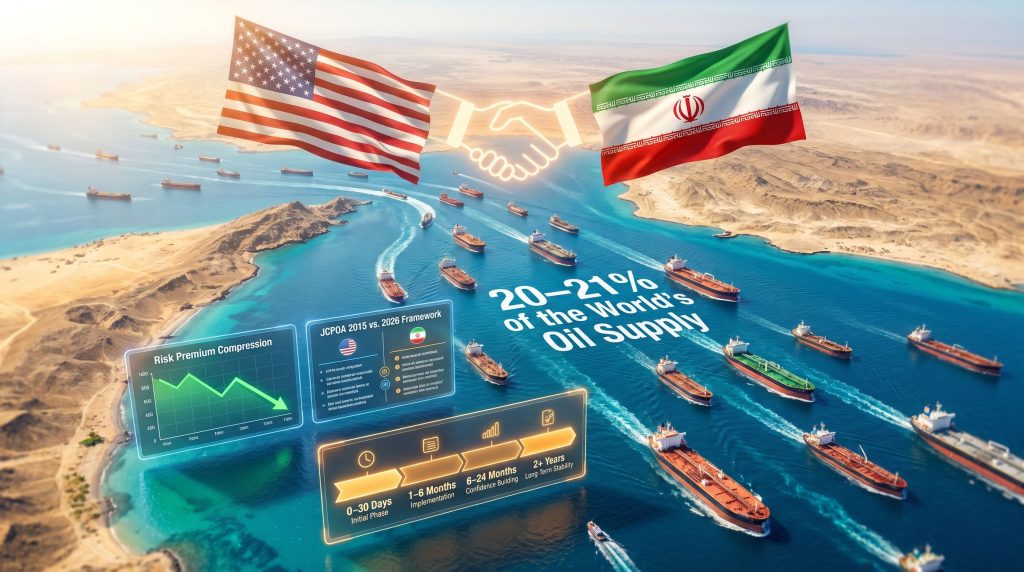
| Share of Global Oil Supply | Approximately 20 to 21% |
| LNG Shipments | Roughly 20% of global LNG trade |
| Refined Petroleum Products | Significant volumes from Gulf refineries |
The UAE operates the Habshan to Fujairah pipeline, which provides a partial bypass route for Abu Dhabi crude. However, its capacity covers only a fraction of total Gulf export volumes. Saudi Arabia's East-West pipeline similarly offers limited bypass functionality. Neither alternative can absorb full Gulf export capacity if the strait were completely closed, meaning the world's most oil-dependent economies remain structurally exposed to events along a 33-kilometre corridor.
The nations bearing the greatest exposure include:
- Japan and South Korea, which source the majority of their crude imports from Gulf producers transiting Hormuz
- China, the world's largest crude importer, with deep economic dependency on Gulf supply chains
- India, where Gulf crude represents a substantial share of total energy imports
- European LNG importers, whose reliance on Gulf liquefied natural gas increased sharply following supply disruptions from the Russia-Ukraine conflict — a trend also reflected in european gas market shifts observed throughout 2025
- Global shipping insurance markets, where war risk premiums on vessels transiting the region can spike hundreds of percentage points during periods of elevated tension
The concentration of global energy supply through a single geographic point has no parallel in modern commerce. A disruption at Hormuz does not create localised inconvenience; it triggers systemic repricing across every energy-dependent economy on the planet.
What Trump's Announcement Actually Said and What Remains Unconfirmed
On June 13, 2026, President Trump posted on Truth Social that the deal was scheduled for signing the following day, and that the Strait of Hormuz would open to all maritime traffic immediately after the agreement was executed. He also referenced a future process, described in vague terms, in which the United States would assist Iran in removing enriched uranium stored deep within hardened underground geological formations, suggesting the material is buried beneath granite mountain structures.
The announcement identified several structural elements of the reported framework:
- A ceasefire arrangement halting active military hostilities between U.S.-aligned forces and Iran
- A structured 60-day negotiation window establishing a formal diplomatic timeline for longer-term resolution
- An immediate Hormuz reopening conditional on deal execution
- A future, undefined process for removing enriched uranium from Iranian territory under conditions described as requiring calm and stability
The critical limitation of this announcement is what it does not include. Iranian officials had not publicly confirmed final approval of the agreement at the time of publication. According to Reuters reporting on the matter, Iran was calling for "actions, not words" — a telling signal of the gap that remained. This distinction matters enormously. A unilateral announcement from one party to a prospective agreement is structurally different from a jointly confirmed, signed instrument.
Disclaimer: The situation described reflects conditions as reported on June 13 to 14, 2026. Geopolitical developments of this nature are inherently fluid. Readers should not treat any information in this article as a basis for financial or investment decisions. Independent verification of current developments is essential.
How Energy Markets Respond to Hormuz Risk Events
Oil markets do not wait for geopolitical outcomes to be confirmed before repricing risk. Futures markets operate on probability-weighted expectations, meaning the mere announcement of a potential Hormuz reopening will begin compressing the risk premium embedded in crude benchmarks before any ink dries on an agreement. Furthermore, the oil price dynamics seen during Trump's earlier tariff cycle demonstrate just how quickly sentiment can shift market fundamentals.
Historical precedent illustrates how sensitive crude prices are to Hormuz tension cycles:
| Event | Oil Market Response |
|---|---|
| 1980s Tanker War (Iran-Iraq Conflict) | Brent crude surged; war risk insurance premiums rose by more than 300% |
| 2019 Gulf of Oman Tanker Attacks | Brent crude rose approximately 4% within 48 hours |
| 2020 U.S.-Iran Tensions Following Soleimani Strike | WTI jumped roughly 4% overnight before retracing |
| 2026 Hormuz Closure Threat | Significant upward pressure on Brent and Asian LNG spot prices |
A confirmed, binding agreement reopening Hormuz would likely trigger a sequence of interconnected market movements:
- Short-term Brent crude price decline driven by the unwinding of geopolitical risk premiums
- Downward pressure on Asian LNG spot rates, particularly for Japanese, South Korean, and Taiwanese buyers
- Shipping freight rate normalisation for Very Large Crude Carriers operating in Gulf trade lanes, reversing the elevated rates that accompany perceived closure risk
- Potential Iranian export volume re-entry, with Iran holding approximately 157 billion barrels of proven oil reserves according to OPEC data, providing meaningful additional supply capacity if sanctions relief accompanies the diplomatic framework
The interplay between risk premium deflation and supply re-entry is nuanced. A Hormuz reopening alone compresses the threat premium. If it is accompanied by partial or full sanctions relief allowing Iran to increase export volumes, the downward price pressure would be amplified through actual supply mechanics rather than sentiment alone. In addition, OPEC's production management frameworks would face immediate recalibration pressure as Iranian barrels re-enter the market.
The Nuclear Dimensions: What the Enriched Uranium Clause Actually Means
The reference to removing enriched uranium stored in deep underground granite formations is not merely diplomatic language. It carries specific technical and geopolitical implications that require careful analysis.
Iran's nuclear programme has accumulated enriched uranium at multiple enrichment levels. Highly enriched uranium, particularly material enriched above 60%, represents a proliferation concern because it sits closer to the weapons-grade threshold. The description of material buried deep beneath hardened geological formations is consistent with what is publicly known about Iran's Fordow Fuel Enrichment Plant, which is built into a mountain and designed to withstand air strikes.
The announced clause raises several unresolved questions that will determine whether this agreement carries lasting non-proliferation value:
| Dimension | Current Status in Reported 2026 Framework |
|---|---|
| Enrichment Level Caps | Not publicly specified |
| Centrifuge Operational Limits | Not publicly confirmed |
| Verification and Inspection Body | Not identified in public statements |
| Timeline for Uranium Removal | Deliberately vague; conditional on stability |
| Sanctions Relief Conditions | Terms not fully disclosed |
Comparing this to the 2015 Joint Comprehensive Plan of Action, which capped uranium enrichment at 3.67%, limited Iran to approximately 5,060 IR-1 centrifuges, and established robust International Atomic Energy Agency inspection protocols, the reported 2026 framework appears to be at a significantly less technically defined stage. Whether the 60-day negotiation window produces comparable technical specificity will be the defining measure of the agreement's durability.
The United States' withdrawal from the JCPOA in 2018 introduced a structural credibility problem for any future U.S.-Iran nuclear agreement. Iranian domestic political factions will weigh that history when evaluating whether to commit to irreversible compliance steps before receiving tangible economic relief. Consequently, this minerals and resources deal dynamic — where uranium removal is framed partly as a resource transfer — adds an additional layer of strategic complexity rarely seen in prior non-proliferation frameworks.
Geopolitical Scenario Analysis: Three Trajectories
Scenario One: Full Execution and Durable Settlement
The agreement is signed as announced, Hormuz reopens immediately, and the 60-day window produces a comprehensive framework with technically defined enrichment limits, verified centrifuge reductions, and an agreed international mechanism for uranium removal. Oil markets reprice lower, shipping normalises, and Middle East stability improves materially.
This outcome requires Iranian domestic political consensus, a credible verification architecture acceptable to both parties, and a U.S. political environment that sustains diplomatic commitment through implementation. Historically, all three conditions being met simultaneously has been rare in U.S.-Iran diplomatic cycles.
Scenario Two: Partial Implementation with Stalled Nuclear Resolution
The Hormuz reopening proceeds as a confidence-building measure, functioning effectively as a de facto ceasefire rather than a comprehensive settlement. Nuclear-related clauses remain unresolved beyond the initial 60-day window, with enrichment parameters, inspection access, and sanctions relief all subject to extended negotiation. Oil markets stabilise but retain a residual geopolitical risk premium reflecting the unresolved nuclear dimension.
This scenario reflects the most historically common pattern in U.S.-Iran diplomatic engagement: partial progress on economic and security stabilisation without resolution of the fundamental nuclear dispute.
Scenario Three: Framework Collapse Before Signing
Iranian domestic opposition, a breakdown in final-stage negotiations, or a triggering event prevents execution of the agreement. The strait remains contested, oil markets reprice sharply upward, and shipping insurance costs escalate further. The diplomatic window closes, potentially requiring significant new conditions to reopen. As the New York Times has noted, the risk of conflict over the strait remains a live concern even amid negotiation progress.
This outcome is lower probability but non-negligible given the gap between the U.S. public announcement and the absence of confirmed Iranian ratification at the time of reporting.
The next major ASX story will hit our subscribers first
Regional Power Reactions and the Broader Strategic Calculus
A U.S.-Iran rapprochement does not exist in a diplomatic vacuum. The reactions of regional powers will shape whether any agreement produces durable stability or generates new fault lines. Furthermore, the geopolitical landscape for metals and mining is directly affected, as Iranian sanctions relief could unlock significant resource supply dynamics across the broader region.
Saudi Arabia has historically treated Iranian nuclear capability as an existential security concern. Any agreement perceived as insufficiently constraining enrichment capacity could accelerate Saudi Arabia's own interest in developing a civilian nuclear programme, a pathway Crown Prince Mohammed bin Salman has explicitly referenced in prior public statements. The UAE, by contrast, benefits directly from Hormuz reopening given the volume of its oil export infrastructure and its Fujairah bypass terminal.
Israel represents the most consequential regional variable. Israeli government policy has consistently held that no acceptable agreement leaves Iran with the technical capacity to produce weapons-grade material within a short breakout timeline. Israeli reaction to the reported framework's technical terms, once disclosed, will signal whether the agreement generates broader regional stabilisation or triggers countermeasures.
China's role is largely aligned with supporting Hormuz reopening, given its position as Iran's largest oil customer and its broader interest in Gulf energy supply chain stability. Russia's calculus is more complex: elevated crude prices driven by Hormuz tension partially benefit Russian export revenues, meaning Moscow has less pure incentive to support rapid resolution than Beijing.
Short, Medium, and Long-Term Energy Market Implications
| Timeframe | Key Market and Strategic Impact |
|---|---|
| Immediate (0 to 30 days) | Risk premium compression in crude; shipping freight rate decline; VLCC rate normalisation |
| Short-Term (1 to 6 months) | Potential Iranian export volume re-entry; Brent price pressure; LNG spot rate softening in Asia |
| Medium-Term (6 to 24 months) | Sanctions relief negotiation dynamics; Iranian oil infrastructure investment; OPEC+ production balance recalibration |
| Long-Term (2 or more years) | Structural reshaping of Middle East energy geopolitics; nuclear non-proliferation architecture evolution |
Beyond the immediate price mechanics, the recurring Hormuz crisis cycle carries a deeper structural message for energy policy. Every episode in which a single waterway holds global energy supply hostage strengthens the economic case for diversified, domestically produced energy sources, particularly for Asia-Pacific import-dependent economies that bear disproportionate exposure. The long-term transition incentive embedded in Hormuz risk is one that energy security analysts across the political spectrum increasingly recognise.
Key Indicators to Monitor as the Situation Develops
For investors, policymakers, and analysts tracking this situation, several specific signals will determine which scenario trajectory materialises:
- Official confirmation from Iranian government sources, which remains the single most important indicator of whether the deal proceeds on the announced timeline
- Oil futures market behaviour at the weekly open, which will price in the probability of deal execution based on weekend developments
- Israeli government statements, which serve as a critical regional stability barometer and may indicate whether countermeasures are being considered
- Technical nuclear terms disclosed during or after signing, including enrichment level caps, centrifuge limits, and verification access provisions
- U.S. Congressional and allied reaction, particularly from Gulf Cooperation Council partners and European NATO members whose energy and security interests are directly affected
- OPEC+ production committee communications, as Iranian export re-entry would require recalibration of the broader production management framework
The Trump Iran deal and Strait of Hormuz reopening announcement represents a potential inflection point in both Middle East geopolitics and global energy markets. Whether it ultimately delivers durable stability or functions as one more cycle in a long history of partial diplomatic progress will depend on the technical specificity, verified Iranian commitment, and sustained implementation capacity that emerge in the days and weeks ahead.
This article is intended for informational purposes only and does not constitute financial, investment, or geopolitical advice. The situation described involves rapidly evolving diplomatic developments, and conditions may have changed since the time of writing. Readers should consult current reporting and seek independent professional advice before making decisions based on this information.
Want to Capitalise on the Resource and Energy Opportunities Emerging From Major Geopolitical Shifts?
Discovery Alert's proprietary Discovery IQ model delivers real-time alerts on significant ASX mineral discoveries — including those tied to energy security and critical commodities reshaping global markets — ensuring subscribers can identify actionable opportunities ahead of the broader market. Explore how historic discoveries have generated substantial returns on Discovery Alert's dedicated discoveries page, and begin your 14-day free trial today to position yourself ahead of the next major move.