May 18, 2026
The Quiet Vulnerability in America's Coastal Energy Infrastructure
Few regulatory frameworks in the United States carry as much quiet influence over everyday commodity prices as the rules governing who can move goods between domestic ports. The Jones Act, formally known as the Merchant Marine Act of 1920, sits at the intersection of national security policy, labour protectionism, and supply chain economics. For most of the past century, its requirements have operated in the background, rarely attracting public attention. However, in periods of geopolitical turbulence, the structural constraints embedded in this century-old law become impossible to ignore.
When global trade war impacts compress the availability of international supply routes, the domestic vessel capacity question transforms from an abstract policy debate into a real-time logistics problem with direct consequences for fuel prices at the pump and fertiliser availability on the farm.
When big ASX news breaks, our subscribers know first
What the Jones Act Actually Does to Domestic Shipping Economics
The Jones Act establishes a clear statutory requirement: any goods transported between US ports must travel aboard vessels that are built in the United States, owned by US entities, and crewed by American workers. This cabotage restriction has defined domestic maritime commerce for over a century, creating a protected market for US-flag operators while simultaneously constraining the total vessel capacity available during periods of elevated demand.
The Gulf Coast-to-East Coast Bottleneck
The economic consequences of this framework become most visible along one of the most commercially significant coastal corridors in the world. Gulf Coast refining infrastructure serves as the primary production hub for gasoline, diesel, and crude derivatives consumed across the US East Coast. When vessel capacity along this corridor falls short of demand, the shortfall translates directly into distribution bottlenecks and, ultimately, regional price pressure for consumers and businesses alike.
This structural tension has long been understood by maritime economists but rarely enters public discourse outside of crisis moments. The US-flag fleet, while substantial, operates with limited surge capacity. Furthermore, unlike foreign shipping markets, where vessel supply responds dynamically to rate incentives, the Jones Act framework restricts the pool of eligible carriers, reducing the system's ability to absorb sudden demand spikes. These supply chain disruptions are increasingly difficult to isolate from broader geopolitical pressures.
Key Policy Tension: The same legal framework designed to protect domestic maritime employment and national security readiness also creates a structural ceiling on vessel supply during geopolitical or environmental shocks, turning a protectionist safeguard into a potential supply chain liability.
Why Trump Extends US Shipping Waiver by 90 Days: The Policy Timeline
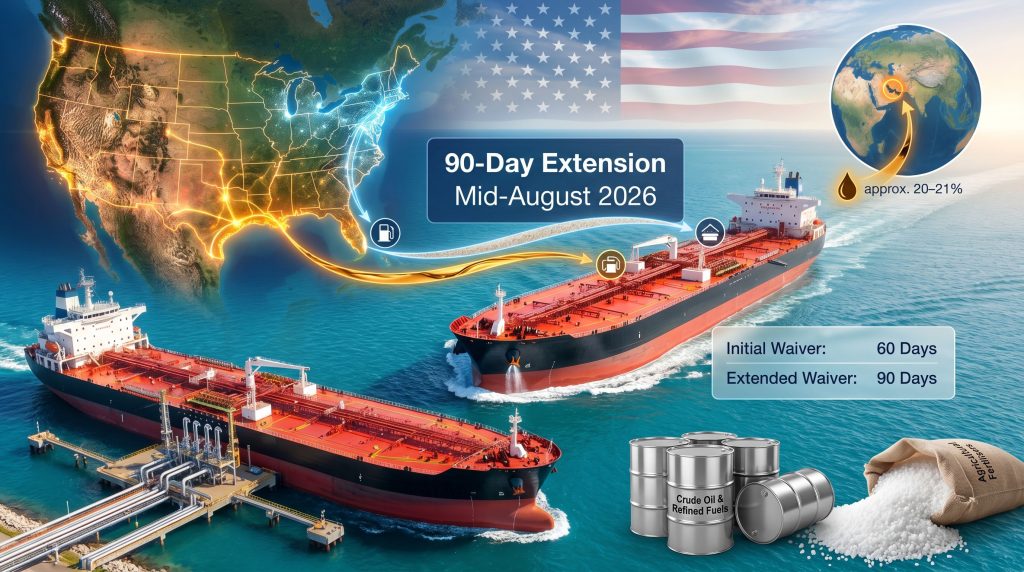
The decision by US President Donald Trump to extend an existing Jones Act shipping waiver by 90 days, confirmed on April 25, 2026, reflects both the persistence of the underlying supply chain disruption and a shift toward evidence-based waiver policy design. Trump extends US shipping waiver by 90 days as a direct response to documented supply performance improvements recorded during the initial relief period.
From Initial Measure to Extended Relief
The original 60-day waiver was issued in March 2026 as a targeted response to disruptions in global shipping lanes, including sustained pressure on vessel traffic through the Strait of Hormuz, a chokepoint through which approximately 20 to 21 percent of global oil flows pass. Disruptions to this corridor created downstream pressure across international energy logistics networks, compressing the availability of imported supply and placing additional strain on domestic coastal redistribution infrastructure. Consequently, an oil price rally added further urgency to the administration's decision-making timeline.
The waiver timeline breaks down as follows:
| Waiver Phase | Duration | Trigger | Approximate Expiry |
|---|---|---|---|
| Initial Waiver | 60 days | Global shipping lane disruptions; Hormuz pressure | Mid-May 2026 |
| Extended Waiver | 90 days | New White House supply data; ongoing disruptions | Mid-August 2026 |
What makes the 90-day extension notable is the justification offered for it. White House assistant press secretary Taylor Rogers confirmed that new supply data compiled during the initial waiver period demonstrated measurably faster delivery of critical commodities to US ports. The administration characterised the extension as providing both certainty and stability, not just for domestic markets but for the broader global economic environment as well.
This framing signals a deliberate shift: rather than treating waivers purely as emergency reactive tools, policymakers are now using supply performance data to calibrate their duration and scope. According to reporting from OilPrice.com, the extension is set to run through August, underlining the administration's commitment to sustained logistics relief.
What Three Months of Relief Actually Covers
The 90-day window running to approximately mid-August 2026 is not arbitrary. It spans two of the most logistically demanding periods in the US commodity calendar simultaneously:
-
Peak summer driving demand season, during which gasoline and diesel consumption rises substantially across the East Coast and Midwest, placing maximum pressure on coastal fuel distribution networks.
-
Spring-to-early-summer fertiliser application windows, during which agricultural producers across corn, soybean, and wheat belts depend on reliable access to nitrogen-based and phosphate inputs arriving via coastal distribution networks connected to Gulf Coast import terminals.
The convergence of both demand peaks within a single waiver window reflects a deliberate policy calibration rather than coincidence. The dual-sector scope of the waiver, covering both energy and agricultural logistics simultaneously, acknowledges that these two supply chains increasingly face compound risk from the same geopolitical pressures.
How the Waiver Reshapes Fuel and Fertiliser Logistics
By permitting foreign-flagged carriers to participate in US coastwise trade on a temporary basis, the extended waiver expands the effective vessel pool available for domestic commodity transport. The practical consequences of this expansion operate across several dimensions.
Fuel Supply Chain Implications
-
Reduced freight bottlenecks along the Gulf Coast-to-East Coast corridor, where constrained vessel availability typically inflates shipping rates during periods of elevated demand.
-
Greater rerouting flexibility for refiners and distributors, allowing more efficient load allocation between coastal terminals without being bound by the availability of qualifying US-flag vessels.
-
Short-term freight cost reduction on coastwise tanker routes, with downstream benefits passed to wholesale fuel buyers and, eventually, retail consumers in affected regions.
-
Improved supply balance between Gulf Coast production centres and high-consumption East Coast markets, reducing the risk of localised product shortages during the summer demand peak.
Agricultural Input Logistics
Fertiliser supply chain dynamics add a distinct layer of complexity to this policy decision. Unlike fuel, which can be stored and redistributed across relatively flexible timeframes, fertiliser delivery is constrained by rigid agricultural calendars. Missed application windows do not translate into delayed purchases; they translate into reduced crop yields with effects that ripple through the full harvest cycle.
Agricultural stakeholders have consistently emphasised that dependable logistics during spring planting periods are not merely commercially convenient but are structurally critical to crop output projections. Concerns around US fertiliser import reliance make the waiver's agricultural coverage particularly significant for producers dependent on coastal distribution networks.
Agricultural Logistics Reality: In major corn and soybean producing states, fertiliser application timing is one of the most yield-sensitive variables in the production cycle. A disrupted logistics window of even two to three weeks during peak application periods can translate into measurable reductions in per-acre output across millions of planted hectares.
The Competing Interests Shaping Jones Act Waiver Policy
No Jones Act waiver is issued without generating significant pushback from sections of the domestic maritime industry. The structural tension between waiver proponents and opponents has remained remarkably consistent across administrations and crisis types.
Arguments Supporting Waiver Flexibility
-
Supply chain resilience during geopolitical shocks requires adaptive regulatory capacity that the current Jones Act framework does not inherently provide.
-
Constrained vessel availability inflates freight costs that are ultimately passed through to end-users of fuel and agricultural inputs, creating an implicit tax on consumers during supply disruptions.
-
Temporary waivers preserve the core legal architecture of the Jones Act while providing targeted relief during documented market failures, without permanently altering the statutory framework.
Arguments Against Recurring Waivers
-
US maritime industry groups have raised concerns that repeated waivers erode the commercial viability of maintaining a US-flag fleet by periodically removing the market protection that justifies the investment required to operate Jones Act-compliant vessels.
-
Reduced commercial certainty for domestic operators may suppress investment in new vessel construction, progressively weakening the long-term capacity of the fleet that waivers are supposed to supplement.
-
Each waiver episode sets a precedent that foreign-flagged capacity is accessible during disruptions, potentially reducing political pressure to address the underlying domestic capacity constraints through structural investment.
In addition, as TradeWinds has reported, the current extension is already among the historically longest Jones Act waivers on record, intensifying debate across the maritime sector.
Policy Approaches Compared
| Approach | Near-Term Benefit | Long-Term Risk | Stakeholder Support |
|---|---|---|---|
| Temporary Jones Act Waiver | High flexibility immediately | Fleet investment disincentive | Energy sector yes; maritime groups no |
| Domestic Fleet Expansion | Low near-term impact | Strengthens US maritime capacity | Strong maritime industry support |
| Port Infrastructure Investment | Medium-term congestion relief | Reduces structural bottlenecks | Broad cross-sector support |
| Permanent Jones Act Reform | Maximum flexibility | Political resistance; industry opposition | Strongly contested |
A Century-Old Law in a Fractured Geopolitical Era
The recurring pattern of Jones Act waivers across administrations, spanning hurricane responses, pandemic disruptions, and now geopolitical shipping lane pressures, reveals something important about the structural relationship between the law and modern energy markets. Each waiver episode highlights the same underlying constraint: the domestic fleet lacks the surge capacity required to absorb concentrated demand shocks without regulatory assistance.
What distinguishes the current situation from previous waiver instances is the nature of the triggering event. Past waivers responded primarily to domestic disasters, where the cause of disruption was geographically contained and temporary. The Strait of Hormuz disruption, however, represents an externally driven, potentially prolonged disruption to a globally significant chokepoint, one over which US domestic policy has limited direct influence.
Most major maritime economies do not operate equivalent cabotage restrictions of the same rigidity, allowing vessel deployment to respond more dynamically to regional supply imbalances. The contrast between the US framework and more flexible international approaches will likely intensify as energy security concerns become a more persistent feature of global policy planning. These pressures are further reflected in broader commodity price impacts being felt across resource-dependent sectors worldwide.
The Long-Term Policy Question
The dual-commodity scope of the current waiver, simultaneously addressing fuel distribution and agricultural input logistics, also signals an emerging policy recognition that energy and food security are not separate systems to be managed independently. They share infrastructure, face common geopolitical risks, and respond to the same logistical constraints.
Future waiver frameworks may need to incorporate pre-defined trigger mechanisms, linked to specific measurable thresholds in shipping costs, vessel availability rates, or global chokepoint traffic volumes, rather than relying on reactive case-by-case determinations.
Policy Signal: The transition from purely reactive waiver issuance toward data-validated extensions, as evidenced by the White House supply performance review underpinning the 90-day extension, suggests a maturing approach to using temporary regulatory flexibility as a calibrated economic stabilisation tool rather than a blunt emergency measure.
The next major ASX story will hit our subscribers first
Key Facts: Trump's 90-Day Jones Act Shipping Waiver Extension
-
Waiver duration: 90-day extension from approximately mid-May to mid-August 2026.
-
Commodities covered: Crude oil, refined petroleum products including gasoline and diesel, and agricultural fertilisers.
-
Mechanism: Temporary relaxation of Jones Act requirements permitting foreign-flagged vessel participation in US coastwise trade.
-
Justification: White House supply data confirmed faster commodity delivery to US ports under the initial 60-day waiver, supporting the case for extension.
-
Sector impact: Gulf Coast refining hubs benefit from reduced transport bottlenecks; agricultural producers gain logistics continuity during spring planting cycles.
-
Industry tension: Energy and agricultural sectors broadly support the measure; US maritime groups warn of long-term fleet investment disincentives from repeated waivers.
-
Broader signal: Successive waivers across multiple crisis types may be building the policy conditions for a deeper structural review of Jones Act provisions in the context of modern energy security requirements.
Disclaimer: This article is intended for informational purposes only and does not constitute financial, legal, or investment advice. Market conditions, geopolitical developments, and policy decisions referenced herein are subject to change. Readers should conduct independent research and consult qualified advisors before making decisions based on information contained in this article.
Want to Stay Ahead of the Commodity Shifts Driving ASX Mineral Markets?
Discovery Alert's proprietary Discovery IQ model delivers real-time alerts on significant ASX mineral discoveries, translating complex commodity and resource data into actionable investment insights — particularly valuable as geopolitical pressures reshape global supply chains and energy markets. Explore how historic mineral discoveries have generated substantial returns on Discovery Alert's dedicated discoveries page, and begin your 14-day free trial today to position yourself ahead of the broader market.