July 9, 2026
When Geopolitics Rewrites the Energy Playbook Overnight
Few forces reshape financial markets as abruptly as a sudden shift in Middle East stability. Energy investors understand this intuitively: the region's supply infrastructure does not merely influence oil prices at the margins. For decades, Persian Gulf export routes have functioned as the circulatory system of the global economy, and any perceived threat to that system triggers an almost reflexive repricing across every major asset class simultaneously.
That dynamic returned with full force in early July 2026, when Trump warns US-Iran ceasefire is over became the defining headline driving markets. Renewed confrontation between the United States and Iran pushed Brent Crude above US$80 per barrel, rattled equity markets from Tokyo to London, and sent Australian investors into a fresh round of defensive positioning. Understanding why these moves happened, and what they might signal next, requires looking beyond the headlines.
When big ASX news breaks, our subscribers know first
The Architecture of a Failed Ceasefire
Interim peace arrangements in active conflict zones share a structural vulnerability that formal peace treaties do not: without enforcement mechanisms, third-party verification, or multilateral guarantees, they are essentially built on mutual restraint rather than institutional architecture. The mid-June 2026 memorandum of understanding between the U.S. and Iran was precisely this kind of agreement.
From its inception, the MOU lacked the scaffolding that durable ceasefires require. There was no independent monitoring body, no sequenced compliance roadmap, and critically, no consequence framework for violations. When Iranian forces targeted vessels navigating the Strait of Hormuz, the U.S. conducted retaliatory strikes, and Iran subsequently launched attacks on Bahrain and Kuwait, the agreement had effectively already collapsed in practice before any formal declaration was made.
Iran's Foreign Ministry formally declared the interim arrangement invalid, a diplomatic signal carrying significant weight. Formal repudiation by a foreign ministry, rather than a military communique, indicates that the decision to exit the framework was deliberate and coordinated at the highest levels of government, not a reactive tactical decision.
The U.S. simultaneously revoked the sanctions waiver that had permitted Iranian oil sales, reintroducing economic pressure as a parallel lever alongside military signalling. This dual-track approach, escalating militarily while preserving nominal diplomatic openings, is a recognisable pattern in U.S. foreign policy toward Iran stretching back years.
At a NATO summit in Ankara, Turkey, Donald Trump declared that the ceasefire arrangement was finished, characterising Iranian leadership in sharply adversarial terms while simultaneously suggesting future negotiations remained theoretically possible. The mixed messaging itself became a source of market volatility: investors cannot price a situation where escalation and negotiation are presented as simultaneous possibilities. Consequently, the oil market impact of this uncertainty was felt almost immediately across global benchmarks.
Why the Strait of Hormuz Is in a Category of Its Own
The Geography That Cannot Be Rerouted
To understand why Trump warns US-Iran ceasefire is over became the most consequential market headline of the week, one must understand what the Strait of Hormuz actually represents in physical terms.
At its narrowest point, the strait measures approximately 33 kilometres across, with viable shipping lanes on each side spanning only a few kilometres in width. Through this narrow corridor, an estimated 20 to 21 million barrels of oil per day transit toward global markets, representing roughly one-fifth of the world's total petroleum liquids consumption.
There is no credible large-scale alternative. The East-West Pipeline across Saudi Arabia and the ADNOC-operated Fujairah bypass in the UAE provide partial diversions, but their combined capacity falls dramatically short of replacing full Strait throughput. Any sustained disruption to Hormuz transit would be a structural supply shock, not a temporary inconvenience. Furthermore, the oil price volatility trends emerging from such disruptions have historically reshaped portfolios far beyond the energy sector alone.
Kharg Island: The Facility Markets Are Watching
Compounding the Hormuz concern is the specific infrastructure Trump's statements targeted. Kharg Island, located in the northern Persian Gulf, functions as Iran's primary crude oil export terminal, handling the overwhelming majority of Iran's petroleum exports. Iranian crude production currently runs at an estimated 1.5 to 1.7 million barrels per day, with the bulk of those exports flowing through Kharg.
Any military action that degraded Kharg Island's operational capacity would not merely reduce Iranian export volumes. It would send an unambiguous signal to every other Persian Gulf producer about the vulnerability of coastal export infrastructure, amplifying the risk premium across the entire region's output.
The market is not currently pricing a full-scale conflict. What it is pricing is genuine uncertainty about whether Iranian export continuity can be maintained over the coming weeks, and that uncertainty alone is sufficient to sustain elevated risk premiums in Brent Crude above US$78 per barrel.
How Global Financial Markets Responded
Equity Market Selloff Across Major Indices
The market reaction was swift and broad-based, consistent with the pattern of risk-off repricing that follows major geopolitical escalation events.
| Index | Movement | Regional Context |
|---|---|---|
| Dow Jones Industrial Average | -1%+ | Largest single-session drop in recent weeks |
| S&P 500 | Negative | Broad U.S. equity risk-off |
| FTSE 100 (London) | Retreated | European markets tracking U.S. sentiment |
| Euro Stoxx | Retreated | Eurozone equities under geopolitical pressure |
| Nikkei 225 (Japan) | -2.1% | Sharpest Asia-Pacific response |
Japan's outsized decline is worth examining. As a nation almost entirely dependent on imported energy, Japan carries structurally elevated sensitivity to Persian Gulf disruption risk. A sustained oil price shock hits Japanese corporate margins, trade balances, and yen stability simultaneously, making the Nikkei a reliable amplifier of Middle East escalation signals.
Oil Prices and the Risk Premium Mechanism
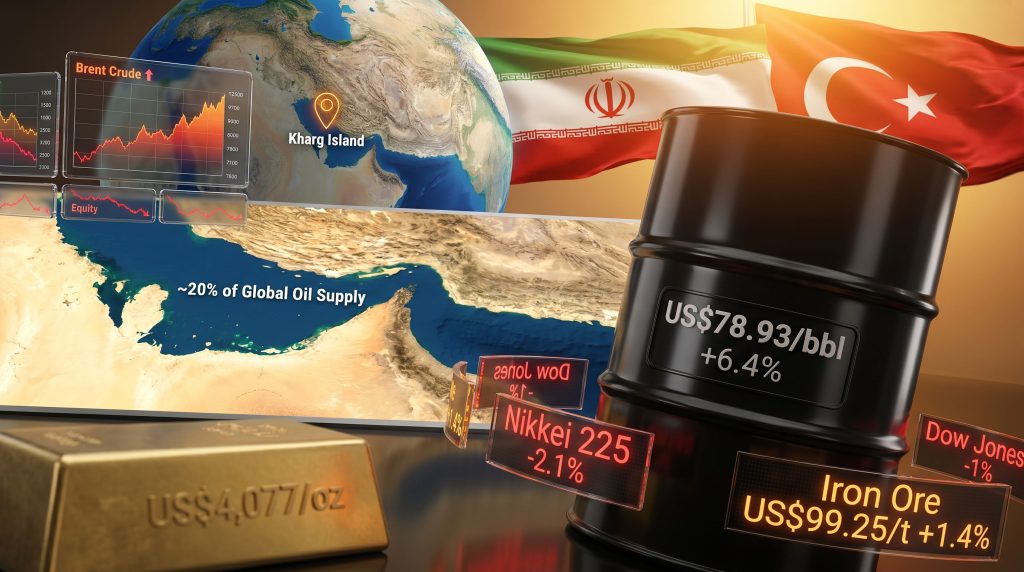
Brent Crude surged +6.4% to US$78.93 per barrel, briefly crossing the US$80 threshold for the first time in several weeks. This move illustrates an important distinction that experienced energy investors understand well: the difference between a geopolitical risk premium and a fundamental supply disruption.
A risk premium is priced into oil when uncertainty about future supply exists, even before any barrels have actually been withheld from the market. Historical evidence consistently shows that these premiums are transient when physical supply remains intact. However, when supply is actually disrupted, the price signal changes character entirely and becomes far more persistent.
The key variable to monitor in the coming weeks is whether Iranian crude exports, currently estimated at 1.5 to 1.7 million barrels per day, are materially reduced. If exports continue uninterrupted, the Brent premium above fundamental value should gradually compress. If physical volumes decline, the price signal changes character entirely.
Commodity and Currency Market Snapshot
| Commodity / Asset | Price | Movement |
|---|---|---|
| Brent Crude | US$78.93/barrel | +6.4% |
| Iron Ore | US$99.25/tonne (Singapore) | +1.4% |
| Gold | US$4,077/ounce | Slight decline |
| US Natural Gas Futures | US$3.21/gigajoule | Down |
| AUD/USD | US$0.6930 | Risk-off pressure |
Gold's marginal decline despite acute geopolitical stress represents one of the more instructive signals in this data set. Conventional thinking holds that gold benefits unconditionally from geopolitical uncertainty. In practice, when gold is already trading above US$4,000 per ounce, profit-taking and position management by large institutional holders can temporarily suppress prices even as uncertainty rises. The underlying gold safe-haven demand remains intact; the positioning dynamics are simply more complex at elevated price levels.
Iron ore's modest +1.4% gain reflects a partially independent dynamic. The iron ore demand prospects tied to Chinese industrial activity can provide a cushion for Australian mining stocks even when global risk appetite compresses. This partial decoupling is not guaranteed, but it does mean Australian materials sector exposure is not a simple one-dimensional trade during Middle East escalation events.
The Australian dollar's position at US$0.693 reflects its well-established character as a risk-sensitive currency. AUD tends to weaken against the USD when global risk aversion rises, not because of direct Australian exposure to Middle East conflict, but because investors reduce allocations to higher-yielding, commodity-linked currencies during periods of uncertainty.
The ASX in a Compounding Risk Environment
Geopolitical Pressure Meets Domestic Disruption
Australian investors entering the week faced not one headwind but two converging pressures. Beyond the geopolitical-driven commodity volatility, BHP (ASX: BHP) confronted a potential industrial action at Port Hedland operations, with workers planning to strike the following week. The revenue exposure from this potential disruption is estimated at US$120 million per day.
If the industrial action proceeds, it would represent the most significant labour disruption in Western Australian mining in approximately 25 years, a threshold that places it in a genuinely rare category of operational risk for the resources sector.
The compounding effect matters analytically. Global risk-off sentiment from geopolitical escalation typically pressures mining equities through reduced risk appetite and commodity price uncertainty. A simultaneous domestic operational disruption at a flagship asset adds an idiosyncratic risk layer that is not diversifiable within an Australian resources portfolio. In addition, broader Australian share market performance indicators suggest the ASX was already navigating a complex macro backdrop before these latest geopolitical developments emerged.
The next major ASX story will hit our subscribers first
Scenario Framework: Three Pathways Forward
Rather than attempting to predict a single outcome, investors navigating this environment benefit from a structured scenario framework. Three credible pathways exist from the current position:
Scenario 1: Diplomatic De-escalation
- Back-channel negotiations resume through intermediaries such as Oman or Qatar
- Iran halts targeting of Strait of Hormuz vessel traffic
- The oil risk premium unwinds; equity markets stabilise; AUD recovers
- Probability: Moderate – Trump's own statements acknowledged future negotiations remain possible despite escalatory rhetoric
Scenario 2: Contained Military Exchange
- U.S. conducts targeted strikes on Iranian infrastructure; Iran responds through proxy networks rather than direct military engagement
- Brent Crude remains elevated in the US$80 to US$90 range; equity volatility persists; gold resumes its upward trajectory
- Probability: Elevated – consistent with the established pattern of U.S.-Iran confrontation since at least 2019
Scenario 3: Full-Scale Regional Escalation
- Direct Iranian strikes on U.S. assets or Gulf state infrastructure; sustained U.S. air campaign follows
- Oil potentially surges toward US$100 to US$120 per barrel; global recession risk is repriced; safe-haven assets surge
- Probability: Lower but non-trivial – Iran's formal repudiation of the peace arrangement raises tail-risk probability materially above baseline
Investment Disclaimer: The scenario analysis above is a structural framework for understanding potential market outcomes. It does not constitute investment advice. Geopolitical situations of this nature can shift rapidly and unpredictably. Investors should consult a certified financial adviser before making any allocation decisions based on geopolitical risk assessments.
Historical Precedent: What Past Hormuz Tensions Taught Markets
This is not the first time U.S.-Iran confrontation has threatened Persian Gulf energy infrastructure. The Tanker War period of the 1980s, during which Iran and Iraq both targeted commercial shipping in the Gulf, established the foundational template for how energy markets respond to Hormuz disruption risk.
More recently, the 2019 tanker attacks in the Gulf of Oman and the drone strikes on Saudi Aramco's Abqaiq facility demonstrated how quickly energy infrastructure vulnerability translates into oil price spikes. The Abqaiq attack temporarily removed approximately 5 to 6 million barrels per day of Saudi production capacity from the market, triggering the largest single-day percentage rise in Brent Crude in decades.
The 2026 situation differs in one important structural respect: Iranian export capacity is already constrained by years of sanctions, meaning the marginal impact of further supply disruption would fall disproportionately on an already tight market. This asymmetry is part of why energy markets are repricing risk as sharply as they are. A deal to end hostilities, should it eventuate, would therefore need to address these underlying structural imbalances to meaningfully restore market confidence.
Portfolio Considerations for Australian Investors
Investors seeking to think structurally about Middle East escalation risk within an Australian portfolio context should consider several dimensions:
- Energy sector equities provide a natural hedge against oil price spikes during geopolitical escalation, as higher crude prices flow through to upstream producer revenues
- Gold exposure at current elevated levels above US$4,000 per ounce warrants nuanced positioning, distinguishing between the structural safe-haven case and near-term profit-taking dynamics
- AUD/USD sensitivity means currency-unhedged international positions may provide partial natural hedging, as a weaker AUD amplifies USD-denominated returns
- Materials sector differentiation is important: iron ore's partial independence from Middle East risk means not all ASX mining exposure carries equivalent geopolitical sensitivity
- Distinguishing short-term noise from structural shifts remains the most critical cognitive discipline, as geopolitical risk premiums in oil historically compress when physical supply is preserved
Frequently Asked Questions
What Did Trump Say About the US-Iran Ceasefire?
At a NATO summit in Ankara, Turkey, Trump declared the ceasefire arrangement effectively finished, noting that the U.S. had already conducted military strikes and would continue doing so in response to Iranian targeting of vessels in the Strait of Hormuz. He also suggested, separately, that he did not necessarily expect full-scale war to resume immediately.
Why Did Brent Crude Surge Above US$80 Per Barrel?
Brent jumped +6.4% because the Strait of Hormuz, through which roughly 20% of global oil supply transits, faces potential disruption if hostilities escalate. Even the credible threat of interference is sufficient to reprice global crude benchmarks.
What Is Kharg Island and Why Do Markets Care About It?
Kharg Island is Iran's primary crude export terminal, handling the vast majority of the country's petroleum exports. Military action targeting this facility would represent a structural supply shock with global energy price implications.
How Does This Situation Affect Australian Shares?
The ASX is exposed through energy cost pass-through effects, materials sector sensitivity to global risk appetite, AUD/USD pressure as a risk-sensitive currency, and direct exposure through Australian resources companies facing both global and domestic operational headwinds.
Is the Ceasefire Permanently Over?
Iran's Foreign Ministry has formally declared the interim peace arrangement invalid. Trump warns US-Iran ceasefire is over in terms of the current structure, though he indicated continued military action was likely while not entirely closing the door on future negotiations. Back-channel diplomatic options through intermediary nations remain theoretically available.
Want to Stay Ahead When Geopolitical Events Reshape Commodity Markets Overnight?
Discovery Alert's proprietary Discovery IQ model delivers real-time alerts on significant ASX mineral discoveries, instantly cutting through market complexity to surface actionable opportunities — even when global uncertainty is running high. Explore historic examples of major mineral discoveries and their market returns, then begin your 14-day free trial at Discovery Alert to position yourself ahead of the next major market-moving event.