August 26, 2026
Africa's Industrial Centre of Gravity Is Shifting Southward
For most of the twentieth century, South Africa functioned as the undisputed industrial engine of sub-Saharan Africa. Its steel mills, power stations, and manufacturing corridors formed the backbone of a regional economy that smaller neighbouring nations depended on for finished goods, capital equipment, and employment. That structural dominance is now being contested, not by policy reform or multilateral trade architecture, but by the quiet and methodical arrival of vertically integrated Chinese industrial capital in a country that, until recently, had been written off as an industrial wasteland.
The Tsingshan Zimbabwe steel plant expansion represents one of the most consequential industrial developments in Southern Africa in decades. Zimbabwe's manufacturing sector collapsed in the late 2000s alongside its broader economic implosion. The closure of Ziscosteel in 2008 was emblematic of that collapse, ending large-scale domestic steel production and leaving the country reliant on imports for one of the most fundamental inputs in construction and infrastructure development. That sixteen-year vacuum is now being filled at a pace and scale that is beginning to alter the competitive geometry of the entire Southern African steel market.
When big ASX news breaks, our subscribers know first
Manhize: Understanding the Plant That Is Rewriting Zimbabwe's Industrial Narrative
From Idle Ground to Operating Furnace in Under a Decade
The Manhize steel plant, situated approximately 205 kilometres southeast of Harare, became operational in 2024 under the ownership of Tsingshan Holding Group's Zimbabwean subsidiary. Its geographic positioning was deliberate. The site offers reasonable proximity to the capital for domestic distribution while maintaining viable access to cross-border logistics corridors serving South Africa, Zambia, and Malawi.
Tsingshan Holding Group is not a peripheral player in global metals. Founded and controlled by Xiang Guangda, the company holds the distinction of being the world's largest nickel producer and the dominant force in global stainless steel manufacturing. Applying that industrial template to Zimbabwe, where iron ore is available for domestic mining and labour costs remain structurally low, represents a logical extension of Tsingshan's vertically integrated model rather than an opportunistic bet on frontier market growth.
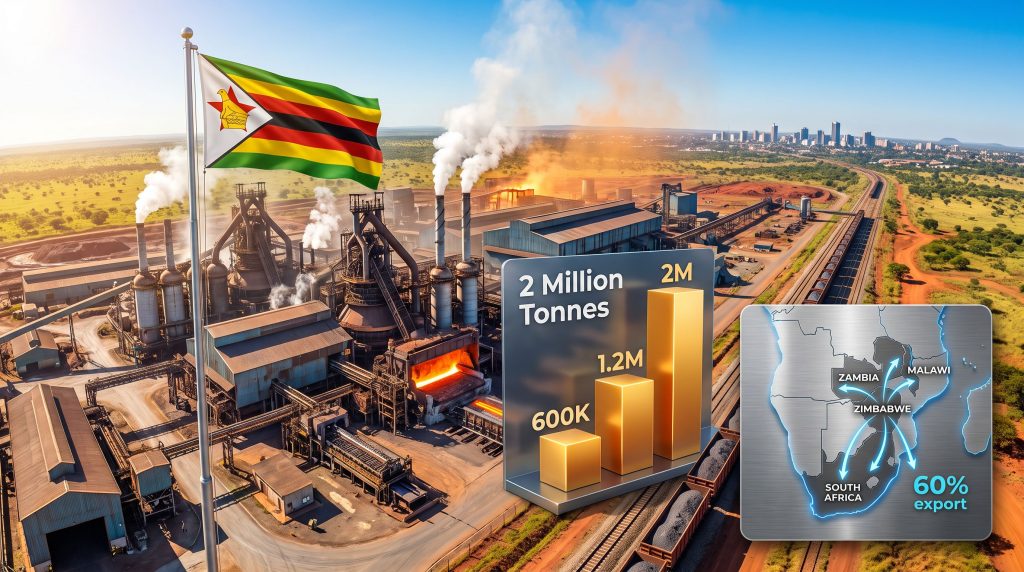
Current annual output at Manhize stands at approximately 600,000 tonnes, primarily focused on construction-grade steel. Of that volume, roughly 40% is absorbed by Zimbabwe's domestic market, with the remaining 60% directed toward export destinations, the largest of which is South Africa, followed by Malawi and Zambia.
The Expansion Blueprint: Three Phases, One Strategic Objective
Mapping the Output Trajectory
Benson Xu, the chief executive of Tsingshan's Zimbabwean operation, confirmed to Bloomberg in an August 2026 site interview that the company is evaluating a significant scaling of the plant's output. Two distinct targets have emerged from that review:
| Production Phase | Annual Output Target | Key Requirements |
|---|---|---|
| Current Operations | 600,000 tonnes | Active as of 2024 |
| Phase 1 Expansion | ~1.2 million tonnes | ~$800M investment scope; blast furnaces, rolling mills |
| Full Expansion Ceiling | Up to 2 million tonnes | Rail JV, coal processing plant, power capacity |
The gap between the 1.2-million-tonne and 2-million-tonne figures reflects an internal strategic review that is still evolving rather than any contradiction in the company's public messaging. Xu indicated that product diversification would precede volume growth, suggesting that Tsingshan intends to broaden its steel product categories before committing to the infrastructure spend required for full-scale expansion.
This sequencing matters. It signals that Manhize is not simply a commodity-grade producer racing to flood export markets with cheap construction steel. The emphasis on diversification points toward potential movement into higher-value product categories, including structural steel sections, wire rod, or even flat-rolled products, any of which would deepen the competitive threat to South African producers operating across multiple market segments.
The Infrastructure Prerequisites That Will Define the Timeline
No expansion plan at this scale can be evaluated independently of its infrastructure constraints. Xu was candid on this point, identifying rail logistics as the primary operational bottleneck. The infrastructure requirements for scaling to 2 million tonnes include:
-
Rail network upgrades: Zimbabwe's rail corridors have suffered decades of underinvestment. Moving an additional 1.4 million tonnes of steel annually requires substantially improved capacity between Manhize, Harare, and key border crossings. Tsingshan is reportedly in negotiations with Zimbabwe's sovereign wealth vehicle, the Mutapa Investment Fund, to establish a rail joint venture that would address this gap.
-
Metallurgical coal processing facility: The existing plant relies on coal as a furnace input. Scaling output requires a dedicated processing plant capable of converting metallurgical coal to the specifications required for blast furnace operations.
-
Power generation capacity: Expanded steelmaking is energy-intensive. Separate reporting indicates that power infrastructure forms part of the broader capital investment scope for the expansion phases.
-
Iron ore supply continuity: Tsingshan already mines iron ore domestically within Zimbabwe to supply the Manhize plant. This vertical integration provides a meaningful cost buffer, but sustained expansion may require additional mining capacity or exploration to secure long-term ore feed.
The Mutapa Investment Fund rail joint venture is arguably the single most consequential variable in the entire expansion equation. Without a logistics solution capable of moving multi-million-tonne volumes efficiently, the upper expansion target remains constrained by geography rather than capital.
The South African Steel Sector: Already Under Pressure, Now Facing a New Competitive Force
A Market in Structural Retreat
South Africa's domestic steel industry entered 2025 and 2026 navigating a deeply unfavourable operating environment. The combination of sluggish economic growth, chronically unreliable rail infrastructure managed by Transnet, and electricity costs that rank among the highest in the industrial world has systematically eroded the competitiveness of domestic producers. Furthermore, understanding the broader China steel and iron ore market dynamics helps contextualise why Chinese-backed producers like Tsingshan are increasingly competitive across export markets.
ArcelorMittal South Africa, historically the country's dominant steelmaker, took the significant step of shutting down a construction-grade steel mill in 2025. The company cited intensifying import competition alongside the cost disadvantage created by competing producers who use subsidised scrap metal as their primary feedstock rather than iron ore, a structural input cost asymmetry that domestic integrated mills cannot offset through operational efficiency alone.
The product segment ArcelorMittal South Africa vacated, construction-grade steel, is precisely the category that Manhize currently produces and exports in volume. The competitive alignment is direct and significant. In addition, the China steel outlook for 2025 suggests that Chinese-backed operations will continue exerting downward pressure on regional steel pricing well into the latter part of this decade.
Quantifying the Import Pressure
At current output, approximately 360,000 tonnes of Manhize steel flows into export markets annually, with South Africa receiving the majority. If expansion reaches the 2-million-tonne ceiling while the 60% export ratio is maintained, annual export volumes would approach 1.2 million tonnes, a figure that would represent a transformative increase in the volume of competitively priced construction steel entering the South African market.
The cost structure underpinning Manhize's competitive advantage is worth examining closely:
- Domestically mined iron ore eliminates import dependency on the primary raw material
- Lower labour cost structures relative to South African integrated mills
- Geographic proximity to key export markets reduces freight cost disadvantage
- Potential access to subsidised or preferentially priced coal through domestic sourcing
Structural cost advantages of this nature are not easily competed away through productivity improvements or energy efficiency gains at South African facilities. The competitive threat is architectural rather than cyclical, meaning that South African producers may face a permanently altered market landscape rather than a temporary import surge.
Zimbabwe's Emerging Industrial Identity: More Than a Steel Story
The Vertical Integration Model as a Competitive Moat
What distinguishes the Manhize investment from typical greenfield industrial projects in frontier markets is the degree of vertical integration Tsingshan has embedded from the outset. By mining its own iron ore within Zimbabwe, the company insulates itself from the commodity price volatility that periodically devastates import-dependent steel producers. Adding a metallurgical coal processing facility would extend that insulation further up the input cost curve.
This model, controlling the raw material, the processing, and the export channel simultaneously, mirrors Tsingshan's global playbook in nickel and stainless steel. The company's willingness to replicate that template in Zimbabwe suggests a long-duration commitment rather than an opportunistic capital deployment. The global crude steel outlook for 2025 further reinforces why vertically integrated producers are increasingly well-positioned to weather commodity cycle disruptions.
Zimbabwe's Broader Mineral Endowment: Context for Industrial Scale
Zimbabwe's mineral resource base extends well beyond iron ore and metallurgical coal. The country hosts significant lithium deposits, chromite resources, platinum group metals, and a range of industrial minerals that collectively position it as a potential multi-commodity industrial hub rather than a single-sector extraction economy. The arrival of large-scale Chinese manufacturing capital in steel could serve as a blueprint for similar vertically integrated investments in adjacent mineral sectors.
The Mutapa Investment Fund: State Capital Meets Private Industrial Ambition
The proposed rail joint venture between Tsingshan and Zimbabwe's Mutapa Investment Fund reflects a maturation of the Chinese industrial investment model in Africa. Earlier iterations of this model were characterised by resource-for-infrastructure exchanges that drew criticism for their opacity and asymmetric benefit distribution. A formal joint venture with a sovereign wealth fund introduces a more structured framework that aligns private industrial incentives with state infrastructure priorities.
For the Mutapa Investment Fund, a rail JV with a partner of Tsingshan's scale and financial depth offers access to logistics investment that Zimbabwe's public balance sheet cannot currently fund unilaterally. For Tsingshan, the partnership reduces sovereign risk while securing preferential access to the infrastructure that makes the full expansion viable. According to Mining Technology, the total investment scope for the broader Manhize development could reach $1 billion when all infrastructure components are included.
Three Scenarios for Manhize's Regional Impact Through 2030
Scenario 1: Constrained Growth (Output Plateaus at 1.2 Million Tonnes)
Rail and power infrastructure challenges slow the expansion timeline. Manhize completes the first phase but the logistics prerequisites for the full 2-million-tonne ceiling are not resolved within the decade. South Africa's steel market absorbs increased imports but domestic producers adapt through product specialisation into higher-margin categories. Zimbabwe establishes itself as a mid-tier regional steel supplier rather than the dominant force.
Scenario 2: Full Expansion Realised (Output Reaches 2 Million Tonnes)
The Mutapa Investment Fund rail joint venture is formalised and capital is deployed at scale. Metallurgical coal processing infrastructure comes online ahead of schedule. Manhize becomes the highest-volume steel producer in Southern Africa, and South Africa's remaining construction steel producers face an existential competitive challenge. Zimbabwe's industrial identity is fundamentally rewritten.
Scenario 3: Geopolitical or Financial Disruption Delays Expansion
Financing constraints, shifts in Chinese industrial policy, sovereign risk events, or commodity market disruptions slow capital deployment at Manhize beyond 2028. The expansion timeline extends materially, providing South African producers and policymakers with a temporary reprieve. Structural vulnerabilities on both sides remain unresolved, and the competitive dynamic is deferred rather than avoided.
The next major ASX story will hit our subscribers first
What Industry Observers and Investors Should Track
For those monitoring the Tsingshan Zimbabwe steel plant expansion and its downstream implications, several leading indicators will be particularly informative:
-
Rail JV formalisation: A signed agreement between Tsingshan and the Mutapa Investment Fund would represent the most significant de-risking event for the full expansion scenario.
-
Metallurgical coal plant groundbreaking: Physical construction commencement on the coal processing facility signals committed capital rather than exploratory planning.
-
Output milestone crossings: Watch for Manhize production reports indicating movement toward 800,000 or 1 million tonnes annually as leading indicators of trajectory.
-
South African trade policy response: If Manhize export volumes continue to grow, South African industry groups may seek trade remedy investigations or tariff adjustments from the International Trade Administration Commission.
-
Product category diversification signals: Any public disclosure by Tsingshan regarding new product types at Manhize, beyond construction-grade steel, would indicate progress toward the higher-margin diversification strategy Xu described.
-
ArcelorMittal South Africa strategic positioning: Decisions by the South African steelmaker regarding capacity rationalisation, product mix shifts, or import substitution strategies will reflect how seriously the industry is taking the Manhize competitive threat. However, broader regional comparisons, such as Indian steel prices in 2025, also illustrate how emerging market producers are reshaping competitive benchmarks globally.
Frequently Asked Questions
What is the Manhize steel plant?
The Manhize steel plant is a large-scale integrated steel manufacturing facility operated by a Zimbabwean subsidiary of Tsingshan Holding Group. Located approximately 205 kilometres southeast of Harare, it commenced production in 2024 and currently produces around 600,000 tonnes of steel per year, primarily construction-grade product.
Why did Zimbabwe lack domestic steel production for so long?
Zimbabwe's state-owned steelmaker Ziscosteel ceased all operations in 2008 during the country's broader economic collapse. The facility was never successfully revived, leaving a sixteen-year gap in domestic steel manufacturing capacity before Manhize's establishment.
How significant is the planned expansion?
Tsingshan is evaluating raising output to as much as 2 million tonnes annually, more than triple current capacity. An intermediate phase targeting approximately 1.2 million tonnes is associated with an estimated $800 million capital investment covering blast furnaces, rolling mills, and power infrastructure. Furthermore, the emphasis on green steel pricing trends globally may eventually influence product strategy decisions at Manhize as the facility matures.
Why does this matter for South Africa?
South Africa currently receives the majority of Manhize's export output. A tripling of production would dramatically increase the volume of competitively priced construction steel entering the South African market, intensifying pressure on domestic producers already operating under significant cost disadvantages. ArcelorMittal South Africa's 2025 mill closure in the construction steel segment illustrates how real that pressure already is.
Who is Tsingshan Holding Group?
Tsingshan Holding Group is a privately held Chinese industrial conglomerate controlled by its founder, Xiang Guangda. The company is the world's largest nickel producer and the dominant global manufacturer of stainless steel, with major industrial operations across Asia, Europe, and increasingly, Africa.
Disclaimer: This article contains forward-looking statements, scenario projections, and market assessments based on publicly available information as of August 2026. These projections are inherently uncertain and should not be construed as investment advice. Readers should conduct independent due diligence before making any financial or business decisions based on the information presented. Expansion timelines, capital costs, and output targets remain subject to change based on infrastructure developments, financing conditions, and corporate strategy revisions.
Want to Track the Resource Discoveries Reshaping Southern Africa's Industrial Landscape?
Discovery Alert's proprietary Discovery IQ model delivers real-time alerts on significant ASX mineral discoveries — instantly converting complex geological data into actionable investment insights, so subscribers can identify opportunities ahead of the broader market. Explore historic examples of major discoveries and their market returns on Discovery Alert's dedicated discoveries page, and begin your 14-day free trial today to position yourself at the forefront of the next transformative find.