August 11, 2026
The Metal That Cannot Be Replaced: Understanding the Tungsten Supply Crisis
There is a small category of industrial materials where the physics of substitution simply does not work. Tungsten sits firmly in that group. With the highest melting point of any known metal at 3,422 degrees Celsius, a density that rivals gold, and a hardness that outperforms virtually every competing material in cutting and penetration applications, tungsten occupies a functional position in modern industry and defence that no commercially viable alternative has been able to displace. This is not a gap that materials science is close to bridging.
That physical irreplaceability, combined with a supply chain concentrated almost entirely within a single geopolitical actor, has created one of the more consequential strategic mineral situations of the current decade. And it is precisely this backdrop that gives the Tungsten Mining Watershed Tungsten Project drilling campaign its significance beyond the routine rhythms of ASX exploration news.
When big ASX news breaks, our subscribers know first
Why Tungsten's Demand Structure Is Unlike Other Critical Minerals
Most critical minerals serve one or two dominant end-use categories. Tungsten is unusual in that it underpins three entirely separate demand pillars, each with its own structural growth dynamic. Furthermore, as a critical strategic metal, tungsten's position is reinforced by its irreplaceable physical properties across each of these sectors:
-
Defence and armaments – Tungsten is the material of choice for kinetic energy penetrators, armour-piercing munitions, and high-density fragmentation applications. Its density and hardness make it functionally superior to alternatives like depleted uranium in certain configurations, and demand from elevated global defence budgets is now running at multi-year highs. For a broader view of how minerals serve military needs, exploring defence metal applications across comparable commodities provides useful context.
-
Industrial tooling and cemented carbide – Roughly 60% of global tungsten consumption flows into cemented carbide production, which manufactures the cutting inserts, drill bits, and dies used across manufacturing, mining, and construction. This demand is durable and tied directly to global industrial output.
-
Emerging technology applications – Semiconductor fabrication equipment, radiation shielding in medical imaging, and high-temperature aerospace components all rely on tungsten's unique thermal and density properties. This demand segment is growing as advanced manufacturing scales.
The convergence of all three demand vectors tightening simultaneously, against a supply base that has not materially expanded outside China in decades, is what makes the current market environment structurally different from previous tungsten price cycles. Indeed, the broader critical minerals demand surge across multiple commodities is amplifying this pressure further.
China's Grip on Supply and the Policy Response Taking Shape
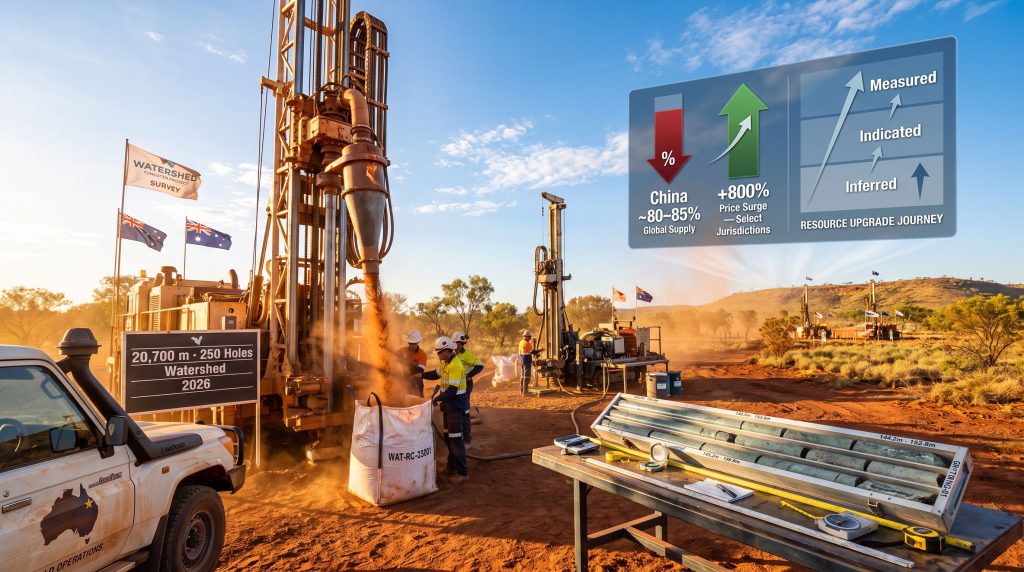
China controls an estimated 80 to 85 percent of global tungsten mine production, a concentration that exceeds even its dominance in rare earths when measured against commercially recoverable reserves and processing infrastructure. For decades, this concentration was tolerated because tungsten prices remained low enough to discourage competing project development in Western jurisdictions.
That calculus has now shifted materially. In 2026, the United States moved to restrict tungsten scrap exports, requiring deliveries to flow exclusively to domestic customers rather than international buyers. This is a significant policy inflection point, because scrap tungsten recycling has historically served as a meaningful secondary supply source for industrial consumers outside China. Restricting that flow tightens global availability and pushes more demand pressure onto primary mine supply.
The US export restriction on tungsten scrap mirrors a policy pattern already observed with rare earths, graphite, and gallium, where dominant producer export controls triggered urgent supply chain diversification responses among allied nations. Tungsten appears to be following the same trajectory.
Tungsten prices have surged as much as +800% across certain jurisdictions in recent history as compounding supply chain disruptions have intersected with rising demand. The metal has received comparatively limited investor attention relative to lithium or cobalt, despite its arguably greater strategic criticality in defence applications. That information asymmetry is now beginning to close as Western governments formalise tungsten's inclusion in multilateral strategic mineral frameworks.
| Critical Mineral | Dominant Producer Share | Western Policy Response | Current Stage |
|---|---|---|---|
| Rare Earths | China (~60%) | Allied project acceleration | Multiple projects funded |
| Graphite | China (~70%) | Supply chain diversification programs | Early-stage alternatives |
| Gallium | China (~80%) | Export control alarm response | Limited alternatives identified |
| Tungsten | China (~80-85%) | US scrap export restrictions (2026) | Western project pipeline accelerating |
What Makes the Watershed Tungsten Project Technically Significant
Located in north Queensland, Australia, the Watershed Tungsten Project occupies a position in the global tungsten development pipeline that is difficult to replicate. Most advanced-stage tungsten projects with meaningful resource scale exist in jurisdictions carrying varying degrees of political, regulatory, or infrastructure risk. Watershed's location in a politically stable, Five Eyes-aligned nation with established mining law and existing northern Queensland infrastructure represents a structural advantage that is not lost on potential offtake partners or project financiers evaluating supply chain exposure.
The deposit style at Watershed is characterised by near-surface tungsten mineralisation amenable to open-pit extraction methods. This matters enormously for project economics because open-pit operations carry meaningfully lower capital intensity per tonne of ore processed compared to underground mining configurations. Near-surface, high-grade mineralisation also shortens the pre-stripping phase before ore extraction begins, improving early-stage cash flow projections in any feasibility model.
Tungsten Mining NL (ASX: TGN) has seen its share price rise nearly +200% on a year-on-year basis as the strategic tungsten theme has gathered momentum, reflecting growing market recognition of the project's positioning within an accelerating Western supply chain build-out.
Where Watershed Sits in the Development Sequence
| Development Stage | Typical Milestone | Watershed Status (2026) |
|---|---|---|
| Exploration | Initial resource delineation | Completed |
| Resource Definition | JORC-compliant resource | In progress (drilling underway) |
| Preliminary Economic Evaluation | Feasibility inputs | Positive results reported |
| Mine Design | Open pit and process design | Underway via current drill program |
| Development Decision | Formal FID | Subject to studies and approvals |
| First Production | Ore processing commences | Targeted: 2027 (conditional) |
Dissecting the 2026 Watershed Drilling Campaign
The scale and design of the current Tungsten Mining Watershed Tungsten Project drilling program signals a deliberate transition from exploration-phase activity into the kind of systematic engineering data collection that precedes formal development decisions. The campaign is not structured around discovery drilling. It is structured around de-risking a project that already has known mineralisation, and translating that geological knowledge into bankable technical documentation.
The total program encompasses 250 holes across approximately 20,700 metres of drilling, combining two methodologically distinct approaches that serve different but complementary engineering objectives.
Reverse Circulation Drilling: Resource Definition at Scale
The RC component targets 175 holes across 15,000 metres of core equivalent. RC drilling works by driving a drill bit into rock while circulating compressed air through an inner tube to carry rock chips back to surface through an outer annulus. The result is a continuous stream of rock chip samples that can be logged, split, and dispatched for geochemical assay with considerable speed and cost efficiency relative to diamond methods.
The Watershed RC program is specifically designed as infill drilling across planned early mining areas, tightening the drill hole spacing to approximately 20 metres by 20 metres. This is a technically specific objective with direct consequences for project financing viability. For investors new to exploration-stage companies, interpreting drill results correctly is essential to understanding why these technical distinctions carry such material weight:
-
Tighter drill spacing reduces the interpolation distance between known data points in the geological block model, improving grade estimation accuracy.
-
Improved estimation accuracy allows the resource to be reclassified from Inferred to Indicated or Measured categories under the JORC 2012 reporting framework.
-
Higher JORC classification categories directly reduce the risk discount applied by project financiers, because lenders typically require a substantial Measured and Indicated resource base before committing to project debt.
In open-pit mine planning, the distinction between an Inferred and Measured resource can determine whether a project qualifies for commercial project finance at all. Infill drilling is therefore not just a geological exercise. It is a financial de-risking activity with direct implications for project advancement timelines.
Diamond Core Drilling: Engineering the Mine Before It Is Built
The 75-hole diamond component targeting 5,700 metres of continuous core serves three distinct technical functions that RC chip samples fundamentally cannot fulfil:
-
Metallurgical testwork samples – Diamond core provides intact cylindrical rock samples that preserve the mineralogical relationships between tungsten minerals (primarily scheelite in skarn-type deposits) and the surrounding host rock. These samples feed directly into processing circuit design, including gravity separation and flotation testing, which determines the tungsten recovery rate achievable in the plant. Recovery rate is one of the most sensitive variables in any tungsten project financial model because a shift of even a few percentage points in recovery materially changes project NPV.
-
Geotechnical characterisation – Rock mass quality data from diamond core informs open-pit wall angle design, slope stability modelling, and excavation sequencing. Wall angles affect the strip ratio, meaning the volume of waste material that must be moved to access each tonne of ore. Strip ratio is a primary driver of operating cost and, by extension, the breakeven tungsten price at which the project remains economically viable.
-
Structural geology inputs – Oriented core from diamond drilling captures the orientation of geological structures, discontinuities, and foliation planes that influence how a rock mass behaves when excavated at scale. This data feeds directly into mine infrastructure design and blast pattern optimisation.
From Drill Holes to Development Decision: The Technical Pathway
Understanding how raw drilling data translates into a mine plan helps contextualise why the October 2026 results timeline carries the weight that it does. The process is sequential and each step gates the next:
-
Sample dispatch and laboratory analysis – RC chips and diamond core are logged on site, systematically sampled, and submitted to an accredited analytical laboratory for tungsten and multi-element assay.
-
Assay result release – First results are expected approximately six weeks after drilling commencement, with progressive releases as batches are returned from the laboratory. Staged releases over an extended period can sustain technical market engagement with the project's development story.
-
3D geological block modelling – Assay data is integrated into a three-dimensional block model using geostatistical interpolation methods such as ordinary kriging or nearest-neighbour estimation. The block model assigns grade estimates to discrete volume units throughout the deposit.
-
JORC 2012 resource update – A qualified competent person uses the block model to publish an updated mineral resource estimate under JORC 2012 reporting guidelines, with classification into Measured, Indicated, and Inferred categories based on data confidence.
-
Pit optimisation – The resource model feeds into pit optimisation software to generate the economically optimal pit shell at assumed metal prices, operating costs, and recovery rates.
-
Engineered open-pit design – Geotechnical data from the diamond program is incorporated to finalise bench heights, wall angles, and haul road configurations in a detailed pit design.
-
Feasibility study integration – All outputs combine into the formal technical and financial studies required to support a development decision. A thorough definitive feasibility study at this stage will be critical in determining whether the project advances to construction.
The comprehensive resource update incorporating the full program dataset is anticipated around October 2026, with a conditional first production target of 2027 remaining subject to successful study completion, regulatory approvals, project financing arrangements, and a formal investment decision.
The next major ASX story will hit our subscribers first
The Investor Lens: What the Market May Be Underpricing
Tungsten has historically been under-covered by the financial media and investment community relative to the strategic risk it represents. Unlike lithium, which attracted intense retail investor attention driven by the electric vehicle narrative, tungsten's primary demand drivers in industrial tooling and defence applications are less visible to general market participants.
This creates a potential valuation asymmetry. The strategic case for Western tungsten supply chain development is arguably more structurally secure than many better-publicised critical minerals, because defence procurement demand operates on multi-year contract horizons that provide demand visibility independent of consumer sentiment cycles. Industrial cemented carbide demand is similarly durable, tied to global manufacturing output rather than technology adoption curves.
Several dynamics are worth monitoring as the Watershed program progresses. According to recent reporting from Australian Resources and Investment, the project's strategic positioning has attracted growing attention from both industry observers and potential project financiers:
-
Progressive assay releases over the coming months will provide multiple potential news catalysts before the full resource update.
-
The JORC resource classification upgrade from Inferred to Indicated or Measured categories, if achieved, will represent a qualitative shift in how financiers and offtake counterparties assess project risk.
-
Metallurgical recovery data from the diamond program will be closely scrutinised, as this variable has historically been the factor that distinguishes economically robust tungsten projects from those that struggle to attract project finance.
-
Any further escalation in US or allied-nation policy restricting Chinese tungsten supply access would likely accelerate the strategic premium attached to projects like Watershed.
This article contains forward-looking statements and analysis that involve assumptions, projections, and speculation. It does not constitute financial or investment advice. Readers should conduct independent research and consult a qualified financial adviser before making investment decisions.
Frequently Asked Questions: Watershed Tungsten Project Drilling
What Is the Total Scale of the Current Watershed Drilling Program?
The 2026 drilling campaign at the Tungsten Mining Watershed Tungsten Project encompasses 250 holes across two methodologies: 175 RC holes targeting 15,000 metres and 75 diamond holes targeting 5,700 metres, for a combined total of approximately 20,700 metres of drilling.
What Is the Difference Between RC and Diamond Drilling at Watershed?
RC drilling produces rock chip samples rapidly and cost-effectively, making it well suited to resource definition across the broad infill grid. Diamond drilling recovers intact cylindrical core essential for metallurgical testing, geotechnical characterisation, and structural geological analysis, functions that chip samples cannot reliably support.
When Will Drilling Results Be Available?
Initial assay results are expected approximately six weeks after drilling commenced, released progressively as laboratory batches are returned. A comprehensive resource update incorporating all program data is expected around October 2026.
What Is the Targeted First Production Date?
Tungsten Mining has indicated a conditional target of first production in 2027, subject to successful completion of technical studies, regulatory approvals, financing arrangements, and a formal development decision.
Why Does 20m x 20m Infill Drilling Matter for Project Finance?
Tighter drill spacing improves the statistical confidence of the resource model, enabling JORC classification upgrades from Inferred to Indicated or Measured. Higher-confidence classifications are typically required before project lenders will commit to financing, making infill drilling one of the highest-value capital allocation decisions in the development pipeline.
How Do US Export Restrictions Affect the Australian Tungsten Development Case?
The US restriction on tungsten scrap exports to non-domestic customers tightens global secondary supply availability and reinforces the strategic rationale for developing primary tungsten production in politically aligned jurisdictions. Australia's established mining regulatory framework and geopolitical alignment with the US position it as a natural candidate for supply chain diversification investment, though project-specific outcomes remain dependent on technical and financial milestones.
Readers seeking further coverage of ASX-listed resources companies and strategic mineral project developments can explore ongoing reporting available through The Market Online at themarketonline.com.au.
Ready to Track the Next Major ASX Mineral Discovery Before the Broader Market Does?
Discovery Alert's proprietary Discovery IQ model delivers real-time alerts on significant ASX mineral discoveries — including strategic commodities like tungsten — turning complex geological and market data into actionable investment insights for both short-term traders and long-term investors. Explore historic examples of exceptional discovery returns and begin your 14-day free trial today to position yourself ahead of the market.