
June 12, 2026
How Commodity Export Restrictions Reshape Domestic Pricing: A Turkish Sulphur Case Study
When a government restricts the outward flow of a raw material, the consequences rarely stay contained within political borders. Supply that once competed across international markets suddenly has nowhere to go, and the resulting pressure on domestic clearing prices can be severe, fast, and structurally distorting. This mechanism sits at the heart of one of the most notable sulphur pricing events of 2026: the Tupras sulphur tender price drop recorded on April 28, which sent shockwaves through Mediterranean commodity markets and raised urgent questions about Turkey's role as a regional sulphur supplier.
Understanding why prices fell so dramatically requires looking beyond a single tender outcome and examining the policy architecture, supply dynamics, and cross-regional forces that made this correction both predictable and significant. The trade restrictions mechanics at play here offer a compelling lens through which to understand modern commodity market distortion.
When big ASX news breaks, our subscribers know first
The April 28 Tender Outcome: Breaking Down the Numbers
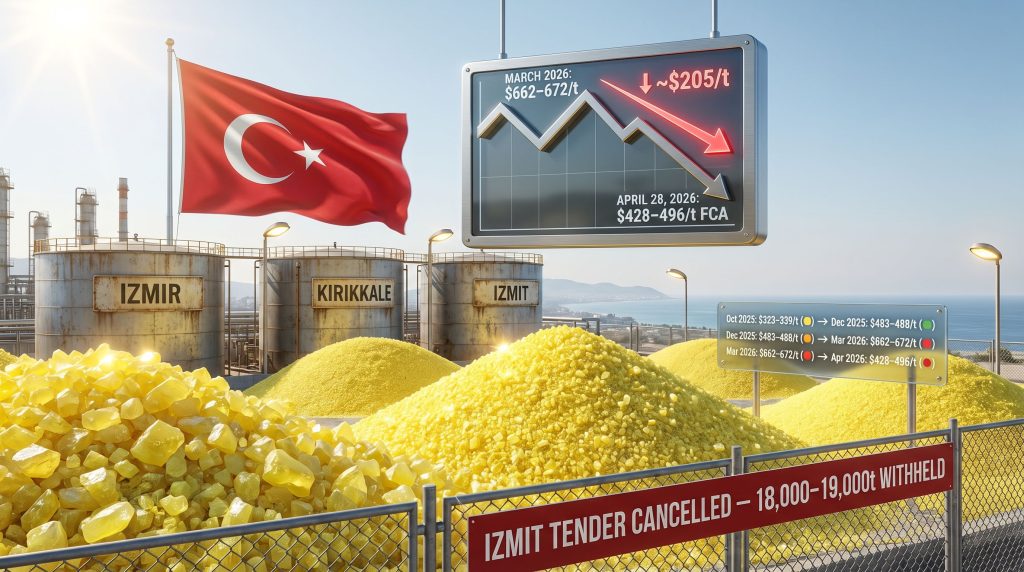
Turkish refiner Tupras completed an e-tender on April 28, 2026, awarding small lots of May-loading sulphur at prices that stunned market observers. The cleared price range of $428 to $496 per tonne free carrier (FCA) represented a decline of approximately $205 per tonne on average compared to the March 24, 2026 tender, which had settled at $662 to $672/t FCA. That single-cycle drop of roughly 31% is extraordinary by any commodity market standard.
| Tender Date | Price Range (FCA) | Approximate Average | Cycle-on-Cycle Change |
|---|---|---|---|
| March 24, 2026 | $662 to $672/t | ~$667/t | Baseline |
| April 28, 2026 | $428 to $496/t | ~$462/t | Down |
The FCA pricing basis is the standard reference point for Turkish refinery sulphur sales. Under FCA terms, the seller delivers goods to a named carrier at a specified location and all risk, freight costs, and onward logistics transfer to the buyer from that point forward. This matters because it means buyers absorb transport costs to their end destinations, making the FCA price a true ex-works-style comparison point across tender cycles.
Refinery-by-Refinery Results: A Fragmented Picture
The April 28 tender was not uniform across Tupras's refinery network. Each site produced a materially different outcome, and together they paint a complex picture of localised supply pressure:
-
Izmir refinery: Awarded 5,000 tonnes across lots ranging from 150 to 800 tonnes, in bulk, liquid, or big bag form, at $493 to $496/t FCA. Notably, Tupras opened the bidding process at $800/t FCA before revising the opening floor down to $400/t FCA, signalling internal acknowledgment of changed market conditions mid-process.
-
Kirikkale refinery: Awarded 3,500 tonnes across lot sizes of 400 to 950 tonnes at $428 to $431/t FCA, the lowest clearing range of the cycle and roughly $65/t below the Izmir outcome.
-
Izmit refinery: A tender for 18,000 to 19,000 tonnes in various lots was reportedly cancelled entirely after bids came in below the seller's acceptable threshold.
The Kirikkale-Izmir price spread illustrates how logistics, lot sizes, and form-factor specifications create localised micro-markets within a single tender cycle. Smaller lots in specific physical forms attract different buyer profiles and different risk premiums, contributing to divergent clearing prices even within the same national tender framework.
Turkey's Sulphur Export Ban: The Structural Cause
The Tupras sulphur tender price drop did not emerge from demand destruction or a broader global commodity correction. It was overwhelmingly driven by one factor: Turkey's recently enacted ban on sulphur exports, which confined domestic refinery output to the Turkish market exclusively.
This is a critical distinction. When supply cannot exit a market, it does not simply accumulate quietly. It competes aggressively for a fixed pool of domestic buyers, and the resulting auction dynamic systematically compresses achievable prices. Sellers who previously had export optionality, the ability to route volumes to higher-value international markets, lose that leverage entirely. Domestic buyers, aware of this constraint, adjust their bids accordingly.
The export ban effectively converted Turkey's sulphur market from an internationally competitive environment into a closed system. In a closed system, the marginal clearing price is determined not by global benchmarks but by the depth and urgency of domestic demand alone. When domestic demand is insufficient to absorb available supply at prevailing international prices, local clearing levels deteriorate sharply, which is precisely what the April 28 tender demonstrated.
Export restrictions on commodities create a concentrated pressure effect: supply volumes that would normally be distributed across multiple international markets are redirected into a single domestic pool, forcing prices downward even when global benchmarks remain elevated or stable.
This dynamic is not unique to Turkey. India's Gujarat Chamber of Commerce and Industry, for example, put forward a recommendation in April 2026 calling for a minimum six-month ban on elemental sulphur exports, citing supply security concerns. If implemented, India would face an analogous domestic oversupply scenario to Turkey's, with similar downward pressure on local clearing prices. That two major emerging-market economies with significant sulphur throughput are simultaneously contemplating or implementing export restrictions underscores how supply security concerns are reshaping commodity market volatility across the fertilizer input chain.
The Izmit Cancellation: The Most Important Signal of This Tender Cycle
While the awarded prices at Izmir and Kirikkale generated immediate attention, the most analytically significant event of the April 28 cycle was the cancellation of the Izmit refinery tender. At 18,000 to 19,000 tonnes, the Izmit volume represented the largest single tranche in the tender, dwarfing the combined awards from Izmir and Kirikkale by a factor of more than two.
Tender cancellations in refinery sulphur markets occur when the lowest submitted bids fall below the seller's internally established reserve price threshold. This threshold reflects a combination of factors:
- The seller's assessment of fair market value based on production costs and opportunity cost
- Storage and inventory carrying costs versus the cost of selling at a loss
- Strategic expectations about near-term price recovery that may justify withholding supply
- Regulatory or contractual minimum pricing obligations
When a seller the size of Tupras cancels its largest tender tranche, it sends a clear signal to the market: the current bid environment is not acceptable for large-volume disposal. This implies an informal price floor somewhere above the bids received at Izmit, likely in the range of $430 to $450/t based on the cleared prices at the other refineries.
| Dimension | Short-Term Impact | Longer-Term Implication |
|---|---|---|
| Izmit inventory | Volume remains on-site, building storage pressure | May trigger a re-tender at a revised reserve price |
| Market pricing signal | Confirms seller resistance below approximately $430/t | Establishes an informal clearing floor for future rounds |
| Buyer behaviour | Opportunistic purchasing at awarded lots | Expectation calibration for May and June tender cycles |
| Export ban duration | Continued domestic supply accumulation | If ban lifts, a sharp price recovery becomes structurally plausible |
Mediterranean Supply Context: Why Regional Dynamics Complicate the Picture
Turkey's domestic oversupply situation does not exist in isolation. Across the broader Mediterranean and North African sulphur supply corridor, a contrasting dynamic has been unfolding simultaneously. Furthermore, the supply chain disruption caused by regional conflict has compounded these already complex market conditions.
Libya's state-owned refiner, the National Oil Corporation (NOC), issued a sulphur export tender on April 27, 2026, offering two cargoes of 6,000 tonnes each for May loading out of Mellitah. The first cargo's laycan dates were set for May 7 to 9 and the second for May 24 to 26. Critically, NOC had not offered April-loading sulphur, and its last export tender before this one had closed on February 16, before the Middle East conflict disrupted regional energy flows.
The reason for this gap is instructive. Many oil refineries across North Africa and the broader Mediterranean basin reduced sulphur production rates after the Middle East conflict disrupted crude availability from late February onward. With less crude being processed, less sulphur is produced as a byproduct, and export volumes fell accordingly. Libya's re-entry into the market with May-loading cargoes signals some normalisation of crude throughput at Mellitah, but the overall Mediterranean sulphur availability picture remains constrained relative to pre-conflict levels.
This creates a notable divergence: the Mediterranean region at large is experiencing tighter supply due to production cutbacks, while Turkey faces a localised oversupply driven by its export restriction. These two conditions are not contradictory; they are the direct consequence of policy intervention decoupling a national market from its natural regional equilibrium.
Sulphur's Role in the Fertilizer Supply Chain: Why Prices Matter Beyond Turkey
The Tupras sulphur tender price drop carries implications that extend well beyond Turkish commodity markets. Sulphur is an indispensable input across multiple stages of the fertilizer production chain, and indeed forms part of the broader category of critical raw materials that underpin modern industrial and agricultural supply systems:
- It is the primary feedstock for sulphuric acid production, which is itself required for the manufacture of phosphate fertilizers including diammonium phosphate (DAP) and single superphosphate (SSP)
- It is used directly in ammonium sulphate production, a nitrogen-sulphur fertilizer with significant agricultural demand
- It feeds into sulphuric acid leaching processes in certain mining and mineral processing operations
Turkey sits within a Mediterranean fertilizer corridor that supplies agricultural markets from Southern Europe through to the Middle East and parts of South Asia. When Turkish domestic prices are artificially suppressed by export restrictions, local fertilizer manufacturers gain a temporary input cost advantage, potentially improving their competitiveness in downstream markets. However, this advantage is fragile and entirely dependent on the duration of the export restriction.
India's fertilizer sector response to regional supply disruption is illustrative of broader market stress. In late April 2026, India's fertilizer ministry recommended that national fertilizer companies shift to consortium-based collective purchasing of key raw materials, including sulphur, phosphoric acid, sulphuric acid, and phosphate rock, as well as finished fertilizers such as DAP, MOP, and NPS/NPK grades. This represented a significant structural shift from individual procurement toward aggregated demand management, a model previously applied successfully to urea imports. The recommendation reflected genuine concern about supply security following disruptions linked to the closure of the Strait of Hormuz.
India's move toward consortium-based raw material purchasing for sulphur and related fertilizer inputs marks a significant evolution in how large importing nations are responding to supply chain fragility in the post-conflict regional environment.
The next major ASX story will hit our subscribers first
Price Trajectory in Context: From October 2025 to April 2026
To properly assess the magnitude of the April correction, it is essential to view the Tupras sulphur tender price drop within its full historical trajectory over the preceding six months. The geopolitics in commodity markets have clearly played a decisive role in shaping this pricing journey.
| Period | Price Range (FCA) | Primary Driver |
|---|---|---|
| October 2025 | $323 to $339/t | Seasonal demand trough, post-summer inventory normalisation |
| December 2025 | $483 to $488/t | Pre-winter demand strengthening, supply constraints |
| February 2026 | $487 to $536/t | Post-maintenance tightness at Izmit |
| March 2026 | $662 to $672/t | Peak pricing, pre-export restriction cycle high |
| April 28, 2026 | $428 to $496/t | Export ban-driven domestic oversupply correction |
The price trajectory from October 2025 to March 2026 represented a near-doubling of FCA values in roughly five months, a rally driven by post-summer demand recovery, refinery maintenance tightness, and broader Mediterranean supply constraints. The March 2026 level of $662 to $672/t now appears to have been the cycle peak, with the export ban acting as a policy-triggered reversal mechanism.
What makes this correction particularly notable is its velocity. A single tender cycle separates the peak and the correction, with no gradual unwinding visible in the data. This kind of step-change correction is characteristic of policy interventions rather than organic demand shifts, where market participants have limited time to adjust positioning before the new equilibrium is revealed. Consequently, Tupras's recent tender outcomes have become a closely watched indicator for the entire Mediterranean sulphur market.
Scenario Outlook: What Drives Tupras Sulphur Prices From Here
Three primary scenarios frame the outlook for subsequent Tupras tender cycles through mid-2026:
Scenario 1: Export ban remains in place, prices stay compressed
If Turkey's sulphur export restriction continues without modification, domestic oversupply will persist across all three refineries. Future tenders are likely to clear in the $420 to $480/t FCA range, with the Izmit refinery eventually re-tendering at a revised reserve price if storage constraints become acute.
Scenario 2: Export ban is lifted, prices recover sharply
A full removal of the export restriction would immediately restore Turkey's participation in regional Mediterranean supply flows. With competing export demand restored, domestic buyers would face higher-priced competition and clearing prices could recover toward the $550 to $620/t FCA range within one to two tender cycles, depending on broader Mediterranean supply conditions.
Scenario 3: Partial policy adjustment with volume or quota modifications
A middle path involving export quotas or volume caps rather than a full ban could partially relieve domestic pressure while preserving some supply security objectives. Under this scenario, a $480 to $520/t FCA stabilisation range represents a plausible transitional equilibrium as the market adjusts to the modified regulatory environment.
The key variables to monitor across all three scenarios include the official duration and any announced modifications to Turkey's sulphur export ban, whether Izmit re-tenders and at what reserve price signal, the trajectory of Libya's NOC export volumes as Mediterranean crude availability normalises, and the pace of Indian consortium purchasing activity as it absorbs or redirects regional sulphur flows.
Frequently Asked Questions
What caused the Tupras sulphur tender price drop in April 2026?
The primary cause was Turkey's sulphur export ban, which restricted refinery output to the domestic market only. This created a localised oversupply condition in which domestic buyers faced little competitive pressure from export demand, allowing bids to fall approximately $205/t below the March 2026 cycle average.
What does FCA mean in sulphur pricing?
FCA stands for Free Carrier, an international trade term under which the seller delivers goods to a named carrier at a specified location. From that point, the buyer assumes all risk and transportation costs. In the context of Turkish refinery sulphur sales, FCA pricing means the quoted price reflects collection at the refinery gate, with buyers responsible for all onward logistics.
Why was the Izmit tender cancelled?
The Izmit tender for 18,000 to 19,000 tonnes was cancelled after submitted bids fell below the seller's acceptable price threshold. This is the standard mechanism by which refinery sellers protect against clearing volumes at economically unsustainable prices. The cancellation signals that Tupras views current spot market bids as insufficient for large-volume disposal at Izmit.
How does this affect fertilizer markets?
Sulphur is a critical upstream input for sulphuric acid, phosphate fertilizers, and ammonium sulphate. Artificially suppressed domestic prices in Turkey may temporarily benefit Turkish fertilizer producers, but the policy-driven distortion creates uncertainty for regional supply planning, particularly for import-dependent markets like India that rely on consistent sulphur availability across the Mediterranean corridor.
Disclaimer: This article is intended for informational and analytical purposes only and does not constitute financial or investment advice. Price forecasts, scenario analyses, and market projections involve inherent uncertainty and should not be relied upon as definitive predictions of future outcomes. Readers are encouraged to consult primary market data sources and professional advisers before making any commercial or investment decisions.
Want to Stay Ahead of Commodity Market Shifts That Drive ASX Mining Opportunities?
Discovery Alert's proprietary Discovery IQ model scans ASX announcements in real time, instantly identifying significant mineral discoveries across sulphur, phosphate, and more than 30 other commodities — turning complex market signals into clear, actionable investment insights. Explore how major discoveries have historically generated substantial returns on Discovery Alert's dedicated discoveries page, and begin your 14-day free trial today to position yourself ahead of the broader market.