June 12, 2026
The Hidden Metal Powering Your Devices Has a Dangerous Secret
Every smartphone unlocked, every laptop booted, every electric vehicle charged draws on a global supply chain that most consumers never think about. At its foundation lies tantalum, a dense, corrosion-resistant metal refined from coltan ore, without which the miniaturised capacitors inside modern electronics simply cannot function. Tantalum capacitors regulate electrical current with extraordinary precision in compact form factors, making them irreplaceable in the architecture of contemporary hardware. Yet the geographic concentration of coltan supply in one of the world's most volatile regions has created a structural vulnerability that is now moving from investigative reports into courtrooms, regulatory chambers, and corporate boardrooms simultaneously.
Understanding why M23-linked coltan in tech supply chains has become one of the most consequential supply chain integrity crises of the decade requires examining not just the conflict itself, but the technical, commercial, and regulatory architecture that allows conflict-origin ore to travel invisibly from a war zone to the device in your pocket.
When big ASX news breaks, our subscribers know first
Why Tantalum's Geology Creates an Unavoidable Geopolitical Problem
Coltan's Mineralogical Profile and Why It Cannot Be Easily Substituted
Coltan is a shorthand term for the mineral assemblage columbite-tantalite, which occurs naturally in pegmatite rock formations and is most commonly extracted through artisanal and small-scale mining methods in the Great Lakes region of Central Africa. The ore contains both niobium and tantalum, but it is the tantalum fraction that drives critical minerals demand. Tantalum's exceptionally high melting point, resistance to chemical attack, and ability to form a stable oxide layer make it the preferred material for electrolytic capacitors in high-density electronics applications.
No commercially viable substitute currently exists for tantalum in these applications at the same performance-to-size ratio. Ceramic and aluminium electrolytic alternatives exist but fall short in frequency response and volumetric efficiency, which is why tantalum capacitors remain embedded in premium smartphone designs, aerospace systems, and medical devices. This substitution barrier is a critical, lesser-known dynamic in the conflict minerals debate: demand cannot simply be redirected away from tantalum without meaningful performance trade-offs at the device level.
The Rubaya District: A Geographic Chokepoint in Global Electronics
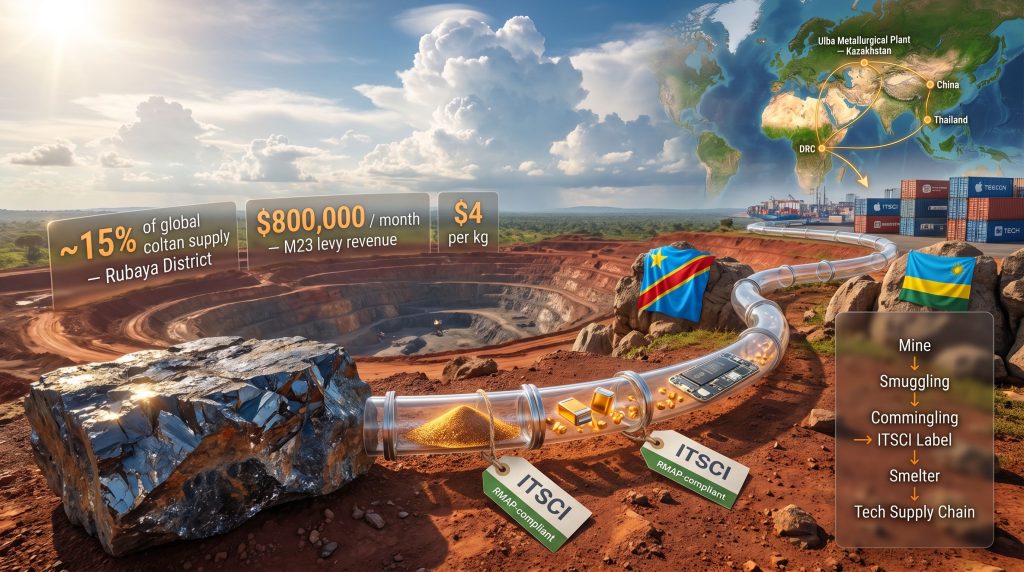
The Rubaya mining cluster, positioned within the Masisi territory of North Kivu province in eastern DRC, is estimated to account for roughly 15% of global coltan supply, according to reporting based on UN expert assessments. The broader Great Lakes region contributes approximately 30% of the world's coltan, figures cited in Atlantic Council analysis, meaning that a significant share of the tantalum flowing into global electronics manufacturing passes through one of the most conflict-affected territories on earth.
This is not an accidental outcome of market development. The DRC mineral wealth concentrated in the Kivus hosts some of the highest-grade coltan deposits found anywhere, with tantalum pentoxide concentrations that make artisanal extraction economically viable even without industrial infrastructure. That geological richness is precisely what makes the region so contested and so difficult to exit from a supply chain perspective.
"When a single mining district contributes 15% of global supply for a critical technology metal, any disruption to legitimate sourcing in that district does not simply reduce supply. It redirects purchasing pressure toward channels that may not be conflict-free."
The M23 Revenue Model: How Conflict Is Financed by Consumer Electronics
From Mine Control to Monthly Revenue
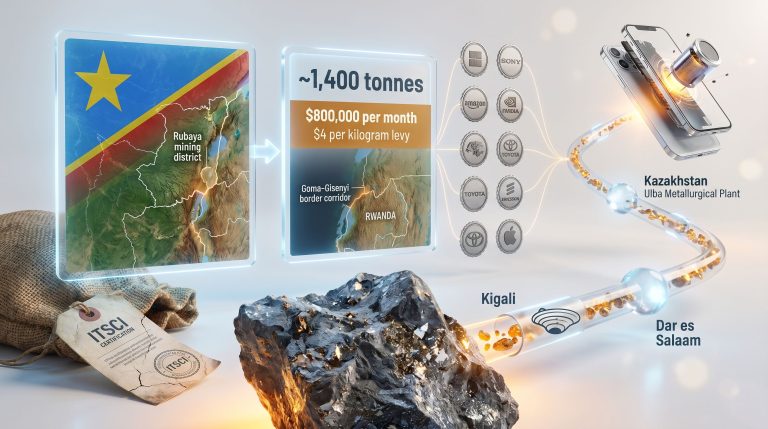
Since April 2024, M23, an armed group with documented links to Rwanda, has exercised operational control over the Rubaya mining district. The group's monetisation mechanism is straightforward and its financial scale is significant. M23 collects a levy of approximately $4 per kilogram of extracted coltan, a figure that exceeds the $3 per kilogram tax collected by the Rwandan government on legitimately sourced ore.
According to UN expert assessments, this taxation structure generates an estimated $800,000 per month for M23 operations. This revenue architecture has a particularly troubling implication for technology companies and their customers: global consumer demand for smartphones, laptops, and electric vehicles is functioning, indirectly and involuntarily, as a financing mechanism for an armed insurgency. The causal chain from device purchase to conflict funding is long and opaque, but it is documentable.
The Smuggling Corridor: Goma to Gisenyi
A year-long investigation by Global Witness, published in June 2026 and drawing on customs data and field interviews, traced the movement of conflict-origin coltan from Rubaya to international smelters. The findings identify the Goma-Gisenyi border crossing as the primary transit point, with investigators documenting that ore movements occur openly rather than through concealed smuggling routes.
At least 1,400 tonnes of coltan were estimated to have crossed from DRC into Rwanda during the first twelve months following M23's seizure of the Rubaya mines. The scale of this movement relative to Rwanda's total coltan export volumes makes statistical detection theoretically possible, yet existing audit frameworks have not been designed to apply this kind of volumetric cross-checking systematically.
The Four-Stage Laundering Architecture
The pathway by which conflict-origin coltan enters certified supply chains involves four distinct transformation stages, each of which reduces traceability and increases legitimacy in the eyes of downstream buyers.
Stage 1: Armed group taxation at source. M23 extracts its $4/kg levy from artisanal miners operating in the Rubaya district, capturing revenue before the ore leaves the mine site.
Stage 2: Cross-border movement through Goma-Gisenyi. Ore is transported in open daylight across the DRC-Rwanda border, often without meaningful interdiction, and enters the Rwandan commercial mineral system.
Stage 3: Commingling and label assignment in Rwanda. Once inside Rwanda, conflict-origin ore is blended with domestically sourced coltan. Labels from the International Tin Supply Chain Initiative (ITSCI) traceability system are then assigned to the commingled product. Field investigators documented accounts of exporters attaching ITSCI labels to ore from Masisi after it had already crossed the border, effectively re-certifying its origin as Rwandan.
Stage 4: Export to international smelters. The laundered material is shipped through the ports of Dar es Salaam in Tanzania and Mombasa in Kenya to smelting facilities in China, Kazakhstan, and Thailand. Once processed into refined tantalum metal, current audit methodologies cannot reliably distinguish its geographic origin.
"The ITSCI system is designed to provide mine-to-export traceability. Its vulnerability is not a technical flaw in the system itself. It is a geographic bypass: when conflict ore enters the tracking system after the border crossing rather than at the point of extraction, the entire traceability chain is built on a false foundation."
Which Companies Are Exposed and What the Data Shows
Smelter Disclosure and the Limits of RMAP Compliance
The Global Witness investigation identified eight smelters connected to the supply chain pathway, all of which were certified as compliant under the Responsible Minerals Assurance Process (RMAP), the primary industry audit standard administered by the Responsible Minerals Initiative. This certification was maintained during periods when at least four of the eight facilities are alleged to have processed coltan likely originating from the Rubaya district.
The named technology companies disclosed these smelters in their public supply chain reports. Furthermore, conflict coltan linked to major brands illustrates the breadth of exposure. The table below summarises the disclosed connections identified in the investigation:
| Company | Disclosed Smelter Connection | RMAP Audit Status During Investigation Period |
|---|---|---|
| Apple | Ulba Metallurgical Plant, Kazakhstan (2023 report) | Certified compliant |
| Microsoft | Smelters linked to Rubaya-origin coltan | Certified compliant |
| Sony | Smelters linked to Rubaya-origin coltan | Certified compliant |
| Amazon | Smelters linked to Rubaya-origin coltan | Certified compliant |
| Nvidia | Smelters linked to Rubaya-origin coltan | Certified compliant |
| Toyota | Smelters linked to Rubaya-origin coltan | Certified compliant |
| Ericsson | Smelters linked to Rubaya-origin coltan | Certified compliant |
| Vodafone | Smelters linked to Rubaya-origin coltan | Certified compliant |
"It is critical to note that no direct purchasing relationship between these companies and M23 has been established. The concern documented in the investigation is that conflict-origin material may have entered their supply chains through multiple layers of intermediaries and smelters that passed industry audits. This raises questions about audit adequacy rather than the direct conduct of brand-level buyers."
Apple's Legal and Regulatory Exposure in Detail
Apple's position in this dispute is particularly complex. In 2024, the DRC filed legal complaints against Apple subsidiaries in both France and Belgium, alleging the handling of conflict minerals and misleading responsible sourcing representations. Apple responded by requiring its suppliers to suspend purchases of tin, tantalum, and tungsten from both DRC and Rwanda, while formally rejecting the Congolese government's allegations.
In France, the complaint was dismissed in February 2025 after courts determined that the alleged offences could not be sufficiently established on the evidence presented. Congolese legal teams subsequently challenged this ruling and were pursuing a civil-party complaint pathway. In Belgium, the situation is more advanced: an investigation was formally opened and an examining magistrate was appointed, representing a procedurally more serious stage than the French proceedings reached before dismissal.
The Global Witness report also flagged that Apple, alongside other U.S. companies, did not publish a supplier list under the U.S. conflict minerals disclosure framework for 2024, a transparency gap that sits in tension with the company's public responsible sourcing commitments.
Why Industry Audit Systems Are Structurally Inadequate
The RMAP Methodology Gap
RMAP audits are conducted at the smelter level and rely primarily on documentation review and supplier declarations. They are not designed to cross-reference smelter intake volumes against verified mine-level production data in the source countries. This creates a specific and exploitable weakness: a smelter can declare compliant sourcing based on paperwork generated after the commingling event has already occurred.
Without mine-level production data integrated into audit methodology, there is no baseline against which to assess whether declared export volumes are statistically consistent with legitimate mine output. If a Rwandan exporter declares 200 tonnes of coltan in a quarter where Rwandan mines verifiably produced far less, this discrepancy should trigger investigation. Currently, it largely does not.
Geochemical Fingerprinting: The Technical Solution That Remains Unused
Geochemical fingerprinting uses the isotopic ratios and elemental trace profiles of ore samples to match mineral material to specific geological deposits. Every geological formation has a unique geochemical signature, and this signature is preserved through the crushing, washing, and early processing stages of coltan preparation. Matching ore samples at the border or at the smelter against a reference database of known Rwandan and Congolese deposit signatures would make commingling detectable with a high degree of confidence.
Rwanda has declined to implement geochemical fingerprinting as part of its mineral export verification process. Without this tool, independent verification of origin claims at the exporter level is structurally impossible under current frameworks, regardless of how many audit certifications are applied downstream.
Comparative Framework Weaknesses
| Verification System | Designed Purpose | Key Vulnerability |
|---|---|---|
| ITSCI | Mine-to-export chain of custody | Post-border label application bypasses origin tracking |
| RMAP | Smelter-level compliance auditing | No mine-level production data cross-check |
| Geochemical Fingerprinting | Geological origin verification | Not implemented in Rwanda |
| Better Mining | Artisanal miner data collection | Alleged infiltration by conflict-origin material |
The next major ASX story will hit our subscribers first
The DRC's Multi-Jurisdictional Pressure Campaign
The Congolese government is not relying solely on the outcome of any single legal proceeding. Its strategy combines active court cases in Belgium, targeted sanctions efforts against identified smuggling networks, and regulatory lobbying in Brussels and Washington. The Belgian investigation, with an examining magistrate formally appointed, represents the most procedurally advanced accountability mechanism currently in motion.
At the regulatory level, the DRC is pressing European and American authorities to strengthen traceability requirements for tantalum imports. The EU Conflict Minerals Regulation, which has been in force since 2021, established due diligence obligations for importers of tin, tantalum, tungsten, and gold. However, its enforcement architecture mirrors many of the same limitations that exist within the RMAP framework, relying on documentation chains that can be compromised at the border-crossing stage.
The mining geopolitics dimension compounds the regulatory challenge considerably. Rwanda's role as a transit and export hub for coltan, including material alleged to originate in DRC, places the mineral trade at the intersection of a regional security dispute and an international trade relationship, making straightforward regulatory intervention politically complex for Western governments managing multiple concurrent diplomatic priorities.
What Meaningful Due Diligence Actually Requires
Moving Beyond Smelter-Level Certification
For technology companies operating under tightening ESG scrutiny, the current audit-based compliance model is increasingly difficult to defend as sufficient. Institutional investors and ESG rating agencies are beginning to examine the gap between corporate responsible sourcing commitments and the structural limitations of the systems those commitments rely upon.
Robust upstream due diligence requires moving beyond smelter certification toward a genuinely integrated verification approach:
- Mine-level production data integration — Cross-referencing declared export volumes against independently verified mine output statistics to identify volume anomalies that indicate commingling.
- Mandatory geochemical traceability — Requiring isotopic baseline matching for all tantalum imports from the Great Lakes region as a condition of procurement, regardless of existing certification status.
- Independent field verification — Supplementing desk-based audits with on-the-ground investigators operating in source regions, particularly in conflict-affected zones where documentation is most easily manipulated.
- Full smelter and refiner transparency — Publishing complete supplier lists annually under applicable conflict minerals disclosure frameworks rather than relying on industry-level aggregate reporting.
- Extraterritorial liability frameworks — Extending legal accountability upstream beyond the smelter level, consistent with the obligations emerging under the EU Corporate Sustainability Due Diligence Directive.
The Commercial Opportunity in Conflict-Free Sourcing
As regulatory pressure intensifies and legal precedents develop, demand for geochemically verified tantalum from lower-risk jurisdictions is structurally likely to increase. Producers operating in Australia, Brazil, and Canada who can demonstrate verifiable origin through documented chain of custody and geochemical certification will find themselves positioned advantageously in a market where responsible sourcing is transitioning from a reputational preference to a legal requirement.
Furthermore, the Congolese critical minerals rivalry between the US and China adds another layer of urgency to resolving these supply chain integrity questions at a geopolitical level, beyond individual corporate compliance.
"If the Belgian investigation produces a liability finding against a major technology company, the precedent would extend across the entire sector. Every manufacturer sourcing tantalum through Rwanda-based exporters would face immediate pressure to implement independent mine-level verification, potentially triggering a sector-wide restructuring of critical mineral supply chains and accelerating commercial demand for alternative, verifiable sources."
Frequently Asked Questions
What makes tantalum impossible to trace once smelted?
Once coltan is processed into refined tantalum metal at a smelter, the physical and chemical characteristics that allow geochemical fingerprinting to identify geographic origin are largely destroyed by the smelting process. Without upstream sampling and documentation before smelting, the link to the original deposit cannot be reconstructed under current methodologies.
Why has Rwanda not implemented geochemical fingerprinting?
Rwanda has not publicly provided a detailed technical explanation for its decision. Critics argue the absence of fingerprinting creates a verification gap that makes Rwanda's mineral export system susceptible to laundering of DRC-origin material. Rwanda disputes characterisations of its mineral trade as a conflict-financing mechanism.
What is the significance of the Belgium investigation compared to France?
The appointment of an examining magistrate in Belgium indicates that investigators found sufficient grounds to open a formal judicial inquiry, a more substantive procedural step than the French proceeding reached before its dismissal. Examining magistrate proceedings in Belgium have broader investigative powers and can lead to formal charges against named entities.
How does this affect ESG ratings for technology companies?
Supply chain integrity in conflict-affected mineral sourcing sits directly within the social pillar of ESG assessment. Companies with disclosed smelter connections to potentially conflict-linked coltan face the risk of rating downgrades, particularly as ESG methodologies evolve to incorporate supply chain depth beyond tier-one supplier declarations. Understanding critical metal applications more broadly also highlights how pervasive these sourcing risks are across defence and consumer technology alike.
What volume of coltan does the Rubaya district produce relative to Rwanda's total exports?
The Rubaya district is estimated to account for approximately 15% of global coltan supply. Rwanda's total coltan exports, combined with the volume allegedly smuggled across from DRC and commingled with Rwandan production, would represent a significant share of the tantalum flowing to Asian smelters. The statistical discrepancy between Rwanda's verified domestic mine output and its total export volumes is one of the analytical tools investigators are using to quantify the scale of alleged smuggling. M23-linked coltan in tech supply chains remains traceable, at least in aggregate terms, through this kind of volumetric analysis even when individual shipments evade detection.
For ongoing coverage of African mining, trade dynamics, and regulatory developments relevant to critical mineral supply chains, Ecofin Agency provides sector-focused reporting at ecofinagency.com.
Want to Stay Ahead of Major Mineral Discoveries Before the Broader Market Reacts?
As critical mineral supply chains face intensifying scrutiny and demand for verifiably sourced tantalum from lower-risk jurisdictions grows, Discovery Alert's proprietary Discovery IQ model delivers real-time ASX alerts the moment significant mineral discoveries are announced — turning complex data across 30+ commodities into clear, actionable insights. Explore Discovery Alert's dedicated discoveries page to understand how historic ASX mineral discoveries have generated substantial returns, and begin your 14-day free trial today to position yourself ahead of the market.