June 12, 2026
When Commodity Windfalls Meet Structural Fragility: Reading Ghana's Recovery Honestly
Across Africa's resource-dependent economies, the gap between macroeconomic recovery and household welfare improvement is not an anomaly. It is the norm. Nations that rebuild GDP growth on the back of rising commodity prices can generate impressive headline statistics while leaving the majority of citizens largely untouched by the gains. Understanding this dynamic is essential before examining any single country's recovery trajectory, because the numbers that look most impressive are often the ones that tell the least complete story.
Ghana's ongoing recovery under President John Mahama offers one of West Africa's most instructive case studies in this tension. The statistical picture has improved markedly. The policy architecture has demonstrated notable continuity. Yet the social challenge is only now fully crystallising, and the vulnerabilities embedded within the recovery are significant enough to warrant careful analysis.
When big ASX news breaks, our subscribers know first
How Bad Was Ghana's Economic Crisis Before the Recovery Began?
The Debt and Inflation Emergency That Defined the Starting Point
To appreciate where Ghana stands today, it is necessary to understand the severity of the conditions from which recovery was required. Ghana's 2022 crisis represented one of the most acute economic contractions in the country's modern history. Inflation surpassed 50% at its peak, a level that compressed real incomes across every income bracket and eroded the purchasing power that Ghanaian households had accumulated over years of relative stability.
The Ghanaian cedi underwent severe depreciation against major currencies, amplifying the inflationary shock by raising the domestic cost of imported goods, fuel, and food. The government's debt burden had become unsustainable, forcing a fundamental restructuring of both domestic and external public debt obligations. Ghana's engagement with the International Monetary Fund became unavoidable, and the resulting programme required significant fiscal adjustment as a condition of continued multilateral support.
What Ghana Inherited in January 2025: A Baseline Assessment
A critical point that is frequently misrepresented in political discourse is the sequencing of Ghana's recovery. The groundwork for stabilisation was not laid by the Mahama administration. The debt restructuring agreements and the IMF Extended Credit Facility framework that underpinned Ghana's recovery were established under the preceding administration led by Nana Akufo-Addo. Mahama's government inherited a partially stabilised economy, not a crisis at its worst.
| Indicator | Peak Crisis Level | Status at Mahama's Inauguration (Jan 2025) |
|---|---|---|
| Inflation | Above 50% (2022 peak) | Approximately 23% (2024 average) |
| GDP Growth | Severely compressed | Recovering (~5.8% in 2024) |
| Foreign Reserves | Critically depleted | Partially rebuilt via IMF programme |
| Cedi Stability | Sharp depreciation | Fragile but stabilising |
| Debt Burden | Unsustainable | Under active restructuring |
This distinction matters enormously for any honest assessment of the Ghana economic recovery under Mahama. The administration's primary early policy choice was not to initiate recovery but to sustain it, maintaining continuity with a reform programme already in motion rather than disrupting it.
What Is the IMF Extended Credit Facility and Why Does It Matter for Ghana?
Understanding the Multilateral Framework Underpinning the Recovery
The IMF's Extended Credit Facility provides concessional long-term financing to low-income countries experiencing persistent balance-of-payments difficulties. Unlike short-term stabilisation instruments, the ECF is designed to support multi-year structural adjustment processes, making it well-suited to economies like Ghana's that required sustained fiscal and monetary discipline rather than temporary liquidity relief.
Ghana's programme under the ECF framework delivered what the IMF assessed as substantial stabilisation gains across four dimensions: inflation reduction, the rebuilding of international reserves, improved confidence in the national currency, and a gradual easing of the public debt burden. These gains were the direct product of programme conditionality, including fiscal deficit reduction targets, monetary policy discipline, and structural benchmarks relating to governance and revenue mobilisation.
One of the less-discussed aspects of IMF programme dynamics is that policy continuity across government transitions is itself a form of signal to international capital markets. When an incoming administration chooses not to renegotiate inherited reform frameworks, it communicates predictability to sovereign risk analysts and foreign investors. This implicit credibility signal can reduce risk premiums on government borrowing and attract private capital flows that a more disruptive transition would deter.
Ghana's 8-Point Economic Recovery Framework: What It Covers
The Mahama administration formalised its economic strategy around a comprehensive recovery framework addressing both macroeconomic stabilisation and structural transformation:
- Macroeconomic stabilisation and inflation control
- Rebuilding investor confidence and sovereign credibility
- Fiscal discipline and restrained public borrowing
- Support for private-sector-led growth
- Structural reform in agriculture and agro-processing
- Industrial development and value-added manufacturing
- Governance improvements in extractive sectors covering gold, oil, and cocoa
- Long-term economic resilience through diversification away from commodity concentration
The breadth of this framework is significant. Points 1 through 3 represent continuity with the inherited reform agenda. Points 4 through 8 represent the Mahama administration's attempt to differentiate its economic approach and build toward a more diversified growth model. The critical question is whether sufficient institutional capacity and fiscal space exist to pursue the structural agenda while the stabilisation agenda remains incomplete.
How Strong Is Ghana's GDP Growth in 2025–2026?
Reading the Headline Numbers in Context
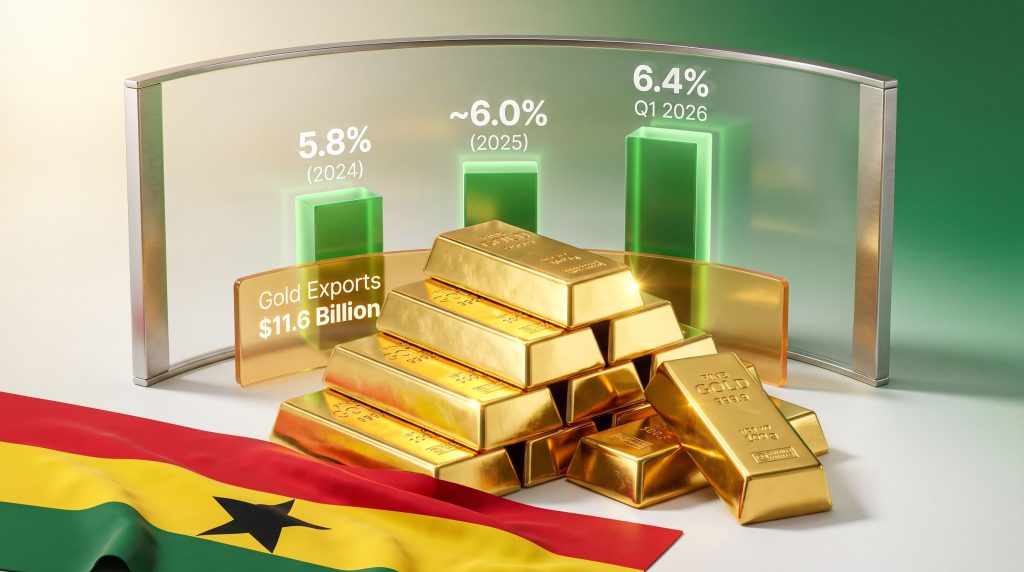
Ghana's growth statistics for 2025 and 2026 are genuinely strong by both historical and regional standards. According to Ghana Statistical Service data, GDP grew at 5.8% in 2024, accelerated to approximately 6.0% in 2025, and reached 6.4% in Q1 2026, up from 6.2% in the same quarter of the prior year. This represents a sustained and sequentially improving growth trajectory that few post-crisis economies in sub-Saharan Africa have achieved.
| Year | GDP Growth Rate | Key Driver |
|---|---|---|
| 2022 | Severely constrained | Debt crisis, inflation shock |
| 2023 | Partial recovery | IMF programme initiation |
| 2024 | 5.8% | Debt restructuring, gold exports |
| 2025 | ~6.0% | Continued stabilisation, oil sector reform |
| Q1 2026 | 6.4% | Gold price surge, investor confidence |
Inflation has fallen from above 23% in 2024 to single-digit levels by early 2026, with some data points placing it around 3.2% in March 2026, though this figure derives from government-aligned reporting and should be cross-referenced against official Ghana Statistical Service releases before being treated as definitive. Furthermore, the cedi reportedly appreciated by more than 40% across 2025, a remarkable reversal from the sharp depreciation of the crisis period, though partial retracement occurred in mid-2026 amid broader global market volatility.
What the headline figures do not reveal is the sectoral composition of growth. Ghana's expansion has been heavily concentrated in capital-intensive extractive industries, particularly gold mining and petroleum. These sectors generate foreign exchange revenues and contribute to government receipts but do not create employment at a scale proportional to their contribution to GDP. This composition issue is central to understanding why macroeconomic recovery and household welfare improvement are running at different speeds.
What Role Does Gold Play in Ghana's Economic Recovery Strategy?
Africa's Largest Gold Producer and the Commodity Windfall
Ghana's status as Africa's largest gold producer places it in a uniquely advantaged position during periods of elevated global gold prices. The sustained rally in gold prices from 2023 onwards created a substantial commodity windfall that materially strengthened Ghana's external accounts, supported cedi stability, and provided the government with revenue headroom that would not have existed at lower price levels. Monitoring the broader gold price outlook is therefore directly relevant to any assessment of Ghana's near-term fiscal position.
Gold exports reached $11.6 billion in 2024, representing a year-on-year increase of more than 50%. This single statistic explains much of the improvement in Ghana's external account position and reserve accumulation over the same period. The foreign exchange inflows from gold exports reduced pressure on the cedi and gave the Bank of Ghana greater capacity to manage monetary conditions without triggering another depreciation spiral.
In addition, understanding the gold price drivers behind this sustained rally — including geopolitical tensions and central bank accumulation — helps contextualise how durable Ghana's windfall revenues may prove to be.
The Ghana Gold Board (GoldBod): Centralising Artisanal Gold Revenues
One of the Mahama administration's most significant institutional innovations has been the establishment of the Ghana Gold Board, universally referred to as GoldBod. This body was created to centralise purchases of artisanal and small-scale mining gold and regulate sector exports, effectively bringing informal-sector gold production into a formal institutional framework.
The implications of this structural shift extend well beyond simple revenue capture. Artisanal and small-scale mining (ASM) in Ghana is an enormous economic activity involving hundreds of thousands of participants, but it has historically operated outside formal tax and regulatory systems. GoldBod represents an attempt to formalise this activity in a way that simultaneously captures export revenues, improves anti-money-laundering compliance, and gives the government visibility over a major foreign exchange earning sector.
In its initial months of operation, GoldBod reportedly exported more than 55 tonnes of gold valued at approximately $5 billion. This is a substantial figure that, if sustained, would represent a significant expansion of formally captured artisanal gold revenues relative to the pre-GoldBod baseline.
The formalisation of artisanal gold through GoldBod carries an underappreciated systemic benefit: it creates a data trail. Historically, the opacity of artisanal gold flows made it nearly impossible for policymakers to accurately model Ghana's true gold export volumes or to assess the sector's contribution to foreign exchange earnings. With centralised purchase and export data, Ghana's monetary authorities gain an important new input for reserve management and currency policy.
Reforming the Industrial Mining Royalty Structure
The Mahama administration has also proposed a significant reform to the royalty structure applied to industrial gold mining. The existing framework applies a fixed royalty rate of 5%, regardless of the prevailing gold price. The proposed reform would replace this with a progressive royalty system under which rates could rise to as high as 12% when gold prices reach elevated thresholds comparable to current market levels.
This reform logic is economically sound. Fixed royalty rates in commodity sectors effectively transfer windfall rent to mining companies during price booms, depriving the resource owner (the state) of its proportional share of extraordinary profits. Progressive systems, by contrast, allow the state to capture a larger share of windfall revenues without materially affecting mining economics at lower price levels when thinner margins make investment viability more sensitive to fiscal terms.
The key policy risk is calibration. If the progressive rate is set too aggressively or the trigger thresholds are too low, the reform could deter exploration investment and long-term capital commitments in Ghana's mining sector. Comparable frameworks in other resource-rich economies offer useful benchmarks, and the broader concept of gold as a strategic asset underscores why both governments and investors carefully monitor royalty environments that affect long-term production economics.
How Is Mahama Rebuilding Ghana's Oil Sector After Years of Decline?
Addressing Investor Confidence Through Policy Reversal
Ghana's petroleum sector entered the Mahama period in a state of erosion. Production had been declining, exploration activity was subdued, and investor confidence had been damaged by a series of regulatory decisions under the preceding administration that operators regarded as commercially irrational and legally uncertain.
The most consequential of these was a directive requiring the forced unitisation of Eni and Vitol's Sankofa field with Springfield Exploration and Production's Afina discovery. This directive compelled two separate oil fields with distinct ownership structures, reservoir characteristics, and development timelines to be merged into a single operational unit, creating disputes that legal and technical experts widely considered counterproductive.
In February 2025, the Mahama government withdrew this directive. The practical effect was to restore commercially rational, negotiation-based frameworks for field development and remove a source of above-ground political risk that had been deterring both investment decisions and exploration commitments.
Jubilee and TEN Field Licence Extensions: Investment Implications
Following the restoration of operator confidence, the Mahama administration secured concrete commercial outcomes in the form of licence extensions for Ghana's two most significant producing oil fields. Licences for the Jubilee and TEN (Tweneboa, Enyenra, and Ntomme) fields were extended through 2040, providing a 15-plus year horizon of tenure certainty.
This timeline is material for investment decision-making. Capital-intensive offshore oil field development requires financing commitments that extend over decades, and lenders providing development finance require reasonable assurance of the operating period over which revenues will be generated. Licence extensions through 2040 are expected to catalyse investments of up to $2 billion in field development, production maintenance, and enhanced recovery programmes.
Tema Refinery Reactivation: Downstream Strategy
The state-owned Tema Oil Refinery was returned to operation following a period of extended inactivity. Maintenance and rehabilitation work carried out during 2025 enabled the facility to resume crude oil processing in December 2025. Current crude feedstock is sourced from Nigeria while the government works toward allocating a portion of Ghana's domestic crude production to the facility.
The strategic logic of domestic refinery reactivation is straightforward but often underappreciated. Ghana's historical dependence on imported refined petroleum products created a structural vulnerability in which every period of cedi depreciation simultaneously raised the cost of fuel imports, amplifying the inflationary impact of currency weakness. Domestic refining capacity, if sustained, reduces this transmission mechanism and provides a buffer against the most damaging cycle of currency-depreciation-induced energy price inflation.
The next major ASX story will hit our subscribers first
What Are the Key Vulnerabilities Threatening Ghana's Recovery?
Commodity Concentration Risk: The Gold Price Dependency Problem
The most significant structural vulnerability in Ghana's current recovery is its dependence on elevated gold prices. A substantial portion of the improvement in Ghana's external accounts, reserve position, and fiscal revenue is directly attributable to gold prices that, while remaining elevated by historical standards, are not guaranteed to remain at current levels. The record gold prices seen in recent years have been a tailwind for Ghana, but such conditions can reverse with limited warning.
The procyclical nature of this vulnerability is worth emphasising. Ghana's recovery metrics look strongest precisely at the moment when the commodity price environment supporting them is most susceptible to reversal. A significant correction in gold prices would simultaneously reduce foreign exchange inflows, weaken the cedi, increase imported inflation, and reduce government revenue, creating a compound shock across multiple dimensions of the macroeconomic framework.
Energy Sector Debt: The Fiscal Overhang
The electricity value chain presents a persistent fiscal risk that headline macroeconomic stabilisation does not resolve. Substantial debts have accumulated across Ghana's power sector over multiple years, reflecting a combination of governance failures, inadequate cost recovery mechanisms, and structural imbalances between generation costs and regulated tariff levels.
This overhang constrains the government's fiscal space for social investment at precisely the moment when political expectations for visible improvements in living standards are highest. Resolving energy sector debt requires politically difficult decisions about tariff reform, utility governance, and the allocation of fiscal resources to clearing legacy obligations. These decisions have been deferred across multiple administrations and cannot be deferred indefinitely without increasing cost.
Narrow Tax Base: Financing Development Needs
Ghana's tax-to-GDP ratio remains relatively low for a country with significant infrastructure, healthcare, and education financing requirements. The IMF's Extended Credit Facility conditionality includes revenue mobilisation benchmarks, but structural tax base expansion is a medium-term challenge that cannot be resolved within a single programme cycle.
GoldBod's formalisation of artisanal gold represents a meaningful step toward bringing informal economic activity into the fiscal system, but the informal economy extends far beyond the mining sector. Agriculture, services, and small-scale manufacturing all represent significant economic activity that largely falls outside formal tax collection systems. However, sustained institutional investment in revenue administration capacity is a prerequisite for the kind of tax base expansion Ghana needs. These dynamics also reflect broader resource dependency risks facing commodity-reliant economies attempting to fund diversified development agendas.
External Volatility Signals Already Emerging
The IMF's May 2026 assessment of Ghana's external position included a cautionary note regarding the indirect transmission of geopolitical pressures through higher energy, food, and fertiliser costs. While the direct impact of Middle East tensions on Ghana has remained limited, the institution stressed that heightened external volatility reinforces the need for prudent domestic policymaking and proactive resilience-building.
These warnings have found early empirical support. After appreciating strongly through 2025, the cedi gave back a portion of its gains in mid-2026 amid geopolitical uncertainty. Inflation, which had declined to historically low levels, edged back upward to 3.7% year-on-year in May 2026. These are modest movements, but they illustrate the fragility of a recovery that remains heavily dependent on favourable external conditions.
The pattern emerging in Ghana in mid-2026 is consistent with a well-documented dynamic in commodity-dependent emerging economies: stabilisation gains achieved during commodity booms can reverse rapidly when external conditions shift, and the institutional buffers built during the boom period often prove insufficient to fully absorb the shock.
Has Ghana's Economic Recovery Actually Reached Ordinary Households?
The Gap Between Macroeconomic Indicators and Lived Experience
The divergence between Ghana's improving macroeconomic statistics and the lived experience of ordinary households is perhaps the most politically consequential aspect of the current recovery phase. After multiple consecutive years of high inflation and declining real incomes during the 2022 to 2024 period, Ghanaian households face a significant purchasing power recovery deficit. Reversing the cumulative erosion of living standards requires sustained real wage growth over an extended period, not simply a reduction in the rate of inflation.
This dynamic is often misunderstood in public discourse. When inflation falls from 50% to 3%, prices are not declining — they are rising more slowly from a level that is already dramatically higher than it was three years earlier. Household welfare improves only when real incomes consistently outpace even the lower prevailing inflation rate across multiple consecutive years.
What Would a Household-Level Recovery Actually Require?
Translating macroeconomic gains into meaningful household welfare improvement requires progress across several dimensions that GDP growth figures alone do not capture:
- Sustained formal and semi-formal job creation in sectors with high employment multipliers, beyond capital-intensive extractive industries
- Real income growth that consistently exceeds inflation over multiple consecutive years
- Affordable access to food, energy, healthcare, and education, which are the categories where price pressures have been most acute and persistent
- Meaningful reduction in underemployment and structural youth unemployment, which remain elevated across much of Ghana's labour force
- Broadening of economic participation beyond the extractive sectors that drive headline growth
The fundamental challenge is that gold and oil exports, while generating foreign exchange and government revenue, do not directly employ large numbers of Ghanaians at wages that transform household welfare at scale. For the Ghana economic recovery under Mahama to be judged a genuine success by citizens rather than statisticians, this employment and income generation challenge must be addressed more explicitly than it has been so far.
How Does Ghana's Recovery Compare to Other Post-Crisis African Economies?
Comparative Framework: Stabilisation vs. Transformation
Ghana's recovery trajectory is more clearly understood when placed within the broader pattern of post-crisis recovery in commodity-dependent African economies. The available evidence across comparable cases suggests that macroeconomic stabilisation and household welfare improvement operate on fundamentally different timescales.
| Country | Crisis Type | Recovery Mechanism | Household Impact Timeline |
|---|---|---|---|
| Ghana (2025–2026) | Debt and inflation crisis | IMF ECF, gold windfall, oil reform | Lagging macroeconomic gains |
| Zambia (post-2020) | Sovereign default | Debt restructuring, copper revenues | Gradual and uneven |
| Ethiopia (post-2022) | Conflict plus fiscal stress | IMF programme, export diversification | Slow, constrained by security |
| Egypt (2016–2019) | Currency and fiscal crisis | IMF programme, tourism and remittances | Delayed, inflation-heavy transition |
The pattern across these cases is consistent: macroeconomic stabilisation, measured in terms of inflation, currency, and external accounts, typically consolidates within two to three years of programme initiation. Household welfare improvement, measured in terms of real incomes, employment quality, and consumption capacity, typically requires five to seven years from the same starting point. Ghana in mid-2026 appears to be completing Phase 1 while Phase 2 remains nascent.
What Are the Structural Reforms Ghana Still Needs to Sustain Long-Term Growth?
Beyond Stabilisation: The Medium-Term Policy Agenda
Sustaining Ghana's growth trajectory beyond the current commodity-favourable environment requires addressing a set of structural challenges that the IMF programme has identified but not resolved. The medium-term reform priorities outlined by Ghana's Ministry of Finance encompass several interconnected dimensions:
- Debt sustainability management: Ensuring that the fiscal discipline achieved through the IMF programme is institutionalised through domestic budget rules and expenditure frameworks, preventing the accumulation of new unsustainable obligations
- Revenue mobilisation: Broadening the formal tax base beyond the extractive sector to reduce fiscal dependence on commodity price cycles and fund social services at adequate levels
- Energy sector reform: Resolving the accumulated debt and governance failures across the electricity value chain through a combination of tariff adjustment, efficiency improvement, and potentially managed debt relief for viable state utilities
- Private investment facilitation: Building a regulatory environment attractive to domestic and foreign capital in manufacturing, agro-processing, and services, which are sectors with employment multipliers significantly higher than mining or petroleum
- Institutional capacity building: Developing the governance infrastructure required to manage resource revenues transparently and counter-cyclically, accumulating buffers during price booms rather than expanding expenditure commitments that become unsustainable when prices fall
Frequently Asked Questions: Ghana Economic Recovery Under Mahama
What caused Ghana's economic crisis before the Mahama recovery?
Ghana's crisis resulted from excessive public borrowing, rapidly rising debt service costs, currency depreciation, and an inflation rate that exceeded 50% at its 2022 peak. The country was compelled to seek IMF assistance and restructure domestic and external debt obligations beginning in 2023.
What is Ghana's current GDP growth rate in 2026?
According to Ghana Statistical Service data, Ghana's economy expanded at 6.4% in the first quarter of 2026, building on growth of approximately 6.0% recorded for the full year 2025 and 5.8% in 2024.
What is the Ghana Gold Board (GoldBod)?
GoldBod is a government-established institution responsible for centralising the purchase and export of artisanal and small-scale mining gold in Ghana. In its initial operational months, it reportedly exported more than 55 tonnes of gold valued at approximately $5 billion, bringing previously informal sector activity into a formal institutional framework.
Is Ghana still in an IMF programme in 2026?
Ghana entered an IMF Extended Credit Facility programme as part of its debt crisis response beginning in 2023. The programme has delivered what the IMF described as substantial stabilisation gains. Some reporting indicates Ghana is approaching or has completed the formal programme period, though the broader policy relationship with the IMF remains active and influential.
Why hasn't Ghana's recovery improved living standards for most households?
Ghana's recovery has been driven primarily by capital-intensive sectors, particularly gold mining and oil, which generate foreign exchange and government revenue but do not create employment at a scale proportional to their GDP contribution. The cumulative purchasing power losses from the 2022 to 2024 inflation period require sustained real wage growth over multiple years to reverse, meaning household welfare improvements systematically lag macroeconomic stabilisation.
What are the biggest risks to Ghana's economic recovery?
The primary risks include a reversal in global gold prices reducing foreign exchange inflows, persistent energy sector debt constraining public finances, a narrow tax base limiting fiscal capacity for social investment, and external shocks including geopolitical disruptions affecting food, energy, and fertiliser costs.
Key Takeaways: Ghana's Recovery in Numbers
| Metric | Data Point | Significance |
|---|---|---|
| Q1 2026 GDP Growth | 6.4% | Highest recent quarterly reading |
| 2025 Full-Year Growth | ~6.0% | Sustained above crisis-era levels |
| 2024 Gold Exports | $11.6 billion | More than 50% year-on-year increase |
| GoldBod Initial Exports | ~55 tonnes valued at ~$5 billion | New institutional revenue capture from artisanal sector |
| Proposed Maximum Gold Royalty | 12% progressive | Up from fixed 5% across all price levels |
| Jubilee and TEN Licence Extension | Through 2040 | Expected to unlock up to $2 billion in investment |
| Peak Crisis Inflation | Above 50% | Baseline reference point for recovery measurement |
| May 2026 Inflation | 3.7% year-on-year | Modest uptick from recent lows, signalling fragility |
| Cedi Appreciation in 2025 | More than 40% | Partially retraced in mid-2026 |
The Ghana economic recovery under Mahama represents a genuine and statistically robust improvement from a crisis baseline that was severe by any measure. The administration has demonstrated policy continuity that has supported investor confidence, deployed institutional innovation through GoldBod, and secured meaningful commercial agreements in the oil sector that extend the production horizon for Ghana's two largest fields. These are real achievements.
What remains unresolved is whether the recovery's foundations are deep enough to withstand a commodity price reversal, whether structural reforms can advance at sufficient pace to broaden economic participation, and whether the macroeconomic gains can be translated into the kind of employment creation and income growth that ordinary Ghanaian households will recognise as genuine improvement in their daily lives. The stabilisation phase is largely complete. The transformation phase is only beginning.
This article is based on publicly available macroeconomic data and reporting. Readers should note that economic forecasts, growth projections, and commodity price scenarios are subject to significant uncertainty. Nothing in this article constitutes financial or investment advice.
Want To Track The Next Major Mineral Discovery Before The Market Does?
Ghana's gold windfall underscores how transformative commodity discoveries can be for investors positioned early — Discovery Alert's proprietary Discovery IQ model delivers real-time ASX mineral discovery alerts, turning complex data across 30-plus commodities into clear, actionable opportunities. Explore historic discovery returns that demonstrate just how significant early positioning can be, and begin your 14-day free trial at Discovery Alert to secure your market-leading edge.