June 12, 2026
The Hidden Architecture of a Global Supply Chain Failure
Every smartphone sold in 2025 contains a component most consumers have never heard of: a tantalum capacitor. Tantalum is refined from coltan, a dull, heavy ore extracted predominantly by hand from the mineral-rich soils of Central Africa. The metal's extraordinary physical properties, including resistance to corrosion, a melting point exceeding 3,000 degrees Celsius, and exceptional electrical conductivity at miniaturised scales, make it functionally irreplaceable in the capacitors that regulate current across billions of consumer devices. There is currently no commercially viable substitute in high-performance electronics applications.
This technical dependency creates a structural problem that no amount of corporate policy language has yet resolved. Eastern Democratic Republic of Congo supplies an estimated 15% of global tantalum, with the Rubaya mining district in North Kivu province representing one of the highest-concentration coltan deposits on earth. Since April 2024, that district has been under the operational control of the M23 armed group, transforming a globally significant mineral source into a conflict-financed revenue engine. DRC's mineral wealth extends far beyond coltan alone, however, making this region a persistent focal point for geopolitical competition.
Understanding how M23-linked coltan in tech supply chains becomes embedded in the devices of the world's largest technology brands requires tracing a supply chain architecture that is deliberately opaque, structurally exploitable, and currently operating well beyond the reach of existing verification systems.
When big ASX news breaks, our subscribers know first
Tantalum's Unique Properties and Why They Create a Supply Chain Trap
Tantalum occupies a narrow but critical position in the electronics materials hierarchy. Its value is not derived from abundance or price but from performance characteristics that competing materials cannot replicate at scale.
Key properties that make tantalum irreplaceable in current-generation electronics include:
- High volumetric capacitance: Tantalum capacitors store more charge per unit volume than ceramic or aluminium alternatives, enabling miniaturisation
- Self-healing oxide layer: The oxide film that forms on tantalum surfaces provides natural insulation and durability under thermal stress
- Stability across temperature ranges: Tantalum capacitors maintain consistent performance in automotive and aerospace environments where temperature variance is extreme
- Compatibility with surface-mount manufacturing: The physical form factor of tantalum capacitors suits automated circuit board assembly at scale
These characteristics are not merely desirable but structurally embedded in current device design. Reformulating a smartphone motherboard or an electric vehicle control unit to eliminate tantalum would require a multi-year engineering programme and significant capital investment. This gives tantalum a degree of demand inelasticity that is unusual even among critical minerals, and it is precisely this inelasticity that conflict actors in eastern DRC have learned to exploit.
How M23 Converted Mining Access into a Revenue Machine
When M23 consolidated control over the Rubaya mining district in April 2024, the armed group did not simply take physical possession of a territory. It acquired an ongoing revenue stream embedded in global electronics demand. The broader issue of Congo mining security has consequently attracted significant international attention as the scale of this revenue extraction has become clearer.
The mechanics of revenue extraction operate through a systematic taxation framework:
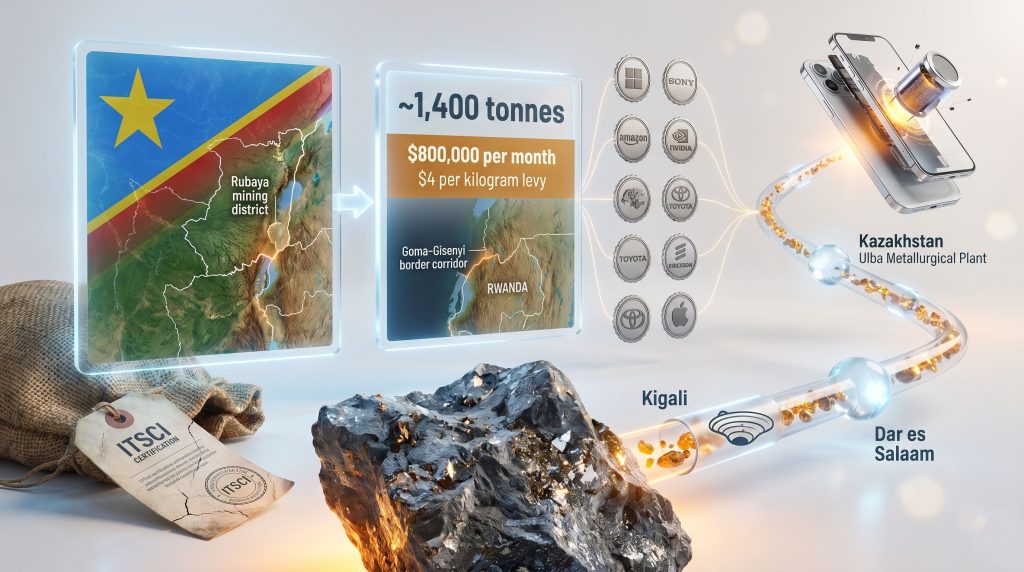
- M23 imposes a levy of $4 per kilogram on all coltan extracted from mines under its control
- For context, the Rwandan government collects $3 per kilogram on legitimate coltan exports, meaning M23's coercive rate exceeds the sovereign levy of an adjacent state
- United Nations expert assessments estimate this taxation system generates approximately $800,000 per month for M23
- This revenue stream provides a self-sustaining financial base that funds armed operations and incentivises the group to maintain territorial control over mineral-producing areas
The economic logic is precise: so long as global tantalum demand remains strong and the Rubaya deposits remain productive, M23's monthly revenue from coltan taxation is structurally guaranteed by the purchasing decisions of technology consumers worldwide.
Within the first year of M23's occupation of the Rubaya district, an estimated 1,400 tonnes of coltan were smuggled from eastern DRC into Rwanda, according to the Global Witness investigation published in June 2026. The investigation drew on a year-long review of customs data and direct interviews with traders operating along the supply corridor.
The Rubaya-to-Kigali Corridor: Anatomy of an Industrial-Scale Laundering Operation
The movement of M23-linked coltan from mine to market follows a well-defined sequence. Each stage adds a layer of documentation that progressively obscures the mineral's origin, until traceability becomes technically impossible at the processing stage.
| Stage | Location | Key Activity | Critical Vulnerability |
|---|---|---|---|
| Extraction and taxation | Rubaya, North Kivu, DRC | M23 levies $4/kg on all extracted ore | Armed coercion at source |
| Cross-border transit | Goma-Gisenyi corridor | Open smuggling, often in daylight | Low inspection infrastructure |
| Urban consolidation | Kigali, Rwanda | Blending with legitimate Rwandan production | Origin becomes unverifiable |
| Certification labelling | Rwanda | ITSCI traceability labels applied to blended ore | Labels attached to conflict-origin material |
| International export | Dar es Salaam / Mombasa | Shipping to smelters in China, Kazakhstan, Thailand | Certified documentation accepted at ports |
| Industrial processing | Kazakhstan, China, Thailand | Refining into tantalum powder and components | No geochemical testing required |
| Brand supply chain entry | Global | Tantalum components purchased by manufacturers | Full origin traceability lost |
The Goma-Gisenyi border crossing functions as the critical vulnerability point in this chain. The crossing handles high volumes of commercial traffic, and without dedicated mineral-specific inspection infrastructure, distinguishing smuggled coltan from legitimate commerce is logistically prohibitive. The scale of documented smuggling, nearly 1,400 tonnes in a single year, reflects an organised commercial operation rather than opportunistic border violations.
Furthermore, once ore arrives in Kigali, the laundering mechanism activates. Traders blend smuggled Congolese coltan with legitimately produced Rwandan ore. At this stage, the blended material is physically indistinguishable without geochemical fingerprinting analysis. According to traders interviewed during the Global Witness investigation, exporters personally attach ITSCI certification labels to ore sourced from M23-controlled Masisi mines, after which it is formally designated as Rwandan in origin and enters the certified export stream.
What the ITSCI System Is, and Why It Cannot Detect This Problem
How Mineral Traceability Certification Is Designed to Work
The Industry Tin Supply Chain Initiative operates as a multi-stakeholder programme built to certify that minerals from the Great Lakes region are free from conflict linkages. The system relies on three core mechanisms:
- Bag tagging at extraction points to assign identifiers to batches of ore
- Chain-of-custody documentation maintained across each transfer in the supply chain
- Third-party auditor verification at designated checkpoints along the route to smelters
Downstream buyers, including major electronics brands, use ITSCI participation as a primary due diligence mechanism to satisfy their obligations under conflict minerals disclosure frameworks in the United States and European Union.
Where the System Structurally Fails
The critical weakness in ITSCI is its dependence on documentation integrity at the exporter level. Once ore from multiple sources is physically combined, the documentation attached to the blended batch reflects the exporter's designation rather than the material's actual provenance. An auditor reviewing ITSCI-labelled ore in Kigali cannot determine how much of the batch originated in Rwanda and how much crossed the border from M23-controlled mines in North Kivu.
This is not a minor procedural gap. The Global Witness investigation found that all eight smelters identified as receiving ore from the compromised supply chain had been assessed as compliant under the Responsible Minerals Assurance Process (RMAP), including during periods when their sourcing included conflict-linked coltan. Audit compliance, in this context, certified process adherence rather than material origin.
Compliance with a certification framework and actual supply chain integrity are not interchangeable. When the verification architecture relies on documentation that can be manipulated upstream, audit results reflect the quality of the paperwork, not the ethics of the sourcing.
The Geochemical Fingerprinting Gap
Geochemical fingerprinting is the one technical method that could close this verification gap. By analysing the trace element composition of ore samples and comparing them against known deposit signatures, laboratories can establish physical origin with high confidence, independent of any documentation. Different coltan deposits have distinct geochemical signatures shaped by the specific geological conditions of their formation, including host rock chemistry, hydrothermal alteration patterns, and co-occurring mineral assemblages.
Rwanda has declined to incorporate geochemical fingerprinting into its mineral export verification process. Without pre-blending geochemical data and mine-level production records, there is no technical basis on which auditors can distinguish Rwandan from Congolese coltan in a blended batch. This single regulatory decision effectively removes the only method that could render the existing certification system functional in a conflict-affected cross-border context.
Which Global Technology Companies Face Supply Chain Exposure
The Global Witness investigation identified eight smelters receiving ore traceable to the compromised supply corridor. At least four of those smelters were linked to coltan with probable origins in M23-controlled Rubaya. The following companies have publicly disclosed these smelters within their supply chain reporting:
| Company | Disclosed Smelter Exposure | Additional Notes |
|---|---|---|
| Microsoft | Disclosed implicated smelters | Included in supply chain reporting |
| Sony | Disclosed implicated smelters | Included in supply chain reporting |
| Amazon | Disclosed implicated smelters | Included in supply chain reporting |
| Nvidia | Disclosed implicated smelters | Included in supply chain reporting |
| Toyota | Disclosed implicated smelters | Included in supply chain reporting |
| Ericsson | Disclosed implicated smelters | Included in supply chain reporting |
| Apple | Listed Ulba Metallurgical Plant (Kazakhstan) in 2023 report | Did not publish a 2024 conflict minerals supplier list |
Kazakhstan's Ulba Metallurgical Plant is the most specifically identified smelter of concern, having been named in Apple's 2023 supply chain disclosure and identified by investigators as a processing destination for ore traced to Rubaya-origin coltan. Indeed, a Canadian Mining Journal report further corroborated the links between conflict coltan and the supply chains of Sony, Microsoft, and Nvidia, reinforcing the scope of the exposure. Apple's decision not to publish a 2024 conflict minerals supplier list under the U.S. Securities and Exchange Commission's Section 1502 conflict minerals disclosure framework is noted as a specific transparency gap in the June 2026 investigation.
It is important to emphasise that smelter disclosure does not imply knowing participation in conflict mineral sourcing. These disclosures reflect the structural difficulty of maintaining verified origin tracing across multi-tier supply chains that pass through conflict-affected regions and blending operations where provenance becomes technically indeterminate.
The next major ASX story will hit our subscribers first
The DRC's Legal and Regulatory Campaign Against Technology Companies
Multi-Jurisdictional Legal Action
The Democratic Republic of Congo escalated its response to alleged conflict mineral handling in 2024, filing formal complaints in both France and Belgium against subsidiaries of Apple. The complaints alleged involvement in conflict mineral handling and misleading commercial practices related to publicly stated responsible sourcing commitments.
The two jurisdictions have produced markedly different outcomes:
- France: The complaint was dismissed in February 2025 on the basis that the alleged offences could not be sufficiently established under the applicable evidentiary standard. Congolese legal representatives challenged the dismissal and were pursuing a civil-party complaint as an alternative procedural route.
- Belgium: The case advanced further. An investigation was formally opened and an examining magistrate was appointed, representing a more substantive legal proceeding than the French outcome.
Apple publicly stated during 2024 that its suppliers were required to suspend purchases of tin, tantalum, and tungsten from both DRC and Rwanda, while rejecting the Congolese allegations.
How the June 2026 Investigation Changes the Legal Landscape
The Global Witness investigation published on 10 June 2026 provides a documented supply chain trace that was not previously available to Congolese legal teams in evidentiary form. The investigation maps the specific route from M23-controlled mines through named Rwandan exporters to identified smelters and onward to brand supply chains, creating a more complete evidentiary record than existed at the time the French complaint was filed.
Beyond legal proceedings, the DRC is pursuing parallel tracks:
- Seeking targeted sanctions against individuals and entities identified in the smuggling trade
- Lobbying European and U.S. regulators to strengthen mandatory traceability requirements for minerals from conflict-affected regions
- Positioning the investigation findings as grounds for structural regulatory reform rather than exclusively legal redress
The Regulatory Framework: What Rules Apply and Where They Fall Short
Three primary regulatory instruments currently govern conflict mineral supply chains for global technology companies:
| Framework | Jurisdiction | Key Requirement | Primary Gap |
|---|---|---|---|
| Dodd-Frank Act, Section 1502 | United States | SEC-registered companies must disclose conflict mineral use and conduct due diligence | No mandatory physical verification; relies on supplier declarations |
| EU Conflict Minerals Regulation (2021) | European Union | Due diligence obligations for EU importers of 3TG minerals from conflict-affected areas | No geochemical testing mandate; audit-based compliance |
| OECD Due Diligence Guidance | International | Framework standard for responsible mineral supply chain programmes | Voluntary baseline; no enforcement mechanism |
The common thread across all three frameworks is reliance on documentation-based due diligence rather than physically verified origin tracing. None of the frameworks currently mandate geochemical fingerprinting, mine-level production data submission, or cross-border data sharing between adjacent producing and transit countries. These gaps are not incidental; they reflect the political and commercial difficulty of imposing verification burdens on supply chains that the global electronics industry depends on for its core inputs. The broader challenges of the critical minerals supply chain extend well beyond coltan, however, with similar structural vulnerabilities identified across multiple strategic inputs.
The Deeper Structural Problem: Why Certification Systems Lag Behind Conflict Realities
The coltan situation in eastern DRC illustrates a broader principle that applies across conflict-affected mineral supply chains globally. The Congolese minerals rivalry between major powers further compounds these structural pressures, as competing geopolitical interests reduce the appetite for coordinated regulatory reform. Three structural conditions consistently enable supply chain contamination regardless of which certification framework nominally governs a given corridor:
-
Geographic supply concentration: When a single conflict-affected region produces a disproportionate share of a critical input, buyers have limited alternative sourcing options and reduced leverage to impose stricter verification conditions without accepting supply risk.
-
Multi-layer intermediary structures: Artisanal miners, local aggregators, cross-border traders, national exporters, and international smelters each add a documentation layer that can be manipulated. Each transfer point is also a potential origin laundering point.
-
Audit architecture misalignment: RMAP and similar frameworks audit at the smelter level, which is downstream of the blending operations that render origin indeterminate. Compliance assessments conducted after origin traceability has been destroyed cannot restore it.
What the coltan case demonstrates, and what is rarely acknowledged in corporate responsible sourcing commitments, is that the technical limitations of the audit infrastructure are not a solvable problem within current frameworks. Without geochemical fingerprinting deployed upstream, without mine-level production data shared across borders, and without coordinated mineral-specific inspection at key transit crossings, the documentation that underpins RMAP compliance will always be vulnerable to systematic falsification by actors with commercial access to the labelling infrastructure.
The growing analytical consensus is that M23-linked coltan in tech supply chains, and related minerals more broadly, should now be treated through a dual framework: as conflict minerals subject to humanitarian supply chain obligations, and as strategic minerals subject to national security-grade supply chain verification. Consequently, this dual classification would trigger different regulatory tools, including the export controls, state-level intelligence sharing, and mandatory physical testing regimes that strategic mineral frameworks can compel but humanitarian conflict mineral regimes currently cannot. The evolving landscape of mining geopolitics suggests that pressure for precisely this kind of structural reform is intensifying across multiple jurisdictions simultaneously.
Disclaimer: This article presents factual reporting based on publicly available investigative findings and documented supply chain data. It does not constitute legal, financial, or investment advice. References to corporate supply chain disclosures reflect published reporting and do not imply conclusive findings of wrongdoing by any named company. Readers should consult primary sources for verification of all claims and statistics cited herein.
Want to Stay Ahead of Major Mineral Discoveries Before the Broader Market?
While conflict minerals and supply chain vulnerabilities reshape the global critical minerals landscape, Discovery Alert's proprietary Discovery IQ model delivers real-time alerts on significant ASX mineral discoveries — instantly translating complex geological data into actionable investment insights for both short-term traders and long-term investors. Explore how historic mineral discoveries have generated substantial returns and begin your 14-day free trial today to position yourself ahead of the market.