August 10, 2026
The Infrastructure Equation: Who Really Controls the Value of Africa's Resources
UAE investment in Africa ports and minerals is reshaping the continent's economic architecture at a pace and scale that demands careful scrutiny. Capital flows toward resource-rich regions during periods of rising demand, infrastructure gets built to facilitate extraction, and the bulk of economic value accumulates in the hands of whoever controls the processing, logistics, and end-market relationships. Africa is now at a pivotal inflection point in that cycle, and the $168 billion investment pipeline announced by UAE entities since 2017 is forcing a continent-wide reckoning with a question that has never been more urgent: what terms are being set, and who benefits once the contracts are signed?
Understanding this dynamic requires looking beyond the headline figures and examining the structural mechanics of how port concessions, mining rights, and logistics networks actually distribute economic power over time.
When big ASX news breaks, our subscribers know first
From Trading Partner to Infrastructure Architect: The UAE's Strategic Evolution in Africa
The UAE's commercial relationship with African economies predates the current investment wave by several decades. Gulf merchants, re-export hubs in Dubai, and diaspora trade finance networks established foundational commercial ties long before sovereign wealth funds and state-linked logistics groups began targeting physical infrastructure at scale. What has changed since approximately 2017 is the nature and ambition of Emirati engagement.
The shift is from facilitating trade to controlling the physical systems through which trade moves. This is a fundamentally different strategic posture. A trading partner helps goods move between markets. An infrastructure architect determines the conditions, costs, and corridors through which goods reach those markets.
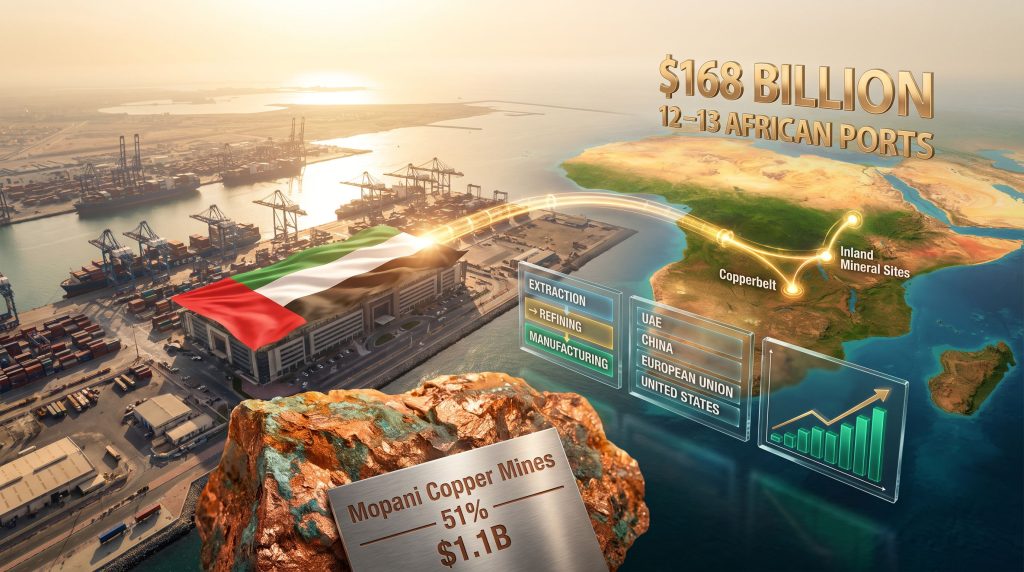
According to Financial Times analysis, UAE entities have announced more than $168 billion in African projects since 2017 across mining, ports, agriculture, and green energy. It is critical to understand what this figure represents and what it does not.
Important context: The $168 billion figure represents an announced pipeline of project commitments, not capital that has already entered African economies. Some projects within this pipeline have experienced delays or have not yet moved to active development phases. Earlier datasets covering shorter time windows cited UAE-disclosed African investment commitments of approximately $97 billion for 2022–2023, with other estimates placing cumulative commitments above $110 billion between 2019 and 2023. Variations across these figures reflect differing methodologies, time horizons, and project disclosure standards.
The sectors covered by this pipeline span a wide range of strategic assets:
| Sector | Key UAE Operators | Representative Projects | Investment Scale |
|---|---|---|---|
| Ports and Logistics | DP World, AD Ports Group | 13 African countries, including Maputo and DRC deep-water port | Multi-billion USD |
| Critical Minerals | UAE sovereign and private investors | 51% stake in Zambia's Mopani Copper Mines | $1.1 billion confirmed |
| Agriculture | UAE agri-investment vehicles | Sub-Saharan food security and farmland projects | Part of $168B pipeline |
| Renewable Energy | Emirati energy groups | East and West Africa green energy projects | Part of $168B pipeline |
Port Concessions and the Mechanics of Trade Corridor Control
Why Ports Are More Than Shipping Infrastructure
DP World's presence on the African continent dates to 2006, and its footprint has expanded substantially since then into port concessions, inland container depots, free zones, and integrated logistics platforms. Together with AD Ports Group, UAE operators are active in approximately 13 African countries, managing or developing ports that sit at the junction of three strategically critical maritime corridors: the Red Sea, the Gulf of Aden, and the Indian Ocean.
These are not incidental trade routes. They carry a disproportionate share of African commodity exports, and the operator of a port along these corridors occupies a position of considerable structural power. Furthermore, African mining finance trends confirm that current active projects include the expansion of Mozambique's Maputo port under DP World concession and the development of the Democratic Republic of Congo's first deep-water port, both of which are positioned to reshape regional trade dynamics significantly.
A port concession, in technical terms, transfers operational control to the concessionaire for a fixed period. This includes pricing authority, scheduling decisions, capacity allocation, and access conditions. These operational parameters determine which exporters can afford to use the facility, how efficiently domestic producers can reach international buyers, and whether the port serves local industrial development or functions primarily as an export accelerator for foreign-owned extraction operations.
The critical distinction for policymakers: A port that is connected to industrial zones, rail corridors, and domestic supplier networks creates economic multiplier effects that extend inland. A port optimised solely for commodity export throughput concentrates value at the point of extraction and moves it offshore rapidly. The concession terms agreed before construction or handover determine which model takes effect.
The Gulf Competition Dimension
Saudi Arabia's reported interest in securing a 25-year concession over a Cape Town port terminal introduces a dynamic that African governments should understand clearly. When two Gulf sovereign investors compete for the same strategic asset, the host government's negotiating position improves measurably.
Competing bids create the conditions under which governments can extract better ownership structures, local content obligations, and infrastructure sharing provisions than bilateral negotiations with a single investor would typically yield. This competitive tension is not a threat to African interests. It is a structural opportunity, provided governments are prepared to run formal, transparent tender processes rather than defaulting to bilaterally negotiated arrangements.
The Minerals Dimension: Copper, Cobalt, and the Processing Gap
What the UAE Is Targeting in Africa's Resource Endowment
UAE-linked investors have demonstrated consistent interest in a range of strategic commodities present across the African continent. The primary targets include copper, cobalt, gold, tin, tantalum, and tungsten, all of which sit at the centre of global critical minerals demand driven by the energy transition and electronics manufacturing supply chains.
The anchor transaction in this strategy is the acquisition of a 51% controlling stake in Zambia's Mopani Copper Mines for approximately $1.1 billion, one of the largest individual UAE-Africa mineral deals on record. The controlling stake structure is significant: it provides operational authority over production decisions, export scheduling, and processing arrangements, not merely a financial return on a passive equity position.
When this minerals acquisition is viewed alongside the UAE's port expansion strategy, an integrated supply chain logic becomes visible: control assets at the point of extraction, connect them through UAE-operated logistics corridors, and route commodities to end markets via UAE-managed infrastructure. Each link in that chain captures a portion of value that would otherwise remain within the host economy or accrue to third-party intermediaries.
The Three-Tier Value Chain Problem
The structural challenge facing mineral-rich African nations is well understood in development economics but rarely applied rigorously at the moment of deal negotiation. Raw material extraction generates royalties, taxes, and employment at the mine site. However, the majority of value created from those materials accrues further up the processing chain.
| Value Chain Stage | Activity | Primary Location of Value Capture |
|---|---|---|
| Extraction | Mining, ore concentration, primary processing | Africa (partially) |
| Refining and Processing | Smelting, chemical separation, cathode production | Asia, Europe, Middle East |
| Manufacturing and End Use | Battery cells, electronics, industrial components | China, EU, North America |
African governments that negotiate local processing obligations as a binding condition of investment access can begin shifting value retention upward through this chain. The challenge is that processing obligations require companion investments in energy infrastructure, water access, technical skills, and transport connectivity. A government that negotiates processing requirements without securing these companion investments risks holding an obligation that investors cannot practically fulfil.
Namibia's Negotiation Model and Its Replicability
Namibia's experience managing simultaneous investment interest from China and the European Union for its uranium, lithium, and rare earth deposits provides one of the most instructive recent case studies in mineral deal structuring. The country's approach demonstrates that the terms of an investment agreement — covering ownership architecture, processing mandates, employment targets, infrastructure access, and procurement requirements — carry more long-term economic significance than the headline capital figure attached to any announcement.
This framework is increasingly being applied by other African governments when evaluating new investment proposals from any origin, including those from UAE-linked entities. In addition, the evolving minerals security partnership landscape means that establishing non-negotiable conditionality before entering deal discussions produces materially better outcomes than attempting to renegotiate terms after concession agreements have been executed.
Three Scenarios for How UAE Investment in Africa Plays Out
The developmental trajectory of UAE investment in Africa is not predetermined. Three distinct scenarios are plausible depending on the policy choices African governments make in the near term.
Scenario 1: Extraction Acceleration (Low Value Retention)
UAE capital finances port upgrades and mine development. Royalties, taxes, and some employment flow to host countries. Raw materials move faster and more efficiently to global markets via UAE-operated corridors. Refining and manufacturing remain offshore. Export volumes improve; domestic industrial capacity does not expand materially.
Scenario 2: Industrial Anchor Development (High Value Retention)
Port concessions include provisions for industrial free zones, rail connectivity, and domestic supplier access. Mining investment agreements carry binding local processing requirements and procurement quotas. UAE logistics networks serve domestic manufacturers and smallholder farmers alongside foreign-owned extractive operations. Trade infrastructure becomes a platform for broad-based industrial development.
Scenario 3: Competitive Leverage Maximisation
African governments use simultaneous interest from UAE, Chinese, European, and American investors to run competitive tender processes. Each bidder is required to submit quantified local content, employment, and processing commitments alongside financial terms. Selection criteria prioritise total economic value rather than headline investment size.
Policy observation: The countries most positioned to capture lasting economic benefit from this investment cycle are those that construct clear, enforceable investment conditionality frameworks before concession agreements and supply contracts are signed, not as afterthoughts to renegotiate once operations are underway.
Comparing UAE Capital to Other Foreign Investors in Africa
The UAE does not operate in isolation. Its investment push is part of a broader contest among multiple foreign powers for strategic positioning across African infrastructure and resources. The evolving energy transition minerals race has intensified this competition considerably.
| Investor | Primary Focus Areas | Strategic Objective | Structural Model |
|---|---|---|---|
| UAE | Ports, logistics, minerals, agriculture | Trade corridor control, supply chain integration | Commercial concession-based operations |
| China | Infrastructure, mining, manufacturing, energy | Resource access, Belt and Road connectivity | State-financed construction and lending |
| European Union | Energy transition, governance, critical minerals | Supply security, geopolitical alignment | Grants, blended finance, partnership frameworks |
| United States | Energy, digital infrastructure, security | Countering Chinese influence, Lobito Corridor | Growing bilateral and multilateral investment |
One important distinction between UAE and Chinese investment models is frequently overlooked. UAE logistics investment is concentrated in commercially operated infrastructure — port concessions, free zones, and logistics platforms — rather than state-financed construction loans that create sovereign debt obligations. This means African governments face a different risk profile: lower direct debt exposure, but potentially greater long-run operational dependency on foreign-controlled logistics networks.
Commercial operators have strong incentives to make ports efficient and cost-competitive. However, the shifting dynamics of mining geopolitics reveal that the efficiency optimised by a global logistics operator serving its own international trade network may not automatically align with the development priorities of the host country's domestic industrial sector.
The next major ASX story will hit our subscribers first
A Practical Negotiation Framework for African Governments
Before entering any port concession or mining rights agreement with a foreign investor, African governments should evaluate and seek binding commitments across the following dimensions:
- Ownership and equity structure — What percentage of the asset remains under domestic or state control throughout the concession period?
- Local content requirements — What share of procurement, construction, maintenance, and operational contracts must be awarded to domestic businesses, with clear enforcement mechanisms?
- Processing and value-addition obligations — Is the investor required to refine, process, or manufacture within the host country, and at what production thresholds do these obligations activate?
- Infrastructure sharing provisions — Can domestic producers, smallholder farmers, and SME exporters access port, rail, and logistics infrastructure on competitive and transparent terms?
- Employment and skills transfer commitments — What are the binding, time-bound targets for local hiring at all levels, and what technical training obligations accompany them?
- Revenue transparency and audit rights — Does the government retain independent audit access to royalty calculations, production data, and revenue reporting?
- Renegotiation and exit clauses — Under what conditions can terms be reviewed as commodity prices, geopolitical relationships, or domestic development priorities change over the concession period?
Regional coordination among African governments — including the sharing of deal benchmarks, investment conditionality standards, and concession term comparisons — can further strengthen collective bargaining power. UAE investments across Africa are growing at such scale that a bloc of governments sharing information and setting minimum standards substantially narrows the negotiating gap against well-resourced global operators.
Frequently Asked Questions: UAE Investment in Africa's Ports and Minerals
What does the $168 billion UAE investment pipeline actually cover?
Financial Times analysis found that UAE entities have announced more than $168 billion in African projects since 2017, spanning ports, logistics, critical minerals, agriculture, and renewable energy. This figure represents announced project commitments rather than fully deployed capital. Some projects within this pipeline have experienced delays or remain in early development stages.
Which UAE companies are driving African port expansion?
DP World and AD Ports Group are the two principal UAE logistics operators on the continent. Their combined footprint covers approximately 13 African countries, encompassing port concessions, inland terminals, free zones, and integrated logistics platforms.
What critical minerals is UAE investment targeting in Africa?
UAE-linked investors have pursued copper, cobalt, gold, tin, tantalum, and tungsten assets. The most significant confirmed single transaction is the acquisition of a 51% controlling stake in Zambia's Mopani Copper Mines for approximately $1.1 billion.
How does a port concession affect African trade sovereignty?
A port concession transfers operational control — including pricing, scheduling, capacity allocation, and access conditions — to the concession holder for the agreement's duration. Concession terms that do not include domestic producer access provisions, infrastructure sharing requirements, and industrial zone connectivity can result in ports that serve the operator's global network rather than the host country's development agenda.
Does Gulf competition over African ports benefit African governments?
Yes, when managed strategically. The simultaneous interest of UAE and Saudi Arabian investors, alongside Chinese, European, and American capital, creates meaningful negotiating leverage for host governments. Consequently, competitive tender processes consistently produce better terms than bilateral negotiations with a single investor. The key is having the institutional capacity and political will to run structured, transparent competitive processes.
What is the difference between announced and deployed investment?
Announced investment reflects project commitments disclosed at signing or announcement. Deployed capital refers to funds that have physically entered African economies through construction spending, equipment procurement, and operational activity. For large infrastructure projects with multi-year development timelines, the gap between these figures can be substantial and should be tracked carefully by host governments and analysts. UAE sovereign wealth strategy analysis further confirms that this distinction is consistently understated in public reporting.
Key Takeaways
- UAE investment in Africa across ports and minerals represents one of the continent's largest and fastest-growing foreign investment pipelines, but developmental impact is determined by deal terms, not investment volume
- Port concessions are strategic assets that govern the conditions under which African exporters, manufacturers, and farmers access global markets; the operational model embedded in concession agreements shapes economic outcomes for the duration of the agreement
- The three-tier value chain structure means that raw material extraction captures only a fraction of the total value generated by Africa's critical mineral endowments; processing and manufacturing obligations in investment agreements are the primary mechanism through which that value retention ratio can be improved
- Gulf competition between UAE and Saudi Arabian investors over African infrastructure is a structural negotiating opportunity for host governments prepared to leverage competing interests through transparent tender processes
- Regional coordination among African governments on investment conditionality standards and deal benchmarks can materially strengthen collective bargaining power against well-resourced foreign investors
- The countries that will retain the most economic value from this investment cycle are those that prioritise rigorous pre-deal conditionality frameworks, enforce processing obligations with adequate companion infrastructure investment, and resist the short-term attraction of headline investment figures over long-term industrial development terms
This article contains forward-looking analysis and scenario projections based on publicly available information. Readers should note that announced investment pipelines do not guarantee project execution, and developmental outcomes will vary significantly based on deal terms, policy environments, and macroeconomic conditions. This article does not constitute financial or investment advice.
Want to Identify the Next Major Mineral Discovery Before the Broader Market Does?
Africa's critical minerals boom — spanning copper, cobalt, and beyond — is reshaping global supply chains, and the ASX is home to explorers positioned at the forefront of that shift. Discovery Alert's proprietary Discovery IQ model delivers real-time alerts the moment significant ASX mineral discoveries are announced, turning complex geological data into actionable investment insights for both short-term traders and long-term investors — explore historic discovery returns to understand the scale of opportunity, then begin your 14-day free trial to position yourself ahead of the market.