
August 10, 2026
When the River Stops, Industry Follows: The Rhine Low-Water Crisis Reshaping European Supply Chains
Inland waterway systems are among the oldest and most cost-efficient freight corridors in the world, yet they carry a vulnerability that road and rail networks do not: they are entirely subject to the whims of hydrology. When precipitation patterns shift, when Alpine snowpacks thin faster than expected, or when drought conditions settle over central Europe for weeks at a time, the rivers that underpin industrial logistics do not negotiate. They simply recede. What is happening along the Rhine in August 2026 is a textbook illustration of how Rhine barge traffic almost halted, and how quickly a single hydrological variable can unravel supply chains that took decades to build.
When big ASX news breaks, our subscribers know first
The Rhine Corridor: An Industrial Artery That Cannot Be Easily Replaced
The Rhine functions as the central nervous system of western European bulk freight, connecting the Amsterdam-Rotterdam-Antwerp (ARA) hub, which is Europe's largest refining and petrochemical complex, to manufacturing heartlands stretching deep into Germany and Switzerland. The scale of dependence on this single corridor is difficult to overstate.
Inland waterway transport along the Rhine moves enormous volumes of oil products, chemicals, fertilisers, agricultural commodities, and industrial raw materials at freight costs that road and rail cannot replicate at equivalent tonnage. A single large barge can carry cargo volumes that would require dozens of heavy trucks, and it does so at a fraction of the per-tonne cost. Furthermore, this economic reality has shaped the infrastructure decisions of chemical plants, refineries, and bulk storage terminals for generations, with many facilities built specifically around Rhine waterfront access.
The consequence of this design philosophy is structural dependency. When the Rhine is navigable, the system hums. When it is not, the entire freight ecosystem contracts simultaneously, and no alternative transport mode can absorb the displaced volume quickly or cheaply enough to prevent market disruption. These supply chain disruptions are compounded further when geopolitical and environmental pressures collide.
Understanding Kaub: The Single Point That Controls Everything
Within the Rhine system, one location carries disproportionate strategic weight. Kaub, a small town located in the Rhine Gorge in Rhineland-Palatinate, sits at the shallowest navigable point on the commercially critical stretch of the river. Its rocky, narrow channel geometry means that water levels here fall faster and recover more slowly than elsewhere along the route.
Every barge operator, commodity trader, and logistics manager with Rhine exposure watches the Kaub gauge reading as the primary real-time indicator of operational viability. The gauge does not merely measure water depth in an abstract sense. It determines the maximum draft, the depth to which a loaded barge can safely sit in the water, and therefore the maximum cargo tonnage any vessel can carry through the passage without grounding.
Kaub is not simply a geographic feature. It is the rate-limiting step of an entire industrial supply system, functioning as a hydrological valve that controls the flow of hundreds of millions of euros worth of cargo each week.
When Kaub readings fall below roughly 40 centimetres, operational constraints become serious for most commercial operators. Below that threshold, the freight economics of barge transport deteriorate rapidly, and the cascading effects begin to ripple outward into commodity markets, refinery operations, and manufacturing supply chains.
How Severe Is the Current Crisis? The Numbers Tell a Stark Story
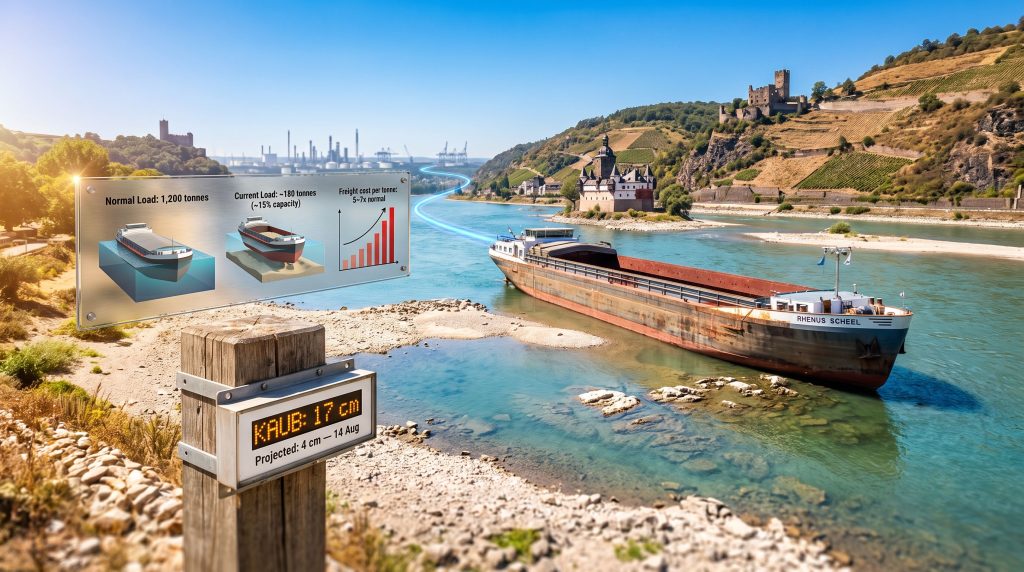
The current episode of Rhine barge traffic disruption has produced some of the most extreme gauge readings in the river's recorded history. Barge operations have come almost to a halt, with the Kaub reading reaching 17 centimetres over the weekend, and projections from Germany's federal waterways and shipping administration pointing to a potential further decline to as little as 4 centimetres by 14 August. At 4 centimetres, the question of whether commercial barge operations through Kaub are physically possible at all becomes genuinely uncertain.
The practical consequences of a 17-centimetre reading are already severe:
| Metric | Normal Conditions | Current Crisis Conditions |
|---|---|---|
| Kaub gauge level | 150-300+ cm (seasonal average) | 17 cm (weekend reading) |
| Projected gauge (14 August) | – | As low as 4 cm |
| Standard barge rated capacity | 1,200 tonnes | 180 tonnes (~15% of rated load) |
| Specialised low-draft vessel max load | 700 tonnes | Severely constrained |
| Voyage time ARA to Karlsruhe | ~2 days | ~5 days |
| Effective freight cost per tonne | Baseline | 5-7x baseline |
The economics embedded in these figures explain why Rhine barge traffic almost halted. A vessel rated to carry 1,200 tonnes that is physically restricted to carrying 180 tonnes must still cover broadly similar operating costs, including crew, fuel, and canal fees. The per-tonne freight rate required to make such a voyage economically viable may exceed what the cargo market will bear, pushing operators toward either accepting losses or withdrawing from the market altogether.
Specialised low-draft vessels, which are built wider and longer but designed to sit higher in the water, can carry up to 700 tonnes under current conditions. However, these assets are limited in number and command premium freight rates even in normal operating environments.
Historical Context: Rhine Droughts Are Getting Worse and More Frequent
Rhine low-water events are not new phenomena, but the frequency and severity of extreme episodes appears to be increasing. The 2018 Rhine drought caused disruptions severe enough to contribute to measurable contractions in German industrial output, with economic losses across affected sectors estimated in the billions of euros. The 2022 event similarly generated significant supply chain stress across chemical, energy, and manufacturing sectors.
What distinguishes the current situation from historical precedents is the trajectory of the gauge readings and the speed of deterioration. Hydrologists at the German Federal Institute of Hydrology (BfG) have modelled scenarios in which extreme low-water events on the Rhine become two to three times more frequent by mid-century under moderate climate warming trajectories. The underlying drivers include:
- Declining Alpine glacier mass, which historically buffered summer Rhine flows by releasing meltwater during dry periods
- Structural reductions in summer precipitation across the Rhine catchment basin in central Europe
- Earlier and faster snowmelt in spring, which front-loads Rhine flows into a period of lower industrial demand
- Increased evapotranspiration from warmer temperatures, reducing effective water availability even when precipitation occurs
This structural deterioration in hydrological reliability is not a peripheral concern. For industries that have built their supply chain economics around Rhine barge transport, it represents a fundamental and growing risk to business continuity.
Which Industries and Commodities Face the Greatest Exposure?
Road Fuels: The Most Immediate Pressure Point
Road fuel availability across western Germany has tightened materially as barge deliveries from the ARA hub have contracted. Traders who typically source product from tank farms positioned along the Rhine are diverting procurement toward alternative supply points, with the Miro consortium's 310,000 barrel-per-day Karlsruhe refinery in southwestern Germany becoming a key alternative source for buyers who can no longer rely on barge-delivered ARA product.
Several German federal states have suspended regulations that ordinarily prohibit heavy truck traffic on Sundays and public holidays, enabling road freight to partially compensate for lost barge capacity. However, road transport carries structural limitations in this context: it operates at significantly higher per-tonne cost and faces physical capacity constraints that prevent it from absorbing anything approaching the full volume ordinarily moved by river.
A Compounding Shock: Southern Germany's Refinery Outage
The supply squeeze facing southern Germany is not purely a logistics problem. A leak at a mild hydrocracker unit at the Bayernoil consortium's 207,000 barrel-per-day Vohburg-Neustadt refinery prompted two regional suppliers to withdraw product from the spot market on 7 August. The disruption is expected to persist for approximately one week.
The simultaneous occurrence of a major transport constraint and a refinery-level production disruption in the same regional market creates a compounding risk scenario. Each factor would be manageable in isolation. Together, they produce a supply shortfall that is qualitatively different from either event alone.
This type of concurrent failure is rarely captured in standard supply chain stress tests, which typically model logistics disruptions and production outages as independent events. The Rhine crisis illustrates why that modelling assumption may be inadequate, and consequently, why commodity market volatility is intensifying across affected sectors.
Petrochemicals and the Naphtha Paradox
Perhaps the most analytically striking dimension of the current situation involves naphtha supply to inland petrochemical consumers. European naphtha imports actually rose in July 2026, reaching 1.74 million tonnes, up from 1.25 million tonnes in June, according to Vortexa data. Algeria was the largest single supplier at 397,400 tonnes, with additional volumes arriving from Italy, Spain, and the United States.
Yet despite this increase in coastal import volumes, inland steam crackers have been forced to cut operating rates because they cannot receive adequate feedstock deliveries. Some crackers approached minimum feasible run rates as the transport constraints persisted into August.
This creates a situation that commodity analysts describe as a distribution failure rather than a production failure. Naphtha exists in abundance at ARA coastal terminals. It simply cannot move efficiently to the inland facilities that need it. The inability to bridge the gap between coastal surplus and inland deficit is a direct consequence of Rhine barge traffic almost halted conditions persisting across the network.
The next major ASX story will hit our subscribers first
How Operators Adapt: A Step-by-Step Crisis Response Framework
When Rhine gauge readings fall into crisis territory, commodity traders and logistics operators follow a broadly consistent sequence of adaptive responses:
- Activate real-time monitoring of Kaub gauge readings, using data from Germany's federal waterways authority to assess viable load factors on a daily or even hourly basis.
- Reduce barge loads progressively as the gauge falls, accepting higher effective per-tonne freight costs while maintaining physical navigability.
- Redirect procurement upstream toward refinery-gate supply points or rail-connected depots that are not dependent on Rhine barge access.
- Engage emergency road freight contracts, accepting the cost premium as a necessary expense to maintain supply continuity for critical customers.
- Evaluate demand deferral or substitution, assessing whether industrial consumption can be temporarily reduced or shifted to alternative inputs.
- Extend storage positions at coastal terminals rather than moving cargo at uneconomic freight rates, creating a delayed demand pulse that materialises once water levels recover.
Each of these responses carries its own cost and risk profile. None of them is a complete substitute for functional barge operations. Together, they represent an industry in triage mode rather than normal operating mode.
Freight Economics and Price Transmission: How the Crisis Reaches Commodity Markets
The economic mechanism through which a hydrological event becomes a commodity price event is worth understanding in detail. When effective barge load factors fall to roughly 15% of rated capacity, the per-tonne freight cost for moving product from ARA to inland German destinations increases by a factor of five to seven times relative to normal operating conditions.
This cost escalation does not remain contained within the logistics sector. It transmits directly into regional spot price premiums for every commodity that ordinarily moves by barge. Road fuel buyers in western Germany face basis widening between ARA benchmark prices and their actual delivered cost. Petrochemical buyers pay elevated feedstock premiums. Agricultural commodity processors absorb higher input costs.
| Transport Mode | Normal Cost Index | Crisis Cost Index | Scalability During Disruption |
|---|---|---|---|
| Rhine barge (full load) | Low (baseline) | Very High (per tonne) | High volume, low flexibility |
| Road freight | Medium | High (capacity constrained) | Low volume, high flexibility |
| Rail freight | Medium | Medium-High | Medium volume, moderate flexibility |
| Pipeline (fixed routes) | Very Low | Very Low | Fixed infrastructure, limited reach |
The absence of a scalable, cost-competitive alternative to Rhine barge transport for bulk commodities means that freight cost escalation during low-water episodes is not merely a transient nuisance. It is a structural price shock that persists for the duration of the disruption and leaves residual effects in inventory positioning and procurement contracts for weeks afterward.
The Long-Term Question: Is Rhine-Dependent Infrastructure Becoming Obsolete?
The current crisis raises a question that is increasingly difficult for industrial planners to avoid. If extreme low-water events on the Rhine are becoming structurally more frequent and severe, at what point does infrastructure designed around Rhine barge economics become a strategic liability rather than a competitive advantage?
Some large industrial operators have already begun diversifying their logistics infrastructure, investing in dedicated rail connections and pipeline access to reduce Rhine dependency. However, these investments are capital-intensive and take years to implement. Furthermore, many existing facilities were built with waterfront access as a core design assumption that cannot be easily unwound.
German federal and state governments face pressure to accelerate Rhine channel maintenance and dredging programmes, but engineering interventions in the Rhine Gorge face significant ecological constraints. The river's Gorge section, where Kaub is located, is a UNESCO World Heritage Site, limiting the scope of physical modifications that could deepen or widen the navigable channel.
The European Commission has identified inland waterway resilience as a component of broader EU supply chain security policy, particularly for energy and chemical sectors. Indeed, European supply chain resilience has become a priority concern, with European raw materials supply strategies increasingly factoring in hydrological risk. In addition, the broader context of global trade disruptions means that policy frameworks and infrastructure investment must operate with greater urgency than timelines measured in years and decades alone.
Frequently Asked Questions: Rhine Barge Disruption Explained
What is causing Rhine barge traffic to almost halt?
An extended drought across the Rhine catchment has reduced river depth at the Kaub chokepoint to a recorded low of 17 centimetres, with projections indicating a potential further decline to approximately 4 centimetres. At these depths, standard commercial barges can carry only a small fraction of their rated cargo, making most voyages economically unviable.
Which sectors are most affected by the Rhine low-water disruption?
The most directly affected sectors include road fuel distribution in western Germany, naphtha supply to inland steam crackers, and bulk chemical logistics. Secondary exposure extends to manufacturing industries dependent on these inputs, including automotive, agricultural processing, and consumer goods production.
How long do Rhine low-water events typically last?
Duration is highly variable and depends on rainfall patterns across the Rhine catchment and Alpine snowmelt conditions. Historical episodes have ranged from several weeks to several months. Summer low-water events often persist until autumn precipitation increases sufficiently to recharge river levels.
Why can't road and rail fully replace Rhine barges during disruptions?
The volume asymmetry is the central constraint. A single large Rhine barge carries the equivalent of roughly 100 to 150 heavy trucks in cargo volume. Replicating barge capacity through road freight would require a degree of trucking surge that exceeds available vehicle and driver capacity across the affected region, and at a cost per tonne that is commercially unsustainable for bulk commodities.
How does the Kaub reading translate into cargo restrictions?
The Kaub gauge determines the maximum permissible draft for vessels transiting the passage. As the gauge falls, operators must reduce cargo loads to keep their vessels riding higher in the water. At 17 centimetres, a standard 1,200-tonne capacity barge is restricted to approximately 180 tonnes of cargo, representing roughly 15% of rated capacity.
Key Takeaways for Market Participants
The current Rhine barge traffic crisis is not a localised logistics inconvenience. It is a multi-sector supply chain event with direct consequences for commodity pricing, industrial production, and regional energy security. Several conclusions stand out for market participants and strategic planners:
- The Kaub gauge functions as a single-point failure mechanism for a freight network serving hundreds of billions of euros in annual commerce, and its vulnerability is structural, not incidental.
- Compounding disruptions, such as the simultaneous Bayernoil refinery outage, can transform a manageable logistical challenge into a regional supply crisis that standard risk models may fail to anticipate.
- The naphtha distribution paradox, in which coastal import surpluses coexist with inland feedstock shortages, illustrates a type of market failure that is increasingly relevant as climate-driven Rhine disruptions become more frequent.
- Freight cost escalation of five to seven times baseline rates transmits directly into regional commodity price premiums, creating basis widening that affects buyers and sellers across multiple commodity chains simultaneously.
- The structural increase in extreme low-water event frequency documented by hydrological modellers suggests that logistics diversification investment is no longer a discretionary strategic option for Rhine-dependent industries.
Disclaimer: This article contains references to hydrological projections, economic estimates, and market analysis drawn from publicly available sources. Forward-looking statements regarding climate trends, market conditions, and infrastructure investment timelines involve inherent uncertainty and should not be construed as forecasts or investment advice.
Want to Stay Ahead of Supply Chain Shocks Driving Commodity Markets?
When infrastructure crises like the Rhine low-water disruption ripple through global commodity chains, the investors best positioned to respond are those with real-time intelligence on where capital is flowing next — Discovery Alert's proprietary Discovery IQ model scans ASX announcements the moment they land, delivering actionable alerts on significant mineral discoveries across 30+ commodities, so subscribers can identify opportunities before the broader market reacts. Explore historic discovery returns that demonstrate why being early matters, and begin a 14-day free trial at Discovery Alert to secure a market-leading edge.