August 10, 2026
The Strategic Inflection Point: Why US Mineral Independence Is Now a Federal Priority
The history of industrial superpowers is, in large part, a history of resource control. From Britain's coal-powered empire to the petrochemical foundations of twentieth-century American dominance, the nations that controlled raw material flows shaped global economic and military outcomes. Today, that logic has reasserted itself with renewed urgency, and the materials in question are no longer coal or crude oil. They are scandium, graphite, tantalum, rare earth elements, and silicon-carbon battery anodes. Washington's response to this new resource reality has arrived in the form of something the US mining sector has not seen in the modern era: a coordinated, multi-agency, multi-billion-dollar federal investment architecture designed to rebuild domestic mineral production from the ground up.
The scale and coherence of this initiative marks a genuine departure from decades of fragmented agency grants and reactive import policy. Understanding what is being funded, why it matters, and what structural gaps remain is essential for anyone tracking the evolving landscape of US domestic mining initiatives funding.
When big ASX news breaks, our subscribers know first
Decades of Contraction: How the US Lost Its Mineral Footing
The vulnerability being addressed today was not created overnight. Over the past four decades, the US mining and mineral processing sector contracted steadily as cheaper foreign production, regulatory complexity, and the offshoring of manufacturing capacity made domestic operations economically uncompetitive. The consequences were largely invisible during periods of stable global trade. Processing facilities closed. Mine engineering programmes at universities lost enrolment. The institutional knowledge required to operate a full mineral value chain atrophied.
What made this contraction strategically dangerous was its asymmetry. While the US was reducing domestic production, China was systematically building out processing capacity across rare earth elements, graphite, and battery materials. Today, China accounts for a dominant share of global rare earth processing capacity, and controls significant portions of the midstream processing steps for materials used in defence guidance systems, electric vehicle motors, and semiconductor manufacturing.
Furthermore, the US critical minerals strategy has increasingly emphasised the need to address these vulnerabilities across the entire supply chain, not merely at the extraction layer. As the following quote illustrates, the dependency problem is both broad and deep:
"The US currently imports significant volumes of critical minerals from countries that present geopolitical risk, and for certain materials, domestic production capacity is effectively zero at the commercial scale."
This is the structural problem that the current wave of US domestic mining initiatives funding is designed to solve.
What the $2 Billion+ Package Actually Funds: A Full Breakdown
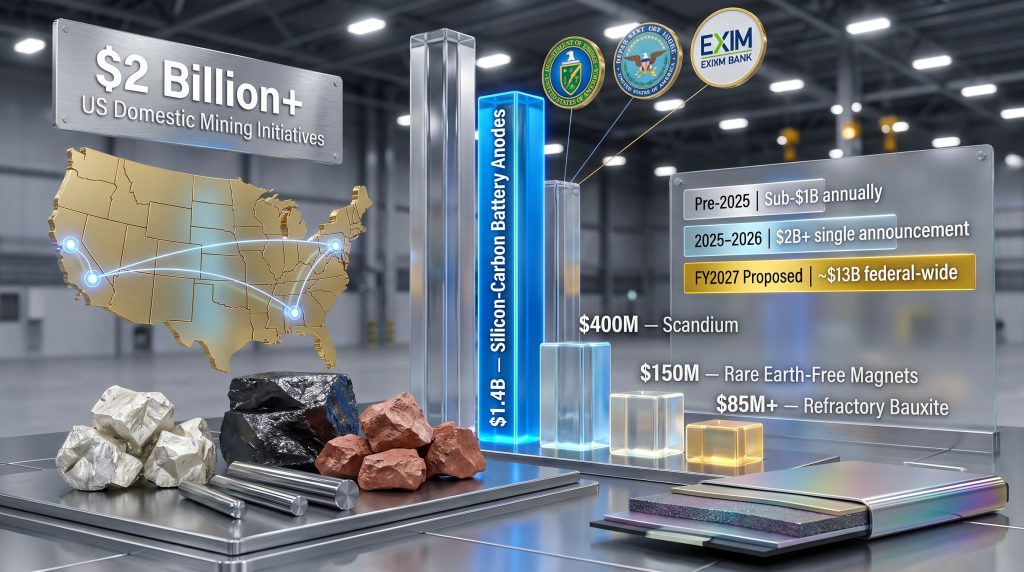
The announcement, delivered during an industry roundtable hosted by President Donald Trump, confirmed more than $2 billion in new project funding alongside more than $180 million in workforce and education investment. The funding spans five distinct categories.
Advanced Battery Materials: The Largest Single Commitment
The most significant single allocation in the package is $1.4 billion directed to Sila Nanotechnologies, a California-based advanced materials company, to expand manufacturing capacity for silicon-carbon battery anodes and lithium-ion battery cells.
Silicon-carbon anode technology represents a meaningful generational step beyond conventional graphite anodes. Graphite-based anodes, which currently dominate lithium-ion battery manufacturing, are largely sourced from China. Silicon-carbon composites offer substantially higher energy density, but have historically presented challenges around volumetric expansion during charge cycles.
The strategic rationale here extends beyond energy storage. Domestic anode manufacturing capacity is a prerequisite for any credible US EV supply chain security position. Without it, domestically assembled battery packs remain dependent on foreign-sourced active materials. In addition, the critical minerals executive order signed in early 2025 explicitly prioritised battery material sovereignty as a national security concern.
Rare Earth-Free Permanent Magnets: A $150 Million Strategic Hedge
Minnesota-based Niron Magnetics is set to receive $150 million to develop permanent magnets that do not rely on rare earth elements for defence applications. This allocation deserves careful analysis because it represents a technology bet rather than a production investment.
Conventional high-performance permanent magnets, of the type used in missile guidance systems, electric motors, wind turbines, and advanced robotics, rely on neodymium-iron-boron (NdFeB) compositions. The concerns around rare earth supply chains are well documented, given that the rare earth elements required for these magnets are predominantly processed in China.
Niron's iron nitride-based magnet technology, if it achieves commercial performance parity with NdFeB magnets, would structurally reduce this dependency. The $150 million commitment reflects both the magnitude of the strategic upside and the genuine technological risk involved. Federal investment at this scale signals a willingness to accept that risk in exchange for the strategic optionality the technology provides.
Scandium Value Chain: A $400 Million Bet on an Overlooked Metal
$400 million has been allocated to Sunrise Energy Metals for establishing an end-to-end scandium production and processing ecosystem. Scandium sits in a peculiar position in the critical minerals landscape: it is strategically important, genuinely scarce in terms of concentrated deposits, and almost entirely absent from US domestic production.
Scandium's primary commercial significance lies in its alloying properties. When added to aluminium in concentrations as low as 0.1 to 0.3 percent by weight, scandium dramatically increases strength, weldability, and corrosion resistance while reducing weight. These properties are directly relevant to aerospace structural components and advanced defence platforms.
Global scandium supply is extremely limited and concentrated. Most commercial scandium is produced as a byproduct of uranium and titanium mining in Russia and Ukraine, creating a supply profile that is both geopolitically exposed and volume-constrained. Consequently, establishing a dedicated domestic scandium value chain would be a structurally significant development for US aerospace and advanced manufacturing.
Refractory-Grade Bauxite: The Industrial Base Protection Play
More than $85 million has been committed to Standard Bauxite to support the domestic supply of refractory-grade bauxite. This allocation tends to receive less media attention than battery materials or rare earths, but its industrial logic is equally important.
Refractory bauxite is not the same material used in primary aluminium smelting. High-alumina refractory-grade bauxite is used to manufacture the heat-resistant linings in steel furnaces, aluminium smelters, cement kilns, and other high-temperature industrial processes. Without reliable refractory supply, the US steel and aluminium industries face a secondary import dependency that is rarely discussed in mainstream critical minerals policy dialogue.
EXIM Bank's Targeted Mineral Financing
The Export-Import Bank of the United States deployed targeted financing across three companies:
| Company | State | Material | EXIM Allocation |
|---|---|---|---|
| 5E Advanced Materials | California | Boron | $8 million |
| Westwater Resources | Alabama | Graphite | $25 million |
| Global Advanced Materials | Pennsylvania | Tantalum and Niobium | $25 million |
The EXIM Bank's activation as a domestic mineral financing instrument is itself a notable institutional development. Its traditional mandate centres on supporting US export competitiveness, and its deployment here toward domestic production financing represents a meaningful expansion of that role. EXIM Chairman John Jovanovic has publicly framed this as part of a broader strategy to fortify supply chains and restore industries that support well-paying American jobs, whilst protecting the domestic economy from external supply disruptions.
The DOE's Parallel Investment Architecture
Alongside the project funding announced at the industry roundtable, the Department of Energy has committed up to $855 million across complementary programmes.
Mine of the Future and Byproduct Recovery
The Department of Energy's critical minerals programme is central to this effort, funding two key initiatives:
- Up to $275 million targets the recovery of critical minerals from industrial and coal processing byproducts, transforming legacy waste streams into domestic supply assets
- Up to $80 million funds the Mine of the Future proving-ground programme, designed to pilot next-generation extraction technologies at operational scale
The byproduct recovery initiative is particularly significant from a geological and processing standpoint. Many industrial waste streams, including coal fly ash, phosphate processing residues, and tailings from base metal operations, contain meaningful concentrations of rare earth elements and other critical minerals. New hydrometallurgical and bioleaching techniques are changing the economics of extraction from these sources.
The $500 Million Processing, Recycling, and Manufacturing Push
A three-pronged investment covering mineral processing infrastructure, battery material recycling, and advanced manufacturing scale-up addresses what analysts broadly identify as the most critical bottleneck in the US mineral value chain. The US has documented mineral deposits, but limited domestic refining and value-add capacity. Raw ore exported for processing offshore returns as finished product at a substantial value premium that accrues to foreign processors.
ARPA-E's MINER Program and Pilot-Scale Investments
- $39 million across 16 projects through the ARPA-E MINER programme, focused on increasing mineral yield while reducing energy intensity and emissions per tonne extracted
- $45.7 million across 19 pilot-scale projects targeting specific supply chain gaps, with emphasis on magnesium and rare earth element processing
The ARPA-E MINER programme applies advanced engineering approaches to extraction efficiency, including sensor fusion for real-time ore grade assessment, selective leaching technologies, and AI-driven process optimisation. These are not incremental improvements; they represent a technology-first approach to solving the productivity and environmental footprint challenges that have made domestic mining economically and politically difficult for decades.
Workforce Investment: The Often-Overlooked Strategic Variable
Capital without skilled operators, engineers, and geoscientists cannot translate into production. This is a lesson that the semiconductor industry learned expensively, and one that the current administration appears to have internalised in designing the mineral investment package.
The workforce component of the initiative includes:
- $100 million from the Department of Energy directed to 14 mining schools to double enrolment and qualification output in mining and minerals-related disciplines
- Over $80 million from the Department of Defense to three institutions for workforce development and technological innovation programmes
The structural workforce contraction in US mining has been severe. Mining engineering programme enrolments declined significantly from the 1980s through the 2010s, and many universities reduced or eliminated specialised mining and mineral processing programmes. Rebuilding this pipeline requires a decade-long investment horizon, which means the funding announced today will yield its human capital returns in the 2030s. This is not a criticism; it is a recognition that systemic problems require systemic timeframes.
The Policy Architecture: Executive Orders and Budget Commitments
The project funding sits within a broader policy framework that reflects surging critical minerals demand and is supported by executive orders in early 2025 mandating cross-agency coordination of loans, capital assistance, technical support, and working capital for domestic mineral projects. Those directives also called for a dedicated domestic mineral production fund and expanded use of public financing tools.
The FY2027 budget proposal takes this further, with approximately $13 billion in proposed federal financing and resources directed toward critical mineral supply chain security. This includes $364 million specifically for the Department of Energy's Office of Advanced Mining and Mineral Production Technologies.
The progression is instructive:
| Policy Era | Primary Instrument | Annual Scale | Strategic Focus |
|---|---|---|---|
| Pre-2025 | Fragmented agency grants | Sub-$1 billion | Research and development |
| 2025 to 2026 | Multi-agency coordinated deployment | $2 billion+ single tranche | Full value chain: extraction to manufacturing |
| FY2027 Proposed | Systemic budget allocation | ~$13 billion federal-wide | Supply chain security and industrial base rebuilding |
The next major ASX story will hit our subscribers first
Priority Minerals and Their Strategic Rationale
Across all funding streams, certain minerals emerge as the highest-priority targets:
- Silicon-carbon anode materials and graphite: Battery dominance and EV supply chain security
- Rare earth alternatives and rare earth processing capacity: Defence and clean energy applications with reduced China exposure
- Scandium: Aerospace structural applications and solid oxide fuel cell development
- Boron: Industrial chemicals, speciality glass, semiconductor manufacturing, and nuclear neutron absorption applications
- Tantalum and niobium: High-performance electronics, aerospace superalloys, and medical device manufacturing
- Refractory bauxite: Industrial base support for steel and aluminium manufacturing
Risks, Limitations, and the Gap Between Funding and Production
A sober assessment of this investment wave requires acknowledging what capital alone cannot solve.
Permitting timelines for new mining operations in the US remain among the longest in the developed world, often spanning seven to ten years from initial application to production approval. Federal funding does not accelerate state-level environmental review processes. Technology readiness levels for some funded projects, particularly rare earth-free permanent magnets, remain well below commercial deployment thresholds.
Workforce development funding will take years to translate into qualified professionals in the field, and the institutional capacity of mining schools to rapidly double enrolment without compromising programme quality is a genuine logistical challenge. However, Defense Production Act support may help streamline some of these processes by classifying critical mineral production as a national defence priority.
"The gap between announced funding and operational production capacity is measured in years, not months. Investors and policymakers should calibrate their expectations accordingly."
Market conditions also remain a significant variable. Critical mineral prices are notoriously cyclical. Projects that are economically viable at current price levels may face different dynamics by the time they reach production, potentially affecting the commercial sustainability of federally supported operations.
What This Signals for the Industry's Long-Term Trajectory
The coherence and scale of the current US domestic mining initiatives funding programme represents something genuinely new in the modern history of American industrial policy. The deliberate use of public capital to de-risk private investment across the full mineral value chain draws structural parallels with the CHIPS Act framework for semiconductor manufacturing, and with post-WWII industrial mobilisation decisions that shaped the twentieth century's economic geography.
Whether this investment translates into durable domestic production capacity will depend on sustained political commitment across administration cycles, resolution of the permitting bottleneck, and the ability of funded technologies to achieve commercial performance at scale. What is clear is that the direction of travel has changed, and the scale of federal commitment makes a reversal to pre-2025 policy norms increasingly unlikely.
For companies operating in the critical minerals space, the message embedded in this funding architecture is unambiguous: domestic production is no longer a niche strategic preference. It is federal policy at a scale not seen in decades.
Want to Stay Ahead of the Next Major Mineral Discovery?
As the US doubles down on critical mineral sovereignty and federal capital flows into the sector at historic scale, the window for early-mover advantage narrows fast. Discovery Alert's proprietary Discovery IQ model scans ASX announcements in real time, delivering instant alerts on significant mineral discoveries — from rare earths to battery materials — so subscribers can act before the broader market catches on. Explore Discovery Alert's discoveries page to see how historic finds have generated extraordinary returns, and start your 14-day free trial today to position yourself at the forefront of the next major find.