August 10, 2026
The Incomplete Tariff Wall: Why Protecting Smelters Without Protecting Fabricators Falls Short
Trade policy designed to protect a single node in a manufacturing chain often creates unintended vulnerabilities elsewhere. The US aluminium downstream tariffs domestic supply chain illustrates this tension with particular clarity. When tariffs are applied exclusively at the primary metal level, foreign manufacturers can sidestep the cost burden entirely by converting cheaper overseas aluminium into finished goods and exporting those value-added products directly into the American market. The result is a protected smelting sector sitting atop an exposed fabrication base, a structural inconsistency that the expansion of Section 232 to downstream derivatives is now attempting to resolve.
Understanding why this matters requires tracing how the US aluminium supply chain reached its current state of fragility, and what the data actually reveals about whether trade protection is translating into industrial recovery.
When big ASX news breaks, our subscribers know first
How Four Decades of Smelter Attrition Created Structural Import Dependency
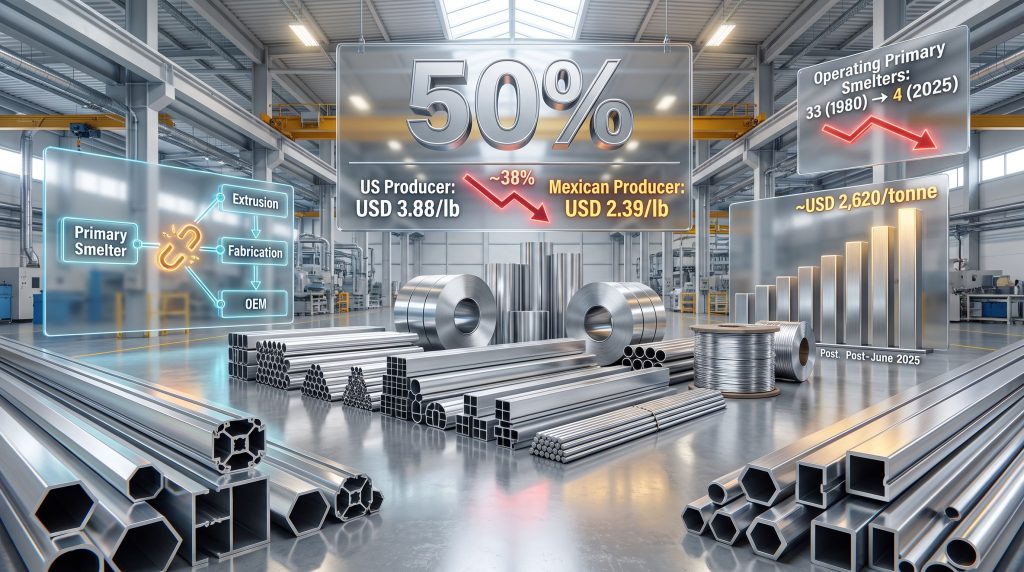
The scale of US aluminium's industrial contraction is difficult to overstate. In 1980, the country operated 33 primary aluminium smelters. By 2025, that figure had fallen to just four. Annual primary production, which reached approximately 1.59 million tonnes in 2015, dropped by 58.49% over the following decade to just 660,000 tonnes in 2025. Installed smelting capacity has remained static at 1.31 million tonnes, and no new primary smelter has been commissioned anywhere in the United States for 45 years.
| Metric | Historical Peak | 2025 Figure | Change |
|---|---|---|---|
| Operating primary smelters | 33 (1980) | 4 | -88% |
| Annual primary production | ~1.59M tonnes (2015) | 660,000 tonnes | -58.49% |
| Installed smelting capacity | — | 1.31M tonnes | Unchanged since 2024 |
| New smelters built (last 45 years) | — | 0 | — |
The Electricity Cost Barrier: Why New Capacity Remains Commercially Unviable
The single most intractable obstacle to domestic smelter recovery is electricity pricing. Power accounts for approximately 40% of total aluminium smelting costs, making access to affordable, long-term electricity contracts a prerequisite for commercial viability. Modelling consistently points to a threshold of USD 40/MWh or below as the upper boundary for a new US smelter to generate acceptable returns on invested capital.
The problem is that the four US states with idle smelting capacity currently average USD 73.42/MWh for industrial electricity, nearly double the viability threshold. This is not a marginal gap that targeted subsidies could easily bridge. It represents a structural cost disadvantage rooted in energy market dynamics that trade policy alone cannot address.
Furthermore, as the Fraser Institute's analysis of unintended supply chain vulnerability demonstrates, the consequences of failing to account for these structural gaps can be far-reaching and difficult to reverse once embedded.
Without a credible pathway to long-term power contracts at commercially viable rates, the electricity cost barrier will continue to prevent new primary smelting capacity from entering service regardless of how high import tariffs are set.
This reality explains why, despite years of Section 232 protection, domestic production has not meaningfully recovered. The tariff framework addresses import competition but does not resolve the underlying energy economics that make building a new US smelter financially unattractive.
From Producer to Importer: The Sectoral Transformation
As domestic smelting capacity contracted, demand from automotive, aerospace, packaging, construction, and electrical manufacturing sectors continued expanding. The structural gap between what the US produces and what it consumes was progressively filled by imports. This shift from producer to importer did not happen suddenly. It unfolded gradually over decades as energy-intensive smelting migrated toward regions with abundant hydroelectric power or subsidised electricity, including Canada, the Middle East, and parts of Europe and Asia.
Section 232: The Policy Architecture and Its 2026 Expansion
The Original National Security Rationale
Section 232 tariffs were introduced in March 2018 following a formal determination that the United States' excessive dependence on imported aluminium posed a national security vulnerability. The policy objectives were deliberately broad: restricting imports was only one goal. Policymakers also aimed to restart idle smelting capacity, attract new manufacturing investment, create employment in industrial communities, and rebuild a supply chain capable of reliably serving defence, energy, and critical infrastructure applications.
The US steel and aluminium tariffs introduced in 2018 set the foundation for this framework, and the 2025 escalation extended these objectives by introducing a universal 50% tariff on aluminium imports from most countries, substantially increasing the cost penalty on overseas suppliers while providing additional margin support for domestic producers.
The 2026 Downstream Tariff Framework: Rates, Coverage, and Thresholds
The June 2026 proclamation extended Section 232 coverage to aluminium derivative products, creating a tiered tariff structure based on aluminium content and product category:
| Policy Layer | Rate | Scope | Effective Date |
|---|---|---|---|
| Universal Section 232 tariff | 50% | Most aluminium-exporting countries | 2025 |
| General downstream/derivative goods | 25% | Listed aluminium derivative articles | June 8, 2026 |
| High-aluminium-content products | 50% | Products made almost entirely of aluminium | June 8, 2026 |
| Selected industrial/power equipment | 15% | Specific machinery categories | Through 2027 |
| Low-metal-content products (≤15% metal) | Exempt from Section 232 | Falls under standard tariff rules | 2026 |
A key provision within the 2026 framework is the 85% US metal-content threshold. Products manufactured using aluminium that meets an 85% US-smelted and US-cast content standard are treated as having wholly domestic metal content for duty calculation purposes. This creates a meaningful commercial incentive for supply chain localisation, rewarding manufacturers who source domestically while penalising those who continue relying on imported feedstock.
What Is the US Aluminium Downstream Tariff Rate in 2026?
As of June 8, 2026, most listed aluminium derivative products face a 25% Section 232 tariff. Products composed almost entirely of aluminium are subject to a 50% rate. A reduced 15% rate applies to certain industrial machinery through 2027, and products with 15% or less aluminium content by value are exempt from Section 232 and fall under standard tariff classifications.
Has Section 232 Delivered on Its Objectives? A Data-Driven Assessment
Import Volume Suppression: Where the Policy Has Worked
The quantitative evidence for import suppression is clear. Primary aluminium imports declined 16.53% year-on-year, falling from 3.63 million tonnes in 2024 to 3.03 million tonnes in 2025. This compares favourably even with the original 2018 tariff introduction, which generated a 14.34% year-on-year contraction in import volumes, from 4.88 million tonnes in 2017 to 4.18 million tonnes in 2018.
The proportionally steeper decline in 2025 reflects the more aggressive tariff rate, confirming that the escalation to 50% is generating a stronger import suppression effect than the original policy design. The broader US aluminium tariffs impact on market dynamics has consequently become one of the most closely watched developments across global commodity trading desks.
Domestic Production: The Persistent Gap
Despite the improvement in import volumes, domestic smelting capacity has not responded. Production capacity has remained static at 1.31 million tonnes throughout 2025, with no meaningful new facilities entering service. The Emirates Global Aluminium (EGA) proposed smelter project in Oklahoma, one of the most prominent potential capacity additions, faces a 60-day construction moratorium, introducing further uncertainty around when, or whether, meaningful new primary supply will materialise.
The implication is significant. Tariff policy has successfully reduced import volumes without generating the domestic supply response needed to replace foreign metal. The result is a tighter overall supply environment with higher prices, rather than a genuine supply chain rebuilding.
The Downstream Sector Absorbs a Compounding Cost Burden
For extruders, rolling mills, foundries, can sheet producers, and automotive-grade fabricators, the current environment combines two simultaneous pressures. First, domestic primary aluminium supply is insufficient to meet fabrication demand. Second, imported feedstock has become significantly more expensive due to elevated tariffs.
These manufacturers face higher input costs without a corresponding increase in domestic metal availability, placing them in a structurally difficult competitive position. The knock-on effects across aluminium and alumina markets have consequently been felt well beyond the United States border, influencing global pricing benchmarks and trade flow redirections.
The Coalition for a Prosperous America has articulated this as a fundamental policy inconsistency. A tariff on primary metal flows directly into the US country premium, meaning that every extruder and fabricator operating in the United States absorbs that cost. Foreign manufacturers who fabricate offshore and import the finished product do not bear the same burden, provided those finished goods were not yet covered by downstream tariff measures. This asymmetry is precisely the gap the 2026 derivative tariff expansion is designed to close.
The Midwest Premium: How Tariff Policy Transmits Through the Entire Value Chain
Understanding the All-In US Aluminium Price Structure
Aluminium transactions in the United States are not priced on the LME benchmark alone. A regional premium is layered on top, incorporating freight, storage, insurance, financing, local supply conditions, and applicable tariffs. This Midwest premium has become an increasingly dominant component of the all-in transaction cost, now accounting for more than 40% of the total US aluminium price.
Premium Escalation: A Timeline of Tariff Transmission
| Period | Midwest Premium Level |
|---|---|
| Pre-escalation (early 2025) | Moderate baseline |
| Post-50% tariff introduction (June 2025) | Sharp upward trajectory begins |
| November 2025 | USD 1,942/tonne (88.10 cents/lb) — a 77% rise in seven weeks |
| Early May 2026 | ~USD 2,529/tonne |
| Peak (May 2026) | ~USD 2,620/tonne |
| Mid-July 2026 | ~USD 2,374/tonne |
The premium's trajectory illustrates a critical dynamic that is often underappreciated in trade policy debates: tariff costs do not remain at the border. They propagate through the entire domestic value chain. Every tonne of aluminium purchased by a US fabricator, whether domestically sourced or imported, carries the Midwest premium. Until new primary smelting capacity enters production at meaningful scale, this elevated premium is likely to persist as a structural feature of the US market rather than a temporary disruption.
The USMCA Variable: How a Single Exemption Could Reshape US Downstream Competitiveness
The Cost Arithmetic Behind a Mexican Exemption Scenario
The ongoing review of the United States-Mexico-Canada Agreement introduces a scenario that could materially undermine the downstream tariff framework's protective intent. Under the current full 50% Section 232 tariff regime, the estimated landed cost of an extruded aluminium product is approximately USD 3.88/lb for a US producer versus USD 3.59/lb for a Mexican producer.
If Mexico were to receive a USMCA-based exemption from Section 232 downstream tariffs, that landed cost calculation shifts dramatically. A Mexican producer's estimated landed cost would fall to approximately USD 2.39/lb, creating a roughly 38% cost advantage over the equivalent US-manufactured product. This is not a marginal difference that can be absorbed through operational efficiencies. It represents a gap large enough to fundamentally alter sourcing decisions across entire product categories.
Why Supplier Transitions Create Durable Market Share Shifts
A less widely understood dynamic in the downstream aluminium market is the certification timeline that governs supplier changes. OEM qualification processes, technical approvals, and buyer certification procedures for aluminium derivative products typically require 12 to 24 months to complete. This means that even a temporary cost advantage, if sustained long enough for buyers to complete the qualification cycle, can result in supply chain migration that persists well beyond the period of the original cost differential.
Strategic Risk: A prolonged USMCA exemption gap does not need to be permanent to cause lasting damage to US downstream market share. Once buyers qualify alternative sources, the cost of switching back creates a durable competitive disadvantage for domestic fabricators even if tariff parity is later restored.
The next major ASX story will hit our subscribers first
The Downstream Import Data: Evidence for Extending the Tariff Wall
A Decade of Rising Derivative Exposure
One of the most compelling empirical arguments for extending Section 232 coverage to downstream products is the trajectory of derivative import volumes over the past decade. Despite primary metal tariffs being in place since 2018, imports of aluminium derivatives including bars, rods, profiles, tubes, and wire have remained stubbornly elevated.
| Year | Import Volume (Bars, Rods, Profiles, Tubes, Wire) | Change vs. 2016 |
|---|---|---|
| 2016 | 501,516 tonnes | Baseline |
| 2022 | 679,628 tonnes | +35.52% (peak) |
| 2025 | 579,001 tonnes | +15.45% |
Even after years of primary metal protection, 2025 derivative import volumes remain 15.45% above 2016 baseline levels. The 2022 peak at 679,628 tonnes — a 35.52% increase over 2016 — demonstrates the degree to which downstream trade channels absorbed import demand that primary metal tariffs were structurally unable to intercept. This data forms the empirical foundation for the argument that downstream coverage is not simply an extension of existing policy but a necessary complement to it.
As Prosperous America's analysis of downstream tariff coverage makes clear, securing the entire aluminium supply chain requires extending protection well beyond the primary smelting stage to ensure fabricators and manufacturers are not left exposed.
Three Scenarios for US Aluminium Supply Chain Outcomes
The trajectory of the US aluminium domestic supply chain over the next several years will depend on the interaction of tariff policy, energy markets, and trade agreement negotiations. Three plausible scenarios illustrate the range of possible outcomes:
Scenario 1: Full Downstream Tariff Enforcement Without USMCA Exemptions
- US fabricators achieve cost parity with foreign competitors across most product categories.
- Domestic downstream investment increases as margin visibility improves.
- Risk: input cost inflation continues if domestic primary supply does not expand to compress the Midwest premium.
Scenario 2: Downstream Tariffs With a USMCA Exemption for Mexico
- Mexican extruders gain a roughly 38% cost advantage over US counterparts.
- OEM qualification cycles begin shifting sourcing toward exempt-country suppliers.
- Tariff policy succeeds at restricting primary metal imports but fails to protect the fabrication sector, the largest employer in the value chain.
Scenario 3: New Domestic Smelting Capacity Enters Service
- Midwest premium compression reduces the input cost burden for downstream manufacturers.
- The domestic supply chain becomes structurally more competitive without relying solely on tariff barriers.
- Currently constrained by electricity costs averaging USD 73.42/MWh against a USD 40/MWh viability threshold, capital requirements, and the EGA Oklahoma moratorium.
What Tariffs Alone Cannot Solve: The Structural Reform Agenda
The Policy Gaps That Must Be Addressed in Parallel
Trade protection can reshape import cost structures and alter sourcing incentives, but it cannot independently rebuild a manufacturing base that has atrophied over four decades. Several structural reforms are required alongside tariff policy to create the conditions for genuine supply chain recovery:
- Long-term industrial power agreements at commercially viable rates at or below USD 40/MWh, potentially through federal energy infrastructure investment or negotiated arrangements with power utilities hosting idle smelter sites.
- Streamlined permitting frameworks that reduce timeline risk and capital uncertainty for greenfield primary smelting projects.
- Domestic scrap recovery and secondary aluminium capacity expansion, which offers a near-term feedstock alternative that bypasses primary supply constraints entirely. Recycled aluminium requires only around 5% of the energy needed to produce primary metal, making it a strategically important complement to new smelter development. In this context, investing in recycling supply chains represents one of the most energy-efficient pathways to closing the domestic feedstock gap.
- Strategic alignment between trade policy and energy policy to ensure the electricity cost barrier does not permanently prevent supply chain reconstruction regardless of how favourable the tariff environment becomes.
Measuring Policy Success Beyond Import Volume Metrics
Import volume reduction is a measurable and politically visible outcome, but it represents an incomplete success metric for Section 232. A tariff regime that suppresses imports without generating domestic capacity growth functions primarily as a cost-transfer mechanism. It raises prices for domestic fabricators and consumers without producing the industrial investment and employment creation that justified the national security rationale in the first place.
The true measure of Section 232's effectiveness will be whether sustained trade protection translates into new primary smelting projects breaking ground, downstream fabricators expanding capacity, and the Midwest premium compressing as domestic supply improves. The broader question of how tariffs and supply chains interact over the long term remains one of the most consequential challenges facing US industrial policy. Until those outcomes materialise, the US aluminium downstream tariffs domestic supply chain will remain structurally dependent on imported metal, paying a premium for the privilege.
Frequently Asked Questions: US Aluminium Downstream Tariffs and Supply Chain Dynamics
What Are Section 232 Aluminium Derivative Tariffs?
Section 232 derivative tariffs extend trade protection beyond primary aluminium to cover semi-finished and finished goods containing aluminium as a significant material input, including extrusions, tubes, rods, wire, and fabricated components with meaningful aluminium content.
What Tariff Rate Applies to Aluminium Extrusions Imported Into the US in 2026?
As of June 8, 2026, most listed aluminium derivative products including extrusions are subject to a 25% Section 232 tariff. Products composed almost entirely of aluminium face a 50% rate.
Why Hasn't Section 232 Increased US Primary Aluminium Production?
Domestic smelting capacity has remained static at approximately 1.31 million tonnes despite tariff protection. The core barrier is electricity costs averaging USD 73.42/MWh in states with idle smelting capacity, nearly double the USD 40/MWh viability threshold required for a new smelter to be commercially attractive.
How Does the Midwest Premium Affect Downstream Manufacturers?
The Midwest premium is added to the LME benchmark and now accounts for more than 40% of the all-in US aluminium transaction cost. It reached approximately USD 2,620/tonne at its 2026 peak, directly increasing input costs for every US fabricator purchasing aluminium regardless of whether that metal is domestically sourced or imported.
What Is the 85% US Metal-Content Threshold?
Under the 2026 Section 232 proclamation, products manufactured using aluminium meeting an 85% US-smelted and US-cast content standard are treated as having wholly domestic metal content for duty calculation purposes, enabling access to reduced tariff treatment and creating a commercial incentive for supply chain localisation.
Could USMCA Exemptions Undermine Downstream Tariff Protection?
If Mexico receives a USMCA-based exemption, modelling suggests Mexican extruders could achieve a landed cost of approximately USD 2.39/lb versus USD 3.88/lb for equivalent US-produced goods, a roughly 38% cost differential capable of driving gradual supply chain migration across a 12 to 24 month OEM qualification cycle.
Disclaimer: This article contains forward-looking analysis, scenario projections, and cost modelling based on publicly available data and industry reporting. These projections involve assumptions that may not be realised and should not be interpreted as financial or investment advice. Readers are encouraged to conduct independent research and consult appropriate professional advisors. Further context on US aluminium trade policy and downstream market dynamics is available through industry analysis published by AL Circle at alcircle.com.
Want to Identify the Next Major Commodity Discovery Before the Market Does?
While trade policy reshapes aluminium supply chains and commodity markets worldwide, Discovery Alert's proprietary Discovery IQ model scans ASX announcements in real time, instantly identifying significant mineral discoveries across more than 30 commodities and translating complex data into actionable investment insights. Explore historic discovery returns on Discovery Alert's dedicated discoveries page and begin your 14-day free trial today to position yourself ahead of the broader market.