August 10, 2026
The Structural Fault Lines in Energy Storage That Are Pushing Chemistry Beyond Lithium
Every dominant technology carries the seeds of its own disruption. For lithium-ion batteries, those seeds are becoming increasingly visible: concentrated supply chains, price volatility in critical materials, documented safety incidents, and a growing mismatch between what grid-scale storage demands and what lithium-based chemistries can economically deliver. Eqonic aluminium battery technology represents one of the most closely watched responses to this structural challenge.
The global push toward renewable energy has amplified these tensions considerably. Grid operators need storage that is not just technically capable, but also affordable, safe to install at scale, and free from geopolitical supply risk. Lithium, cobalt, and nickel — the core materials underpinning most commercial battery systems — source predominantly from a small number of countries, creating structural vulnerabilities that energy planners are now actively trying to engineer around.
This is the environment in which alternative battery chemistries are gaining serious institutional attention. The battery raw materials market is under increasing pressure, and among the emerging responses, aluminium-based systems occupy a particularly interesting position: abundant, recyclable, supported by existing global industrial infrastructure, and capable of electrochemical operation without the fire risk associated with conventional lithium cells.
UK-based Eqonic Group is among the companies advancing this direction. Its August 2026 confirmation that aluminium will serve as the core material in its next-generation battery platform marks a meaningful step in a technology category that has attracted growing scrutiny from investors, governments, and energy developers alike.
Important context: As of mid-2026, no aluminium-based battery chemistry has reached commercial-scale production anywhere in the world. Eqonic's development represents a pre-commercial platform currently moving toward industrial validation, not a commercially deployed product.
When big ASX news breaks, our subscribers know first
Understanding Eqonic: What the Company Has Built and Where It Is Headed
Company Background and Strategic Positioning
Eqonic Group is a UK-based energy storage technology developer founded with a clear thesis: that the next generation of stationary and industrial battery systems should be built around materials that are geographically accessible, inherently safe, and structurally cheaper to produce at scale than lithium-based alternatives.
The company is led by founder and CEO Jas Kandola, whose strategic rationale centres on achieving a combination of material abundance, elevated safety, and reduced cost simultaneously, rather than accepting the compromises that chemistries built around lithium, sodium, or rare earth elements have historically required. Eqonic's development roadmap deliberately targets stationary storage, industrial energy management, and critical infrastructure applications rather than consumer electric vehicles — a pragmatic choice that reflects where the company's current technology profile is most competitive.
The past year has seen Eqonic execute a disciplined sequence of milestones designed to progress the technology from development toward commercial readiness:
| Timeline | Development Activity |
|---|---|
| February 2026 | Senior management expanded with appointments in banking, regulatory, and legal roles |
| May 2026 | Strategic partnership signed with Barton Knight Group for UK storage and renewable energy deployment |
| June 2026 | Selected to participate in the UK Government's £452 million Battery Innovation Programme (Innovate UK) |
| August 2026 | Aluminium confirmed as core battery material; industrial validation phase publicly announced |
The sequential nature of these steps is notable. The addition of banking and regulatory expertise to the senior team in February signals preparation for capital raising and compliance processes. The Barton Knight Group partnership in May indicates commercial intent beyond the laboratory. Furthermore, Innovate UK selection in June provides institutional validation of the technology's credibility before the August confirmation of aluminium as the core material.
How Eqonic Aluminium Battery Technology Actually Works
What Has Been Publicly Disclosed
Eqonic's battery platform is built around aluminium as its primary electrochemical material. The architecture deliberately excludes lithium, sodium, and rare earth elements — a design choice with direct implications for supply chain structure, material procurement costs, and end-of-life recyclability. For further context on how this compares to conventional options, aluminium battery technology versus lithium-ion systems reveals some striking differences in safety and cost profiles.
The company describes its chemistry as non-flammable, asserting that it eliminates the thermal runaway behaviour that presents a documented safety hazard in conventional lithium-ion systems. Thermal runaway is a self-reinforcing reaction cascade that can cause lithium-based cells to combust or rupture under conditions of overcharging, physical damage, or manufacturing defects. A genuinely non-flammable battery chemistry would substantially reduce the safety infrastructure requirements for grid-scale and industrial installations, potentially including fire suppression systems, minimum separation distances, and operator training protocols.
The company is currently preparing for industrial-scale testing to demonstrate that the technology can be manufactured reliably and perform consistently under real production conditions, rather than only in controlled laboratory environments. This distinction between laboratory performance and industrial manufacturability is critical: it is precisely where many promising battery chemistries have historically encountered their most significant technical barriers.
What Remains Proprietary
Several core technical parameters have not been publicly disclosed. These include the electrolyte composition, the cathode architecture, and the full cell voltage profile. These elements are being protected as trade secrets and are likely covered by pending patent applications.
This means that independent analysis of the electrochemical mechanisms underlying Eqonic's claims — including the basis for its non-flammability assertion and its projected cycle life characteristics — is not yet possible from publicly available information. As of mid-2026, no independent third-party validation of the technology's performance at commercial scale has been published.
Reader advisory: Eqonic's cost targets, performance projections, and safety claims are company-disclosed figures based on the company's own assessments. They have not been independently verified at industrial scale. Readers should evaluate all such claims as pre-commercial projections rather than demonstrated commercial outcomes.
Comparing Aluminium Battery Chemistry to Conventional Lithium-Ion Systems
A Framework Comparison: Aluminium vs. Conventional Battery Chemistries
| Attribute | Lithium-Ion (Conventional) | Eqonic Aluminium (Projected) |
|---|---|---|
| Core Material | Lithium plus rare earth compounds | Aluminium |
| Flammability Risk | Thermal runaway documented | Claimed non-flammable |
| Material Cost (relative) | Baseline (100%) | Approximately 30% of lithium-ion equivalent |
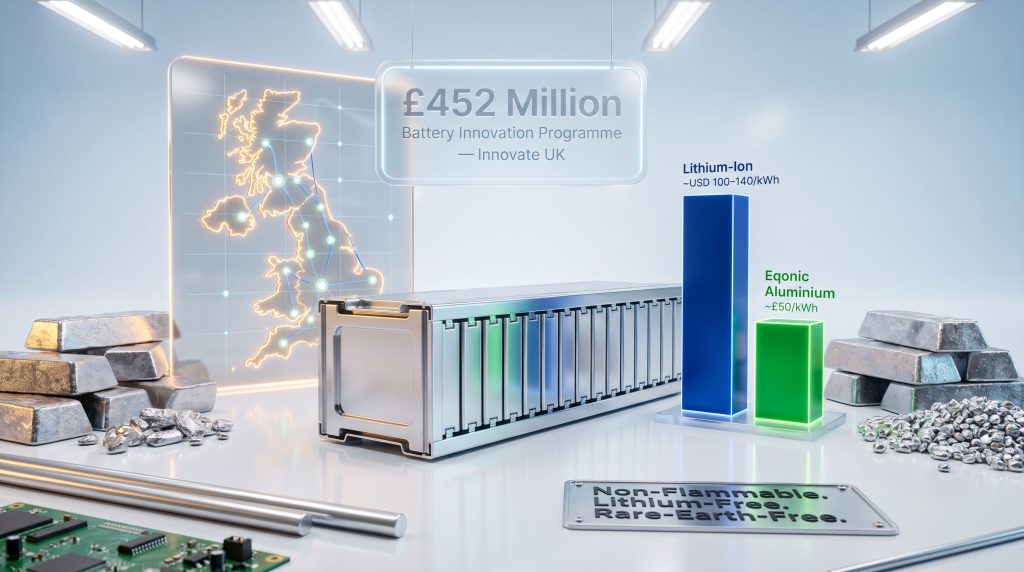
| Target Manufactured Cost | Approximately USD 100-140/kWh (2025-2026 range) | £50/kWh (approximately USD 67/kWh) at scale |
| Commercial Scale Status | Mature and globally deployed | Pre-commercial, industrial validation pending |
| Primary Supply Chain Risk | High (lithium, cobalt, nickel) | Low (aluminium is globally abundant) |
| Primary Application Focus | EVs, consumer electronics, grid | Stationary storage, industrial, critical infrastructure |
Eqonic's material cost target is particularly significant. The company states that its aluminium-based chemistry is designed to bring material costs down to approximately 30% of those associated with conventional lithium-based batteries — a claim that, if achievable at scale, would represent a fundamental restructuring of the battery cost equation for stationary storage applications.
The £50/kWh (approximately USD 67/kWh) manufactured cost target sits notably below current lithium-ion benchmarks. However, this projection is contingent on scaled production, and the cost trajectory from current pre-commercial status to that target involves significant manufacturing optimisation, supply chain development, and yield improvement work that has not yet been publicly validated.
What is Eqonic aluminium battery technology? Eqonic's platform is a lithium-free, sodium-free, and rare-earth-free energy storage system using aluminium as its core electrochemical material. The company targets a manufactured cost of approximately £50/kWh at scale and asserts the chemistry is inherently non-flammable, targeting stationary storage and industrial applications.
The UK Battery Innovation Programme: What Eqonic's Selection Means
The £452 Million Programme and Its Strategic Purpose
Eqonic's selection for the UK Government's £452 million (approximately USD 610 million) Battery Innovation Programme, led by Innovate UK with support from the Department for Business and Trade, is one of the most substantive external credibility signals the company has received to date.
The programme is designed to accelerate battery technology development and build domestic manufacturing capability within the United Kingdom. Within this framework, Eqonic's participation will support the development of a full-stack digital twin of its battery manufacturing process. This is a significant technical mandate: a digital twin models every stage of the production process in simulation, enabling manufacturers to identify bottlenecks, optimise parameters, and predict performance before committing capital to physical production infrastructure.
For a pre-commercial technology like Eqonic's, this represents a structurally valuable form of de-risking. Digital twin development compresses the timeline between laboratory validation and commercial-scale manufacturing by enabling iterative simulation-based optimisation, reducing the number of costly physical prototype cycles required.
It is important to note that programme participation is an institutional credibility signal rather than a guarantee of commercial success or technical validation. Innovate UK's selection criteria reflect the alignment of Eqonic's development goals with the UK's broader industrial strategy objectives, not an endorsement of the technology's performance claims.
The Broader UK Battery Manufacturing Context
The UK faces a distinctive strategic challenge in battery manufacturing. Post-Brexit, the country lost automatic access to EU-coordinated supply chain frameworks and battery development networks, creating urgency around building domestic capability. At the same time, both the EU's own gigafactory programme and the United States' Inflation Reduction Act have created powerful incentives that risk drawing battery investment away from the UK.
In this context, stationary storage technologies may offer a faster commercialisation pathway than EV battery chemistries for UK-based developers. Grid storage applications are less demanding in terms of energy density requirements, which are among the most technically challenging specifications for non-lithium chemistries to meet. This makes stationary and industrial applications a more accessible entry point for alternative battery platforms at their current stage of development.
Deconstructing the Cost Advantage: Where the Savings Are Structurally Embedded
Why Aluminium Changes the Economics of Battery Production
The cost structure of a battery system reflects contributions from raw materials, cell manufacturing, module and pack assembly, and supply chain logistics. Aluminium's characteristics affect several of these categories simultaneously:
-
Raw material procurement: Aluminium is among the most widely traded and extensively recycled metals in the world. Unlike lithium or cobalt, it does not depend on a small number of producing nations for the majority of global supply, reducing both procurement cost volatility and geopolitical exposure.
-
Supply chain geography: Removing lithium, cobalt, and rare earth elements from the supply chain eliminates the most geopolitically sensitive procurement dependencies. Aluminium supply infrastructure exists across multiple continents with well-established logistics and pricing mechanisms.
-
Manufacturing compatibility: Aluminium's properties are well understood within existing industrial fabrication environments. This compatibility with established metalworking infrastructure may reduce the capital expenditure required to establish battery manufacturing capacity compared to chemistries demanding purpose-built production facilities.
-
End-of-life economics: Aluminium has one of the most developed recycling ecosystems of any industrial material globally. Recovered aluminium retains substantial value, which could create a meaningful secondary revenue stream from battery end-of-life processing and reduce net disposal costs. This aligns closely with the broader battery recycling breakthrough developments reshaping end-of-life economics across the sector.
-
Safety compliance costs: If the non-flammable chemistry claim is validated at scale, installations may require less extensive fire suppression infrastructure, lower insurance loadings, and reduced operational safety compliance costs compared to lithium-ion systems.
These structural advantages are embedded in the material selection itself rather than being dependent on manufacturing process innovation alone, which gives the cost thesis a degree of logical coherence even prior to industrial-scale validation.
The next major ASX story will hit our subscribers first
A Critical Assessment: Strengths, Risks, and What to Watch
Factors Supporting Credibility
Several independent signals support taking Eqonic's technology development seriously:
-
Innovate UK programme selection demonstrates that the technology has passed institutional scrutiny from a government body with technical evaluation capabilities.
-
The Barton Knight Group partnership indicates commercial partners are prepared to build deployment relationships before full commercial validation is complete.
-
Management team composition now spans banking, regulatory, and legal expertise alongside technical roles, suggesting the company is preparing for capital-intensive next phases rather than remaining a pure research entity.
-
Scientific basis: Aluminium's electrochemical properties are well established in academic literature. Aluminium-air and aluminium-ion cell architectures have been extensively studied, providing a legitimate scientific foundation for the claims being made, even if Eqonic's specific implementation details remain proprietary.
Risks and Uncertainties That Demand Ongoing Scrutiny
Balancing the positive signals, several material uncertainties remain:
-
No aluminium-based battery chemistry has achieved commercial-scale production anywhere globally as of mid-2026, meaning Eqonic is pursuing a technically and commercially unproven category.
-
Core architecture details, including electrolyte composition, cathode design, and voltage specifications, are undisclosed, making independent technical assessment impossible at this stage.
-
The transition from laboratory performance to consistent industrial manufacturing yield is historically the highest-attrition stage in battery technology development. Many chemistries that performed well in controlled settings have not translated successfully to production environments.
-
All cost and performance projections remain company-disclosed figures without external validation.
The history of battery technology development contains numerous examples of chemistries that demonstrated compelling laboratory results before encountering insurmountable barriers at the manufacturing scale. Industrial validation is not a formality but the genuinely critical test of whether Eqonic's platform can deliver on its stated potential.
Application Landscape: Where Aluminium Batteries Could Compete at Scale
Near-Term Target Markets
Eqonic's current focus on stationary and industrial applications reflects a considered prioritisation of sectors where the technology's current profile is most competitive. Furthermore, the critical minerals demand driven by the energy transition continues to intensify pressure on conventional lithium-based systems, reinforcing the appeal of alternative chemistries:
-
Grid-scale stationary storage: Frequency regulation, peak shaving, and the firming of intermittent renewable generation are high-growth application categories where cost per kWh matters more than gravimetric energy density, favouring aluminium-based systems relative to EV applications.
-
Industrial energy management: Data centres, manufacturing facilities, and logistics infrastructure require reliable backup and peak management capability with high safety standards. A non-flammable chemistry has structural appeal in these environments.
-
Critical national infrastructure: Hospitals, communications networks, and emergency service facilities represent high-value, safety-critical applications where reduced flammability risk is a procurement consideration.
-
Off-grid and remote installations: Locations where lithium supply chain logistics create cost and reliability challenges could represent early commercial opportunities for a chemistry with simpler material sourcing.
Longer-Term Scenarios
If Eqonic achieves its £50/kWh manufactured cost target at scale, the addressable market for its technology expands considerably. Cost-sensitive emerging markets with growing renewable energy penetration but limited capital for expensive storage infrastructure could represent significant long-term demand. Additionally, the potential to displace diesel generator backup systems across industrial settings offers a large, currently underserved application category.
A pathway to EV applications remains a longer-horizon scenario, contingent on achieving energy density improvements that current aluminium chemistries have not yet demonstrated at commercial scale.
Aluminium's Emerging Role in the Post-Lithium Storage Ecosystem
Why Material Diversification in Battery Chemistry Is Now a Strategic Priority
The concentration of critical battery material supply chains has moved from an industry concern to a national security consideration in many countries. The ongoing lithium market downturn has further exposed the fragility of supply chains built around a single dominant chemistry. Lithium supply is concentrated in South America's lithium triangle, cobalt predominantly in the Democratic Republic of Congo, and several rare earth processing operations in China. This geographic concentration creates structural vulnerabilities that no amount of manufacturing efficiency can entirely offset.
Aluminium sits in a fundamentally different position. As the most abundant metallic element in the earth's crust, it is produced commercially across six continents. Its existing trade infrastructure is among the most developed of any industrial metal, and its recycling ecosystem — in which recovered aluminium requires only about 5% of the energy needed to produce primary aluminium from bauxite — creates a genuinely circular material profile.
This positions aluminium-based battery chemistry not merely as a cost story, but as an energy security story — one with increasing relevance to governments evaluating how to build resilient domestic energy storage capacity.
What the Next 12 to 24 Months Should Reveal
Several specific developments will determine whether Eqonic's technology narrative translates into commercial reality:
-
Publication of industrial validation results and any independent performance disclosures from the testing phase currently being prepared.
-
Progress on the digital twin manufacturing model under the Innovate UK programme, which should yield publicly communicable milestones as development advances.
-
Capital raising activity, for which the recent expansion of the management team into banking roles appears to be preparatory.
-
Whether Barton Knight Group deployments proceed to generate real-world operational performance data that can be assessed independently.
In addition, developments in underground lithium mining and other supply-side innovations may influence the competitive dynamics that alternative chemistries like Eqonic's are navigating.
Frequently Asked Questions: Eqonic Aluminium Battery Technology
What Materials Does Eqonic's Battery Use?
Eqonic's platform uses aluminium as its core electrochemical material. The chemistry does not incorporate lithium, sodium, or rare earth elements.
Is Eqonic's Aluminium Battery Commercially Available?
As of August 2026, the technology remains pre-commercial. Eqonic is preparing for industrial-scale validation ahead of any commercial deployment.
How Does Eqonic's Cost Target Compare to Lithium-Ion Benchmarks?
Eqonic targets a manufactured cost of approximately £50/kWh (around USD 67/kWh) at scale, representing roughly 30% of the material costs associated with conventional lithium-based batteries, according to the company's own projections.
Why Does the Non-Flammable Claim Matter for Commercial Applications?
Thermal runaway is a documented failure mode in lithium-ion systems that can result in fire or explosion. A non-flammable chemistry, if validated, would reduce safety infrastructure requirements and potentially lower compliance costs across stationary and industrial installations.
Has Eqonic's Technology Been Independently Verified?
No independent third-party validation of commercial-scale performance has been publicly released as of mid-2026. Programme selection by Innovate UK represents an institutional credibility signal but is not equivalent to independent technical verification of performance claims.
What Is the UK Battery Innovation Programme?
A £452 million (approximately USD 610 million) initiative led by Innovate UK, with support from the Department for Business and Trade, designed to accelerate battery technology development and domestic manufacturing capability across the United Kingdom. For further reading on the company's technical claims and strategy, Eqonic's official platform provides additional background on its development roadmap.
Furthermore, for those interested in a technical industry perspective on how aluminium-based chemistries are being positioned commercially, reporting from Electric Motor Engineering provides useful supplementary context on the broader aluminium battery landscape.
Readers seeking broader context on aluminium industry dynamics and downstream technology developments may find additional coverage through AL Circle's reporting on the global aluminium market at alcircle.com.
This article contains forward-looking statements and company-disclosed projections that have not been independently verified. Nothing in this article constitutes financial advice. Readers should conduct their own due diligence before making any investment decisions related to companies or technologies discussed.
Want to Stay Ahead of the Next Major Mineral Discovery?
Discovery Alert's proprietary Discovery IQ model delivers real-time alerts on significant ASX mineral discoveries — instantly transforming complex mineral data into clear, actionable investment insights for both new and experienced investors. Explore Discovery Alert's dedicated discoveries page to understand how major mineral discoveries have historically generated substantial market returns, and begin your 14-day free trial today to position yourself ahead of the broader market.