August 10, 2026
North Africa's Energy Crossroads: Why Land-Based Oil Corridors Are Reshaping Regional Supply Strategy
The global oil market has spent decades optimising around maritime chokepoints, treating seaborne crude transport as the default architecture of energy supply. Yet every time a major shipping corridor faces disruption, the economic and strategic logic of overland pipelines gains renewed force. The Strait of Hormuz, long considered a structural vulnerability in Middle Eastern crude flows, has demonstrated precisely this dynamic in 2026, pushing neighbouring states to reconsider land-based alternatives with fresh urgency.
Nowhere is this recalibration more visible than across North Africa, where Egypt and Libya are actively studying a proposal that has circulated through planning cycles for years: a dedicated crude oil pipeline connecting Tobruk in eastern Libya with Alexandria on Egypt's Mediterranean coast. What distinguishes the current moment from previous iterations of this concept is the convergence of supply-side pressure, production recovery, and bilateral political engagement occurring simultaneously for the first time in recent memory.
When big ASX news breaks, our subscribers know first
The Infrastructure Fundamentals: What the Egypt and Libya Oil Pipeline Would Deliver
At its core, the proposed Egypt and Libya oil pipeline is a straightforward industrial solution to a geographic opportunity. Libya holds substantial crude reserves and growing production capacity. Egypt possesses refining infrastructure on the Mediterranean coast that is operating below potential relative to domestic fuel demand. A direct overland connection between the two resolves both constraints in a single stroke.
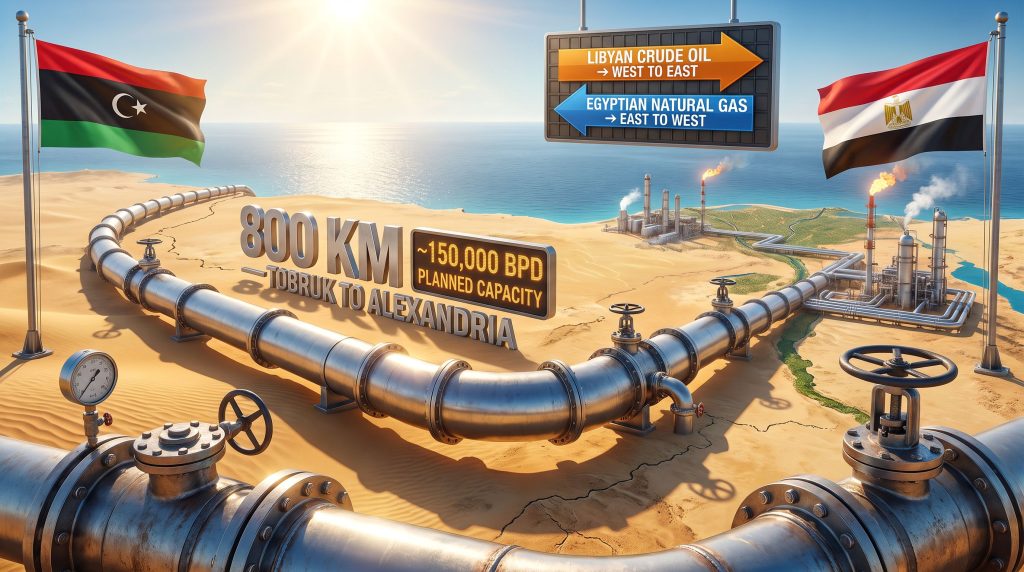
The proposed route spans approximately 800 kilometres, linking Tobruk in Libya's east to Alexandria in Egypt's northwest. Of this total distance, roughly 495 kilometres would traverse Egyptian territory, with approximately 125 kilometres falling within Libya. The planned transport capacity is approximately 150,000 barrels per day of Libyan crude, directed primarily to Alexandria-area refineries for conversion into petroleum products serving Egypt's domestic market.
The preliminary capital cost estimate exceeds $1 billion USD, according to a government official cited by Asharq Bloomberg, reflecting the scale of civil engineering required across two national jurisdictions and varied terrain. Furthermore, this figure does not capture associated costs such as security infrastructure, metering facilities, or long-term operational overheads.
The Joint Venture Entity Behind the Concept
One underappreciated aspect of this project's history is that institutional groundwork was laid well before the current diplomatic push. The Arab Company for Oil and Gas Lines, known by its operational name Altube, was formally established as a joint Egyptian-Libyan entity specifically to develop this pipeline framework. The existence of this entity means that when discussions intensify, as they have in August 2026, there is already a legal and administrative vehicle available to absorb the project's early-stage work rather than building governance architecture from scratch.
This matters more than it might initially appear. Cross-border infrastructure projects in politically complex regions frequently stall not on technical grounds but on institutional ones: questions of liability, revenue sharing, and operational jurisdiction. Altube's prior establishment suggests at least some of these foundational questions have been addressed in principle, even if commercial terms remain open. Egypt's broader energy infrastructure strategy provides useful context for understanding how Cairo approaches long-term bilateral energy architecture.
Libya's Production Recovery: The Upstream Precondition That Changes the Calculus
No pipeline proposal is viable without a reliable upstream source. Libya's crude production trajectory over the past decade has been one of the most volatile in global oil markets, lurching between near-total shutdowns during periods of civil conflict and partial recoveries as political settlements emerged. The current production environment represents the strongest sustained output Libya has achieved since its post-2011 fragmentation.
| Metric | Figure |
|---|---|
| Crude oil production | ~1.43 million bpd |
| Condensate production | ~49,000 bpd |
| Total hydrocarbon output | ~1.48 million bpd |
| Last comparable output level | 2013 |
| NOC production target | 1.5 million bpd |
Libya's National Oil Corporation Chairman Masoud Suleman has publicly framed the 1.5 million bpd threshold as the near-term target, and current output is approaching that ceiling. This creates a specific strategic problem for Libya: producing more crude than domestic refining capacity can process, while Mediterranean export terminals face their own capacity and pricing limitations.
A guaranteed offtake agreement with Egypt's refining infrastructure would address this problem directly, giving Libya a stable destination for incremental barrels that might otherwise be sold at spot prices through competitive tender processes. From a monetisation perspective, receiving a share of refined petroleum products in return for crude inputs can also be more economically attractive than selling raw crude, particularly for a country where domestic fuel supply remains chronically constrained. According to reporting from The New Arab, Egypt's pivot to Libyan oil has accelerated significantly as Gulf supply routes remain under pressure.
The Political Geography Problem: Tobruk's Contested Status
A critical detail that receives insufficient attention in standard coverage of this pipeline is the geographic location of its proposed Libyan origin point. Tobruk sits in Libya's east, a region that has historically operated under the political and military influence of authorities affiliated with the Libyan National Army rather than the Tripoli-based Government of National Unity.
The GNU, led by Prime Minister Abdul Hamid Dbeibeh, is the party conducting energy cooperation negotiations with Egypt. Yet infrastructure originating in Tobruk would need operational cooperation from eastern Libyan authorities whose relationship with the GNU remains contested. This is not merely a diplomatic nuance; it is a structural risk factor that directly affects whether any future pipeline could maintain uninterrupted throughput over a multi-decade operational horizon.
Any cross-border infrastructure agreement signed between Cairo and Tripoli carries an implicit assumption of unified Libyan political authority over the pipeline's origin point, an assumption the current governance reality does not fully support.
Egypt's Supply Imperative: Understanding the Demand Side of the Equation
While Libya's production dynamics create the supply logic, Egypt's import crisis creates the urgency. The suspension of Kuwaiti crude supplies, triggered by disruptions to Strait of Hormuz shipping routes amid regional military escalation, has created an immediate and measurable gap in Egypt's refinery feedstock. Egypt is targeting a minimum of 1 million barrels of Libyan crude per month to compensate, a figure that translates to roughly 33,000 barrels per day as a near-term floor.
This monthly import target is meaningfully below the pipeline's planned capacity of 150,000 bpd, which reflects the difference between an emergency import arrangement and a full-scale infrastructure investment. The near-term crude imports are almost certainly being arranged through existing maritime channels, with the pipeline concept representing a longer-term structural solution. These developments sit within a broader pattern of geopolitical oil price risks reshaping supply decisions across the region.
Egypt's PMI Context and Macroeconomic Sensitivity
Egypt's macroeconomic backdrop adds a layer of complexity to its financing capacity for major infrastructure. Egypt's Purchasing Managers' Index remained in contraction territory as of July 2026, according to S&P Global data, indicating that private sector activity was still contracting. This does not prevent state-to-state infrastructure investment, but it does constrain Egypt's ability to access commercial debt on favourable terms and increases its dependence on bilateral or multilateral concessional financing for a project of this scale.
The Dual-Pipeline Vision: A More Ambitious Framework Than It Appears
What distinguishes the current bilateral energy discussions from previous iterations is the explicit framing of a two-directional energy exchange, not merely a single crude transit arrangement. While the oil pipeline would move Libyan crude west-to-east toward Alexandria, a parallel concept under discussion would route Egyptian natural gas east-to-west into Libya.
| Flow Direction | Commodity | Origin | Destination | Status |
|---|---|---|---|---|
| West to East | Crude oil | Tobruk (Libya) | Alexandria (Egypt) | Under study, cost >$1bn |
| East to West | Natural gas | Egypt | Libya | Conceptual, under discussion |
This reciprocal structure transforms what might otherwise appear as a simple transit arrangement into a genuine energy integration corridor. Egypt, which has developed substantial natural gas production capacity in the East Mediterranean through fields including Zohr, would gain a new export market for gas volumes that exceed domestic consumption. Libya, which currently imports refined fuel products despite being a major crude exporter, would gain a cleaner-burning fuel source for its power generation and industrial base.
The broader energy cooperation framework discussed during the Madbouly-Dbeibeh bilateral meetings also included electricity grid interconnection, suggesting both governments are thinking about this relationship at a systems level rather than as a series of individual commodity deals.
Financing a Billion-Dollar Cross-Border Project: The Structural Challenges
Identifying the project's economic logic is considerably easier than funding it. Cross-border infrastructure exceeding $1 billion in politically complex regions faces a specific financing landscape that differs substantially from comparable projects in stable jurisdictions. However, the bilateral institutional foundations already in place may help accelerate lender confidence in the project's governance framework.
Potential financing mechanisms under exploration likely include:
- Bilateral sovereign co-investment through Egypt's petroleum sector entities and Libya's National Oil Corporation
- Multilateral development institution participation, including bodies such as the African Development Bank or the Arab Fund for Economic and Social Development
- Build-Operate-Transfer arrangements that bring private sector engineering and capital into the project under a defined revenue recovery framework
- Export credit agency-backed debt structured against long-term crude offtake commitments that provide lenders with a contractual revenue stream
Each of these mechanisms carries trade-offs. Sovereign co-investment requires both governments to commit scarce capital to a project whose benefits are long-dated. Multilateral lender participation typically introduces extended due diligence timelines and governance conditions. Private sector BOT structures require creditworthy offtake counterparties, which in Libya's case depends on the NOC maintaining institutional stability.
Historical analysis of comparable cross-border pipeline projects across the MENA region suggests that the gap between feasibility study completion and first oil flow typically spans three to seven years, even in cases where political will is clearly established at the outset.
The next major ASX story will hit our subscribers first
Regional Escalation Risk and the Infrastructure Security Premium
Any assessment of the Egypt and Libya oil pipeline must account for the security environment in which it would be built and operated. The same regional tensions that created Egypt's supply emergency, namely escalation around the Strait of Hormuz and attacks on energy infrastructure, also represent ongoing operational risks for any new pipeline asset. Consequently, understanding OPEC's market influence on price stability adds important context here.
Cross-border pipelines in conflict-adjacent regions attract elevated security costs, higher insurance premiums from international underwriters, and increased scrutiny from lenders assessing country risk. Libya's track record of infrastructure sabotage during periods of political conflict, including deliberate shutdowns of oil terminals and pipeline attacks by competing factions, establishes a precedent that financiers cannot ignore.
For Egypt, the calculus is different. A land-based pipeline eliminates maritime exposure for North African crude flows entirely, which becomes more attractive the longer Hormuz disruptions persist. The security risk profile of a land corridor through Libya and Egypt, while non-trivial, is arguably more manageable than indefinite reliance on shipping routes subject to closure by state actors. Indeed, analysts tracking oil market disruption at a global level note that overland alternatives are increasingly being priced into long-term supply strategies.
Egypt's Hub Ambitions and Where This Pipeline Fits
The Egypt and Libya oil pipeline does not exist in isolation from Egypt's broader energy positioning strategy. Egypt has invested significantly over the past decade in establishing itself as a regional energy transit hub, leveraging its LNG infrastructure at Idku and Damietta, its role in the Arab Gas Pipeline network, and its East Mediterranean gas agreements with Israel, Cyprus, and Greece.
Extending this hub logic into North African crude oil creates a new dimension of strategic relevance. If Alexandria-area refineries process Libyan crude into finished petroleum products, Egypt gains not only domestic fuel supply security but also potential export revenue from surplus refined output, a significantly higher-value proposition than simple transit fees.
Electricity interconnection with Libya, if realised, would further embed Egypt as the central node of North African energy infrastructure, a position with long-term geopolitical and commercial significance that extends well beyond the immediate supply emergency driving current negotiations. Enterprise Egypt's coverage of this strategic pivot offers additional perspective on Cairo's westward energy diversification.
Key Considerations for Evaluating the Pipeline's Realistic Timeline
Assessing where this project sits on the spectrum from concept to completion requires weighing several variables simultaneously. In addition, any shift in the underlying supply context — such as a rapid resolution of Hormuz tensions — could alter the urgency that is currently driving bilateral engagement. Readers interested in related supply-side pressures may also find value in reviewing oil supply shock analysis from comparable market environments.
- Libya's governance trajectory — whether the GNU consolidates authority over eastern Libya, including the Tobruk corridor, in the near to medium term
- Egypt's financing access — whether macroeconomic pressures constrain Egypt's ability to co-fund a billion-dollar infrastructure investment
- NOC institutional engagement — the National Oil Corporation's notably absent public response to pipeline discussions raises questions about internal alignment
- Regional security stabilisation — whether Hormuz tensions and their downstream effects on regional energy security persist or moderate
- Financing market appetite — international lenders' willingness to commit to Libyan-origin infrastructure given country risk classifications
Near-term crude import agreements covering the minimum 1 million barrels per month target will almost certainly precede any physical pipeline infrastructure by several years, serving as both an emergency supply bridge and a proof-of-concept for the bilateral commercial relationship.
Disclaimer: This article contains forward-looking analysis and scenario assessments based on publicly available information as of August 2026. Pipeline project timelines, financing structures, and geopolitical conditions are subject to material change. This content does not constitute investment advice. Readers should conduct independent research before making any financial or commercial decisions related to the topics discussed.
Want to Stay Ahead of the Next Major Resource Discovery?
Discovery Alert's proprietary Discovery IQ model delivers real-time alerts on significant ASX mineral discoveries, transforming complex resource data into actionable investment insights — whether you're tracking energy infrastructure plays or emerging commodity opportunities. Explore how historic discoveries have generated substantial returns on Discovery Alert's dedicated discoveries page, and begin your 14-day free trial today to position yourself ahead of the broader market.