August 10, 2026
The Architecture of a Market in Transition: Understanding the Aluminium Casting Growth Cycle
Few industrial materials tell a more revealing story about the direction of the global economy than aluminium casting. As a manufacturing process, it sits at the intersection of three of the most capital-intensive transitions of the current decade: the electrification of transport, the automation of industrial production, and the physical buildout of digital infrastructure. These forces are not operating in isolation. They are compounding, and the result is a demand environment for cast aluminium that looks structurally different from anything the industry has experienced in previous cycles.
Understanding the aluminium casting market outlook through 2032 requires moving beyond headline valuation figures and examining the mechanics of where demand is actually being generated, which technologies are reshaping production economics, and how regional growth vectors are diverging in ways that matter enormously for capacity planning and investment decisions.
When big ASX news breaks, our subscribers know first
Why Casting Occupies a Strategically Distinct Position in the Downstream Aluminium Mix
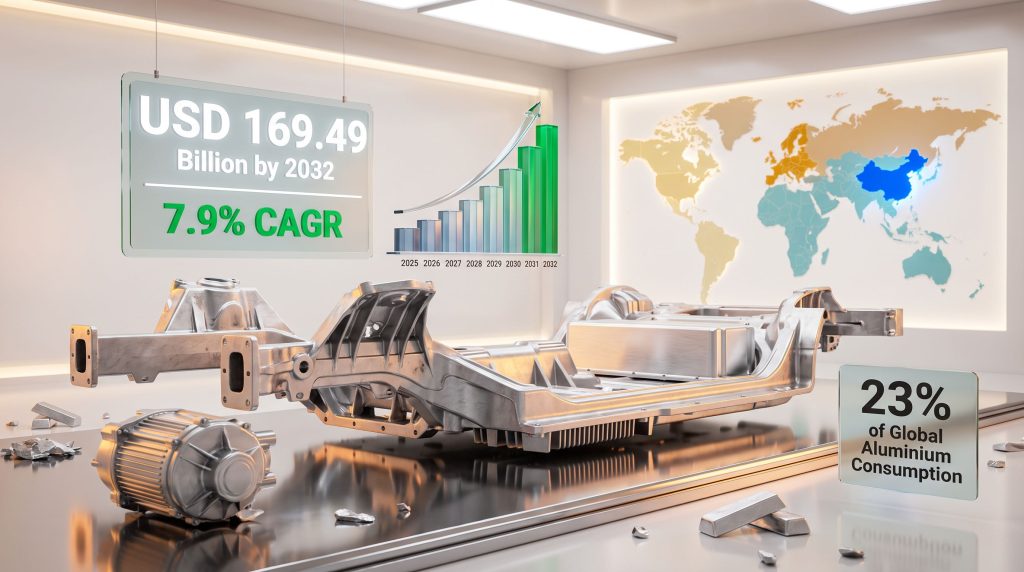
Aluminium casting currently accounts for approximately 23% of global aluminium consumption in 2025, placing it third in the downstream product hierarchy behind extrusion at 34% and flat rolled products at 32%. Wire rod contributes 8% and other applications account for the remaining 3%.
At first glance, casting's third-place ranking might suggest a secondary role in the broader market. The reality is more nuanced. Casting's share is disproportionately concentrated in engineered, high-complexity applications where material performance requirements are most demanding. Battery enclosures, motor housings, industrial robot frames and transformer housings are not interchangeable with extruded profiles or rolled sheet.
They represent specialised end-use categories where the economics of substitution are minimal and where demand growth is tied to long-term structural investment cycles rather than short-term commodity price movements.
Casting's 23% share of global aluminium consumption understates its strategic importance. Its concentration in technically demanding, high-value applications means it functions as a leading indicator of where industrial and transport investment is actually flowing.
Global aluminium casting consumption is forecast to grow at a CAGR of approximately 3.4% between 2025 and 2032 on a volume basis. That figure, while measured, represents durable structural demand rather than a cyclical uplift, and it is being generated across a widening range of end-use sectors that are progressively reducing the market's dependence on any single demand driver.
What the Market Valuation Data Actually Tells Investors
Headline market size figures for the global aluminium casting industry vary considerably depending on the research framework used. The table below presents the range of credible estimates currently in circulation:
| Research Perspective | Estimated Market Size | Forecast Period | CAGR |
|---|---|---|---|
| Conservative baseline | ~USD 100.94 billion (2024) | To 2030 | 4.9% |
| Mid-range scenario | ~USD 129.42 billion (by 2033) | To 2033 | 6.8% |
| High-growth scenario | ~USD 169.49 billion (by 2032) | To 2032 | 7.9% |
| Long-range projection | ~USD 167.33 billion (by 2035) | To 2035 | 5.72% |
| Volume-based CAGR | — | 2025–2032 | ~3.4% |
The divergence across these figures is not a sign of analytical confusion. It reflects genuine methodological differences: base year selection creates compounding variance over multi-year projections; some frameworks capture broader casting alloy categories beyond aluminium-specific grades; top-down macroeconomic modelling produces different outputs than bottom-up demand aggregation; and regional inclusion criteria, particularly whether Middle East and Africa foundry activity is captured, create further variation.
What matters for practical analysis is the directional consistency: every credible forecast framework points to sustained positive growth across the forecast horizon. According to Grand View Research, by 2030 the global aluminium casting market is broadly expected to reach somewhere between USD 129 billion and USD 135 billion, a range that reflects the methodological variation rather than any fundamental disagreement about the market's trajectory.
End-Use Sector Dynamics: Where Demand Is Being Created and How Fast
The composition of aluminium casting demand is shifting. The following table captures the projected evolution of end-use sector shares between 2025 and 2032:
| End-Use Sector | Estimated Share (2025) | Projected Share (2032) | Demand Trajectory |
|---|---|---|---|
| Automotive & Transportation | ~69% | ~66% | Absolute growth continues; share diluted by faster-growing sectors |
| Industrial & Machinery | ~10% | ~12% | Accelerating through automation and robotics investment |
| Other Applications | ~13% | ~14% | Broad industrial and consumer base |
| Building & Construction | ~4% | ~5% | Infrastructure investment and urbanisation |
| Electrical & Electronics | ~3–4% | ~4% | AI infrastructure, grid modernisation, energy storage |
The gradual decline in automotive's percentage share from ~69% to ~66% is one of the most important structural signals in this data. It does not indicate falling automotive demand. It reflects the faster growth rate of industrial, electrical and construction casting categories, which are collectively broadening the market's demand architecture in ways that reduce concentration risk for the industry.
Automotive and Transportation: Casting Intensity Is Increasing Per Vehicle
The electric vehicle transformation is not simply substituting one type of vehicle for another. It is fundamentally changing the amount of cast aluminium required per unit of transport produced. Battery enclosures, electric motor housings, thermal management systems and structural frames all require precision-engineered aluminium castings, and EV platforms typically incorporate significantly more of these components than equivalent internal combustion engine vehicles.
Two manufacturing technologies are amplifying this effect:
- High-pressure die casting (HPDC) enables complex, thin-walled components to be produced at high volumes with tight dimensional tolerances, making it the dominant process for automotive casting applications.
- Giga-casting takes this further by producing large single-piece structural components that replace multi-part welded assemblies. Originally developed for EV body-in-white manufacturing, this technique is now being evaluated for industrial and aerospace applications. It requires large-tonnage casting machines and purpose-engineered aluminium alloys with specific fluidity and strength characteristics.
China is the leading regional driver of automotive casting demand. Its automotive aluminium casting consumption is projected to expand by approximately 10.4% between 2025 and 2032 in absolute terms, underpinned by its scale of vehicle manufacturing, aggressive EV adoption trajectory and advanced casting technology deployment. Furthermore, China industrial demand continues to play a decisive role in shaping global casting volumes, as explored in analyses of China industrial demand across heavy industry sectors.
A less commonly discussed dimension of automotive casting economics is the role of secondary aluminium. Recycled aluminium already constitutes the majority of automotive casting feedstock, and this is not simply a sustainability choice. Recycled aluminium requires approximately 95% less energy to produce than primary metal, creating a direct and substantial cost advantage for foundries with established scrap supply chains.
As energy prices and carbon pricing mechanisms intensify across major manufacturing regions, this feedstock advantage is becoming increasingly material to competitive positioning. In this context, the broader decarbonisation economics of industrial production are reinforcing the financial case for secondary feedstock adoption well beyond the automotive sector.
Industrial Machinery and Automation: The Fastest-Shifting Demand Category
The industrial and machinery sector represents one of the most significant emerging demand vectors in the aluminium casting market outlook, and its growth rate is being driven by forces that are largely independent of the automotive cycle.
Key demand catalysts include:
- Precision robotic components and servo motor housings increasingly specify aluminium castings for their weight-to-strength ratio and thermal conductivity properties
- Semiconductor fabrication facility buildouts require cast aluminium enclosures, process equipment frames and cleanroom infrastructure components
- Hyperscale data centre construction generates demand for cast aluminium heat exchangers, cooling infrastructure and electrical enclosures
- Automation equipment frames and industrial machinery housings are shifting toward aluminium from heavier ferrous materials as lightweighting spreads beyond the automotive sector
China's dominance of this growth vector is particularly pronounced. Its aluminium casting consumption within the industrial and machinery sector is forecast to increase by approximately 40.8% between 2025 and 2032, one of the largest single-sector, single-region growth projections in the entire global casting market. This figure reflects the scale of China's manufacturing investment in automation, robotics, semiconductor infrastructure and data centre capacity.
Electrical and Electronics: The AI Infrastructure and Grid Modernisation Effect
The electrical and electronics sector is generating casting demand through multiple parallel channels that are not always visible in aggregate market data. Grid modernisation programmes require transformer housings and power conversion equipment. The ongoing renewable energy buildout is generating demand for cast aluminium mounting structures, inverter enclosures and junction boxes.
Energy storage systems require thermally conductive enclosures and structural components. And AI data centre buildouts require cooling infrastructure at a scale that was not anticipated in earlier demand forecasts.
China leads this category with an estimated 41.5% increase in electrical sector casting consumption between 2025 and 2032. However, North America and Europe are also contributing meaningfully:
- North America: Grid hardening programmes, utility-scale battery storage deployment and data centre expansion are driving incremental demand
- Europe: Offshore wind buildout, smart grid upgrades and digital infrastructure investment are supporting casting consumption growth
Furthermore, the accelerating battery materials demand cycle is creating additional requirements for precision cast aluminium components across energy storage and electrification infrastructure.
Building and Construction: Infrastructure Cycles as a Durable Demand Floor
Building and construction may represent only ~5% of global casting demand by 2032, but it provides an important demand floor that is tied to long-duration infrastructure investment cycles rather than the faster-moving dynamics of automotive or electronics production.
Cast aluminium applications in this sector include HVAC system components, elevator mechanisms, façade hardware, industrial facility equipment and transportation infrastructure nodes. China's building and construction casting demand is projected to grow approximately 31.5% between 2025 and 2032, supported by urbanisation and infrastructure investment programmes. Southeast Asia and India are contributing incremental growth through urban development and infrastructure investment cycles.
The Regional Landscape: China's Dominance and Asia-Pacific's Emerging Frontier
Regional market structure is as important as sector composition for understanding where casting capacity investment needs to flow over the next seven years.
| Region | Projected Share (2032) | Key Growth Drivers | Notable Risks |
|---|---|---|---|
| China | ~51% | EV production, industrial automation, infrastructure | Overcapacity risk, geopolitical trade tensions |
| Rest of Asia-Pacific | ~22.5% | India industrialisation, Southeast Asia manufacturing expansion | Infrastructure readiness, energy access |
| Europe | ~12.4% | EV adoption, renewable energy, automation | Energy costs, economic headwinds |
| North America | ~9.8% | Reshoring, advanced manufacturing, transport electrification | Labour costs, supply chain reconfiguration |
| South America | ~3.8% | Industrial diversification, infrastructure investment | Currency volatility, political risk |
| Middle East & Africa | ~0.5% | Energy investment, industrial development | Early-stage market maturity |
China's projected 51% share of global aluminium casting consumption by 2032 reflects a combination of manufacturing scale, technology adoption and domestic demand that no other single market can match over this timeframe. However, the Rest of Asia-Pacific region, projected at ~22.5%, represents the market's most dynamic growth frontier.
India's manufacturing sector expansion, vehicle production ramp-up and infrastructure investment are creating a durable long-term demand platform. Southeast Asian economies, particularly Vietnam, Thailand and Indonesia, are benefiting from supply chain diversification away from China, attracting casting-intensive manufacturing investment. Renewable energy deployment across the region is generating incremental electrical and construction casting demand that was not a significant factor in previous growth cycles.
Technology Transformation: How Production Methods Are Evolving
Secondary Aluminium and the Feedstock Economics Shift
The foundry industry's accelerating adoption of secondary aluminium is not simply an environmental trend. It is a fundamental restructuring of casting production economics. The ~95% energy reduction associated with recycling versus primary production creates a cost structure that is increasingly difficult to compete against using primary metal inputs, particularly in regions with high industrial energy costs.
Automotive manufacturers are building closed-loop recycling programmes that return casting scrap directly to foundry supply chains, shortening the secondary metal supply cycle and improving feedstock quality consistency. According to the International Aluminium Institute, foundries and die casters that have invested in secondary aluminium supply chain infrastructure are accumulating a structural cost advantage that will compound as energy and carbon costs escalate.
Foundries with established secondary aluminium supply chains are not simply operating more sustainably. They are building a cost moat that becomes more valuable as energy prices and carbon pricing mechanisms intensify pressure on primary metal-dependent competitors.
Giga-Casting: A Manufacturing Architecture Shift With Demand Implications
Giga-casting deserves particular attention because it changes not only how castings are made but how many castings are needed per vehicle. By consolidating what were previously dozens of separate stamped and welded components into a single large-format casting, giga-casting reduces the total part count in a vehicle structure while simultaneously increasing the volume of aluminium cast per vehicle unit. This is a demand amplifier, not merely an efficiency tool.
The technique requires purpose-engineered aluminium alloys with specific fluidity characteristics that allow metal to fill large, complex die cavities without premature solidification. It also requires significant capital investment in large-tonnage casting machines, meaning that giga-casting capability is currently concentrated among well-capitalised Tier 1 automotive suppliers and major OEM-affiliated foundries.
The next major ASX story will hit our subscribers first
Key Risks That Could Moderate the Growth Trajectory
No aluminium casting market outlook is complete without a candid assessment of the constraints and uncertainties that could alter projected growth paths.
Supply-side risks include:
- Energy cost volatility creating margin pressure for casting operations in high-energy-cost regions, particularly Europe
- LME aluminium price cycles creating planning uncertainty for downstream casting operations dependent on primary metal inputs
- Skilled labour shortages in advanced casting technologies, where HPDC and giga-casting require specialised technical workforces that are in limited global supply
Demand-side risks include:
- EV adoption pace variability driven by consumer affordability constraints or charging infrastructure gaps, which could delay the casting intensity uplift from EV architecture
- Automotive production cyclicality in key markets creating near-term demand softness in the dominant end-use sector
- Geopolitical trade disruptions, including tariff regimes and supply chain decoupling, which could alter regional trade flows for both aluminium and finished cast components
Disclaimer: All market size estimates, CAGR projections and regional share forecasts referenced in this article are drawn from third-party industry research and represent estimates subject to methodological variation and inherent uncertainty. They should not be interpreted as guarantees of future market performance. Investors and industry participants should conduct independent due diligence before making decisions based on forward-looking market data.
Strategic Positioning for the 2025–2032 Cycle
The aluminium casting market outlook through 2032 presents a clear set of strategic imperatives for industry participants:
- Technology alignment: Foundries expanding HPDC and giga-casting capability are best positioned to capture automotive EV casting growth, where component complexity and per-vehicle aluminium content are both increasing
- Feedstock strategy: Operations with established secondary aluminium supply chains hold structural cost and sustainability advantages that will compound over the forecast period
- Sector diversification: The gradual dilution of automotive's percentage share signals that industrial machinery, electrical infrastructure and construction applications are emerging as meaningful secondary demand pillars worth developing dedicated capabilities for
- Regional positioning: The Rest of Asia-Pacific, particularly India and Southeast Asia, represents the market's fastest-growing regional frontier and warrants strategic attention from casting producers looking beyond established markets
The aluminium casting market's long-term growth story has moved well beyond its original identity as an automotive materials narrative. The convergence of electrification, industrial automation, AI infrastructure investment and urban development across emerging Asia is creating a multi-sector demand architecture that is fundamentally more resilient and more diversified than anything the casting industry has operated within before. Participants who align their technology, feedstock and regional strategies with this new architecture will be best placed to capture the value that the 2025–2032 growth cycle is generating.
Want to Know Which ASX Mineral Discoveries Are Shaping the Future of Industrial Metals?
Discovery Alert's proprietary Discovery IQ model delivers real-time alerts on significant ASX mineral discoveries — including those driving demand across aluminium, battery materials, and electrification supply chains — turning complex market data into actionable investment insights for both short-term traders and long-term investors. Explore historic discoveries and their exceptional market returns, then start your 14-day free trial at Discovery Alert to position yourself ahead of the next major find.