August 10, 2026
When Energy Chokepoints Become Policy Catalysts
Every major energy security policy framework in modern history has been born from a crisis. The 1973 Arab oil embargo created the IEA. The 1979 Iranian Revolution accelerated strategic reserve legislation across the OECD. Today, heightened instability around the Strait of Hormuz is forcing Japan to confront a vulnerability that has existed for decades but was never acute enough to demand structural reform. The difference now is that the risk has materialised in real time, with measurable consequences for supply chains, insurance markets, and industrial feedstocks.
The result is a proposed policy framework that energy analysts are watching closely: the Japan crude diversification cost-sharing scheme, a mechanism designed to redistribute the commercial burden of building resilient supply chains away from individual market participants and onto a collectively managed public-private fund.
When big ASX news breaks, our subscribers know first
Why Japan's Hormuz Dependency Is a Systemic, Not Cyclical, Problem
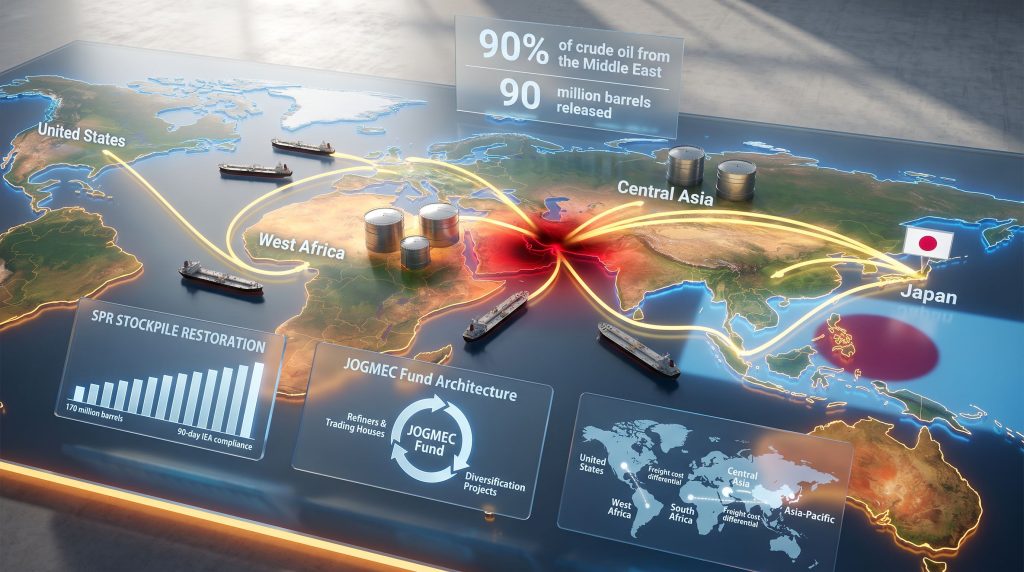
Japan sources approximately 90% of its crude oil from the Middle East, a concentration that has few parallels among advanced economies. Most of that volume transits the Strait of Hormuz, a waterway roughly 33 kilometres wide at its narrowest navigable point. That singular transit corridor has long been identified by energy security analysts as Japan's most critical infrastructure vulnerability, yet for most of the past two decades, the commercial logic of Middle Eastern crude — competitive pricing, reliable volumes, and proximity — made diversification economically unattractive for private sector actors operating on thin refinery margins.
The US-Iran conflict has changed that calculus entirely. Intermittent attacks on commercial shipping, mine threats within the strait, and elevated war risk insurance premiums have collectively disrupted the assumption that Hormuz is a reliably open waterway. Vessel traffic through the strait has been largely confined to specific traffic lanes, with maritime security monitoring recording constrained transit volumes and multiple vessels altering course following nearby explosions.
Even where the strait remains technically navigable, the credible threat of attack is sufficient to deter commercial shippers and push marine insurance costs to levels that erode the price competitiveness of Gulf crude. Furthermore, the oil price shock reverberating through global markets has intensified pressure on governments to act decisively.
The distinction between a strait that is closed and one that is merely dangerous is commercially significant: both produce the same deterrent effect on private shippers making billion-dollar voyage decisions.
This deterrence dynamic means that even partial diplomatic progress, such as ongoing Iran-Oman discussions about designating safe transit coordinates, does not restore the pre-conflict risk environment. Tokyo's policy response reflects a recognition that Hormuz risk is now a permanent feature of the geopolitical landscape rather than a temporary emergency requiring only short-term mitigation.
The Naphtha Problem: Is It a Less Visible but Equally Acute Supply Chain Failure?
While crude oil dominates the public narrative around Japan's energy vulnerability, the naphtha supply disruption has been particularly damaging and is, in some respects, harder to solve. Japan's petrochemical sector depends on naphtha as a primary feedstock for producing ethylene, propylene, and other building blocks of plastics, synthetic resins, and industrial chemicals. These downstream industries underpin Japan's manufacturing export economy in ways that make naphtha supply security a broader industrial policy concern, not merely an energy market issue.
The complication is that naphtha presents storage and safety challenges that crude oil does not. Its high volatility creates significant fire and explosion risk at scale, making large-volume stockpiling in liquid form operationally complex and commercially expensive. This is why Japan's Ministry of Economy, Trade and Industry (METI) has indicated a preference for building strategic reserves in crude oil form rather than refined naphtha. Crude can be processed into naphtha domestically as required, preserving product flexibility while avoiding the safety constraints of naphtha-specific storage at strategic volumes.
How the Japan Crude Diversification Cost-Sharing Scheme Actually Works
The scheme was formally proposed at a METI working group meeting on 7 August. The working group itself was established in late July with a mandate to enhance the resilience of Japan's petroleum supply chains following Middle East disruptions. The proposed mechanism operates as follows:
-
Fund contribution: Crude oil and naphtha importers, including refiners and trading houses, pay into a pooled fund administered by JOGMEC, Japan's state energy security agency.
-
Plan submission: Participating importers submit diversification procurement plans to the government for assessment against defined criteria.
-
Approval and disbursement: JOGMEC provides financial support to approved projects based on criteria including economic efficiency and the degree to which the procurement plan genuinely advances geographic diversification away from Hormuz-transiting supply chains.
-
Cost offset mechanism: Disbursements are designed to cover incremental costs — higher freight rates, extended charter periods, elevated insurance premiums, and pipeline transit fees — that arise when sourcing crude through non-Hormuz routes compared with equivalent Gulf shipments.
| Cost Category | Description |
|---|---|
| Extended freight costs | Additional bunker fuel and vessel time for longer voyages |
| War risk insurance differentials | Elevated premiums for Gulf-transiting vessels vs. alternative routes |
| Pipeline transit fees | Overland routing costs bypassing Hormuz |
| Extended charter periods | Longer vessel employment for non-Gulf origin routes |
The structure mirrors risk-pooling models used in other strategic industries where individual actors cannot efficiently price systemic risk. Agricultural stabilisation funds and aviation fuel hedging programmes operate on similar logic: collective contributions create a buffer that no individual participant could maintain economically on their own.
What Remains Unresolved
It is important to note that the working group had not, as of early August, finalised the precise contribution rates, disbursement thresholds, or the definition of economic efficiency against which plans will be assessed. Several commercially critical questions remain open:
- Whether the scheme covers the full incremental cost differential or only a partial subsidy
- How approval timelines will function and whether they can accommodate the pace of commercial procurement decisions
- Whether the framework applies to spot cargoes as well as term supply agreements
- How the scheme interacts with existing commercial hedging arrangements held by trading houses
The gap between partial and full cost coverage matters enormously for refiners operating on thin margins. If the scheme only offsets a fraction of the incremental freight and insurance cost, non-Hormuz sourcing may remain commercially prohibitive for smaller operators without additional structural incentives.
According to IEEFA's briefing on Japan's LNG procurement strategy, diversified procurement frameworks cannot fully shield Japan from global price spikes, underscoring the importance of getting the cost-sharing calibration right from the outset.
Japan's Strategic Petroleum Reserve: Rebuilding from a Historic Drawdown
Concurrent with the diversification scheme, METI's working group has proposed a phased programme to restore Japan's strategic petroleum reserves to IEA-compliant levels. The sequence of events is significant.
Following the outbreak of the US-Iran conflict, Japan released approximately 90 million barrels of government-held SPR — one of the largest emergency drawdown operations in the country's history. Once the release programme concluded, government stockpiles stabilised at approximately 170 million barrels. This level falls below the IEA's minimum compliance threshold, which requires member countries to maintain reserves equivalent to at least 90 days of net oil imports.
METI has proposed the following replenishment schedule:
| Fiscal Year | Target Action |
|---|---|
| April 2026 to March 2027 (FY2026) | Initiate SPR replenishment programme |
| April 2027 to March 2028 (FY2027) | Reach strategic crude stockpile levels equivalent to 90 days of Japan's crude import volumes, accounting for domestic naphtha feedstock production requirements |
The preference for crude-form reserves rather than refined product stockpiles is driven by both safety considerations and processing flexibility. Storing strategic reserves as crude oil allows domestic refiners to produce naphtha, diesel, gasoline, or other products on demand, preserving optionality across product categories in ways that product-specific stockpiles cannot.
Mapping Japan's Non-Hormuz Supply Alternatives
The commercial viability of the diversification scheme depends heavily on the realistic pool of alternative supply origins available to Japanese importers. The crude oil price trends associated with non-Hormuz routing vary substantially by origin geography, as outlined below.
| Origin Region | Logistics Profile | Key Challenge |
|---|---|---|
| Middle East via Hormuz | Baseline voyage distance | Chokepoint concentration risk |
| Middle East via pipeline bypass (UAE) | Minimal additional cost | Limited throughput capacity |
| United States Gulf Coast | Significantly longer voyage | Higher bunker fuel and charter costs |
| West Africa | Moderately longer voyage | Vessel availability and port infrastructure |
| Asia-Pacific producers | Comparable or shorter voyage | Limited volume scale |
| Central Asia | Overland pipeline dependent | Infrastructure constraints |
| Latin America (Mexico, Venezuela) | Atlantic Basin routing | Variable production reliability |
| Canada | Heavy crude, significant logistics reconfiguration | Refinery compatibility requirements |
The UAE's existing partial bypass option deserves specific attention. Adnoc's Habshan-to-Fujairah pipeline currently carries approximately 1.8 million barrels per day and has been actively used since the start of the US-Iran conflict to route crude exports around the strait. Adnoc has announced plans to expand that capacity to approximately 3.3 million b/d by 2027, which would meaningfully increase the volume of Gulf crude that can bypass Hormuz entirely.
In addition, Adnoc has committed $1.3 billion to acquiring 11 additional tankers, including six VLCCs each capable of carrying approximately 2 million barrels, partly to support higher export volumes as the UAE targets production capacity of 5 million b/d by 2027. According to Reuters reporting on Japan's refinery diversification efforts, Japanese refiners are actively exploring support for precisely these types of Hormuz bypass routes, signalling strong industry alignment with the government's policy direction.
These developments at the UAE level are commercially relevant for Japan because they expand the available volume of crude that can be purchased without Hormuz transit risk, even from a Middle Eastern origin, reducing — though not eliminating — the need to source from far more expensive Atlantic Basin alternatives.
The Broader Geopolitical Context Reshaping Asian Energy Architecture
Japan's policy response does not exist in isolation. The broader regional security environment has shifted in ways that extend well beyond the immediate Hormuz disruption. The signing of a joint defence pact between Saudi Arabia, Turkey, and Pakistan in August signals a significant realignment of regional alliances, with the three Sunni-majority nations collectively committing to treat an attack on any one member as an attack on all.
Saudi Arabia brings OPEC leadership and financial capacity; Turkey contributes NATO's second-largest army and an increasingly capable domestic defence industry; Pakistan adds the world's fifth-largest population and nuclear capability. For Japanese energy planners, this emerging alliance introduces additional uncertainty about the durability and direction of regional security arrangements.
Against this backdrop, and reflecting broader trade war impact on global energy markets, Japan is also developing a financial cooperation initiative of approximately $10 billion to support energy procurement security across Asia. This framework positions Japan as a potential anchor for regional supply chain resilience, extending its energy security architecture from a purely domestic policy problem toward a multilateral supply network strategy.
The next major ASX story will hit our subscribers first
Competitive Implications for Japanese Refiners and Trading Houses
The scheme's design creates differentiated competitive outcomes within Japan's refining and trading sector. Companies with existing relationships with non-Middle Eastern producers are likely better positioned to qualify for early disbursements, given that their diversification procurement plans will already have demonstrated commercial feasibility.
Large trading houses with diversified global crude portfolios may gain a structural advantage over refiners with more concentrated Middle Eastern supply chains, particularly in the scheme's early phases before approval frameworks are fully established. Trading houses can more readily present credible diversification plans spanning multiple origin geographies, while refiners focused on specific crude grades compatible with their processing configurations face a narrower set of viable alternatives.
The mandatory fund contribution element also introduces a compliance cost for all importers regardless of whether they actively pursue diversification. For smaller refiners operating on narrow margins, this contribution obligation — combined with uncertainty around whether disbursements will cover the full incremental cost of non-Hormuz procurement — creates genuine commercial risk. The Japan crude diversification cost-sharing scheme's ultimate success in driving genuine supply chain diversification, rather than simply generating fund contributions without corresponding procurement changes, will depend on whether the financial incentive is calibrated appropriately relative to the actual cost differential of alternative routing.
How Japan's Approach Compares Internationally
| Policy Dimension | Japan (Proposed) | South Korea | United States | European Union |
|---|---|---|---|---|
| Cost-sharing mechanism | Public-private pooled fund via JOGMEC | Partial government subsidies | Strategic reserve releases | Emergency sharing obligations |
| Diversification mandate | Financial incentive-based | Regulatory guidance | Market-driven | IEA-coordinated |
| SPR compliance target | 90 days (under restoration) | 90 days (IEA compliant) | Approximately 90 days | 90 days (IEA framework) |
| Naphtha-specific policy | Under active development | Limited | Minimal | Minimal |
| Private sector role | Mandatory fund contribution | Voluntary participation | Market-led | Emergency coordination only |
Japan's approach is distinctive in its explicit cost-socialisation mechanism. Rather than relying on market forces to drive diversification or using direct government procurement, the scheme attempts to internalise the cost of national energy security into the commercial operations of private importers while simultaneously providing financial relief for those who take concrete diversification steps. Whether this hybrid model proves more effective than purely market-led or purely government-directed approaches is a question that will take several years of operational experience to answer.
Monitoring current crude oil prices will, furthermore, remain essential for assessing how the scheme's financial incentives hold up against shifting global market conditions over that period.
Frequently Asked Questions: Japan Crude Diversification Cost-Sharing Scheme
What Is the Japan Crude Diversification Cost-Sharing Scheme?
It is a policy framework proposed by METI under which crude oil and naphtha importers contribute to a pooled fund administered by JOGMEC. The fund provides financial support for approved procurement projects that source oil through routes avoiding the Strait of Hormuz, offsetting the higher transport and logistics costs associated with longer-haul or pipeline-based supply chains.
Who Participates in the Scheme?
Refiners and trading houses involved in crude oil and naphtha importation are the primary participants. Eligibility for disbursements requires submission of a diversification procurement plan assessed against criteria including economic efficiency and the degree of genuine supply chain diversification achieved.
What Happened to Japan's Strategic Petroleum Reserves?
Japan released approximately 90 million barrels of government-held SPR during the US-Iran conflict. Post-release stockpiles stand at approximately 170 million barrels, below the IEA's 90-day compliance threshold. Japan is planning a phased replenishment targeting full IEA compliance by the end of fiscal year 2027-28.
Why Does Japan Prefer Crude Oil Over Naphtha for Strategic Stockpiling?
Naphtha's high volatility creates significant safety risks at large storage volumes. Crude oil is operationally safer and can be refined domestically into naphtha and other products as required, offering greater flexibility and risk management across product categories.
Which Countries Could Supply Japan with Crude Oil Outside the Hormuz Route?
Japan is actively expanding sourcing from the United States, Latin America including Mexico, West Africa, Central Asia, Asia-Pacific producers, and Canada — all of which offer supply chains that either avoid or substantially reduce Hormuz transit dependency.
Disclaimer: This article contains forward-looking analysis, policy projections, and market assessments that involve inherent uncertainty. The policy framework described remains under active development, and final scheme parameters have not been confirmed. Nothing in this article constitutes financial or investment advice. Readers should conduct independent research before making decisions based on information contained herein.
Want to Stay Ahead of the Next Major Resource Discovery Driving Energy Security Themes?
As geopolitical pressures reshape global energy and commodity markets, Discovery Alert's proprietary Discovery IQ model delivers real-time alerts on significant ASX mineral discoveries — instantly identifying actionable opportunities before the broader market reacts. Explore how historic discoveries have generated substantial returns on Discovery Alert's dedicated discoveries page, and begin your 14-day free trial today to position yourself at the forefront of the next major find.