August 10, 2026
The Geopolitics of Silicon: When Trade Remedy Law Collides with Critical Minerals Strategy
Global supply chains for critical materials have always carried embedded geopolitical risk, but the dominant assumption throughout the 2020s was that allied nations could insulate themselves from each other's trade remedy mechanisms through diplomatic frameworks and bilateral agreements. Simcoa exits US market after tariffs in a way that has shattered that assumption in a highly visible way.
When the United States International Trade Commission (USITC) ruled against Australian silicon metal imports, it did not just impose a commercial burden on a single Western Australian manufacturer. It exposed a fundamental structural flaw in how the US reconciles its domestic industrial protection agenda with its stated goal of building resilient, allied-nation critical minerals demand supply chains.
Silicon metal sits at the intersection of nearly every technology transition the modern world is racing through. It is a primary feedstock for semiconductor fabrication, a core input in solar photovoltaic cell manufacturing, and a strengthening agent in aluminium alloys used across aerospace and automotive applications. As the world accelerates its clean energy buildout and digital infrastructure expansion, demand for silicon metal is structurally anchored to long-term growth trajectories across multiple industries simultaneously.
When big ASX news breaks, our subscribers know first
Silicon Metal's Hidden Criticality and Australia's Singular Market Position
Most conversations about critical minerals focus on lithium, cobalt, or rare earths. Silicon metal tends to receive less attention despite its arguably more pervasive role in modern industrial systems. The reason is partly familiarity: silicon is abundant in the earth's crust as silicon dioxide, and the element itself is not scarce.
What is scarce is the energy-intensive processing capacity required to refine silicon dioxide into metallurgical-grade and polysilicon-grade silicon metal at commercial scale outside of China. China currently dominates global silicon metal production, accounting for roughly 70% of world output according to the United States Geological Survey. The commercial-scale producers operating outside Chinese control can be counted on one hand, and most face significant cost disadvantages due to energy pricing, labour costs, and infrastructure constraints.
Australia's position within this landscape is uniquely concentrated. Simcoa Operations, based at Kemerton in Western Australia and wholly owned by Japan's Shin-Etsu Chemical, represents the entirety of Australia's silicon metal manufacturing capacity. There is no secondary domestic producer, no alternative smelting facility, and no upstream processing redundancy. This single-facility structure means that any disruption to Simcoa's commercial operations carries national-scale consequences for Australia's export challenges within silicon metal trade flows.
Why Energy Intensity Creates Structural Vulnerability
Silicon smelting is among the most energy-intensive industrial processes in the mining and materials sector. The production of one tonne of silicon metal typically requires between 12,000 and 14,000 kilowatt-hours of electricity, a consumption profile that places silicon smelters in the same category as aluminium smelters in terms of energy dependency.
This energy intensity has two critical implications. First, it means that silicon producers operating in high-cost power markets are structurally disadvantaged relative to Chinese producers, who benefit from subsidised electricity and integrated coal-fired power infrastructure in key production provinces like Yunnan and Sichuan. Second, it means that participation in demand-side management programs, where energy-intensive industrial users agree to curtail consumption during peak grid stress events in exchange for lower tariff structures, is not a subsidy arrangement but a standard commercial practice embedded in the economics of industrial power procurement globally.
The USITC's countervailing duty determination, which classified Simcoa's participation in Western Australian energy management programs as a form of government subsidy, fundamentally mischaracterises how energy-intensive manufacturers operate in deregulated electricity markets. Simcoa's leadership has firmly rejected this framing, noting that demand-response participation is a commercially standard mechanism used by energy-intensive industries in jurisdictions worldwide, from Germany to Japan to the United States itself.
Breaking Down the Tariff Architecture That Forced Simcoa's Exit
The tariff structure imposed on Australian silicon metal exports is not a single blunt instrument. It is a layered accumulation of trade remedy mechanisms that, in combination, created an insurmountable cost barrier for continued US market participation.
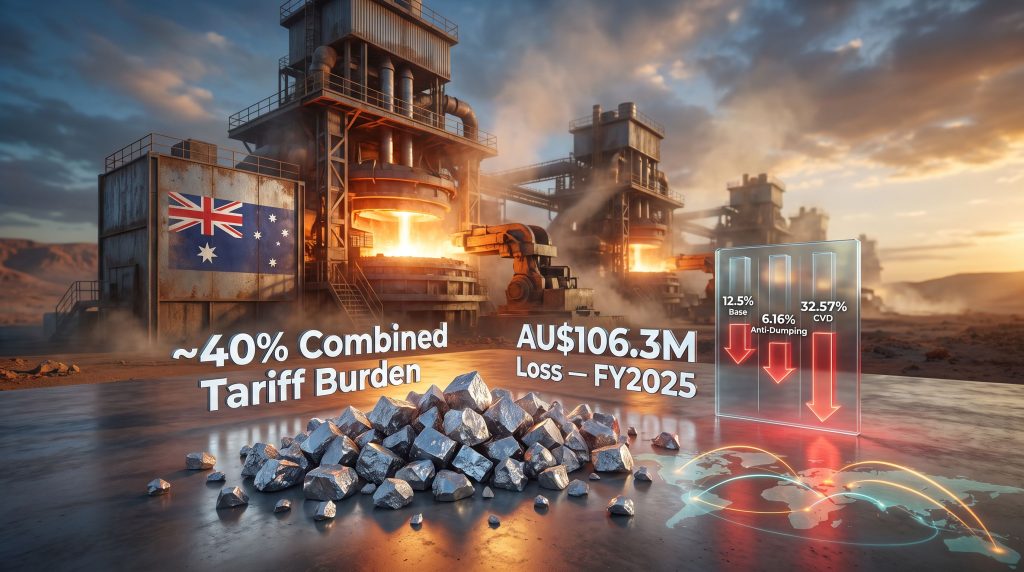
| Tariff Component | Rate Applied |
|---|---|
| Pre-existing base tariff | 12.5% |
| Anti-dumping duty | 6.16% |
| Countervailing duty | 32.57% |
| Combined effective burden (new duties only) | ~40% |
The anti-dumping component reflects the USITC's determination that Australian silicon was being sold into the US market at prices below fair value. The countervailing duty reflects the separate finding that energy program participation constituted a government subsidy. Layered atop a pre-existing 12.5% base tariff, the new duties alone add approximately 40 percentage points to the landed cost of Australian silicon in the US market — a burden that no commercially operating silicon producer outside of a vertically integrated conglomerate could realistically absorb.
Norway was captured by the same ruling, a detail that carries significant strategic implications. Norway is a NATO ally, a democracy with transparent governance, and a significant producer of silicon metal largely from hydroelectric power. Its inclusion alongside Australia in the same trade remedy action signals that the USITC's process operates on strictly legalistic commercial injury grounds, entirely disconnected from the diplomatic or geopolitical status of the exporting nation.
Contextualising the US Tariff Posture Across Critical Materials
The Simcoa ruling does not exist in isolation. It is part of a broader pattern of aggressive US trade remedy deployment across critical material categories, further complicated by the ongoing US-China trade war dynamics reshaping global supply chains.
| Commodity | Tariff Mechanism | Effective Rate | Target Nations |
|---|---|---|---|
| Silicon metal (Australia/Norway) | Anti-dumping + CVD | ~40% (new duties) | Australia, Norway |
| Graphite (China) | Section 301 | 93.5% | China |
| Copper (various) | Section 232 investigation | Pending | Multiple |
| Steel and aluminium | Section 232 | 25% | Global (with exceptions) |
The pattern reveals a US trade policy posture that applies trade remedy mechanisms selectively and without consistent regard for the strategic classification of either the commodity or the exporting nation's alliance status. Graphite tariffs against China are geopolitically coherent. Silicon tariffs against Australia are geopolitically incoherent: they penalise an allied producer in a material the US simultaneously claims it needs to source from non-Chinese suppliers.
Simcoa's Operational and Financial Position: A Company Under Compounding Pressure
To understand why the tariff determination is so damaging, it is necessary to appreciate the financial and operational state Simcoa was already in before the ruling was handed down.
The company recorded a post-tax loss of AU$106.3 million in the 2025 financial year, a dramatic reversal from a AU$2.4 million profit in 2024, representing a swing of more than AU$108 million in a single year. That deterioration was primarily driven by weak global silicon metal prices, which have been under sustained pressure as Chinese production capacity has expanded.
In response to the price environment, Simcoa took the significant operational step of shutting down one of its three furnaces at the Kemerton facility in March 2026. Running at reduced capacity is a double-edged decision for energy-intensive producers: it reduces variable costs but spreads fixed costs across a smaller production base, compressing margins further at a time when the company can least afford it.
The US market represented approximately 10,000 tonnes per year of silicon metal offtake, constituting roughly one-third of Simcoa's total annual production output. According to the ABC, the final shipment to the US was confirmed for 14 August, after which no return to the market is planned under the current tariff regime. Losing a customer base absorbing 33% of output, while already operating one furnace short and recording nine-figure losses, is a body blow by any commercial measure.
Simcoa's ultimate owner, Shin-Etsu Chemical, is one of the world's largest chemical manufacturers with a diversified global footprint. That corporate parentage provides a degree of financial resilience that an independent producer would not have, but it does not eliminate the strategic imperative to restore Simcoa's commercial viability within a realistic timeframe.
Redirecting One-Third of Annual Output: The Asian and European Pivot
Simcoa has confirmed it will pursue market redirection toward Southeast Asia, India, and European buyers to replace the US volume. In strategic terms, this is the correct response. In practical terms, it is considerably harder to execute than the announcement implies.
Why Asian Markets Are Not a Simple Substitute
Southeast Asian silicon metal demand is real and growing. The region's expanding semiconductor packaging and testing industry, combined with accelerating solar panel manufacturing capacity in Vietnam, Thailand, and Malaysia, creates genuine import demand. India's solar manufacturing ambitions, anchored by its Production Linked Incentive scheme targeting domestic panel production, are also adding incremental silicon import demand on a multi-year trajectory.
However, Asian markets for silicon metal are dominated by Chinese suppliers who have established long-standing commercial relationships, can offer competitive pricing underpinned by lower production costs, and have logistics infrastructure optimised for intra-regional trade. Simcoa's product quality advantage, particularly in producing high-purity silicon grades suited for semiconductor and photovoltaic applications, is real but not automatically decisive in markets where price sensitivity is high and buyer relationships are entrenched.
The European Market: Structural Demand but Its Own Constraints
European silicon demand is supported by the region's ongoing decarbonisation investment cycle, with silicon metal consumption growing in both solar module manufacturing and aluminium alloy production. Furthermore, several European countries have lost domestic silicon production capacity over the past decade due to high energy costs, creating genuine import dependency that Simcoa could potentially serve.
The challenge, however, is that European buyers are themselves under energy cost pressure, which constrains their tolerance for premium pricing. Additionally, the logistics cost of supplying Europe from Western Australia, while not prohibitive, adds to landed cost in ways that require careful commercial structuring.
"Redirecting one-third of annual production to new markets is not a simple logistics exercise. It requires renegotiating commercial terms, establishing new buyer relationships, and competing against entrenched Chinese suppliers who command significant price and relationship advantages across both Asian and, increasingly, European markets."
The AU$4.6 Billion Contradiction: Critical Minerals Pact Versus Punitive Tariffs
In late 2025, Australia and the United States formalised a bilateral critical minerals agreement valued at AU$4.6 billion, explicitly framed around reducing joint dependency on Chinese-controlled mineral supply chains. As part of the broader US critical minerals strategy, silicon metal — with over 70% of global production concentrated in China — sits precisely within the scope of what that agreement was designed to address.
The USITC ruling against Simcoa was handed down while that agreement was in force. The Australian federal government characterised the tariff action as unjustified and inconsistent with obligations under the Australia-United States Free Trade Agreement. However, the legal reality is that the USITC operates as a quasi-judicial body whose determinations are insulated from executive branch influence and are not directly constrained by bilateral diplomatic agreements.
This structural disconnect — between what the executive branch signals through diplomatic agreements and what quasi-judicial trade remedy bodies can independently determine — is one of the least-understood dynamics in international minerals trade policy. Allied nations signing critical minerals partnerships with the United States do not thereby acquire immunity from US trade remedy action.
Ian Satchwell, Senior Fellow at the Australian Strategic Policy Institute, has publicly characterised Washington's approach as selectively punishing the very allied-nation suppliers it claims to need, creating a pattern that undermines the credibility of US partnership commitments in the critical minerals space.
The AUSFTA Legal Question
The Australian government has flagged the potential for a legal challenge under the Australia-United States Free Trade Agreement. Whether the AUSFTA provides a viable pathway to contest a USITC determination is genuinely uncertain. Trade remedy actions typically fall within carve-out provisions in free trade agreements that preserve each party's right to apply domestic trade remedy law, which would limit Australia's legal leverage considerably.
Consequently, the appeal pathway through US trade courts exists but is historically slow, expensive, and rarely results in reversal of USITC injury determinations. As reported by the Australian Financial Review, the situation represents a significant test of how bilateral agreements interact with domestic trade remedy frameworks.
The next major ASX story will hit our subscribers first
Scenario Analysis: Three Pathways for Simcoa's Commercial Recovery
| Scenario | Description | Assessment |
|---|---|---|
| Successful Asian Pivot | Simcoa replaces US volume in Southeast Asian and Indian markets within 12 to 18 months | Moderate probability, contingent on price competitiveness and relationship development timelines |
| Sustained Production Curtailment | Inability to place full volume forces further furnace shutdowns at Kemerton | Elevated probability given existing financial losses and competitive market conditions |
| US Market Re-entry via Appeal | Simcoa successfully challenges the tariff determination through US trade courts | Low probability given the historical rarity of successful trade remedy reversals and the extended timeline of appeals processes |
The most likely near-term trajectory involves a combination of the first two scenarios: partial success in redirecting volume to Asian markets while operating at reduced furnace capacity during the transition period. The financial cushion provided by Shin-Etsu's ownership may allow Simcoa to sustain that transitional phase without asset closure, but the company's medium-term commercial viability depends heavily on whether global silicon prices recover sufficiently.
What the Simcoa Case Reveals About Allied-Nation Export Risk
The broader implication of the situation where Simcoa exits US market after tariffs extends well beyond one company's commercial difficulties. It establishes a precedent that fundamentally alters how Australian critical mineral exporters should assess US market exposure. In addition, it raises serious questions about the reliability of bilateral partnerships as commercial safeguards.
Several dynamics are now clearly visible:
- US trade remedy mechanisms are legally insulated from bilateral diplomatic agreements, meaning that no critical minerals partnership provides commercial protection against anti-dumping or countervailing duty actions.
- Energy management programs that are standard practice in industrial operations can be reclassified as subsidies by US trade authorities, creating a novel legal risk for any energy-intensive Australian manufacturer selling into the US market.
- The simultaneous application of trade remedy law against allied-nation suppliers and the promotion of allied-nation supply chain partnerships creates a credibility deficit that could reduce allied-nation willingness to invest in US-facing critical mineral production capacity over time.
- Norway's inclusion in the same ruling demonstrates that proximity to NATO membership or democratic governance credentials provides no protection under USITC proceedings.
The Simcoa case also strengthens the policy argument for Australia accelerating downstream processing of its mineral resources, particularly given the growing importance of green transition materials in global decarbonisation strategies. A silicon metal producer selling into a concentrated export market has limited pricing power and concentrated commercial risk.
For the Australian resources sector broadly, the episode serves as a reminder that market diversification is not merely a strategic aspiration but an operational necessity in a trade environment where allied-nation status provides no guaranteed commercial protection.
Frequently Asked Questions: Simcoa, US Tariffs, and Silicon Metal Trade
What is silicon metal and why does it matter?
Silicon metal is a high-purity refined form of silicon produced by reducing silicon dioxide with carbon in electric arc furnaces. It serves as a critical feedstock for semiconductor manufacturing, solar photovoltaic cell production, and aluminium alloy strengthening, making it foundational to both the digital economy and the clean energy transition. Despite silicon's geological abundance, commercial-scale production outside of China is limited to a small number of facilities globally.
Why did the US impose anti-dumping and countervailing duties on Australian silicon?
The USITC determined that Australian and Norwegian silicon metal was being sold in the US market at less than fair value, materially injuring domestic US producers. A separate countervailing duty was applied on the basis that Simcoa's participation in Western Australian demand-side energy management programs constituted a government subsidy — a characterisation that Simcoa has publicly rejected as inconsistent with standard global industrial energy practice.
How much of Simcoa's production went to the US market?
Approximately 10,000 tonnes per year of silicon metal, representing roughly one-third of total annual production from the Kemerton facility, was directed to US buyers. That volume ceased with the final shipment confirmed for 14 August.
Does the Australia-US critical minerals agreement protect Simcoa from tariffs?
No. The AU$4.6 billion bilateral critical minerals agreement operates through diplomatic and investment channels that are legally separate from the quasi-judicial US trade remedy process. The USITC determination is not constrained by bilateral trade agreements in the way that the Australian government's public statements may imply.
Is Simcoa appealing the tariff ruling?
Simcoa's leadership has indicated the company is evaluating an appeal through US trade courts while simultaneously pursuing market diversification into Southeast Asia, India, and Europe. Trade remedy appeals in the US are typically lengthy proceedings with historically low reversal rates.
What does this mean for other Australian critical mineral exporters?
The ruling establishes a precedent that energy-intensive Australian manufacturers selling into the US market can face anti-dumping and countervailing duty actions regardless of bilateral agreements, diplomatic relationships, or the strategic classification of the commodity involved. Australian exporters of other energy-intensive critical materials should treat US market concentration as a material commercial risk requiring active mitigation through diversification.
This article contains analysis of publicly available information and forward-looking assessments based on current market conditions. It does not constitute financial or investment advice. Readers should conduct independent research and seek professional advice before making any investment or commercial decisions.
Want to Stay Ahead of Significant ASX Mineral Discoveries in Real Time?
Discovery Alert's proprietary Discovery IQ model scans ASX announcements daily, delivering instant alerts on high-potential mineral discoveries — including those shaping the critical minerals landscape explored in this article — so subscribers can identify actionable opportunities ahead of the broader market. Explore historic examples of exceptional discovery returns and begin your 14-day free trial today to secure a market-leading edge.