August 10, 2026
The Economics of Raw Ore: Why Guinea's Bauxite Play Is Bigger Than It Looks
For decades, the global aluminium industry has relied on a simple but lopsided arrangement: resource-rich nations in the tropics dig up bauxite, ship it overseas, and watch the value creation happen somewhere else. Refineries in China, Europe, and the Middle East convert that raw ore into alumina, then into aluminium, capturing the lion's share of the economic return at every step. Guinea, sitting atop the world's largest known bauxite reserves, has largely operated within this model. The Guinea bauxite mining deal with Nimba Mining and Glencore signals that this arrangement is being deliberately dismantled.
What makes this shift significant is not merely the transfer of a single mining concession. It reflects a deeper recalibration of how Guinea intends to participate in the aluminium value chain, and it raises fundamental questions about supply security, commodity financing, and the commercial logic of downstream processing economics in frontier markets.
When big ASX news breaks, our subscribers know first
Guinea's Bauxite Reserves: The Geological Foundation
To understand why the Nimba Mining deal carries such weight in global commodity markets, it helps to appreciate Guinea's geological position. The country holds an estimated 7.4 billion tonnes of bauxite reserves, making it the single largest reserve base on the planet. Guinean bauxite is also notably high quality, characterised by relatively high available alumina content and low reactive silica levels, which reduces processing costs for refineries importing the ore.
Seaborne bauxite from Guinea currently supplies a substantial portion of China's alumina refining industry. Chinese alumina producers have become structurally dependent on Guinean supply, particularly following Indonesia's export restrictions on unprocessed nickel ore, which sent a clear signal across the region that raw commodity exports could not be taken for granted. Furthermore, Guinean bauxite disruptions — whether from political instability, infrastructure constraints, or policy shifts — have historically moved alumina spot prices measurably.
The Value Chain Gap Guinea Is Trying to Close
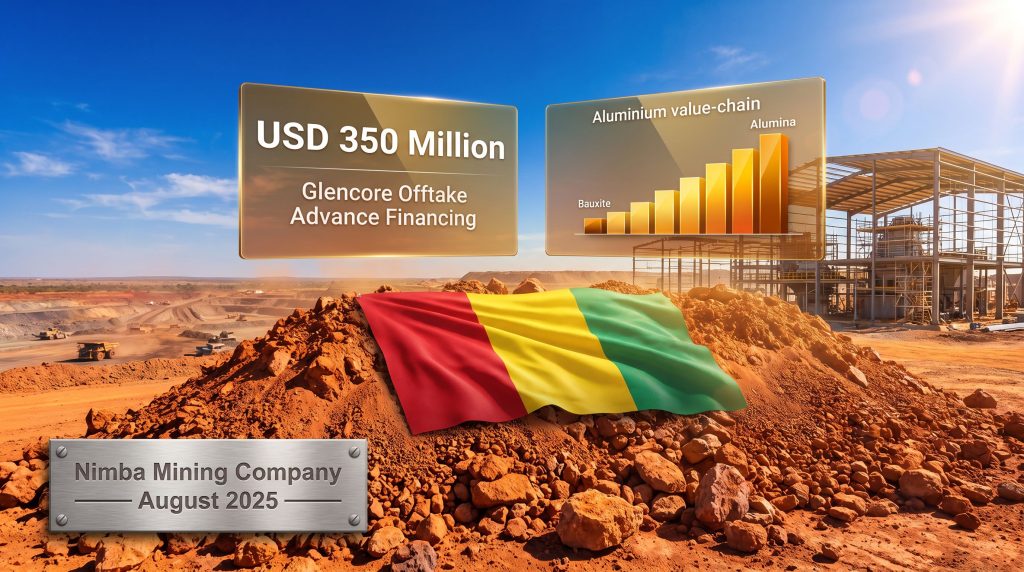
The economics of moving up the aluminium value chain are compelling on paper. Bauxite trades on the seaborne market at roughly USD 30 to 60 per tonne, depending on quality and destination. Alumina, the intermediate product derived from refining bauxite through the Bayer process, typically trades at 3 to 5 times that value per tonne of bauxite equivalent. Aluminium metal itself sits higher again.
Guinea currently exports almost entirely at the bottom rung of this ladder. The refinery ambition embedded in the Nimba Mining convention is a direct attempt to capture the value-add conversion step domestically. Consequently, this transforms Guinea from a raw ore exporter into a processed commodity supplier with meaningfully higher margins per unit of resource extracted. Among the bauxite production leaders globally, Guinea's move represents one of the most assertive attempts at value-chain integration seen in recent years.
Why the Guinea Alumina Corporation Concession Was Revoked
The origins of the Nimba Mining deal lie in a cautionary tale of unmet industrial commitments. Guinea Alumina Corporation, the former concession holder at the site, had received substantial tax exemptions from the Guinean government as part of a quid pro quo arrangement. In exchange for those fiscal concessions, GAC was contractually obligated to construct an alumina refinery.
The refinery was never built. The Guinean government's response was not to renegotiate terms, extend deadlines, or issue warnings. It revoked the concession outright.
This decision establishes a critical precedent in resource governance: tax incentives structured as performance-linked obligations carry real legal and commercial consequences when those obligations are not met. For mining companies operating across West Africa, this outcome deserves careful attention.
The revocation-and-replacement model Guinea employed is more assertive than the partial equity demands or royalty renegotiations seen elsewhere in the region. It signals that Guinea's government is willing to take direct operational control of major assets when foreign operators fail to deliver on industrial development commitments.
What Nimba Mining Company Actually Is
Nimba Mining Company was incorporated in August 2025 as a state-owned enterprise tasked with taking over the former GAC bauxite assets and restarting operations. Unlike its predecessor, Nimba Mining operates without any legacy tax exemptions. All applicable extraction and export taxes apply from the outset, reflecting the government's intention to maximise fiscal returns immediately rather than defer them in exchange for industrial commitments that may or may not materialise.
This is a structurally different arrangement from GAC's original concession in one critical respect: the accountability framework. With a state-owned entity at the centre, the consequences of failing to deliver on the refinery commitment are now political and reputational rather than purely commercial, which arguably creates stronger incentives for follow-through. In addition, observers of bauxite mine production trends will note that state-operated assets of this scale are relatively uncommon in the seaborne market.
The Refinery Obligation: Timeline and Uncertainties
The new mining convention, announced by the Guinean presidency on 3 August 2026, requires Nimba Mining to develop an alumina refinery as a core condition of the agreement. The process is structured in stages:
| Development Milestone | Target Date |
|---|---|
| Appointment of engineering firm | By end of 2026 |
| Feasibility study completion | Approximately mid-2028 |
| Refinery construction commencement | Post-feasibility study |
| Production capacity and project cost | Not yet disclosed |
The 18-month feasibility study timeline is realistic for a project of this complexity, but it also means the refinery is unlikely to begin construction before 2028 at the earliest. For a country that has been trying to build domestic alumina processing capacity for years, the timeline is a reminder that ambition and execution are separated by a great deal of capital, infrastructure, and engineering complexity.
Glencore's Role: Commodity Financing Mechanics Explained
Perhaps the most immediately consequential element of the Guinea bauxite mining deal with Nimba Mining and Glencore is the financing structure underpinning the operational restart. Glencore has committed USD 350 million in advance financing to support the resumption of mining activities at the former GAC site.
This is a prepayment financing arrangement, a mechanism that deserves explanation because it is frequently misunderstood outside commodity trading circles.
How Offtake Prepayment Financing Works: A commodity trader advances funds to a producer before any product is delivered. The producer does not repay this advance in cash. Instead, it repays through physical delivery of the agreed commodity over time, at pricing terms negotiated in advance. The trader effectively secures future supply at agreed commercial terms while the producer gains immediate liquidity without taking on conventional debt.
This structure serves both parties efficiently. Nimba Mining gets the capital to restart operations without relying on conventional project finance or sovereign debt. Glencore, selected through a competitive international tender as the exclusive offtaker for Nimba Mining's bauxite production, secures guaranteed access to a significant volume of high-quality Guinean bauxite. However, it is important to note that Glencore's role is strictly commercial. The company is acting as a buyer and financier, not as an equity investor or operational partner.
The USD 350 million is secured against future bauxite deliveries, not against the alumina refinery project, which remains a separately planned and funded initiative. The aluminium mining majors and trading houses operating across West Africa will be watching this financing model closely as a potential template for future state-operator deals.
Key Commercial Terms Still Pending
At the time of the announcement, several important contract terms had not been finalised or publicly disclosed:
| Commercial Parameter | Status |
|---|---|
| Pricing formula for bauxite deliveries | Not yet publicly disclosed |
| Annual volume commitments | Not yet confirmed |
| Contract duration and renewal terms | Not yet finalised |
| Delivery schedule | Pending finalisation |
Until these terms are confirmed, the commercial framework carries inherent uncertainty. The announced financing commitment and offtake arrangement represent heads of agreement rather than a fully executed and binding commercial contract.
Guinea's Approach Versus Regional Resource Nationalism Peers
Guinea's concession revocation model sits within a broader trend of resource nationalism across the developing world, but its specific mechanics differ from peer nations in instructive ways.
| Country | Commodity | Approach | Downstream Requirement |
|---|---|---|---|
| Guinea | Bauxite | Concession revocation for non-performance | Alumina refinery mandated |
| Indonesia | Nickel | Raw ore export ban | Domestic smelting required |
| Zimbabwe | Lithium | Mandatory beneficiation policy | Processing before export |
| DRC | Cobalt | State equity requirements | Partial processing mandated |
Indonesia's nickel export ban is the most cited comparable, having successfully forced billions of dollars of nickel processing investment into the country within a few years of implementation. Guinea's approach is different in one important respect: rather than banning exports of raw material, it is using contractual conditionality backed by concession revocation as its enforcement mechanism. The result is similar in intent but more surgical in application.
What Guinea's model adds that most peers have not yet adopted is the willingness to replace a failed foreign operator with a wholly state-owned vehicle, rather than simply renegotiating equity terms. This is a more assertive posture, one that carries both higher potential reward and higher execution risk for the state. For context, strategic raw materials supply security is increasingly driving policy decisions not just in Guinea, but across resource-dependent economies globally.
The next major ASX story will hit our subscribers first
Beyond Bauxite: The Siguiri Gold Play
A less-discussed dimension of Nimba Mining's mandate is its diversification into gold exploration. The company has announced a partnership with Australia's Resolute Mining to pursue gold exploration in Guinea's Siguiri region, one of West Africa's established gold-producing belts.
This signals that Nimba Mining is being constructed as a broader national mining vehicle with ambitions extending beyond a single commodity. Whether the organisation has the management depth and technical capacity to pursue multiple resource development programmes simultaneously is a question that remains unanswered. However, the strategic intent is clear: Guinea is building a state mining champion rather than simply a single-asset operator.
Risk Factors Every Observer Should Understand
The deal as structured carries several layers of risk that deserve direct examination:
- Parliamentary ratification is still required. The mining convention does not carry legal force until ratified by Guinea's Parliament and officially gazetted. Political delays or instability could meaningfully postpone the timeline.
- Feasibility study execution is not guaranteed. No engineering firm has been appointed, and no cost, capacity, or technical parameters for the refinery have been disclosed. Appointing a credible firm and completing a rigorous study within the targeted 18-month window is operationally demanding.
- Infrastructure constraints are significant. Building an alumina refinery in Guinea requires substantial supporting infrastructure, including reliable energy supply, water availability, and port capacity for export. These are not trivial challenges in the Guinean context.
- Commodity market sensitivity. Alumina and bauxite pricing are influenced by Chinese aluminium production cycles, global smelter utilisation rates, and energy costs. A sustained softening in aluminium demand could undermine the economic rationale for new refinery investment.
- Offtake contract finalisation risk. Until pricing, volumes, and duration are formally confirmed, the Glencore commercial arrangement remains partially unresolved.
Frequently Asked Questions
What is Nimba Mining Company?
Nimba Mining Company is a Guinean state-owned enterprise established in August 2025 to take over bauxite mining assets previously held by Guinea Alumina Corporation. It operates under Guinea's standard mining code without preferential tax treatment.
Why Did Guinea Revoke GAC's Concession?
The government withdrew GAC's mining rights because the company did not construct an alumina refinery it had committed to building in exchange for significant tax exemptions under the original concession agreement.
What Is Glencore's Role?
Glencore was selected through an international tender as the exclusive commercial offtaker for Nimba Mining's bauxite production. It has committed USD 350 million in advance financing secured against future bauxite deliveries. Glencore is not an equity partner or operational participant in the project. Guinea's selection of Glencore followed a competitive international tender process, underscoring the strategic importance of the arrangement.
When Will the Alumina Refinery Be Operational?
An engineering firm is expected to be appointed by end of 2026, with a feasibility study targeted for completion around mid-2028. Construction will only commence after that study is finalised. No official timeline, capital cost, or production capacity estimate has been announced.
Is the Glencore Offtake Contract Fully Signed?
At the time of announcement, key commercial terms including pricing, volumes, and contract duration were still being finalised. The financing commitment had been confirmed, but the full commercial contract was not yet complete.
Key Takeaways at a Glance
- Guinea's state-owned Nimba Mining Company replaces GAC as operator of a significant bauxite asset, with no legacy tax exemptions applying
- Glencore has been selected as exclusive offtaker through an international tender, providing USD 350 million in advance financing secured against future bauxite production
- The Guinea bauxite mining deal with Nimba Mining and Glencore represents one of the most structurally assertive resource governance moves seen in West Africa in recent years
- The alumina refinery remains a long-term objective, with a feasibility study targeted for mid-2028 and construction timelines, costs, and capacity figures not yet determined
- Guinea's model of concession revocation for non-performance establishes an enforceable precedent for industrial development conditionality across the region
- Parliamentary ratification of the mining convention is still required before the agreement takes legal effect
- Nimba Mining's partnership with Resolute Mining for gold exploration in Siguiri signals ambitions to become a diversified national mining vehicle
Disclaimer: This article is intended for informational purposes only and does not constitute financial or investment advice. All forward-looking statements regarding project timelines, production capacity, and commercial arrangements are subject to change. Readers should conduct independent research before making any investment decisions related to companies or commodities mentioned in this article.
Want to Track the Next Major Mineral Discovery Before the Market Does?
Discovery Alert's proprietary Discovery IQ model scans ASX announcements in real time, instantly identifying high-potential mineral discoveries across more than 30 commodities — turning complex data into clear, actionable opportunities for both short-term traders and long-term investors. Explore how historic discoveries have delivered extraordinary returns on Discovery Alert's dedicated discoveries page, and begin your 14-day free trial today to position yourself ahead of the market.