August 10, 2026
The Geopolitics of Ground: Why Namibia's Mineral Endowment Has Become a Battleground for Global Powers
Across the global mining landscape, a quiet but consequential restructuring is underway. The energy transition has transformed what once were niche industrial inputs into the most strategically coveted commodities on earth. Uranium, lithium, and rare earth elements now occupy the same strategic category as oil did in the twentieth century. The Namibia minerals race between China and the EU has become a defining feature of this shift, as nations holding these resources begin to understand the leverage that comes with geological fortune.
Few countries illustrate this shift more sharply than Namibia. Positioned at the intersection of Southern Africa's mineral belt and global supply chain anxiety, Windhoek has found itself courted simultaneously by the world's two largest economic blocs. This contest is no longer a diplomatic subplot — it has become one of the defining resource competitions of the 2020s, with implications that extend well beyond southern Africa.
When big ASX news breaks, our subscribers know first
Namibia's Geological Position: More Than Just Uranium
To understand why both Beijing and Brussels are focused on this relatively small southern African nation, it helps to start underground. Namibia's geology is unusually productive across multiple mineral categories that are simultaneously critical to both clean energy infrastructure and advanced manufacturing.
| Mineral | Strategic Application | Namibia's Global Standing |
|---|---|---|
| Uranium | Nuclear power generation, defence | Consistently top-5 global producer |
| Lithium | EV batteries, grid-scale storage | Emerging but rapidly developing |
| Rare Earth Elements | Electronics, wind turbines, defence | Prospective and largely underdeveloped |
Uranium has historically anchored Namibia's mining sector, and its two flagship operations, Rössing and Husab, are among the largest open-pit uranium mines in the world. Husab, in particular, operated under Chinese majority ownership through China General Nuclear Power Group, is capable of producing approximately 3,500 tonnes of uranium oxide per year at full capacity, making it a material contributor to global nuclear fuel supply.
Lithium is the forward-looking dimension of Namibia's mineral story. Exploration activity has intensified across the Erongo and Karibib regions, where pegmatite-hosted lithium deposits share geological characteristics with productive hard-rock lithium systems found in Western Australia. Furthermore, the critical minerals demand driving this interest continues to accelerate globally, adding urgency to every new discovery.
Rare earth prospectivity, while less commercially advanced, adds a third dimension to Namibia's strategic appeal, particularly given global efforts to diversify rare earth supply chains away from Chinese-controlled sources.
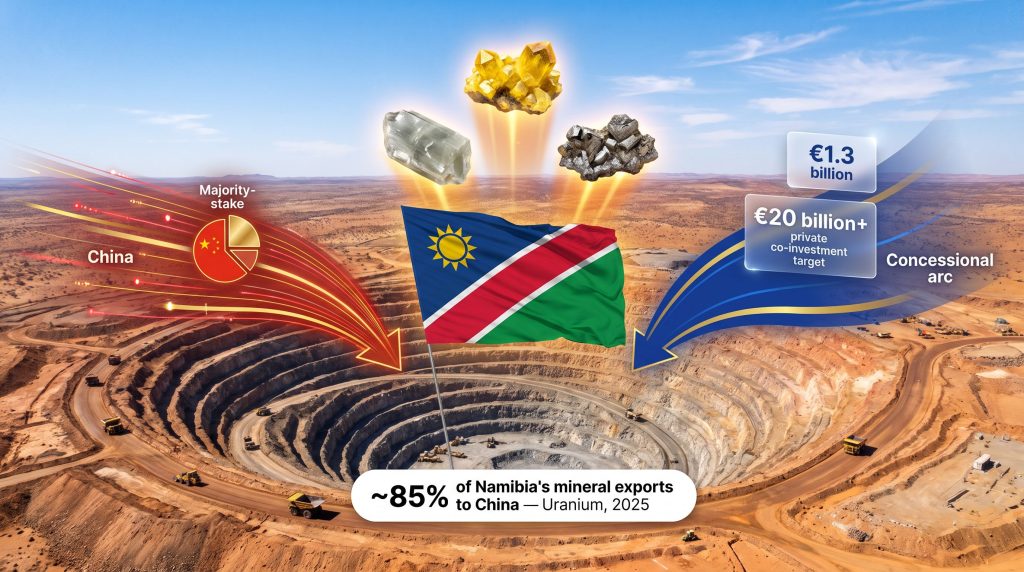
Key Insight: Uranium represented approximately 85% of Namibia's total mineral exports to China by value in 2024, according to Reuters. This single-commodity concentration defines both the strength and the vulnerability of Namibia's current position in the China-EU minerals contest.
China's Structural Advantage: Ownership, Not Just Agreements
When assessing the Namibia minerals race and how China and the EU compete, the most important distinction to grasp is that China's position is not primarily diplomatic. It is ownership-based.
Chinese entities hold majority ownership positions in Rössing and Husab, the two most productive uranium operations in the country. This creates compounding advantages that no volume of new cooperation agreements can easily replicate:
- Offtake control: As the majority owner and operator, Chinese entities influence where ore is sold and at what price structure.
- Infrastructure integration: Mine-adjacent logistics, processing equipment, and power supply arrangements are designed around existing Chinese operational models.
- Financing leverage: Chinese state-linked capital can move quickly and at scale, lowering the cost of expansion capital relative to commercial alternatives.
- Institutional knowledge: Years of operational presence have embedded technical and managerial expertise that takes decades to build.
During President Netumbo Nandi-Ndaitwah's state visit to Beijing, eight cooperation agreements were formalised between Namibia and China, covering energy, mining, infrastructure, agriculture, technical training, and green mineral development. These agreements extend an already deep commercial relationship into new sectors and forward-looking mineral streams including lithium and rare earths. Namibia's nuclear energy ties with major powers, for instance, reflect just how embedded these relationships have become — the Namibia nuclear energy ties with Russia illustrate a parallel dimension of this strategic positioning.
The critical analytical point, however, is that agreements are frameworks. Their economic value to Namibia will be determined entirely by the specific terms embedded at the project level: royalty rates, local procurement thresholds, mandatory processing requirements, and skills transfer obligations.
The Leverage vs. Dependency Tension
The 85% uranium export concentration to a single buyer creates a paradox that Namibia's policymakers must navigate carefully. On one hand, this concentration provides short-term pricing leverage. A dominant buyer with capital invested in Namibian mine infrastructure has strong incentives to maintain supply continuity, giving Windhoek a degree of contractual power.
On the other hand, uranium market volatility can disproportionately affect Namibian export revenues. The DRC's copper sector and Zimbabwe's lithium sector have faced analogous single-buyer concentration risks, and in both cases, the producing nation's bargaining position weakened when commodity demand softened.
Europe's Global Gateway Bid: Capital Without Ownership
The European Union's engagement with Namibia through its Global Gateway strategy represents a structurally different investment model. Rather than direct equity ownership, the EU has mobilised approximately $1.5 billion in concessional loans and grant financing directed at Namibia-focused projects, with stated ambitions to catalyse more than $23 billion in private sector co-investment over the medium term.
The following comparison illustrates how the two engagement models differ across key dimensions:
| Dimension | China's Model | EU's Global Gateway Model |
|---|---|---|
| Financial instrument | State-backed commercial lending | Concessional loans and grants |
| Mine ownership | Majority stakes (Rössing, Husab) | No direct mine ownership |
| Private leverage target | Not publicly disclosed | $23B+ co-investment ambition |
| Processing orientation | Ore export-dominant (current) | In-country processing (aspirational) |
| Conditionality | Low | High (governance, environment) |
| Execution speed | Fast | Slower due to compliance requirements |
| Skills transfer | Included in cooperation frameworks | Embedded in partnership architecture |
Europe's higher conditionality requirements, while often cited as a governance strength, create friction in project timelines. Environmental impact assessments, procurement transparency standards, and social safeguard requirements add layers of process that can extend the gap between announced investment and actual project commissioning by years.
This execution gap is perhaps the EU's most significant strategic liability in the Namibia minerals race. China's ability to move capital quickly from agreement to groundbreaking is a genuine competitive advantage in a market where first-mover advantages in infrastructure and logistics can be decisive. Analysts examining Europe's competitive strategy for African critical minerals have highlighted precisely this tension between governance standards and speed to market.
The EU's green hydrogen partnership with Namibia adds a complementary but distinct strategic track. Namibia's renewable energy potential makes it a credible green hydrogen production candidate, and European interest in this sector intersects with critical mineral processing ambitions, since green hydrogen can potentially power low-carbon mineral refining facilities within Namibia itself.
What Namibia Can Actually Negotiate: The Value Chain Imperative
The most important analytical reframe in the entire Namibia minerals debate is this: the question is not which external partner Namibia should favour. The question is what each partnership produces domestically. Signed agreements are not economic outcomes. Processing plants, training institutes, and grid connections are.
A mineral value chain, when structured to maximise in-country benefit, progresses through distinct stages:
- Exploration and resource definition — geological surveys, drilling programmes, resource estimation reports
- Extraction — mine construction, operational employment, local supplier development
- Primary processing — crushing, milling, concentration, initial physical separation
- Secondary processing — chemical conversion to marketable forms (uranium oxide, lithium carbonate, lithium hydroxide)
- Advanced manufacturing — battery precursor materials, nuclear fuel fabrication, magnet alloy production
- Export of finished product — commanding a significantly higher unit value per tonne than raw ore
Namibia currently operates predominantly at stages one through four, with uranium oxide production representing the most advanced in-country processing step at scale. Furthermore, Australia's approach to critical minerals trade strategy offers a comparative model for how resource-rich nations can progressively shift the value mix of mineral exports.
Scenario Analysis: Two Paths for Namibia's Lithium Sector
Scenario A, the Raw Export Model: Lithium-bearing ore is extracted under a royalty arrangement and exported unprocessed or minimally concentrated. State revenue is limited to royalties and corporate income tax on relatively low-value product. Employment concentrates in extraction-phase roles. The majority of economic value is captured offshore.
Scenario B, the Integrated Processing Model: A cooperation agreement mandates construction of a lithium hydroxide conversion facility as a condition of exploration and mining rights. The state negotiates equity participation and a processing fee structure. Export value per tonne increases substantially. Downstream employment in chemical processing and logistics expands domestically. State revenue grows as a function of finished product pricing rather than raw ore volume.
The difference between these two scenarios is not geological. It is contractual, political, and a matter of negotiating ambition.
The Regional Demonstration Effect: What African Governments Are Watching
Namibia's dual-suitor dynamic is generating close attention across Sub-Saharan Africa. Governments in Zimbabwe, Zambia, and the DRC are evaluating whether the simultaneous competition between major economic blocs can be leveraged to secure stronger project terms than would be available in a less contested investment environment.
The emerging standard across African mineral investment frameworks now includes:
- Mandatory local content and beneficiation requirements tied to licensing approvals
- Minimum in-country processing thresholds before export rights are granted
- State equity participation mechanisms in new mining ventures
- Royalty rate escalators linked to commodity price benchmarks
- Enforceable skills transfer and local workforce development quotas
The African Union's critical minerals framework is working toward standardising these negotiating positions across member states. However, regulatory inconsistency, infrastructure deficits, and skills gaps remain genuine risk factors that can undermine even well-designed agreement structures. Namibia's ability to navigate these dynamics will be closely observed as a regional benchmark. Insight into Namibia's rare earths position suggests that converting geopolitical rivalry into industrial growth is achievable but will require sustained policy discipline.
The next major ASX story will hit our subscribers first
Tracking the Right Indicators After Agreements Are Signed
For investors, analysts, and policymakers monitoring the Namibia minerals race between China and the EU, the signing of cooperation frameworks is the beginning of the analytical process, not the conclusion. The metrics that actually determine whether these partnerships produce development outcomes include:
- Processed mineral exports as a percentage of total mineral exports (year-on-year trend in value terms)
- Number of processing facilities commissioned under cooperation agreements within five years of signing
- Domestic employment ratios in processing and manufacturing relative to extraction-only roles
- Royalty and tax revenue as a share of total mineral export value (indicating state capture rate)
- Private investment disbursed versus announced under Global Gateway commitments
- Skills transfer programme completion rates and retention of trained workers in-country
Investor Note: The distance between a signed cooperation framework and a commissioned processing facility is measured in years of feasibility work, financing negotiations, permitting, and construction. Announcements alone carry no economic weight. Project-level disclosures and construction commencement milestones are the signals that matter.
The Namibia minerals race will ultimately be decided not in Beijing or Brussels, but in the project term sheets, construction timelines, and skills development outcomes that follow diplomatic summits. For a country with Namibia's geological endowment, the opportunity to convert competing international interest into durable industrial capacity is real. Whether that opportunity is captured depends on the quality of the negotiating architecture and the political will to enforce its terms.
Readers seeking additional context on Africa's evolving role in global critical mineral supply chains can find related reporting and analysis at FurtherAfrica, which covers African investment, trade, and resource policy developments across the continent.
This article contains forward-looking analysis and scenario projections intended for informational purposes only. It does not constitute financial or investment advice. All figures and statistics cited reflect publicly available information at the time of writing.
Ready to Position Yourself Ahead of the Next Major Mineral Discovery?
As the global race for critical minerals intensifies across Africa and beyond, Discovery Alert's proprietary Discovery IQ model delivers real-time alerts on significant ASX mineral discoveries — turning complex geological and market data into actionable investment insights for traders and long-term investors alike. Explore historic examples of exceptional discovery outcomes and begin your 14-day free trial today to secure a market-leading advantage as the energy transition reshapes the global resource landscape.