
August 10, 2026
The Hidden Mechanics Behind Oil's Most Volatile Chokepoint
Few forces in global energy markets operate with the quiet, structural power of geography. Long before geopolitical tensions surface in trading terminals, the physical layout of the world's export corridors quietly determines which producers hold leverage and which importers bear risk. Nowhere is this dynamic more consequential than at the mouth of the Persian Gulf, where a narrow stretch of water between Oman and Iran functions as the single most important energy transit point on the planet.
Understanding why oil prices and the Strait of Hormuz reopening have become so tightly intertwined requires more than tracking daily price moves. It demands a working understanding of the waterway's structural role, the negotiating architecture currently shaping its future, and the compounding supply-side threats simultaneously pulling market sentiment in multiple directions. Furthermore, crude oil geopolitics have long amplified how quickly such chokepoints translate into global pricing pressure.
When big ASX news breaks, our subscribers know first
The Structural Weight of a 21-Mile Corridor
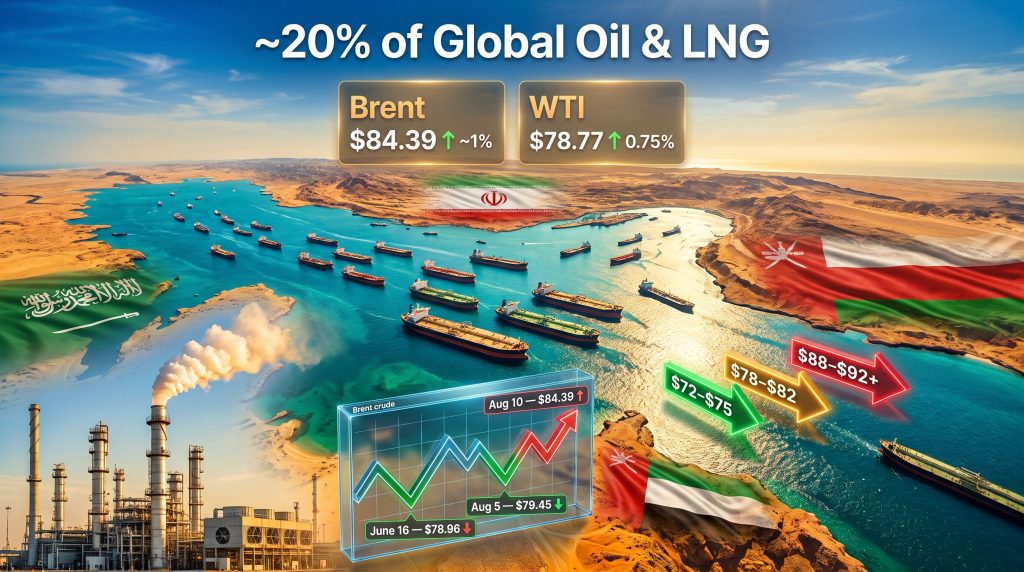
The Strait of Hormuz is not simply a trade route. It is a physical constraint on the global oil system, one that no amount of infrastructure investment has yet been able to fully bypass. At its narrowest navigable point, the channel spans roughly 21 miles, yet through this corridor flows approximately one-fifth of all globally traded oil and liquefied natural gas.
Before the current conflict disrupted shipping flows, the strait served as the primary export artery for Saudi Arabia, the UAE, Kuwait, Iraq, and Iran itself. Every barrel of crude loaded at Gulf terminals and destined for Asian, European, or American refineries was, to a significant degree, dependent on Hormuz remaining open.
| Metric | Pre-Conflict Baseline | Current Disruption Period |
|---|---|---|
| Share of global oil trade | ~20% | Severely curtailed |
| LNG volumes transiting | Significant portion of Asian supply | Redirected or delayed |
| ADNOC vessels attacked | N/A | 15 vessels since conflict began |
| Brent crude price range | Lower equilibrium | $78–$85+ range |
What makes the strait so difficult to replace is not just its volume throughput but the absence of credible alternatives at scale. Saudi Arabia's East-West Pipeline, known as Petroline, and the UAE's Abu Dhabi Crude Oil Pipeline (ADCOP) offer partial bypass capacity, but their combined throughput falls meaningfully short of replacing full Hormuz volumes.
This structural bottleneck is not a temporary problem. It is an architectural feature of Gulf energy infrastructure that has never been resolved despite decades of awareness. In addition, disruptions to global LNG supply through this corridor compound the challenge for Asian importers who depend on both crude and gas from Gulf producers.
How Oil Markets Price Diplomacy in Real Time
The Inverse Signal That Traders Watch Most Closely
One of the less intuitive dynamics playing out in crude markets right now is the inverse relationship between reopening expectations and benchmark prices. When credible signals emerge that a Hormuz shipping agreement is close, oil prices fall, sometimes sharply. When those signals fade or closure conditions are reaffirmed, prices recover.
This is not irrational market behaviour. It reflects the enormous volume of stranded Gulf crude waiting to re-enter global supply the moment the strait opens. Markets are essentially pricing in a forward supply surge every time diplomatic progress appears credible.
The chronology of recent price movements illustrates this dynamic precisely. Oil price movements have repeatedly demonstrated how rapidly sentiment can shift on diplomatic headlines alone:
| Date | Event or Signal | Brent Price | WTI Price | Direction |
|---|---|---|---|---|
| June 16 | Interim U.S.-Iran deal raised reopening hopes | $78.96 | $76.05 | Down ~5% |
| June 29 | Renewed strikes revived closure fears | Rose ~0.9% | N/A | Up |
| August 5 | De-escalation expectations weighed on sentiment | $79.45 | $75.22 | Down |
| August 7 | Negotiation uncertainty reasserted risk premium | $83.55 | N/A | Up |
| August 10 | Iran's conditions tempered optimism | $84.39 | $78.77 | Up ~1% |
In the week before August 10, Brent shed more than 7 percent as markets priced in a high probability of a breakthrough deal between Iran and Oman that would restore normal shipping lanes. Speculative selling intensified as traders anticipated a wave of previously blocked Gulf crude returning to global markets.
According to Al Jazeera, when renewed U.S. and Iranian strikes threatened the reopening timeline, oil prices rose sharply as risk premiums were rapidly repriced across benchmark contracts. When Iran publicly restated its conditions on Sunday, August 10, including a demand for U.S. compensation for military strikes, Brent recovered approximately 1 percent to $84.39 and WTI climbed 0.75 percent to $78.77. The gap between diplomatic language and operational reality had reasserted itself.
Iran's Negotiating Position and What It Means for Supply
A Multi-Condition Framework That Markets Cannot Easily Model
Sugandha Sachdeva, founder of New Delhi-based research firm SS WealthStreet, noted that crude oil prices remain caught between opposing forces, as markets weigh the possibility of a diplomatic breakthrough against Iran's explicit conditions for reopening the waterway. That tension is the defining characteristic of the current trading environment.
Iran's position as of August 10 rests on several interlocking conditions:
- U.S. compensation for military strikes carried out against Iranian territory
- A suspension of direct U.S.-Iran talks, with Tehran citing Washington's alleged breach of the June interim agreement
- The continuation of Oman as the sole active mediation channel
- Iran's insistence that reopening is contingent on political commitments, not just operational agreements
Iranian Foreign Minister Abbas Araqchi confirmed publicly that direct talks with Washington remain suspended. Tehran's stance is that the June interim agreement was breached by U.S. actions, removing the basis for renewed direct engagement.
This framing matters for markets because it signals that even a shipping lane agreement brokered through Oman would not constitute a full normalisation of relations, leaving the risk premium structurally embedded rather than eliminated. Consequently, the OPEC market influence over supply decisions could become increasingly relevant if Iranian volumes remain constrained over an extended period.
The phrase "final stages" in diplomatic contexts has historically preceded both breakthroughs and sudden collapses. In Middle Eastern negotiations specifically, the distance between near-agreement and operational implementation can span weeks or months, and markets that price in the former before achieving the latter tend to experience sharp reversals.
Sachdeva also observed that any meaningful progress toward restoring unrestricted shipping would exert downward pressure on oil prices, while a breakdown in negotiations or renewed supply disruptions could quickly revive the geopolitical risk premium embedded in current benchmarks.
The Compounding Risk Layer Beyond Hormuz
Infrastructure Attacks That Operate on a Separate Track
The complexity of the current situation extends beyond the Hormuz diplomatic track. Two additional supply-side threats are simultaneously active, each capable of moving prices independently.
The Houthi Strike on Jazan Refinery
Iran-aligned Houthi forces claimed responsibility for a strike on Saudi Aramco's Jazan refinery on the same weekend as the August 10 price movements. This attack adds a direct production and refining disruption risk that is entirely separate from the Hormuz shipping lane negotiations. Critically, it occurred just two days after Saudi Arabia formalised a defence pact with Turkey and Pakistan, a Sunni alliance explicitly framed as a response to growing regional instability stemming from the broader conflict.
ADNOC Vessel Attacks: Quantifying the Physical Risk
The UAE's ADNOC confirmed that 15 of its vessels had been attacked while transiting the Strait of Hormuz since the conflict began. This figure is significant for a reason that goes beyond the immediate damage. Even in a scenario where a shipping lane agreement is formalised, the physical security environment for commercial tankers remains hostile.
As Reuters reported, a Hormuz reopening would release a significant wave of oil supply capable of materially depressing prices, yet war-risk insurance premiums and surcharges on Gulf tanker voyages remain structurally elevated, meaning effective delivered prices for Gulf crude will remain above benchmark levels even in a partial reopening scenario.
The Middle East Crude Differential as a Real-Time Sentiment Gauge
A lesser-known market signal that experienced energy traders monitor closely is the Oman/Dubai crude differential relative to Brent. When Hormuz reopening expectations strengthen, Gulf crude grades tend to see their spot differentials compress against Brent, as buyers anticipate increased supply availability.
When closure risks intensify, however, Gulf grades command a scarcity premium that widens the spread. This differential movement often precedes headline price moves by hours, making it one of the more actionable real-time indicators of Hormuz risk sentiment. Furthermore, the trade war oil impact has introduced an additional layer of demand-side uncertainty that complicates how these differentials are interpreted by market participants.
Three Scenarios and Their Price Implications
Mapping the Outcome Space for Brent and WTI
Given the multi-vector nature of the current risk environment, a scenario-based framework offers more analytical value than a single price forecast. The three most plausible pathways and their associated price implications are as follows:
Scenario 1: Full Diplomatic Resolution Within 30 to 60 Days
- Unrestricted commercial shipping resumes through the strait
- Millions of barrels of stranded Gulf crude re-enter global supply simultaneously
- Brent could retrace toward the $72 to $75 range as the risk premium collapses
- LNG markets serving India, Japan, South Korea, and China ease materially
- Key signal to monitor: U.S. willingness to engage on Iran's compensation preconditions
Scenario 2: Partial or Conditional Reopening via Oman Mediation
- A limited shipping lane arrangement allows some commercial traffic but excludes full normalisation
- Brent likely stabilises in the $78 to $82 range, with ongoing volatility tied to compliance monitoring
- War-risk insurance costs remain elevated, keeping effective delivered prices above benchmark levels
- This scenario is arguably the most likely near-term outcome given the stated positions of both parties
Scenario 3: Negotiation Collapse and Renewed Escalation
- Breakdown in Oman-mediated talks combined with further infrastructure strikes pushes Brent toward $88 to $92 or higher
- IEA member nations would likely accelerate strategic reserve releases in response
- Key trigger to monitor: any U.S. military response to the Jazan refinery attack
The next major ASX story will hit our subscribers first
Who Bears the Highest Exposure Among Import-Dependent Economies
Asia's Structural Vulnerability to a Prolonged Closure
The asymmetry of Hormuz exposure across global economies is not evenly distributed. Several large import-dependent nations face compounding risks that go beyond crude oil prices alone:
- India ranks among the most exposed large economies, given its significant reliance on Gulf crude and its geographic proximity to the conflict zone. A sustained closure or restricted lane arrangement would force Indian refiners to source alternative barrels from further afield at a cost premium.
- Japan, South Korea, and China face compounding supply constraints because both crude oil and liquefied natural gas from Gulf producers transit through the same chokepoint. A prolonged disruption affects their energy security across two fuel categories simultaneously.
- European buyers who restructured their supply chains toward Gulf sources following earlier geopolitical disruptions now face renewed route risk, having reduced their exposure to one supply shock only to re-encounter a different one.
Frequently Asked Questions
What Happens to Oil Prices If the Strait of Hormuz Reopens?
A credible and fully operational reopening would likely push Brent down by 5 to 10 percent from current levels in the near term, as stranded Gulf crude re-enters global supply and the geopolitical risk premium dissipates. The speed of the move would depend on whether the reopening is immediate and unrestricted or phased and conditional.
Why Did Oil Rise on August 10 Despite Talks Being in "Final Stages"?
Markets interpreted Iran's public reaffirmation of its preconditions, particularly the demand for U.S. compensation, as evidence that a swift and unconditional reopening was not imminent. The diplomatic progress was real, but the operational distance between a lane agreement and full normalisation was wide enough to reassert the risk premium, driving Brent up approximately 1 percent to $84.39 and WTI up 0.75 percent to $78.77.
What Is Oman's Role in the Current Negotiations?
Oman has historically served as a neutral back-channel intermediary between Iran and Western powers, a role that predates the current conflict. In the present context, Oman is mediating discussions around revised shipping lane arrangements that could allow commercial traffic to resume without requiring a full political settlement between Iran and the United States. This distinction matters: a lane agreement and a political resolution carry very different implications for the durability of any price relief.
Are There Alternative Routes That Can Replace Hormuz?
Not at full scale. Saudi Arabia's Petroline and the UAE's ADCOP pipeline offer partial bypass capacity, but their combined throughput falls significantly short of replacing full Hormuz volumes. This structural bottleneck means that even a prolonged partial closure creates sustained upward pressure on global benchmarks with no readily available fix.
Key Takeaways for Market Participants
The current environment around oil prices and the Strait of Hormuz reopening is defined by a set of structural conditions that are unlikely to resolve cleanly or quickly:
- The geopolitical risk premium is now embedded structurally, not episodically, in Brent and WTI pricing until a verified operational reopening occurs
- Diplomatic language and operational reality remain disconnected, and markets that collapse the gap prematurely face sharp reversals
- Multi-vector risk is the defining feature of the situation: Hormuz negotiations, Houthi infrastructure strikes, ADNOC vessel attacks, and regional alliance realignment are all simultaneously influencing supply expectations
- The asymmetry of potential price moves matters: a reopening-driven decline would likely be faster and sharper than any escalation-driven rise, given the volume of stranded crude waiting to re-enter the market
Traders and energy analysts should monitor three concurrent signals: the Oman-Iran shipping lane agreement status, U.S. policy responses to Iranian preconditions, and the frequency of Houthi and proxy attacks on Gulf infrastructure. The composite picture across these three variables will determine whether Brent holds near current levels, breaks higher toward the low nineties, or collapses toward the mid-seventies.
This article contains forward-looking analysis and scenario projections based on publicly available information. Energy market forecasts involve inherent uncertainty and should not be construed as investment advice. Readers should conduct independent research and consult qualified financial advisers before making investment decisions.
Want to Capitalise on the Next Major Commodity Discovery Before the Market Moves?
While geopolitical forces drive volatility in oil markets, some of the most significant investment opportunities emerge from major mineral discoveries on the ASX — and Discovery Alert's proprietary Discovery IQ model delivers real-time alerts the moment those discoveries are announced, turning complex data across 30+ commodities into clear, actionable insights. Explore historic examples of exceptional discovery returns or start your 14-day free trial today to position yourself ahead of the broader market.