August 10, 2026
When the World's Largest Bulk Port Stops Loading: What the BHP Port Hedland Strike Reveals About Supply Chain Concentration Risk
Global commodity markets are built on assumptions of continuity. Steel mills in Tangshan, shipbuilders in Ulsan, and infrastructure developers across Southeast Asia all operate on the premise that Pilbara iron ore will keep flowing. That assumption has rarely been tested at Port Hedland, which is precisely what makes the ongoing BHP Port Hedland strike so significant — not just as a labour dispute, but as a stress test of one of the world's most consequential export arteries.
The dispute is unfolding at a facility that processes more bulk tonnage than any other port on the planet. Understanding its trajectory requires moving beyond the headline participation numbers and looking at the structural forces driving both sides toward, and potentially away from, resolution.
When big ASX news breaks, our subscribers know first
Port Hedland's Outsized Role in the Global Iron Ore System
To appreciate why this industrial action carries weight far beyond Western Australia's North West Coastal Highway, it helps to understand what Port Hedland actually represents in the global commodity system. Furthermore, the global iron ore market impact of any sustained disruption here extends well beyond a single producer's balance sheet.
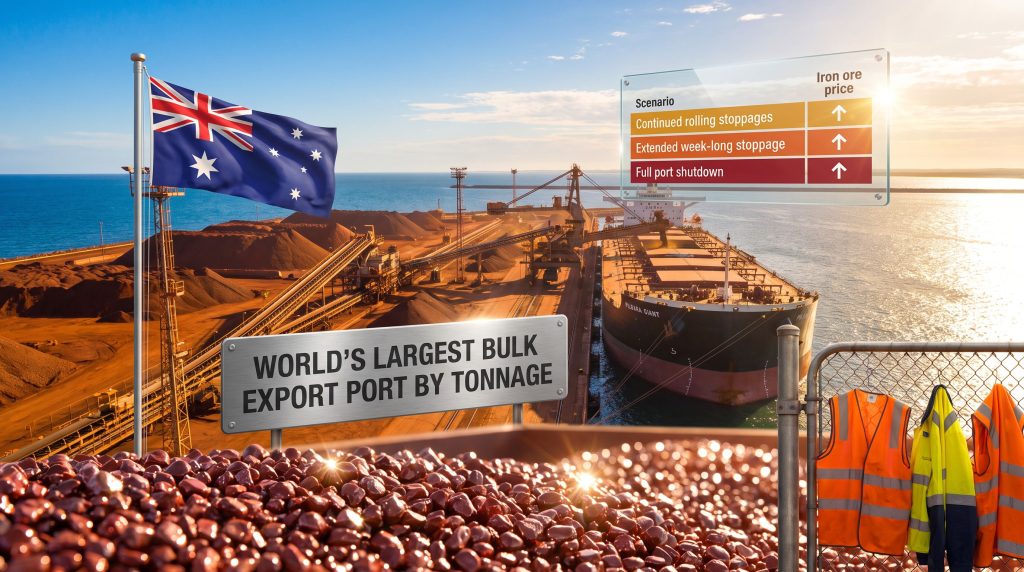
- Port Hedland is the world's largest bulk export port by tonnage, with iron ore shipments flowing to steel mills across China, Japan, South Korea, and Taiwan
- Iron ore consistently ranks as Australia's highest-value export commodity, generating tens of billions in annual foreign exchange earnings
- BHP's Pilbara iron ore system, anchored at Port Hedland, is a vertically integrated network spanning mines, rail corridors, and ship-loading infrastructure
- The port's throughput is not simply a BHP metric; it feeds directly into global steel production economics, affecting construction costs, infrastructure projects, and manufacturing supply chains across Asia
This concentration of supply in a single geographic point creates what commodity analysts call single-node risk — where disruptions at one location propagate across an entire interconnected system. The BHP Port Hedland strike is a live demonstration of that vulnerability.
A Dispute Decades in the Making: The Chronology of Escalation
Industrial relations in the Pilbara have historically been characterised by a relatively stable, if sometimes tense, equilibrium. The current dispute breaks from that pattern in ways that make it structurally distinct from previous grievances.
Phase One: The Historic July Stoppage
The first 24-hour stoppage in mid-July 2026 was, by most accounts, the first strike at Port Hedland in several decades. Workers gathered in a visible picket line outside BHP's Port Hedland facilities, marking a symbolic and physical assertion of collective power that had been absent from the port for a generation. The July action followed months of enterprise agreement negotiations that union representatives described as systematically unproductive, with management failing to advance meaningful proposals across repeated meetings.
Phase Two: The August Rolling Stoppage
The second round of industrial action, conducted over a weekend in early August 2026, adopted a deliberately different tactical posture. Rather than forming a picket line, workers were directed to simply remain at home. Approximately 150 workers participated across the two-day rolling stoppage, according to Reuters reporting.
Simultaneously, ETU members performing high-voltage electrical work at BHP's Newman operations also took industrial action, effectively extending the geographic footprint of the dispute inland into the Pilbara's mining hub. This dual-front approach represents a more sophisticated escalation strategy than a single-location stoppage.
Phase Three: Fair Work Commission Involvement
By the time the August weekend action concluded, the two parties had attended eleven separate meetings at the Fair Work Commission without reaching resolution. A twelfth meeting was scheduled for August 18, with BHP committing to table an updated enterprise agreement offer. The Commission's deepening involvement signals a transition from bilateral negotiation to structured third-party arbitration.
What the Unions Are Actually Demanding
Understanding the union position requires looking past the surface-level wage debate toward the underlying classification architecture of BHP's port workforce.
Pay Equity and Job Classification Reform
The ETU's state secretary characterised existing pay structures as exhibiting significant inconsistency across equivalent roles, with descriptions suggesting wide remuneration gaps between workers performing comparable functions within the same operational environment. The combined unions — comprising the Electrical Trades Union (ETU), the Australian Manufacturing Workers' Union (AMWU), and the Australian Workers' Union (AWU) — are pursuing standardised job classifications that align pay more consistently across the workforce.
This is not simply a demand for higher wages. It is a demand for structural reconfiguration of how work is valued and compensated within BHP's port operations, which carries far longer-term implications for the company's labour cost base than a straightforward pay rise.
Safety Standards and Operational Conditions
Beyond remuneration, the union claims encompass working conditions in one of Australia's most demanding industrial environments. The ETU has framed improved conditions not merely as worker entitlements but as prerequisites for long-term operational sustainability, arguing that safe and fair conditions underpin the productive iron ore industry that both workers and the broader economy depend upon.
The ETU reported a notable increase in union membership since the dispute began, suggesting the visibility of the action is generating solidarity effects that extend beyond the immediate bargaining unit.
The Four-Year Horizon
A critical and often underreported dimension of this dispute is its duration: the parties are negotiating a four-year enterprise agreement. The outcome will not merely resolve the current standoff; it will set the benchmark for labour conditions across BHP's Pilbara port operations well into the 2030s. This extended time horizon raises the strategic stakes considerably for both parties.
The Contested Metrics: What Actually Happened During the Strike?
One of the most analytically interesting aspects of the BHP Port Hedland strike is the significant divergence between union and management accounts of its operational impact.
| Metric | Union Claim | BHP's Reported Position |
|---|---|---|
| Saturday participation | All but 3 eligible workers | Approximately 20 workers |
| Sunday participation | Near-total across port facility | Approximately 90 workers |
| Iron ore loaders affected | 3 loaders at significantly reduced capacity | Operations described as normal |
| Vessels departed Saturday | Impact on loading rates claimed | 4 vessels departed as scheduled |
| Vessels departed Sunday | Impact on loading rates claimed | 4 vessels departed as scheduled |
| Monday departures | Not specified | 3 bulk carriers expected |
These contested figures reflect a deeper truth about industrial action in critical infrastructure: both sides have powerful incentives to shape the narrative. Unions need to demonstrate effectiveness to maintain member solidarity and negotiating leverage. Management, however, needs to signal operational resilience to protect market confidence and investor sentiment.
Pilbara Ports Authority confirmed it did not anticipate broader port-wide disruption, noting the industrial action was specific to BHP's workforce arrangements rather than port operations generally. Indeed, strikes hitting BHP operations have thus far produced less visible export volume disruption than many market observers initially anticipated.
The Productivity Cost Hiding in Plain Sight
The Chamber of Minerals and Energy WA (CMEWA) offered what may be the most analytically useful framing of the strike's true cost — one that transcends the vessel departure count.
CMEWA Chief Executive Aaron Morey identified two compounding cost dimensions that neither the union's participation figures nor BHP's vessel departure numbers fully capture:
- Productivity drag from resource diversion — maintaining normal vessel loading schedules during the strike required a significant redirection of management attention, contingency workforce deployment, and operational planning resources. This hidden cost persists even when output metrics appear unaffected.
- Investment signal deterioration — sustained industrial conflict in the Pilbara risks transmitting a message to international capital markets that the region carries elevated sovereign and operational risk, potentially constraining future capital allocation to Australian iron ore projects.
CMEWA's Aaron Morey indicated that while safety and production were largely maintained, a significant amount of resources had to be dedicated to managing the situation, creating an undoubted productivity impact. He further noted that prolonged disputes of this kind can signal to global investors that the Pilbara is a conflict-prone environment, making it harder to attract future sector investment.
This investment signal argument deserves particular attention from market observers. Australia's iron ore dominance in global markets depends not only on geological abundance but on perceptions of operational reliability — a genuine competitive variable when Brazilian producer Vale and emerging African iron ore projects continuously position for a larger share of Asian steel mill procurement.
The next major ASX story will hit our subscribers first
Global Iron Ore Market Implications: Scenario Analysis
The current dispute has not yet produced material export volume losses, but its continuation or escalation introduces measurable risk premiums into forward supply planning for major Asian steel producers. Consequently, the iron ore market disruption risk profile has shifted meaningfully for traders and steel mills monitoring Pilbara supply continuity.
| Escalation Scenario | Likely Operational Impact | Potential Market Response |
|---|---|---|
| Continued rolling 48-hour stoppages | Manageable with contingency staffing; moderate productivity loss | Limited spot price movement; elevated investor monitoring |
| Extended week-long stoppage | Meaningful reduction in vessel loading rates; backlog formation | Noticeable tightening in spot iron ore supply; possible price uplift |
| Full port shutdown (low probability) | Severe disruption to global iron ore supply | Significant commodity price response; downstream steel cost pressure |
China's Structural Exposure
China absorbs the substantial majority of Pilbara iron ore exports, meaning any supply disruption at Port Hedland intersects directly with Chinese steel production economics. The iron ore demand prospects from China remain constrained by a prolonged property sector slowdown, which means iron ore supply disruptions could produce asymmetric price effects depending on inventory buffer levels held by Chinese mills and trading houses.
In addition, the China steel and iron ore market relationship with Pilbara supply means any escalation in this dispute carries downstream implications for global construction and manufacturing cost structures.
It is worth noting that Chinese steel mills routinely maintain port inventory buffers of between 30 and 45 days, which provides some cushion against short-term supply interruptions. However, a sustained multi-week disruption would begin to pressure those buffers meaningfully.
BHP's Strategic Response and the Updated Offer
BHP's approach throughout the dispute reflects a calculated dual strategy: demonstrating operational resilience while simultaneously accelerating the negotiation process through the Fair Work Commission framework.
The company confirmed it had contingency plans in place ahead of the August strike action, enabling continued vessel loading throughout the weekend. Its public communications consistently emphasised that vessels were loaded and departed as scheduled — a deliberate framing designed to limit market anxiety and investor concern.
BHP has committed to tabling a revised enterprise agreement proposal at the August 18 Fair Work Commission hearing. The company's stated position centres on delivering greater pay consistency across the workforce while preserving what it describes as industry-leading pay and conditions. Critically, BHP characterised the progress made through Commission meetings as significant, framing the ongoing industrial action as unnecessary given the forward momentum in negotiations.
The Political Dimension
Western Australian Premier Roger Cook publicly called on both parties to reach a negotiated outcome, expressing support for workers securing improved wages and conditions while simultaneously emphasising the importance of employer profitability and operational sustainability. This balanced framing reflects the WA Government's dual interest in maintaining strong labour standards and protecting the state's dominant position in global iron ore trade, though no specific government intervention or project-level support has been announced.
Leverage, Resolution Pathways, and What Comes Next
The August 18 Fair Work Commission hearing represents the most consequential near-term milestone in the dispute. Three broad resolution pathways exist:
- Negotiated enterprise agreement — the most likely outcome if BHP's updated offer substantively addresses the pay consistency and classification claims that sit at the core of union demands
- Commission-mediated compromise — the Fair Work Commission could recommend or impose binding terms if voluntary negotiation reaches an impasse
- Continued escalation — if the updated offer is rejected as insufficient, unions retain both the legal framework and the demonstrated organisational capacity to pursue longer or more targeted stoppages
The leverage dynamics are genuinely balanced. Unions have demonstrated willingness to escalate, growing membership solidarity, and the symbolic power of disrupting Australia's most strategically important export facility. BHP, however, holds the advantage of operational continuity through contingency planning, the financial pressure on striking workers over time, and a Commission process that constrains the scope of protected industrial action.
Union representatives described recent Commission meetings as productive and indicated that a path forward had been identified, suggesting cautious optimism that the August 18 hearing may produce a framework for resolution.
Both parties face reputational and financial costs from a prolonged dispute, creating a mutual incentive structure that favours negotiated resolution over extended conflict. The central question is whether BHP's updated offer will be calibrated closely enough to union demands to close the gap, or whether the structural disagreement over job classifications and pay consistency requires further rounds of pressure before a genuine compromise emerges.
Frequently Asked Questions: BHP Port Hedland Strike
Which unions are involved in the BHP Port Hedland strike?
Three unions are party to the dispute: the Electrical Trades Union (ETU), the Australian Manufacturing Workers' Union (AMWU), and the Australian Workers' Union (AWU). The ETU is also separately conducting industrial action at BHP's Newman operations, targeting high-voltage electrical work.
When did the BHP Port Hedland strike begin?
The first formal strike action occurred in mid-July 2026, representing the first stoppage at Port Hedland in several decades. The second round of rolling 48-hour industrial action occurred over a weekend in early August 2026.
Did the August strike disrupt iron ore exports?
BHP reported that vessel loading and departures continued as scheduled, with four ships departing on both Saturday and Sunday. Unions disputed the characterisation of operational impact, claiming iron ore loaders were operating at significantly reduced capacity.
What is the strike fundamentally about?
The core claims centre on pay equity, standardised job classifications, and improved working conditions under a proposed four-year enterprise agreement. Union representatives have described existing pay structures as exhibiting significant inconsistency across comparable roles.
When is the next negotiation scheduled?
The parties are due to return to the Fair Work Commission on August 18, where BHP has committed to presenting an updated enterprise agreement offer — the twelfth formal meeting since the dispute commenced.
Disclaimer: This article contains forward-looking scenario analysis and market assessments that are inherently speculative. Commodity price projections, escalation scenarios, and investment signal assessments reflect analytical frameworks rather than confirmed outcomes. Readers should not treat any content herein as financial advice. All figures and timelines are drawn from publicly available reporting as of the date of publication.
Want to Stay Ahead of the Next Major ASX Mineral Discovery?
While supply chain disruptions at Port Hedland highlight the systemic importance of Australia's resource sector, Discovery Alert's proprietary Discovery IQ model scans ASX announcements in real time, delivering instant alerts on significant mineral discoveries so subscribers can identify actionable opportunities before the broader market reacts — explore historic discoveries and their extraordinary returns, then begin your 14-day free trial to secure a genuine market-leading edge.