August 10, 2026
The Shrinking Discount Nobody Is Talking About
Global energy markets have a way of making headlines feel more catastrophic than the underlying economics actually warrant. When sanctions, tariffs, and geopolitical trade tensions intersect, the instinct is to assume worst-case outcomes. But the relationship between legislative authorization and real-world economic impact is rarely linear, and the current debate around the Trump 100% tariff on Russian oil and India economy is a textbook case of where headline risk and fundamental risk are pulling in very different directions.
Understanding why requires looking past the vote count in Washington and examining what Indian crude economics actually look like in mid-2026, and more importantly, where India's genuine macroeconomic vulnerabilities actually sit.
When big ASX news breaks, our subscribers know first
How the U.S. Senate Bill Actually Works
The 86-11 Senate vote that passed the Russian oil tariff bill made global headlines, and understandably so. A near-unanimous vote creating presidential authority to impose tariffs of up to 100% on nations purchasing Russian crude and natural gas sounds like an immediate economic threat. The reality is considerably more layered.
Several critical structural points are frequently overlooked in the coverage:
- The bill grants discretionary authority to the president, not an automatic tariff mechanism. No tariff takes effect until the president chooses to exercise that authority.
- The legislation must still clear the House of Representatives and receive a presidential signature before it becomes law in any form.
- Historically, tariff threats of this magnitude have been deployed as negotiating instruments rather than fixed policy end-states, particularly in the current administration's diplomatic approach.
- Full enforcement at 100% would create meaningful inflationary pressure within the U.S. economy itself, a factor analysts argue reduces the probability of blanket application against major trading partners.
The distinction between legislative authorization and executive enforcement is not a minor technical footnote. It is the central variable determining whether India faces a genuine economic disruption or a diplomatic negotiating environment.
Furthermore, the Trump tariff impact on global trade remains contested, with active India-U.S. bilateral trade negotiations providing an existing diplomatic channel through which the Russian oil question can be resolved as a distinct track, separate from broader sanctions architecture.
What Russian Crude Is Actually Worth to India in 2026
The economic argument for alarm rests heavily on assumptions about how valuable Russian crude has been to India. However, the discount story has changed dramatically since the early days of the Ukraine conflict.
The Discount Compression Nobody Foresaw
| Period | Russian Crude Discount (per barrel) | Estimated Annual Saving |
|---|---|---|
| Early Ukraine Conflict (2022) | $15 to $20 per barrel | Substantial fiscal benefit |
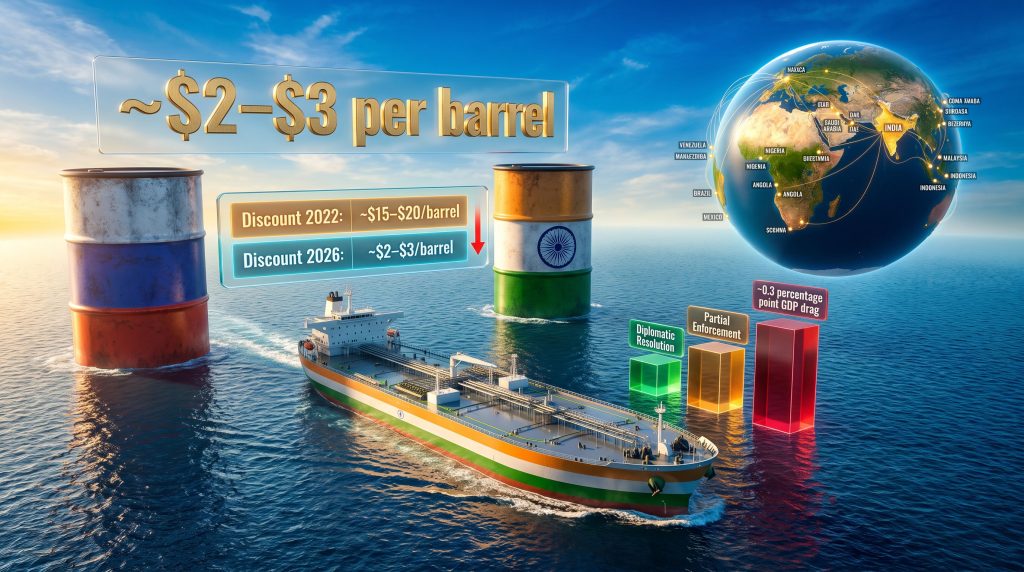
| Current Position (2026) | $2 to $3 per barrel | ~$2 to $3 billion per year |
| India's Total Annual Oil Import Bill | N/A | ~$150 billion |
When Russia first began offering heavily discounted crude following the 2022 invasion of Ukraine, the arbitrage was genuinely significant. At $15 to $20 per barrel, Indian refiners were capturing enormous value relative to market-priced alternatives. That advantage has since been eroded sharply as global demand for non-Gulf crude increased, competing buyers multiplied, and the pricing calculus shifted.
By 2026, the discount has compressed to roughly $2 to $3 per barrel. Against India's annual oil import bill of approximately $150 billion, the total saving from Russian purchases amounts to an estimated $2 to $3 billion per year. That is not trivial, but it represents a fraction of total import expenditure, and the macroeconomic disruption from replacing Russian barrels at marginally higher prices would be correspondingly modest.
Anindya Banerjee, head of commodity and currency research at Kotak Securities, noted through analysis published by ANI that the benefit India currently derives from Russian crude purchases is far smaller than it was at the outset of the Ukraine conflict, and that replacing those volumes with other suppliers would not create significant pressure on inflation, fiscal deficits, or broader economic stability. (Source: ANI via ET EnergyWorld, August 2026)
The Real Risk: Global Oil Price Levels, Not Supply Origin
This is the analytical insight that consistently gets buried beneath geopolitical noise. India's exposure to oil price movements is structurally enormous, and it operates independently of where the crude originates. For a broader perspective on pricing dynamics, the crude oil market overview reveals just how volatile these conditions have become.
For every $10 increase in the average price of India's imported crude basket, the country's annual oil import bill rises by approximately $15 billion. This sensitivity dwarfs the fiscal impact of losing the current Russian discount entirely.
A sustained crude price environment above $100 per barrel would impose macroeconomic strain several times greater than any realistic supply-origin shift. This means the actual economic threat embedded in the tariff debate is not whether India buys Russian oil, but whether geopolitical disruption triggers a sustained spike in global crude prices that flows through to every barrel India purchases, regardless of origin.
Scenario Analysis: Three Enforcement Paths
| Scenario | Tariff Level | Likely India Response | Estimated Economic Impact |
|---|---|---|---|
| Diplomatic Resolution | 0 to 25% | Continued negotiations; modest diversification | Minimal GDP drag |
| Partial Enforcement | 50% | Accelerated supply shift; export sector pressure | Moderate current account widening |
| Full Enforcement | 100% | Export disruption; inflationary pressure; supply restructuring | GDP growth drag of ~0.3 percentage points; current account deficit could more than double in worst-case crude scenario |
Moody's has assessed that India's resilient domestic demand and services-led growth model would cushion the aggregate shock under sustained tariff pressure, while acknowledging a roughly 0.3 percentage point drag on real GDP growth in a full enforcement scenario. The current account deficit risk is most acute in a scenario where forced supply diversification coincides with a simultaneous rise in global crude prices.
Which Export Sectors Face the Greatest Exposure?
Beyond crude, a 100% tariff applied to Indian goods entering the U.S. would create distinct sector-level pressures. In addition, the tariff-driven supply chain risks emerging across global markets compound these sector-specific vulnerabilities:
- Labour-intensive manufactured exports including textiles and engineering goods face the sharpest margin compression under blanket tariff application.
- Pharmaceuticals with high U.S. revenue dependency would face structural repricing challenges.
- IT-adjacent manufacturing would experience supply chain disruption if tariff application extends beyond energy-related goods.
- Services exports remain structurally more insulated, providing a meaningful buffer given India's services-sector weight in total export revenue.
Can India Replace Russian Barrels Without Crisis?
The logistics question is arguably the most practically important one, and the answer emerging from four years of sanctions navigation is substantially more reassuring than the tariff headlines suggest.
India's Supply Architecture Is Already Diversified
India currently sources crude from more than 40 countries, including Venezuela, multiple African nations, and the United States itself. This breadth means no single supply corridor represents an irreplaceable dependency.
The three operational pillars of international oil movement are banking, insurance, and tanker availability. Each has been tested extensively since 2022. Tanker sourcing through non-Western providers has proven to be the most flexible component of the logistics chain, and market participants have noted that no materially new risk type has emerged in the Russian crude supply chain that was not already present and managed during the preceding four years of sanctions pressure.
Strategic Reserve Coverage
| Reserve Category | Coverage Duration |
|---|---|
| Government Strategic Petroleum Reserves | 10 to 12 days |
| Commercial Inventory Stocks | 70 to 75 days |
| Combined Total Coverage | ~82 to 87 days |
| G7 Benchmark Standard | 90 days |
India's combined reserve position of approximately 82 to 87 days places it close to the internationally recognised G7 standard of 90 days. This buffer provides meaningful insulation during any transition period required to reallocate supply volumes away from Russian origins toward alternative sources.
India's Financial Architecture Is Already Adapting
One dimension of this debate that receives insufficient attention is India's deliberate construction of payment infrastructure that reduces its exposure to dollar-denominated coercive mechanisms. Consequently, concerns around weakening trust in the US dollar are informing India's strategic financial planning at the highest levels.
Several concrete frameworks are already operational or in development:
- The Reserve Bank of India's Vostro account system enables rupee-denominated trade settlement without routing through U.S.-controlled financial infrastructure.
- UAE dirham-based bilateral trade settlement agreements have been operationalised, providing an active non-dollar alternative for a significant portion of India's trade flows.
- India is actively exploring CBDC interoperability across BRICS member nations, which would create a parallel settlement layer for cross-border transactions.
The strategic observation here is significant: sustained use of the U.S. financial system as a geopolitical instrument accelerates the global search for dollar alternatives, potentially eroding the very leverage that makes such pressure effective in the first place. Independent analysts estimate meaningful dollar erosion in global trade settlement could emerge over a six to seven year horizon under current trajectory.
This is not merely a reactive adjustment. India's de-dollarisation infrastructure represents a longer-term strategic repositioning, and external tariff pressure is more likely to accelerate that process than to reverse it.
The next major ASX story will hit our subscribers first
Most Probable Outcome: Negotiated Resolution
The constellation of factors — including the bill's incomplete legislative journey, the discretionary nature of presidential tariff authority, the collapse of the Russian crude discount, India's diversified supply base, and the mutual economic interests binding both nations — points strongly toward a negotiated outcome rather than full punitive enforcement.
Key variables that will determine how quickly resolution is reached include:
- Whether the House passes the Senate bill in its current form or modifies it materially.
- Whether the Trump administration treats the tariff authority as a negotiating instrument or as a policy endpoint.
- The pace of India's voluntary crude supply diversification, which reduces the political rationale for punitive action.
- Global crude price trajectories, which independently shape India's macroeconomic resilience and political appetite for continued Russian purchases.
Both economies carry strong mutual incentives to preserve bilateral trade flows. The United States remains a major destination for Indian goods and services exports, while India represents a large and rapidly growing consumer market for U.S. energy, technology, and manufactured goods. Those structural alignments create a powerful gravitational pull toward workable arrangements.
Frequently Asked Questions
Has the 100% tariff on Russian oil buyers been imposed on India?
No. The U.S. Senate passed a bill granting presidential authority to impose tariffs of up to 100% on buyers of Russian crude and natural gas, but this authority has not been exercised. The bill must also clear the House and receive presidential action before any tariff takes effect.
How much does India currently save by purchasing Russian crude?
At current discount levels of approximately $2 to $3 per barrel, India saves an estimated $2 to $3 billion annually on its Russian crude purchases, representing a small fraction of its roughly $150 billion annual oil import bill.
What is India's biggest economic risk in this scenario?
The primary risks are: disruption to goods exports entering the U.S. under tariff enforcement; higher crude import costs if supply transitions away from discounted Russian volumes; and broader inflationary pressure widening the current account deficit.
Can India realistically replace Russian oil volumes?
Yes. India already sources crude from more than 40 countries and maintains combined strategic and commercial reserves covering approximately 82 to 87 days of import needs. Logistics infrastructure built over four years of sanctions navigation supports a manageable transition.
How does this affect India's long-term financial strategy?
The pressure accelerates India's development of rupee-denominated settlement systems, dirham-based bilateral arrangements, and CBDC interoperability frameworks, reducing dependency on U.S.-controlled financial infrastructure over a six to seven year horizon.
Key Takeaways
- The Trump 100% tariff on Russian oil and India economy debate conflates legislative authorization with automatic enforcement, a critical distinction that shapes the actual risk profile.
- The economic incentive for India to maintain Russian crude purchases has diminished substantially, with the per-barrel discount falling from $15 to $20 down to approximately $2 to $3.
- India's true macroeconomic vulnerability is global crude price levels, not supply origin, with every $10 per barrel increase adding roughly $15 billion to the annual import bill.
- Supply logistics are manageable given India's 40-plus country diversification strategy and near-G7-standard reserve coverage of 82 to 87 days.
- Tariff pressure is most likely to accelerate India's financial de-dollarisation trajectory rather than produce immediate macroeconomic disruption.
- A negotiated bilateral resolution remains the most probable outcome given the structural economic interests binding both nations together.
For ongoing coverage of India's oil and gas trade dynamics and U.S. sanctions policy developments, ET EnergyWorld provides detailed reporting across India's energy sector. Additionally, the U.S. Energy Information Administration offers comprehensive data on global crude oil flows and pricing benchmarks relevant to this evolving situation.
Want to Track the Commodity Discoveries Reshaping Energy and Resources Markets?
Discovery Alert's proprietary Discovery IQ model delivers real-time alerts on significant ASX mineral discoveries, turning complex commodity data into actionable investment insights the moment they hit the exchange — begin your 14-day free trial today, or explore historic discoveries and their returns to understand the scale of opportunity that early positioning can unlock.