August 10, 2026
The Hidden Cost of Trade Walls: Why Tariff Burdens Often Fall on the Wrong Side of the Border
There is a persistent misconception embedded in trade policy debates: that import tariffs punish the exporting nation. In practice, the economic incidence of a tariff frequently lands on the importing country's own buyers, manufacturers, and consumers. This dynamic sits at the core of the current US aluminium tariff on Canada dispute, where data from the US aluminium producer price index tells a story that contradicts the protective intent of the policy itself.
Understanding this mechanism is not merely an academic exercise. For procurement managers in Detroit auto plants, construction firms sourcing extrusions in the Midwest, and packaging companies dependent on aluminium can sheet, the tariff burden has become a concrete operational cost, not an abstract trade statistic. Understanding how tariffs work at a structural level helps explain why this burden so often lands on the importing side.
When big ASX news breaks, our subscribers know first
What Section 232 Actually Does to Aluminium Markets
The Legal Mechanism Behind the Tariff Architecture
Section 232 of the Trade Expansion Act grants the US president broad authority to impose import restrictions on national security grounds, bypassing the standard legislative and trade remedy processes that govern anti-dumping or countervailing duty cases. Unlike conventional trade remedies that require proof of material injury to domestic industry, Section 232 actions require only a determination that import volumes threaten national security, a deliberately wide standard that has enabled its application to commodities as commercially integrated as Canadian aluminium.
This legal architecture matters because it places Section 232 tariffs in a different tier of trade law than USMCA preferential provisions. Canadian exporters cannot invoke free trade agreement origin rules to sidestep the 50% duty. The national security classification creates a legal hierarchy where bilateral trade frameworks are effectively subordinate to executive trade authority.
A Timeline of Rapid Escalation
The speed at which US tariff policy shifted on Canadian aluminium compressed what would normally be a gradual market adjustment into an abrupt repricing event:
-
Pre-March 2025: Canada operated under a negotiated exemption from Section 232 aluminium duties, enabling tariff-free access to the US market for Canadian primary and downstream aluminium products.
-
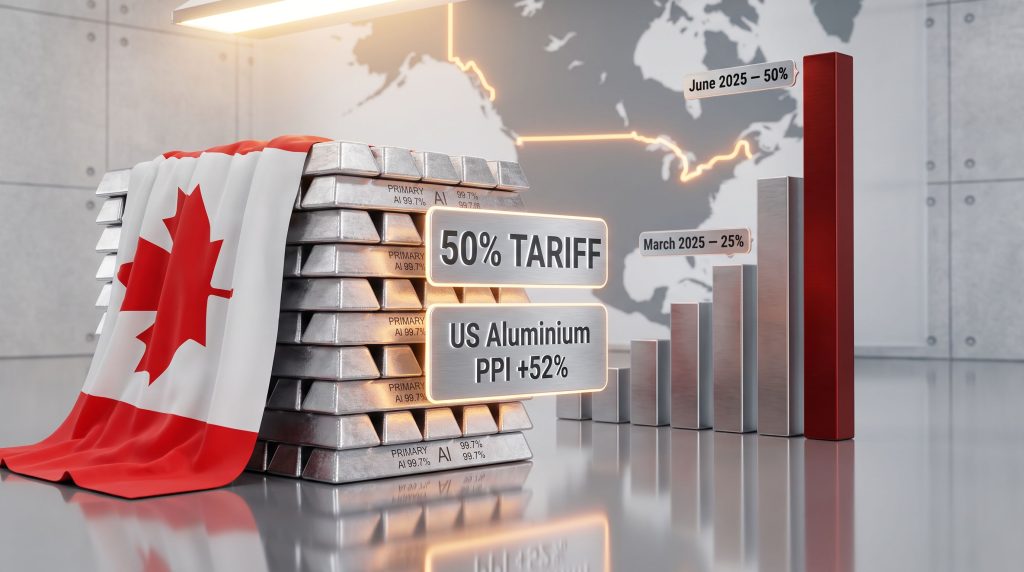
March 12, 2025: The exemption was terminated and the base tariff rate was raised from 10% to 25%, triggering the first wave of procurement cost recalculation across US manufacturing.
-
March 13, 2025: Canada responded with 25% retaliatory tariffs applied to approximately CA$29.8 billion in US-origin goods, effective immediately.
-
June 4, 2025: The US escalated the duty to 50%, effectively doubling the tariff burden on Canadian aluminium within a three-month window.
The compression of this timeline from full exemption to a 50% duty in under 90 days is historically unusual and removed any meaningful runway for US buyers to restructure procurement contracts, qualifying alternative suppliers, or hedge input costs through futures markets.
Furthermore, the US aluminium tariffs have had far-reaching consequences that extend well beyond the aluminium sector alone, reshaping supply chain strategies across multiple industries simultaneously.
By the Numbers: Unpacking the 52% Price Index Surge
The most telling data point in this dispute is not the tariff rate itself but what happened to US aluminium prices in response. The US aluminium producer price index rose 52% between June 2025 and June 2026, a figure that substantially exceeds the general movement of global aluminium benchmarks over the same period.
| Metric | Detail |
|---|---|
| Initial Section 232 tariff rate (March 2025) | 25% on Canadian aluminium |
| Escalated tariff rate (June 4, 2025) | 50% on Canadian aluminium |
| US aluminium producer price index increase (June 2025 to June 2026) | 52% |
| Canadian retaliatory tariff rate | 25% on CA$29.8 billion in US goods |
| Canada's counter-tariff effective date | March 13, 2025 |
The divergence between the LME base price trajectory and the US domestic price index points to a specific phenomenon: tariff pass-through. Global aluminium prices were not rising at anywhere near the pace suggested by the US PPI figure, which means the premium being paid by American buyers is structurally manufactured by trade policy rather than driven by underlying supply-demand fundamentals.
Canadian Prime Minister Mark Carney noted, while speaking at a Rio Tinto aluminium facility in Quebec, that some portion of the US price increase reflected international market conditions. However, he characterised the dominant share as direct pass-through of the tariff cost. The implication is clear: American companies, not Canadian exporters, have absorbed a significant portion of the tariff burden.
Understanding the Midwest Premium as a Tariff Barometer
The Midwest premium is a price differential added on top of the LME base aluminium price to reflect the all-in cost of physical delivery to US buyers, encompassing transportation, insurance, and critically, import duty costs. When tariffs rise, the Midwest premium rises with them, creating a real-time, market-based signal of tariff incidence.
This is not the first time Section 232 has driven Midwest premium spikes. The broader steel and aluminium tariffs of 2018 caused a sharp Midwest premium surge before Canada's exemption was negotiated in 2019, providing a historical precedent for the current repricing cycle. Current premium levels relative to pre-tariff 2024 baselines reflect the layered impact of the 50% duty far more than any shift in underlying aluminium production economics.
Which Industries Are Most Exposed to the US Aluminium Tariff on Canada
The cost impact of the US aluminium tariff on Canada does not fall uniformly across sectors. Tariff sensitivity varies significantly by product category and end-use application:
| Product Category | Tariff Sensitivity | Primary US End-Use Sector |
|---|---|---|
| Primary aluminium ingot | High | Smelting and alloying |
| Aluminium sheet and plate | High | Automotive, aerospace |
| Extrusions | Moderate to High | Construction, transport |
| Aluminium foil | Moderate | Packaging |
| Recycled and secondary aluminium | Lower (varies) | Foundry, automotive |
Automotive manufacturing faces the sharpest exposure given its reliance on aluminium-intensive body panels and structural components. The sector is already navigating its own parallel tariff pressures on vehicle imports, creating a compounding cost burden across the production process.
Construction and infrastructure buyers are absorbing elevated costs on extrusions and structural sheet, with implications for project budgeting on commercial building and infrastructure contracts.
Packaging producers, while somewhat insulated by a higher proportion of domestically sourced recycled aluminium content, still face premium inflation on primary aluminium inputs used in can body stock.
Aerospace and defence procurement teams, sourcing specialty alloys with long contract lead times, face particular difficulties repricing supply agreements mid-cycle in response to sudden tariff escalation.
Why Canadian Aluminium Cannot Simply Be Replaced
The Structural Importance of Quebec's Smelting Corridor
A detail that rarely surfaces in mainstream tariff coverage is the structural role that Canadian aluminium plays in North American supply chains beyond simple volume metrics. Quebec's aluminium production infrastructure is almost entirely powered by hydroelectric generation, giving Canadian primary aluminium one of the lowest carbon intensities of any major producing region in the world.
As US manufacturers face intensifying pressure from customers, regulators, and investors to reduce supply chain emissions, substituting Canadian hydroelectric aluminium with coal-powered production from Gulf Cooperation Council nations or other alternative suppliers does not represent a neutral trade-off. The carbon profile of the raw material changes materially.
For sectors increasingly subject to Scope 3 emissions reporting requirements, this has operational and reputational consequences beyond the unit price. This green aluminium dimension adds a layer of strategic complexity to the sourcing alternatives available to US buyers that a simple price comparison between Canadian and non-Canadian supply does not capture.
Canada's Multi-Sector Negotiating Strategy
Canadian officials have made clear that they are not seeking a narrowly scoped aluminium agreement. The negotiating position links aluminium and steel tariff relief to outcomes in the automotive and lumber sectors, creating a bundled framework where concessions in one area are conditional on reciprocal movement in others.
This approach carries both risk and logic. By refusing to unbundle sector negotiations, Canada avoids a scenario where it concedes aluminium-related leverage without securing meaningful gains in other industries. The trade-off is increased negotiating complexity and the possibility that broader disagreements prevent any sectoral agreement from being reached.
Consequently, the tariff impacts on supply chains have created a complex web of interdependencies that make bilateral resolution considerably harder to achieve than it was during the 2018 to 2019 cycle. US counterarguments from Trade Representative Jamieson Greer and other officials have pointed to a separate set of outstanding grievances:
-
Canada's counter-tariffs on US-manufactured automobiles
-
Trade restrictions and supply management in the Canadian dairy sector
-
Provincial liquor board controls that limit access to US alcohol products in Canadian government-operated retail channels
These issues reflect how deeply integrated and simultaneously contentious the Canada-US trade relationship has become, with individual sector disputes serving as proxies for broader structural disagreements about the terms of continental trade. According to PwC's analysis of the tariff landscape, the legal and commercial complexity of these overlapping measures creates significant compliance and planning challenges for businesses on both sides of the border.
The next major ASX story will hit our subscribers first
Three Scenarios for the Dispute's Resolution
Scenario A: Tariffs Persist at 50%
US aluminium input costs remain structurally elevated, accelerating procurement diversification toward alternative suppliers. Domestic US smelting investment increases in policy rhetoric but faces capital intensity and power cost constraints that limit near-term capacity expansion. Canadian producers gradually lose market share in the US but retain demand from buyers for whom the carbon profile of supply matters.
Scenario B: Partial Relief Through a Bundled Sector Agreement
Aluminium and steel tariffs are reduced or eliminated as part of a broader Canada-US framework covering automotive and lumber. Both sides achieve some measure of market certainty, and Canadian producers regain cost competitiveness in the US market. This scenario requires resolving the dairy, counter-tariff, and liquor board issues simultaneously, which represents significant political complexity on both sides.
Scenario C: Further Escalation
Additional US tariffs are extended to a wider range of Canadian goods, potentially including products referenced in political commentary such as lumber, dairy, beer, and hockey equipment. Canada responds with an expanded counter-tariff package beyond the current CA$29.8 billion scope. Integrated North American supply chains face systemic disruption, with costs extending well beyond the aluminium sector.
Historical Precedent: How This Dispute Compares to 2018
| Period | Tariff Action | Outcome |
|---|---|---|
| 2018 | Section 232 tariffs imposed on Canada across steel and aluminium | Canada imposed retaliatory tariffs; Midwest premium spiked |
| 2019 | Tariffs lifted as part of USMCA negotiations | Canada removed retaliatory measures; market normalised |
| March 2025 | Canada's exemption terminated; 25% duty reimposed | Canada activated CA$29.8 billion counter-tariff package |
| June 2025 | Rate escalated to 50% | Ongoing negotiations; no resolution as of August 2026 |
The 2018 to 2019 cycle provides some basis for cautious optimism that a resolution is achievable. However, the current escalation to 50% exceeds the peak tariff rate applied in that earlier episode, and the breadth of bilateral disagreements beyond aluminium is considerably wider this time. In addition, the broader shifts in aluminium and alumina markets globally have compounded the pressure on North American producers navigating this uncertain environment.
Frequently Asked Questions: US Aluminium Tariff on Canada
What is the current US tariff rate on Canadian aluminium?
The United States is applying a 50% tariff on Canadian aluminium imports under Section 232 authority. This rate was introduced on June 4, 2025, following an initial escalation to 25% when Canada's prior exemption was terminated on March 12, 2025.
Why did the US impose these tariffs on Canada specifically?
The tariffs were authorised under Section 232 of the Trade Expansion Act on national security grounds. Canada's previous exemption, negotiated during the USMCA process, was revoked unilaterally as part of a broader escalation of US trade measures applied globally.
Does USMCA protect Canadian aluminium from these tariffs?
No. Section 232 national security tariffs operate outside the USMCA preferential tariff framework. Canadian exporters cannot use USMCA rules of origin provisions to circumvent the 50% duty rate.
Who ultimately pays the US aluminium tariff on Canadian imports?
The evidence from the US aluminium producer price index, which rose 52% between June 2025 and June 2026, points strongly to US buyers absorbing a substantial portion of the tariff cost through elevated input prices. Canadian exporters do not bear the full burden through reduced export revenues. As EDC's overview of the tariff landscape notes, this cost distribution pattern is a recurring feature of broad-based tariff measures applied to deeply integrated trade relationships.
What would a Canada-US trade deal on aluminium look like?
Canadian officials have indicated they will not accept a narrowly scoped aluminium-only deal. Any resolution is expected to encompass aluminium, steel, automotive, and potentially lumber sectors as a coordinated package requiring reciprocal concessions from both governments.
Key Takeaways for Markets and Policy Watchers
-
The 52% rise in the US aluminium producer price index over 12 months reflects tariff pass-through as the primary driver, not underlying global commodity price movements.
-
US downstream manufacturers across automotive, construction, packaging, and aerospace face structurally elevated input costs with limited short-term alternatives to Canadian supply.
-
The carbon intensity advantage of Canada's hydroelectric-powered smelting infrastructure adds a supply chain sustainability dimension to the sourcing question that purely price-based analysis overlooks.
-
USMCA provides no legal shield against Section 232 duties, creating a treaty-level asymmetry that complicates the bilateral trade relationship independently of the tariff debate itself.
-
Canada's multi-sector negotiating posture increases the complexity of reaching an agreement but also raises the potential value of any eventual resolution for both economies.
-
Failure to negotiate a resolution carries escalation risk, with additional product categories potentially drawn into the dispute on both sides of the border.
This article presents analysis of publicly available trade data, policy frameworks, and market indicators. It does not constitute financial or investment advice. Readers should independently verify all figures and consult appropriate professional advisers before making decisions based on trade policy developments.
Want to Capitalise on the Next Major Mineral Discovery Before the Broader Market Catches On?
While trade policy reshapes commodity supply chains and creates ripple effects across resource markets, Discovery Alert's proprietary Discovery IQ model scans ASX announcements in real time, instantly identifying significant mineral discoveries and turning complex data into actionable opportunities — explore the historic returns major discoveries have delivered and begin your 14-day free trial today to position yourself ahead of the market.