August 10, 2026
The Hidden Architecture Behind the World's Most Consequential Oil Trade Pivot
Global energy markets rarely transform overnight. The shifts that define commodity supercycles tend to unfold across years, shaped by infrastructure constraints, contract inertia, and the slow grind of refinery reconfiguration. Yet the reorientation of India's crude oil supply chain since early 2022 stands as a rare exception — a structural transformation compressed into just a few years, delivering consequences that now ripple through sanctions regimes, refinery economics, and geopolitical leverage calculations spanning three continents.
Understanding why India's Russian crude imports hit record for second straight month in mid-2026 requires looking beyond the headline volume numbers. The deeper story involves refinery engineering choices, payment infrastructure built outside Western financial systems, port-level logistics quietly expanding capacity, and a policy enforcement gap that allows Russian crude, once processed, to flow back into the very markets that sanctioned it. Furthermore, crude oil geopolitical factors are increasingly shaping how these trade flows are interpreted by policymakers and market analysts alike.
When big ASX news breaks, our subscribers know first
From Marginal Supplier to Market Anchor: The Numbers Behind a Historic Shift
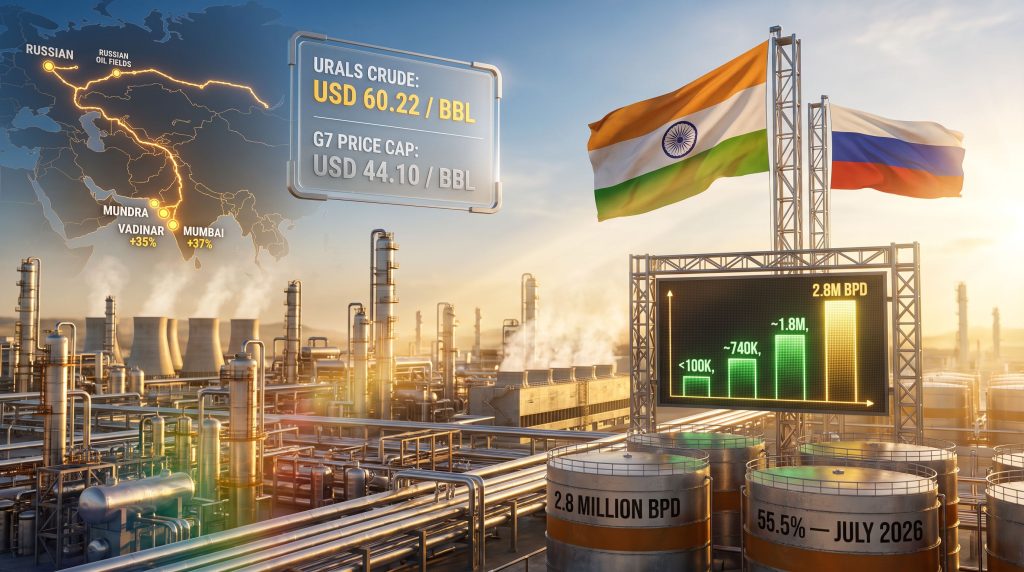
Before February 2022, Russia's presence in India's crude import mix was negligible by any measure. Volumes sat below 100,000 barrels per day (bpd), accounting for roughly 2.5% of India's total crude intake, according to data from the US Energy Information Administration. The relationship was transactional and limited — a minor supplement to India's dominant Middle Eastern and African supply channels.
What followed ranks among the fastest bilateral energy realignments in modern oil market history:
- 2022 average: approximately 740,000 bpd, as Indian refiners began capitalising on deep discounts offered by Russian sellers abandoned by European buyers
- 2023 average: nearly 1.8 million bpd, cementing Russia as India's single largest crude supplier at around 39% of total imports
- 2024 average: roughly 1.8 million bpd, with the relationship stabilising at approximately 40% of imports
- June 2026: approximately 2.6 to 2.7 million bpd, setting what was then a record
- July 2026: a new record of 2.8 million bpd, representing approximately 55.5% of India's total crude imports of just over 5 million bpd
The compounding nature of this trajectory is striking. Russia's share of India's crude supply expanded from under 3% to over 55% in roughly four years — not through a geopolitical alliance, but through pure procurement economics. India's Russian crude imports hitting record highs for consecutive months reflects just how deeply embedded this supply relationship has become.
| Period | Russian Crude Volume (bpd) | Share of India's Total Imports |
|---|---|---|
| Pre-2022 average | under 100,000 | ~2.5% |
| 2022 average | ~740,000 | ~17% |
| 2023 average | ~1.8 million | ~39% |
| 2024 average | ~1.8 million | ~40% |
| June 2026 | ~2.6–2.7 million | ~54% |
| July 2026 | ~2.8 million | ~55.5% |
The Price Mechanism That Rewired Procurement Decisions
At the core of this transformation is a pricing dynamic that has proved more durable than most Western policymakers anticipated. Russian Urals crude averaged USD 60.22 per barrel in July 2026 — a figure that, while sitting well above the G7 and EU price cap of USD 44.10 per barrel that took effect in February 2026, remains meaningfully below competing Middle Eastern and West African benchmark grades.
The G7 price cap mechanism was designed to limit Russian revenue while keeping supply flowing to non-Western markets. The gap between the cap threshold and actual Urals pricing suggests Russian sellers have retained significant pricing power in Asian markets despite the restrictions.
For Indian refinery procurement teams, the arithmetic is straightforward. Every dollar per barrel of feedstock cost advantage translates directly into improved margins on refined product exports. For large, export-oriented refining complexes processing millions of barrels per month, even a moderate discount compounds into substantial competitive advantage over competing refineries sourcing at market rates.
Critically, this discount has become structurally embedded rather than transitory. Indian refiners have had four years to optimise their crude slates, configure processing units for Russian grade specifications, and build out the non-Western shipping, insurance, and payment infrastructure that allows the trade to function outside Western financial systems. The switching costs involved in reversing this configuration are now significant.
Port-Level Distribution: A Less Visible but Critical Signal
One of the most analytically important aspects of the July 2026 record is where the volumes landed. The intake surge was not driven by India's two largest Russian crude terminals, which would be the obvious expectation. Instead, the distribution pattern revealed a broader, more resilient supply architecture:
- HMEL Mundra: imports rose 58% month-on-month from June 2026
- Indian Oil's Vadinar SMPL terminal: volumes increased 35% month-on-month
- Mumbai: receipts rose 37% month-on-month
- Jamnagar: volumes were unchanged from June
- Paradip: imports fell 22% month-on-month
This distribution pattern carries strategic implications that volume headlines alone obscure. When a supply relationship becomes concentrated in a small number of major terminals, it remains vulnerable to port-specific disruptions, regulatory scrutiny focused on key nodes, or logistics bottlenecks. The July 2026 data suggests India's Russian crude supply chain has matured beyond that vulnerability. Multiple secondary terminals are now capable of absorbing large volumes independently, distributing the trade's footprint and reducing its exposure to any single point of disruption.
India as a Refining Hub in the Global Russian Oil Architecture
How Does India Fit Into the Wider Sanctions Picture?
India's role in the Russian oil trade extends considerably beyond its function as a direct crude buyer. This is where the geopolitical and sanctions complexity intensifies in ways not widely understood outside specialist energy trade circles.
Indian refineries that consume Russian crude feedstock are simultaneously significant exporters of refined products to countries that have formally sanctioned Russia. In July 2026, refineries across India, Turkiye, Brunei, and Georgia that process Russian crude collectively exported oil products worth €633 million to sanctioning nations. The breakdown of those exports was:
- United States: €234 million
- European Union: €214 million
- Australia: €184 million
Of that combined total, an estimated €284 million was refined from Russian crude feedstock. Data tracking indicates that five cargoes from Indian refineries using Russian crude were unloaded at EU ports during July 2026, despite the EU's ban on imports of oil products derived from Russian crude, which formally took effect on January 21, 2026.
Exports to the United States in the same month originated in part from the Jamnagar complex, where Russian crude constituted approximately 35% of total feedstock across the three months through July 2026. Consequently, the Russian oil sanctions impact is being felt far more unevenly than Western policymakers originally envisaged.
The EU's ban on Russian-origin refined products contains a structural enforcement blind spot. Under current frameworks, products refined in third-party jurisdictions using Russian crude feedstock can legally enter sanctioning markets, because the product's origin is legally classified by where it was processed rather than what it was processed from.
This is a distinction with major commercial consequences. It means that the refining arbitrage available to Indian operators effectively converts sanctioned Russian crude into compliant Western-market product, providing value extraction at both ends of the supply chain.
India's Position Within Russia's Export Revenue Picture
The bilateral relationship takes on additional significance when viewed against the deteriorating state of Russia's broader oil export revenues. While Indian purchases hit successive records, Russia's overall fossil fuel export picture was notably weaker:
- Russian crude export revenues were broadly flat in July 2026 at approximately €392 million per day
- Pipeline crude earnings fell 21% month-on-month
- Seaborne crude revenues rose 7% month-on-month, partially offsetting pipeline weakness
- Russian oil product loadings dropped 23% in July 2026 to 4.7 million tonnes, the lowest level on record and less than half the 9.6 million tonnes loaded in July 2025
| Metric | July 2026 Data |
|---|---|
| Total Russian fossil fuel imports to India | €6.4 billion |
| Crude oil share | €5.5 billion (87%) |
| Coal | €512 million (~8%) |
| Oil products | €341 million (~5%) |
| Russian crude export revenues (daily) | ~€392 million |
| Russian oil product loadings | 4.7 million tonnes (record low) |
The contrast is stark. India's direct crude purchases reached all-time highs precisely as Russia's product export capacity deteriorated to historic lows. This divergence highlights that Asian refining demand, led by India and China, has become the primary stabilising mechanism for Moscow's oil revenues. Without sustained Indian absorption of crude volumes, the revenue pressure on Russia's energy sector would be materially more severe.
The next major ASX story will hit our subscribers first
Comparative Context: Where India Sits in the Global Russian Crude Buyer Hierarchy
China remains the dominant buyer of Russian crude, absorbing approximately 50% of Russia's crude oil exports since the Ukraine invasion began. India ranks second at approximately 37% of Russian crude exports over the same period. The structural positions of these two buyers effectively determine whether Russian crude maintains viable market access.
| Buyer Nation | Share of Russian Crude Exports | Primary Driver | Sanctions Exposure |
|---|---|---|---|
| China | ~50% | Strategic diversification and pricing | Low (non-sanctioning) |
| India | ~37% | Refinery economics and discount capture | Moderate (Western pressure) |
| Turkiye | Significant | Refining hub and re-export model | Moderate |
| Other Asian markets | Residual | Opportunistic purchasing | Variable |
A less commonly noted dynamic is the competitive tension between Chinese and Indian buyers for Russian crude allocation. As both nations increased purchases simultaneously, Russia gained negotiating leverage to moderate the depth of discounts it offers — which partially explains why Urals pricing at USD 60.22 per barrel in July 2026 remained well above the price cap threshold rather than converging toward it. In addition, shifts in India energy import policy continue to influence how New Delhi balances diversification goals against short-term procurement economics.
Regulatory Risk and the Secondary Sanctions Dimension
What Exposure Do Indian Refiners Actually Face?
The most significant regulatory risk facing Indian refiners in their current procurement posture is not the G7 price cap itself — to which India has no legal obligation — but the secondary sanctions architecture that the United States maintains around entities facilitating above-cap Russian oil trades.
US secondary sanctions can be applied to non-American companies that use dollar-denominated transactions, Western-flagged vessels, or Western insurance products in connection with Russian crude purchased above the cap. The fact that Urals at USD 60.22 sits well above the USD 44.10 cap means that any Western services involvement in these transactions carries legal exposure. Moreover, oil price trade-war effects have added a further layer of complexity to how Indian operators assess their long-term procurement risk.
India has navigated this primarily through the development of alternative infrastructure:
- Shadow fleet shipping: non-Western flagged tankers operating outside traditional Western maritime insurance pools
- Alternative payment mechanisms: including rupee-ruble settlement arrangements and UAE-based intermediary structures
- Indian insurers: providing cover under domestic frameworks rather than London market facilities
The dual-exposure scenario created by processing Russian crude and then exporting refined products to US and EU markets creates a layered compliance challenge. The export revenue channel provides commercial incentive to maintain the refining arbitrage, while the procurement channel carries the sanctions risk. Managing the interaction between these two channels is now a core operational competency for India's largest refining operators.
Furthermore, broader geopolitical realignments — including the US policy on Venezuelan oil — are reshaping the global crude supply landscape in ways that could either intensify or partially relieve pressure on India's current procurement strategy.
Three Scenarios for India's Russian Crude Trajectory Through 2027
The forward outlook for India's Russian crude import volumes depends heavily on how three variables interact: sanctions enforcement intensity, the pricing differential between Russian and alternative grades, and India's domestic refinery expansion timeline.
Scenario 1: Continued Deepening (Base Case)
Russian crude remains the most cost-competitive feedstock option. Secondary sanctions enforcement does not escalate materially. India's import volumes sustain above 2.5 million bpd through 2027, with India's share of Russian exports remaining above 35%.
Scenario 2: Managed Diversification
Diplomatic pressure from Western partners, combined with trade deal incentives from Middle Eastern and US suppliers, leads Indian refiners to gradually broaden their crude slate. Russian crude's share moderates to 40 to 45% of total imports over two to three years. This scenario unfolds through commercial incentives rather than sanctions compliance.
Scenario 3: Forced Reorientation
Aggressive enforcement of secondary sanctions or a significant reduction in the price cap disrupts the economics of Russian crude purchasing. Indian refiners accelerate diversification under financial and reputational pressure. Russian crude's share falls below 35% within 18 months, though the absence of immediately available low-cost alternatives would constrain the pace of any reorientation.
Disclaimer: The scenarios above represent analytical frameworks based on publicly available data and market observations. They are not financial forecasts and should not be relied upon as investment or policy guidance. Energy market dynamics are subject to rapid and unpredictable change.
The Strategic Leverage That Comes With Being an Indispensable Buyer
India's total crude import requirement of over 5 million bpd makes it one of the three or four most consequential oil buyers on the planet. The absorption of Russian crude at a scale that now represents more than half of India's total intake gives New Delhi a form of implicit leverage that extends well beyond energy economics.
For Moscow, the ability to consistently place 2.8 million bpd in Indian refineries represents the difference between manageable revenue pressure and a genuine fiscal crisis. This dependency creates a geopolitical dynamic in which India holds meaningful leverage over Russia's economic resilience — a leverage that can be deployed, consciously or otherwise, across diplomatic and trade negotiations extending well beyond the energy sector.
For Western policymakers, the central challenge is that India's rational commercial interest in discounted Russian crude runs directly against the stated objectives of the sanctions regime. The scale of Indian refining capacity, the depth of its Russian crude integration, and the refining arbitrage that routes processed Russian crude back into Western markets together create a sanctions architecture with structural leakage built into its foundations.
Whether that architecture is reformed, enforced more aggressively, or gradually accepted as a feature rather than a flaw of the current regime will be one of the defining energy geopolitics questions of the next several years. For now, the record volumes recorded in back-to-back months signal that the commercial logic driving India's Russian crude strategy remains fully intact. Independent analysis of Russia's fossil fuel export revenues further underscores how central Indian demand has become to sustaining Moscow's energy income.
Frequently Asked Questions
How much Russian crude did India import in July 2026?
India's Russian crude imports reached a record 2.8 million barrels per day in July 2026, accounting for approximately 55.5% of total crude imports of just over 5 million bpd. This exceeded the previous record set in June 2026.
Why does India keep purchasing Russian crude despite sanctions?
India is not legally bound by Western sanctions on Russia and sources crude based on national economic interest. Russian Urals crude at approximately USD 60.22 per barrel in July 2026 offered a meaningful discount versus competing grades, directly improving margins at Indian refining complexes, particularly large export-oriented facilities.
What is the G7 price cap and does it apply to India?
The G7 and EU price cap of USD 44.10 per barrel, effective February 2026, prohibits Western shipping, insurance, and financial services from facilitating Russian crude trades above this level. India is not bound by the cap, but Indian entities using Western services in connection with above-cap trades could face exposure under US secondary sanctions provisions.
Are Indian refineries exporting products made from Russian crude to Western markets?
Yes. In July 2026, an estimated €284 million worth of refined products exported from Indian refineries to sanctioning countries were derived from Russian crude feedstock. The EU received €214 million, the US received €234 million, and Australia received €184 million of such products.
Which Indian ports are receiving the most Russian crude?
Jamnagar and Paradip have historically led Russian crude receipts in India. The July 2026 record was driven primarily by secondary terminals, with HMEL Mundra rising 58%, Vadinar SMPL rising 35%, and Mumbai rising 37%, while Paradip volumes fell 22%.
Want to Know Which ASX Resource Companies Are Benefiting From Global Commodity Shifts Like This One?
Discovery Alert's proprietary Discovery IQ model scans ASX announcements in real time, instantly identifying significant mineral discoveries and turning complex market data into actionable investment opportunities — just as historic finds from De Grey Mining and WA1 Resources once rewarded early movers. Explore what major discoveries can deliver by visiting Discovery Alert's dedicated discoveries page, and begin your 14-day free trial today to position yourself ahead of the market.