July 27, 2026
The Hidden Fault Lines Running Through OPEC's Production Architecture
For decades, the global oil market has operated under a deceptively simple assumption: that OPEC functions as a unified bloc capable of enforcing collective discipline on production and pricing. In reality, the organisation has always been a coalition of competing national interests, investment timelines, and fiscal needs. UAE leaving OPEC represents the most visible expression yet of structural pressures that had been building inside the cartel for years, held together only by the weight of Saudi Arabia's leadership and the absence of better alternatives.
When big ASX news breaks, our subscribers know first
The UAE's Strategic Weight Inside OPEC: More Than Output Alone
Raw production figures only tell part of the story when assessing any OPEC member's true influence. Before the disruption of Gulf shipping routes, the UAE was producing approximately 3.5 million barrels per day of crude oil, placing it third within the cartel behind Saudi Arabia and Iraq in headline output terms. Yet by most strategic measures, Abu Dhabi occupied a position of far greater consequence than that ranking suggests.
The key differentiator was spare production capacity, which functions as the reserve currency of OPEC's internal power dynamics. Iraq may have produced comparable volumes, but it held substantially less idle capacity available for rapid deployment. The UAE's spare capacity buffer gave it disproportionate leverage over the cartel's tactical decisions, while its deep alignment with Saudi Arabia within the Gulf Cooperation Council framework amplified that influence further.
These two factors combined meant the UAE was arguably the second most influential voice within OPEC despite ranking third by volume. Furthermore, OPEC's market influence extends well beyond headline production rankings, making this departure qualitatively different from any prior exit.
ADNOC's Expansion Blueprint and the Monetisation Imperative
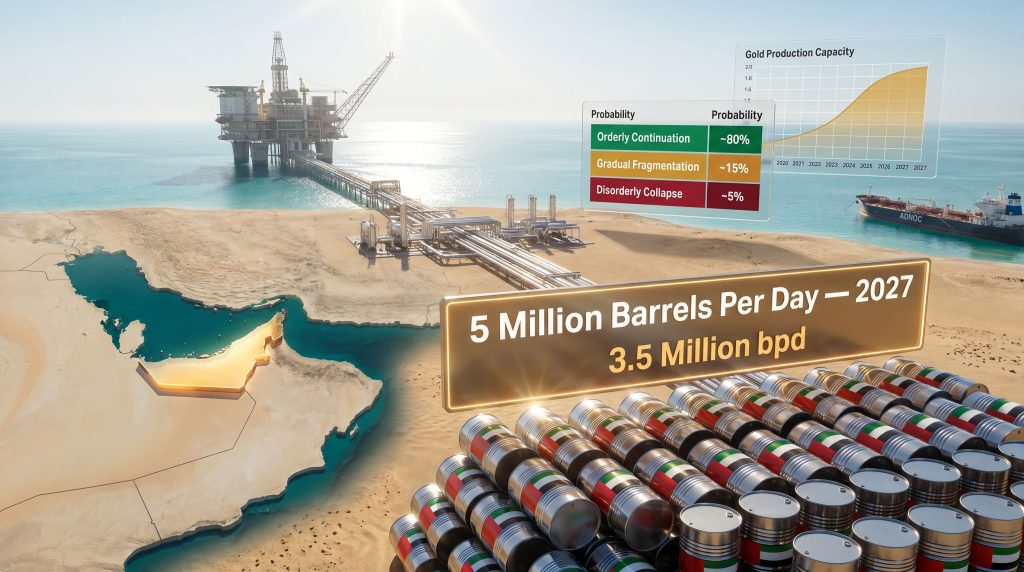
At the centre of the UAE's growing frustration with OPEC sits Abu Dhabi National Oil Company's long-term production ambition. ADNOC has been pursuing a capital-intensive expansion programme targeting 5 million barrels per day of production capacity by 2027, a figure representing a substantial step-change from its pre-expansion baseline.
Since 2019, the UAE has already added approximately 1 million barrels per day in new production capacity through sustained upstream investment. That rate of capacity addition was unmatched across the OPEC membership over the same period. In fact, most other cartel members experienced the opposite trajectory, with production capacity declining due to chronic underinvestment in ageing infrastructure.
The resulting tension was structural and arguably inevitable:
- Tens of billions of dollars had been committed to upstream expansion
- Quota constraints prevented the UAE from fully monetising that investment
- Every extension of production cuts represented lost revenue on capital already deployed
- The gap between permitted output and available capacity widened with each passing year
Capital committed to expanding production capacity does not earn a return while sitting idle. For the UAE, OPEC's quota framework had evolved from a useful collective tool into a direct financial constraint on national revenue.
How Long Had This Been Coming? A Timeline of Internal Fracture
The 2021 Near-Collapse: OPEC's First Warning Signal
The narrative of a sudden departure obscures a much longer history of institutional friction. The UAE came perilously close to fracturing OPEC entirely in 2021, when COVID-era production cuts remained in force and Abu Dhabi began pushing for output rights commensurate with its expanded capacity. The standoff was resolved not through any formal renegotiation of the cartel's structure, but through an informal arrangement that gave the UAE unofficial permission to produce at higher levels.
This arrangement was never properly institutionalised, leaving the core disagreement unresolved and the underlying tension intact. Consequently, OPEC production decisions during this period increasingly reflected a fragile consensus rather than genuine alignment.
Systematic Quota Overproduction: The Open Secret
From 2021 through to the point of formal departure, the UAE consistently produced above its official OPEC quota allocations. The official production data submitted by Abu Dhabi to the cartel did not accurately reflect actual output levels. This discrepancy was, by most accounts within the analyst community, the worst-kept secret in global oil markets.
The practical implication is significant: the UAE had effectively been operating with partial independence from OPEC's supply management framework for several years before any formal announcement was made.
| Period | UAE Behaviour Inside OPEC |
|---|---|
| Pre-2019 | Compliant member, moderate capacity growth |
| 2019–2021 | Rapid capacity expansion underway, quota friction emerges |
| 2021 | Near-OPEC collapse; informal overproduction arrangement reached |
| 2021–2025 | Systematic quota overproduction; nominal compliance only |
| May 1, 2026 | Formal departure announced and effective |
What Triggered the Formal Exit in 2026?
The Geopolitical Dimension: Security Guarantees That Failed to Deliver
The financial calculus alone does not fully explain the timing or the finality of the UAE's decision. A dimension that received relatively limited coverage in mainstream commentary relates to the security architecture that historically underpinned Gulf membership in OPEC-aligned structures.
Since the outbreak of regional conflict involving Iran, the UAE absorbed more than half of all Iranian missile and drone strikes directed at GCC member states combined. This disproportionate targeting created a profound sense of grievance in Abu Dhabi, particularly in the context of what collective GCC and broader Western security guarantees had been understood to provide.
The Carter Doctrine, the longstanding framework under which the United States committed to protecting Gulf oil exports and the producers behind them, appeared to offer diminishing practical protection during the conflict period. From Abu Dhabi's perspective, the implicit bargain had broken down: the UAE was absorbing the greatest military risk of any GCC member while simultaneously being the most economically constrained by OPEC's quota system. According to Al Jazeera's analysis, the exit also signals a closer alignment with U.S. interests, adding a further geopolitical dimension to the decision.
The UAE's departure reflects a dual frustration: bearing disproportionate military exposure while being denied the economic return on years of capital investment. When both sides of a bargain stop delivering value simultaneously, departure becomes rational.
The Market Timing Calculation: Why the Moment Mattered
Perhaps the most strategically astute element of the UAE's decision was its timing. At the point of departure, UAE production capacity was effectively operating at maximum utilisation under wartime conditions, with the Strait of Hormuz disrupted and Gulf export logistics constrained. This created a rare window in which the UAE could exit the cartel without immediately increasing output, meaning the announcement carried political significance without triggering an acute supply shock to global oil prices.
Had the same departure occurred in late 2025 or the early months of 2026, when OPEC cohesion was already under acute stress and market volatility was elevated, the announcement could have produced a disorderly repricing event with consequences well beyond Abu Dhabi's intended message.
What Does UAE Leaving OPEC Mean for the Cartel's Future?
The Case for OPEC Muddling Through
Historical precedent offers cautious grounds for organisational optimism. OPEC has absorbed member departures before without structural collapse:
- Qatar exited in December 2019, citing its focus on natural gas over crude oil
- Angola departed at the beginning of 2024 after disagreements over quota allocations
- In both cases, OPEC continued to function and Saudi Arabia maintained production discipline
There is also a counterintuitive argument that the UAE's departure may actually improve OPEC's internal cohesion in the near term. For several years, Abu Dhabi was the primary source of quota friction and dissent within the cartel, consistently pushing against Saudi Arabia's production restraint agenda. With that source of internal opposition removed, the remaining membership may prove more uniformly aligned behind Saudi-directed output policy.
The base case probability for OPEC maintaining its structural framework through the post-war period sits at approximately 80%, reflecting both the organisation's historical resilience and Saudi Arabia's strong incentive to preserve a functioning cartel.
The Case for Accelerating Fragmentation
The counterargument rests on the qualitative uniqueness of this particular departure. Qatar was a minor crude oil producer. Angola lacked meaningful spare capacity. The UAE was neither of those things. It was the cartel's most strategically significant member outside of Saudi Arabia itself, with deep institutional relationships, substantial spare capacity, and a direct line into the Gulf's geopolitical core.
The exit creates a precedent signal that other capacity-expanding members, most notably Iraq, will be watching closely. Iraq faces structurally similar tensions between its upstream investment ambitions and the quota constraints imposed by OPEC membership. If the post-war production normalisation process is mismanaged and Iraq perceives the UAE's independent path as viable, the risk of further departures rises materially. Reuters confirmed the formal departure on 28 April 2026, underscoring the significance of the announcement.
Scenario Analysis: Three Pathways for Oil Markets
The medium-to-long-term outlook for global oil prices following UAE leaving OPEC can be usefully structured around three distinct scenarios, each with different probability weightings and price implications.
| Scenario | Probability | Key Trigger | Price Implication |
|---|---|---|---|
| Orderly Continuation | ~80% | Saudi discipline holds post-war | Moderate, range-bound |
| Gradual Fragmentation | ~15% | Iraq and others follow UAE's lead | Gradual downward drift |
| Disorderly Collapse | ~5% | Post-war production free-for-all | Sharp multi-year decline |
Scenario 1: Orderly Continuation (Base Case, ~80% Probability)
Saudi Arabia successfully manages the transition out of wartime production constraints, guiding OPEC through a structured normalisation of output. The UAE produces at or near its capacity independently without triggering competitive responses from remaining members. Oil prices stabilise in a moderate range as the Strait of Hormuz reopens and export flows normalise.
Scenario 2: Gradual Fragmentation (~15% Probability)
Iraq and one or more additional members begin to replicate the UAE's de facto non-compliance pattern, first exceeding quotas systematically and eventually seeking formal independence. OPEC retains its institutional form but progressively loses effective price management capability. Prices drift lower over a 12 to 24 month horizon as coordinated supply discipline erodes.
Scenario 3: Disorderly Collapse (~5% Probability)
Post-war, every OPEC member simultaneously attempts to maximise production to compensate for months of suppressed output and lost revenue. Demand has already been crimped by the preceding price shock and export disruption, meaning the supply surge meets a weakened demand base. OPEC quotas become functionally irrelevant and oil prices fall sharply over a one-to-two year period.
Every major oil market boom carries within it the structural conditions for the subsequent bust. The question is not whether the cycle turns, but whether collective discipline can delay and moderate that turn. OPEC's entire purpose is to answer that question in the affirmative.
The next major ASX story will hit our subscribers first
How the UAE's Independence Reshapes the Broader Supply Landscape
ADNOC as an Independent Producer: What Changes
Operating outside OPEC's quota framework, ADNOC now has the freedom to pursue bilateral supply agreements with major importing nations, adjust production decisions to reflect buyer-nation priorities, and accelerate its path toward the 5 million barrels per day capacity target without reference to cartel constraints. Asian importers, particularly India and China, are natural beneficiaries of this new dynamic, as a UAE unencumbered by quota politics can offer more flexible volume commitments and potentially more competitive pricing terms.
The UAE's shift also reflects a broader structural evolution in how resource-rich nations are beginning to think about their market positioning. Bilateral relationships between producers and large consumers are increasingly being prioritised over multilateral supply management frameworks, a trend that OPEC's leadership will need to respond to if the organisation is to remain relevant in a restructuring energy landscape.
Saudi Arabia's Dual Management Challenge
The Kingdom now faces a genuinely difficult balancing act. On one side, it must maintain sufficient internal OPEC cohesion to preserve the cartel's price management function, which underpins Saudi Aramco's fiscal model and the Saudi government's domestic spending commitments. Saudi Arabia's production economics require a price floor broadly in the $70 to $80 per barrel range to fund national budget obligations.
On the other side, it must prevent the UAE's departure from becoming an aspirational model for other members with similar expansion ambitions. Getting that balance right will require deft management of the post-war quota normalisation process, which will be the most consequential test of OPEC's institutional cohesion in recent memory.
Implications for Global Energy Importers and Transition Economics
The downstream effects of a structurally weaker OPEC price floor extend well beyond oil markets themselves. India and China, as the world's largest and second-largest oil importers respectively, would benefit materially from any sustained decline in crude prices resulting from fragmented cartel discipline. Lower energy import costs would ease inflationary pressures and support economic growth in both economies.
Furthermore, the crude oil price geopolitics surrounding this departure will have lasting implications for how crude oil price geopolitics shape investment decisions across producing and consuming nations alike. For the energy transition, a persistently lower oil price environment could simultaneously slow upstream investment in conventional oil while also narrowing the cost competitiveness advantage that fossil fuels retain over renewables in some markets.
U.S. oil production decline risks add another layer of complexity to this picture, as shale producers operating at breakeven thresholds that require oil prices above $50 to $60 per barrel would face meaningful margin compression in a scenario where OPEC fragmentation pushes prices lower. In addition, Brent and WTI futures markets will increasingly reflect these structural uncertainties as the post-war normalisation period unfolds.
Frequently Asked Questions: UAE Leaving OPEC
Why did the UAE leave OPEC?
The departure reflects a convergence of three compounding pressures. The financial imperative to monetise a decade of upstream capital investment targeting 5 million barrels per day of capacity created direct conflict with OPEC's quota framework. The disproportionate absorption of Iranian military strikes, accounting for over half of all attacks on GCC members, eroded confidence in the collective security dimension of OPEC alignment. The recognition that the organisation's quota structure was fundamentally incompatible with Abu Dhabi's long-term production growth strategy made formal departure the logical endpoint of a trajectory that had been building for years.
How long had the UAE been non-compliant with OPEC quotas?
Systematic overproduction relative to official quota allocations began around 2021, following an informal arrangement reached during that year's near-collapse of OPEC negotiations. Consistent exceedance of submitted quota data was widely known within the oil analyst community and was described as the worst-kept secret in the market.
Does the UAE's exit mean OPEC will collapse?
The base case probability remains approximately 80% that OPEC maintains its structural framework following the departure. Prior exits, including Qatar in 2019 and Angola in 2024, were absorbed without institutional collapse. However, the UAE's strategic weight makes this departure qualitatively different, and mismanagement of the post-war production normalisation process could accelerate fragmentation risk.
What is ADNOC's production target?
Abu Dhabi National Oil Company is targeting 5 million barrels per day of production capacity by 2027, up from approximately 3.5 million barrels per day prior to regional conflict. The UAE had already added roughly 1 million barrels per day in new capacity since 2019 through sustained capital investment.
Could other OPEC members follow the UAE and leave?
Iraq is most frequently identified as a candidate given its own capacity expansion ambitions and historical challenges with quota compliance. However, the majority of remaining OPEC members lack the financial reserves and institutional independence to operate effectively as standalone producers outside the cartel framework, making mass departure unlikely in the near term.
Key Takeaways: Structural Signals for Energy Markets
The UAE's decision to leave OPEC is best understood not as a sudden geopolitical rupture but as the logical conclusion of a capital strategy, a security calculation, and an institutional relationship that had been deteriorating for years. Several structural signals stand out for market observers:
- The UAE's departure is the most strategically significant fracture in OPEC's modern history, even if immediate market disruption is constrained by wartime production limits
- OPEC's near-term cohesion now rests almost entirely on Saudi Arabia's capacity to manage post-war production normalisation across a membership with significant pent-up output ambitions
- The medium-term risk is less immediate collapse and more the gradual erosion of quota relevance as members prioritise revenue recovery over collective price discipline
- Bilateral producer-consumer relationships are displacing multilateral supply coordination as the preferred framework for major resource-rich nations
- For investors and energy market participants, the critical variable to watch is not the UAE's exit itself, but how Saudi Arabia navigates the months immediately following any resumption of normal Gulf export flows
This article contains forward-looking analysis, scenario projections, and probability assessments based on publicly available information and structural market dynamics. These represent analytical perspectives and not investment advice. Oil market outcomes depend on geopolitical developments, demand conditions, and policy decisions that remain inherently uncertain.
Want to Capitalise on the Next Major Resource Discovery Before the Market Moves?
While OPEC's structural fractures reshape global energy markets, savvy investors are already positioning themselves in the resource sectors that stand to benefit — Discovery Alert's proprietary Discovery IQ model delivers real-time alerts on significant ASX mineral discoveries, turning complex resource data into actionable insights the moment they hit the exchange. Explore historic discoveries and their extraordinary returns, then begin your 14-day free trial at Discovery Alert to ensure you're positioned ahead of the broader market.