June 15, 2026
The Structural Fault Lines Beneath US-China Energy Trade Expansion
Global energy markets have always been shaped by forces that extend far beyond commodity pricing. Supply chains, geopolitical alignment, tariff architecture, and long-term procurement strategy all intersect in ways that make simple trade expansion narratives misleading. Nowhere is this more evident than in the relationship between the world's largest oil producer and the world's largest energy consumer — a pairing that should, in theory, generate enormous bilateral trade flows but, in practice, makes US-China energy expansion surprisingly shallow.
When big ASX news breaks, our subscribers know first
How Large Is the Gap Between US Production and Chinese Demand?
The arithmetic of US-China energy trade creates an obvious question. The United States produces more oil than any nation on Earth, and China consumes more energy than any other single market. Yet the volume of US energy production that ultimately reaches Chinese buyers represents only a small fraction of what flows to other major importers.
This structural mismatch is not accidental. It reflects years of tariff distortions, deliberately cultivated supply diversity on the Chinese side, and the persistent reality that commercial pricing for US energy cargoes has often been unfavourable compared to alternatives available from the Middle East, Russia, and Australia. Furthermore, the broader US-China trade war impacts have compounded these commercial barriers considerably.
Markel Hubinette, a board member of the American Chamber of Commerce in China, addressed this gap directly at the Global Trade and Investment Promotion Summit in Beijing in May 2026, noting that expanding bilateral energy flows represented a practical mechanism for meeting Chinese demand growth, supporting US exports, and building commercial substance into the bilateral relationship.
The argument is intuitive. The opportunity, however, is considerably harder to execute than the logic implies.
What the Trump-Xi Summit Actually Produced on Energy
Following US President Donald Trump's state visit to Beijing in May 2026, a series of energy-related announcements emerged that attracted significant attention from markets and policy observers alike. Trump indicated that China had agreed to purchase US oil, that Chinese vessels would be directed toward export terminals in Texas, Louisiana, and Alaska, and that LNG had also featured in discussions.
The political framing was ambitious. The commercial substance, however, requires careful scrutiny.
| Category | Political Statement | Commercial Reality |
|---|---|---|
| Crude Oil Purchases | Chinese buyers directed to US supply | No binding volume commitments confirmed |
| LNG Trade | Discussed as a priority area | Pricing barriers remain structurally unresolved |
| Broad Energy Agreements | Described as secured deals | Implementation mechanisms remain unclear |
| Bilateral Energy Framework | Positioned as centrepiece of relations | Enforcement architecture undefined |
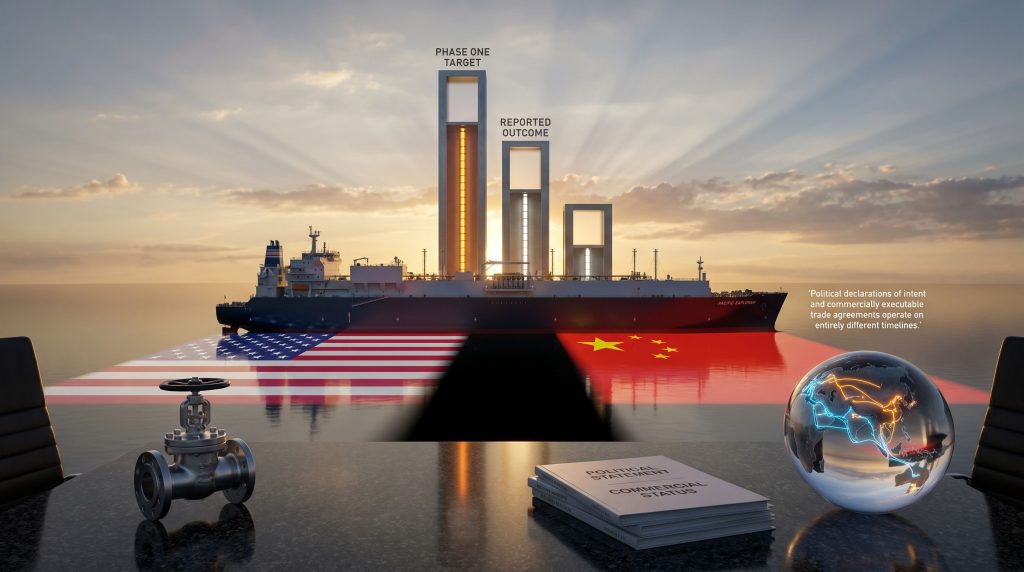
Political declarations of intent and commercially binding trade agreements operate on entirely different timelines. Analysts consistently caution that headline announcements made in diplomatic settings frequently overstate near-term feasibility, particularly when underlying commercial incentives remain misaligned.
"The distance between a diplomatic statement and a signed, enforceable offtake agreement is where most of these announcements quietly expire."
Why US LNG Struggles to Compete in Chinese Markets
The most consequential barrier to meaningful US-China energy trade expansion is not diplomatic — it is economic. US LNG cargoes have repeatedly struggled to compete on delivered price against Russian pipeline gas, Australian LNG, and Qatari supply once tariff burdens and freight premiums are factored into Chinese buyer calculations. Consequently, the global LNG supply outlook continues to shift in ways that disadvantage US exporters targeting Chinese demand.
Several structural disadvantages compound this pricing problem:
- Tariff loading: Trade war-era tariffs have added material cost premiums to US energy imports, creating a structural price disadvantage relative to tariff-free alternatives
- Freight premiums: Routing costs from Gulf Coast export terminals to Chinese receiving ports are higher than those applicable to competing supply origins
- Spot market preferences: Chinese state-owned buyers increasingly favour flexible spot procurement over rigid long-term contract structures common in US LNG project financing
- Russian pipeline competition: Volumes transiting via the Power of Siberia pipeline offer Chinese buyers cost-competitive baseload gas supply with minimal logistical complexity
- Australian and Qatari incumbency: Established long-term supply agreements with non-US origins have deepened over the tariff conflict period, making re-engagement with US supply structurally harder to prioritise
The Center for Strategic and International Studies has documented how the US-China trade war fundamentally altered the commercial calculus for US LNG in Asian markets, with Chinese buyers actively redirecting procurement toward suppliers unaffected by bilateral tariff regimes.
Trade War Rerouting and Its Lasting Structural Consequences
Rather than simply suppressing total energy trade volumes, the US-China tariff conflict has generated a significant and potentially durable rerouting of global energy flows. This trade diversion carries structural implications for commodity markets that extend well beyond the bilateral relationship itself. Indeed, the broader effects of tariffs and supply chains have reshaped procurement strategies across multiple industries simultaneously.
Three major rerouting patterns have emerged:
-
US LNG finding alternative buyers: European markets, Japan, South Korea, and Southeast Asian importers absorbed US LNG volumes that had previously been oriented toward Chinese demand. This reduced US producers' dependence on Chinese offtake, but also diminished their leverage in bilateral negotiations.
-
China accelerating supplier diversification: Long-term supply agreements with Russia, Qatar, Australia, and emerging African LNG exporters have deepened considerably, making structural re-engagement with US energy supply logistically and commercially harder to prioritise.
-
Chinese clean energy capital flowing to third countries: Research from the Columbia SIPA Center on Global Energy Policy documents how bilateral trade tensions have accelerated Chinese clean energy investment across the Global South, reshaping where energy-related industrial capacity is being built independently of US-China dynamics.
This last pattern is particularly consequential. The rerouting of Chinese capital into clean energy manufacturing and infrastructure across Southeast Asia, Africa, and Latin America is creating new supply chain architectures that will influence global energy markets for decades.
The Clean Energy Dimension That Fossil Fuel Narratives Miss
Framing US-China energy trade purely as a fossil fuel procurement story increasingly misses the more strategically significant dimension of the relationship. China's commanding position across clean energy supply chains has elevated the entire energy category from a commodity negotiation into an industrial and technological competition. In addition, questions of critical minerals and energy security are now central to how both nations frame their long-term energy strategies.
China's clean energy industrial position is difficult to overstate:
- Solar manufacturing capacity: Chinese firms control an estimated 80% or more of global solar panel production
- Battery supply chains: Chinese manufacturers dominate lithium-ion cell production, cathode material processing, and upstream critical mineral refining
- EV manufacturing: Chinese automakers are expanding aggressively into global markets, supported by vertically integrated supply chains that most competitors cannot replicate at equivalent cost
- Overseas investment: Chinese clean energy firms are deploying capital across multiple continents to build generation and manufacturing capacity
The US and European policy response has been to implement or expand tariffs on Chinese solar panels, electric vehicles, and battery components, while deploying industrial incentive frameworks designed to onshore clean energy manufacturing domestically.
The result is a parallel clean energy trade war operating alongside the fossil fuel procurement debate. Any expansion of bilateral energy trade in hydrocarbons must now be negotiated within this far more complex industrial and technological contest.
The next major ASX story will hit our subscribers first
Energy as Geopolitical Leverage: The Strategic Weaponisation Problem
Energy has evolved from a commercial category to an instrument of strategic leverage in both US and Chinese policy frameworks. This transformation has significant implications for the feasibility of any bilateral energy trade expansion. The broader geopolitical mining landscape similarly reflects how resource access has become inseparable from national security considerations.
White House trade deal documentation from 2025 indicates that energy, critical minerals, and technology restrictions were being negotiated as an integrated package rather than as discrete commodity issues. The bundling of these categories reflects the degree to which energy procurement has become inseparable from broader strategic competition.
The Phase One trade agreement provides the most instructive historical precedent:
| Metric | Phase One Target | Reported Outcome |
|---|---|---|
| US Energy Export Commitment | Significant volume increase pledged | Substantially underdelivered |
| Structural Tariff Resolution | Partial rollback agreed | Core tariffs remained in place |
| Long-Term Trade Normalisation | Implied by agreement | Bilateral tensions escalated post-agreement |
"The Phase One experience established a clear pattern: politically announced energy purchase commitments require robust commercial incentive alignment and enforcement mechanisms to translate into actual trade volume. Without those foundations, targets reliably underperform."
The Council on Foreign Relations has documented the persistent gap between announced trade frameworks and realised commercial outcomes in the US-China bilateral relationship, noting that structural tensions tend to reassert themselves regardless of short-term diplomatic signals.
Scenario Modelling: Three Pathways for the Next Five Years
Assessing the realistic trajectory of US-China energy trade expansion requires moving beyond optimistic political framing to examine the structural drivers of each possible outcome.
Scenario A: Managed Expansion (Base Case)
Selective tariff reductions on energy categories enable modest increases in US crude and LNG flows to China. Chinese state-owned buyers sign limited long-term contracts as diplomatic goodwill gestures within broader trade negotiations. However, structural pricing disadvantages persist, capping volume growth well below politically stated ambitions.
Scenario B: Strategic Decoupling Deepens (Downside Case)
Renewed tariff escalation or geopolitical friction causes Chinese buyers to accelerate supplier diversification to the point where US energy becomes effectively non-competitive in Chinese markets. Chinese dependence on Russian and Middle Eastern supply deepens further, consequently reducing US leverage.
Scenario C: Structural Breakthrough (Upside Case)
Comprehensive tariff resolution creates a genuinely level commercial playing field for US energy in Chinese markets. Enforceable long-term LNG supply agreements are executed with credible volume commitments. Energy trade, furthermore, becomes a stabilising pillar of the broader bilateral relationship.
The probability weighting across these scenarios is not equal. Scenario A reflects the most likely near-term trajectory, while Scenario C requires institutional and commercial conditions that currently do not exist.
Regional Ripple Effects Across Global Energy Markets
The evolution of US-China energy trade dynamics carries material consequences for commodity pricing, supply chain architecture, and energy security frameworks across multiple regions simultaneously.
| Region | Key Implication |
|---|---|
| Southeast Asia | Growing Chinese clean energy investment; rising LNG import competition |
| Middle East | Beneficiary of Chinese diversification; expanded long-term supply relationships |
| Europe | Absorbing redirected US LNG; energy security exposure from supply rerouting |
| Australia | Competing LNG supplier; exposed to bilateral pricing and tariff dynamics |
| Global South | Primary destination for Chinese clean energy manufacturing investment |
Frequently Asked Questions: US-China Energy Trade
Why doesn't China simply buy more US oil and gas?
Commercial pricing disadvantages, cumulative tariff burdens, and deeply established alternative supply relationships make US energy imports structurally uncompetitive for many Chinese buyers. Political announcements of intent do not resolve these underlying economic barriers.
What is the current status of US LNG exports to China?
US LNG exports to China remain considerably below their theoretical ceiling, constrained by trade war-era tariffs, freight cost premiums, and China's deliberate diversification toward Russian, Qatari, and Australian supply sources.
What did the Phase One agreement reveal about energy purchase commitments?
Energy volume targets embedded in the Phase One trade agreement were substantially underdelivered, establishing a clear precedent for caution around politically announced bilateral energy trade commitments that lack robust enforcement mechanisms.
How does clean energy factor into US-China energy trade discussions?
Clean energy supply chains — including solar, batteries, and electric vehicles — have become inseparable from the broader energy trade debate. China's industrial dominance across these sectors has prompted US and European tariff responses, creating a parallel technological competition alongside the fossil fuel procurement question.
Five Structural Realities That Define the Outlook
The US-China energy trade relationship is best understood as a multi-layered strategic contest rather than a straightforward expansion opportunity. Fossil fuel procurement, clean energy industrial competition, tariff policy, and geopolitical leverage are deeply intertwined in ways that complicate any simple bilateral expansion narrative.
Five structural realities shape the realistic outlook:
- Pricing competitiveness remains the primary barrier to US energy gaining meaningful market share in China, and diplomatic statements do not alter delivered cost calculations
- Trade diversion has already reshaped global energy flows in durable ways, with Chinese buyers establishing supply relationships that are commercially and logistically difficult to redirect
- Clean energy competition has elevated energy from a commodity category to a strategic industrial battleground, complicating any sector-specific negotiation
- Phase One precedent demonstrates a persistent and documented gap between politically announced volume targets and commercial execution
- China's diversification strategy systematically reduces the structural leverage that US energy supply might otherwise provide in bilateral negotiations
For US-China energy trade expansion to move from political aspiration to commercial reality, it requires not merely diplomatic goodwill, but a fundamental resolution of the tariff architecture, pricing dynamics, and supply chain incentives that currently position US energy as a second-tier option for Chinese buyers. Without those foundations, headline announcements will continue to generate market attention without generating proportionate trade volume.
This article contains analysis of geopolitical and commercial developments in energy trade. It does not constitute financial or investment advice. Forward-looking scenarios involve inherent uncertainty and should not be interpreted as predictions of specific outcomes.
Further Reading
Readers seeking independent research on the structural forces shaping US-China energy trade dynamics may find value in analysis published by the Columbia SIPA Center on Global Energy Policy (energypolicy.columbia.edu), the Council on Foreign Relations (cfr.org), and the Center for Strategic and International Studies (csis.org).
Want to Stay Ahead of the Commodity Shifts Reshaping Global Energy Markets?
As geopolitical forces continue to redraw energy trade flows and reshape commodity demand, Discovery Alert's proprietary Discovery IQ model delivers real-time alerts on significant ASX mineral discoveries — instantly translating complex market signals into actionable investment opportunities. Explore historic examples of major mineral discoveries and their market returns on Discovery Alert's dedicated discoveries page, and begin your 14-day free trial today to position yourself ahead of the next significant market move.