August 14, 2026
The Architecture of Oil Market Power Is Shifting Beneath Our Feet
For the better part of six decades, the global oil order rested on a deceptively simple premise: that a coalition of sovereign producers could voluntarily constrain their own output in the collective interest of price stability. That premise has never been perfectly upheld, but it provided enough structural coherence to anchor the market's expectations. Today, that coherence is fracturing, and the decision by the UAE exits OPEC+ from 1 May 2026 is the most significant signal yet that producer coordination as a market-stabilising force is entering a new, more fragile era.
Understanding why this matters requires looking beyond the immediate headlines and into the structural logic that has been steadily unravelling beneath the alliance for years. Furthermore, crude oil price trends suggest this fracturing has been building momentum well before the current crisis.
When big ASX news breaks, our subscribers know first
What the UAE's OPEC+ Departure Actually Signals
The UAE has been a member of OPEC since the organisation's early decades, making its exit a genuinely historic event rather than a routine diplomatic manoeuvre. This is not a case of temporary quota non-compliance, which has occurred repeatedly across OPEC+ membership, nor is it a negotiating tactic designed to extract more favourable terms from Riyadh. According to reporting by Reuters, the decision reflects a definitive strategic recalibration driven by long-standing tensions within the alliance, compounding commercial pressures, and a broader reassessment of Abu Dhabi's foreign policy positioning.
The critical distinction here is between a tactical withdrawal and a structural pivot. Past disputes over production ceilings have been resolved through negotiated baseline revisions. This exit is categorically different because the UAE is not seeking higher quotas within the framework; it is rejecting the framework itself in favour of sovereign commercial autonomy.
The UAE's departure is less a reaction to a single geopolitical event and more the culmination of years of compounding strategic divergence, spanning production ceilings, foreign policy alignment, and fundamentally different visions for the Gulf's economic future.
The Strait of Hormuz crisis, triggered when the US and Israel attacked Iran on 28 February 2026 and Iran subsequently imposed severe restrictions on navigation through the strait, accelerated a decision that had already been forming. It did not create the conditions for departure; it removed the final incentives for restraint.
The Structural Tensions That Made This Inevitable
The Production Capacity Mismatch Problem
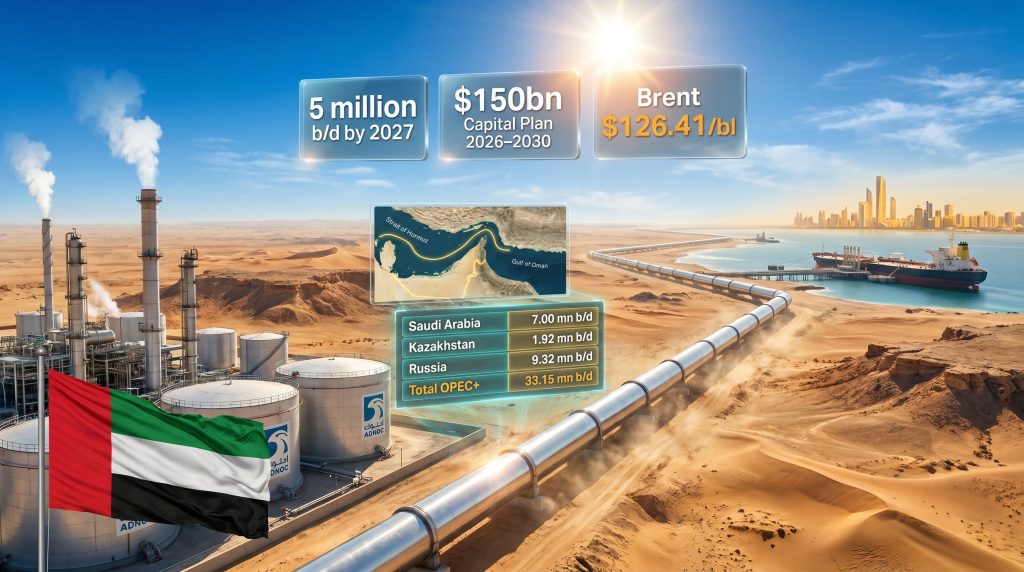
The commercial logic underpinning the UAE's exit is straightforward, even if its strategic implications are complex. State energy company ADNOC has approved a $150 billion capital expenditure programme for 2026 to 2030, spanning oil, gas and chemicals, and the UAE has set a production capacity target of 4.85 million barrels per day (b/d) in 2026, rising to 5 million b/d by 2027, according to Argus Media. Yet the country's OPEC+ production target for March 2026 stood at just 3.41 million b/d, creating a structural mismatch that successive baseline revisions within the alliance only partially addressed.
The table below illustrates the scale of constraint the UAE faced relative to its productive ambitions:
| Metric | Pre-Exit Position | Post-Exit Trajectory |
|---|---|---|
| OPEC+ Production Target | 3.41 million b/d | No ceiling applies |
| 2026 Capacity Target | Subject to negotiation | 4.85 million b/d sovereign target |
| 2027 Capacity Target | Subject to MSC recalibration | 5 million b/d sovereign target |
| Capital Expenditure Plan | Partially constrained by quota logic | $150 billion freely deployable (2026-30) |
| Export Route Flexibility | Hormuz-dependent for most peers | 249-mile bypass pipeline operational |
The OPEC+ framework introduced a Maximum Sustainable Capacity (MSC) recalibration process for 2027 production baselines, designed to better align quota allocations with actual productive potential. For the UAE, this process arrived too late and offered too little. The country's strategic calculus had already shifted from seeking higher quotas to seeking complete operational flexibility.
Why Flexibility Became More Valuable Than Higher Quotas
This is a subtle but critically important distinction. A higher OPEC+ quota still subjects the producer to the alliance's coordination machinery, compliance reviews, and political compromises. Flexibility, by contrast, means the ability to respond instantaneously to market conditions, customer relationships, and commercial opportunities without requiring consensus from 22 other sovereign nations.
As Argus Media reported, the exit is not designed to signal a break with global oil markets, nor to trigger an immediate supply surge. The UAE has indicated there is no intention to flood the market. The commercial strategy appears gradualist: expand production capacity steadily while retaining the sovereign right to respond to market signals without institutional constraint.
The Hormuz Crisis as Catalyst, Not Cause
How Navigation Restrictions Inverted Market Logic
The conflict that erupted on 28 February 2026 transformed the operational environment for Gulf oil exporters in ways that rendered OPEC+ quota frameworks almost immediately irrelevant. Iran's restrictions on Hormuz navigation reduced Mideast Gulf crude loadings from approximately 16 million b/d prior to the conflict to just 1.8 to 1.9 million b/d in April 2026, according to data from Vortexa and Kpler cited by Argus Media. That represents a collapse of roughly 89% in export volumes through the world's most critical oil transit chokepoint.
This inversion is profound in its implications. For two decades, the central question in oil markets was how much producers were willing to supply. Suddenly, the question became how much they could physically deliver, through which routes, at what cost, and with what reliability. Voluntary coordination frameworks are designed to manage the first question. They have no mechanism for addressing the second.
The UAE's Strategic Bypass Advantage
Here lies one of the most consequential and underappreciated dimensions of the UAE's post-OPEC+ positioning. The country operates a 249-mile overland pipeline that routes crude exports to the Gulf of Oman, entirely bypassing the Hormuz chokepoint. During a period when most Mideast Gulf producers have been effectively shut out of export markets, the UAE retains a functioning alternative corridor.
Saudi Arabia possesses a comparable advantage through its East-West pipeline terminating at Yanbu on the Red Sea. Yanbu crude loadings surged from approximately 800,000 b/d before the conflict to 4.0 to 4.2 million b/d in April 2026, according to Argus Media. Yet even this dramatic increase failed to compensate for the broader collapse in Mideast Gulf loading volumes.
The tanker market data tells the story starkly:
| Route | Rate | Period | Context |
|---|---|---|---|
| Mideast Gulf-China VLCC | $17.23/bl (near all-time high) | Early April 2026 | Extreme Hormuz risk premium |
| Yanbu-Northeast Asia VLCC | $4.79/bl | April 2026 | Roughly one quarter of its early March level |
| Rate disparity | Approximately 3.6x difference | April 2026 | Reflects physical access premium |
Looking ahead, these dynamics could shift materially. Shipyards are expected to deliver new tankers representing up to 6% of the global fleet in 2026, adding supply into an already demand-constrained tanker market. As reported by Argus Media, once Hormuz navigation conditions normalise, rates that spiked to historic highs are unlikely to sustain anywhere near those levels.
On 3 May 2026, President Donald Trump announced that the US and Iran had agreed to allow neutral ships stranded in the Mideast Gulf since February to depart through Hormuz under what he described as "Project Freedom." More than 700 vessels had been caught in the Gulf following Iran's navigation restrictions, with approximately 120 fully laden tankers still trapped as of mid-April, according to Argus Media. This development represents an early diplomatic signal, though a comprehensive resolution to safe navigation through the strait had not been achieved as of the time of this reporting.
If Hormuz reopens following a broader US-Iran political resolution, the UAE, unconstrained by OPEC+ production ceilings and equipped with bypass pipeline infrastructure, is positioned to rapidly scale exports and capture market share that disrupted competitors cannot immediately recover.
Three Structural Scenarios for OPEC+ Without the UAE
Scenario 1: Saudi Arabia Consolidates as the Dominant Anchor
The most immediately plausible scenario is one in which Saudi Arabia reinforces its role as the alliance's primary supply manager. Riyadh has consistently demonstrated both the capacity and the strategic willingness to absorb production fluctuations through its unmatched spare capacity position. With the UAE operating independently, Saudi Arabia's influence within a smaller, potentially more disciplined coalition actually increases.
Argus Media reports that Saudi officials have never fully abandoned ambitions to expand production capacity back toward 13 million b/d, a level that would further entrench Riyadh's position as the world's pre-eminent swing producer. The UAE's exit may accelerate internal Saudi discussions around reviving this expansion programme, as a larger capacity base strengthens the kingdom's ability to set the marginal price of oil regardless of what other producers do. In this context, OPEC's market influence remains a critical variable to monitor closely.
Scenario 2: A Domino Effect Among Capacity-Rich Members
The more structurally disruptive scenario involves other quota-constrained OPEC+ members reassessing their own participation in the alliance, emboldened by the UAE's precedent. Several candidates merit attention:
- Kazakhstan has persistently exceeded its production targets, recording actual output of 1.92 million b/d against a March 2026 target of 1.57 million b/d, making it the only major OPEC+ member demonstrably producing above quota.
- Venezuela's position within the group remains uncertain following the January 2026 political transition and its evolving relationship with Washington. Recent memorandums of understanding signed with US independent producers Hunt Oil and Crossover Energy Holdings in the Orinoco heavy oil belt, reported by Argus Media, suggest a reorientation toward US commercial relationships that may not align with OPEC+ coordination objectives.
- Iran's potential reintegration into global markets, if US-Iran negotiations produce a political agreement, would add substantial unconstrained supply that would further test the alliance's capacity to manage aggregate output.
Scenario 3: OPEC+ Evolves Into a Looser Coordination Mechanism
A third pathway involves the alliance reforming itself rather than fragmenting. Russia remains publicly committed to OPEC+ as a market-balancing structure despite the constraints imposed by Ukraine war sanctions, according to Argus Media. A two-tier system could emerge, with Saudi Arabia and Russia anchoring a core coordination mechanism while other producers participate selectively and voluntarily.
Qatar's exit from OPEC in 2019 provides an instructive historical precedent. Doha departed citing oil production constraints relative to its focus on liquefied natural gas, yet continued to engage with global energy markets bilaterally. The cartel survived, but its claims to universality weakened. A similar dynamic now applies at far greater scale.
How Oil Markets Are Absorbing the Shock
Price Volatility and the Multi-Layered Disruption Environment
The market environment into which the UAE exits OPEC+ lands is already operating under extreme stress. Brent and WTI futures front-month contracts saw Brent trade as high as $126.41 per barrel on 30 April, surging over 7% in a single session, according to Argus Media. Pre-war Brent pricing in January and February 2026 had been tracking in the $60 to $70 per barrel range.
The Asian Development Bank revised its baseline Brent price assumption to approximately $96 per barrel for 2026, down from its earlier forecast but substantially above pre-war levels, and projects prices easing toward $80 per barrel in 2027. ADB President Masato Kanda characterised the situation as systemic and long-lasting disruptions to global energy and trade networks rather than temporary volatility.
The macroeconomic ripple effects are already visible across Asia-Pacific:
- Regional GDP growth forecast downgraded to 4.7% for 2026, from a prior projection of 5.1%
- Regional inflation forecast to reach 5.2% in 2026, up from 3.0% in 2025
- In a scenario of further conflict escalation, growth could slow to 4.2% while inflation could spike to 7.4%
Japan's response illustrates the severity of supply disruption facing consuming nations. Tokyo secured approximately 1.4 million b/d of crude for May 2026, covering only around 60% of the country's requirements based on average 2025 imports of 2.36 million b/d, according to Argus Media. Japan is drawing on national strategic reserves and implementing retail fuel subsidies targeting a cap of approximately 170 yen per litre at the pump.
The convergence of Hormuz disruption, rising tanker supply additions, and the UAE's production uncapping creates a multi-directional price pressure environment that resists simple directional forecasting.
The next major ASX story will hit our subscribers first
The Geopolitical Fault Lines Beneath the Oil Story
A Strategic Divergence That Pre-Dates the Iran Conflict
Reducing the UAE exits OPEC+ story to an energy policy decision obscures what is actually a comprehensive reorientation of Abu Dhabi's strategic posture. Tensions between the UAE and Saudi Arabia had been building prior to the Iran conflict across multiple policy dimensions, including differing approaches to Yemen, Sudan, and engagement with Israel. Furthermore, the trade war impact on oil markets has added yet another layer of complexity to these already strained relationships.
The conflict accelerated these pre-existing divergences. The UAE has moved to deepen bilateral relationships with the US, Israel, South Korea, France, and Japan, according to Argus Media. Saudi Arabia adopted a contrasting approach, pursuing de-escalation with Iran despite direct attacks and strengthening its regional security architecture through a military defence agreement with Pakistan.
Broader Institutional Reassessment
The signals extend beyond OPEC+. According to Argus Media, the UAE is considering suspending its Arab League membership and withdrawing from the Organisation of Islamic Cooperation. These potential moves collectively indicate an Abu Dhabi that is repositioning itself as a more independent actor willing to step outside regional institutional frameworks when its strategic interests diverge from collective positions.
The 2017 Qatar isolation episode remains a cautionary reference point for anyone assessing UAE risk exposure. Gulf diplomatic dynamics can shift with extraordinary speed, and a UAE that has simultaneously exited OPEC+, deepened ties with Israel and the US, and distanced itself from Arab institutional frameworks is navigating a genuinely exposed geopolitical position. Consequently, this oil geopolitics analysis is critical reading for anyone tracking the region's shifting power dynamics.
The Monetise Before Demand Peaks Logic
Why the Timing of ADNOC's Expansion Matters
Behind the ADNOC capital expenditure programme lies an implicit strategic calculation that deserves explicit examination. Producers with large proven reserves and low extraction costs increasingly face a shrinking window to monetise hydrocarbon assets before structural demand decline, driven by energy transition forces, accelerates meaningfully. The UAE's aggressive upstream expansion is not inconsistent with its parallel investments in clean energy; it reflects a rational portfolio approach to maximising value from proven reserves while demand conditions remain supportive.
This creates a tension, however, with global price stability. If multiple capacity-rich OPEC+ producers reach a similar conclusion simultaneously, whether Kazakhstan, Venezuela, Iran, or others follow the UAE's logic of prioritising production autonomy over coordination, the market's capacity to absorb additional unconstrained supply would be tested significantly.
OPEC+ Production Snapshot: Where the Alliance Stands
The table below presents March 2026 production data across OPEC+ members, sourced from Argus Media, illustrating the scale of underperformance relative to targets driven primarily by Hormuz disruption constraints rather than voluntary compliance:
| Producer | Actual Output (mn b/d) | Target (mn b/d) | Variance |
|---|---|---|---|
| Saudi Arabia | 7.00 | 10.10 | -3.10 |
| Iraq | 1.70 | 4.27 | -2.57 |
| UAE | 1.90 | 3.41 | -1.51 |
| Kuwait | 1.17 | 2.58 | -1.41 |
| Russia | 9.32 | 9.57 | -0.25 |
| Kazakhstan | 1.92 | 1.57 | +0.35 |
| Nigeria | 1.45 | 1.50 | -0.05 |
| Total OPEC+ | 33.15 | 36.74 | -8.90* |
Significant underproduction reflects Hormuz disruption constraints across core Mideast Gulf members, not deliberate voluntary restraint.
The data reveals an alliance managing a physical logistics crisis rather than executing a coordinated supply policy. This distinction matters enormously: OPEC+ frameworks were designed for the former, not the latter. When the production shortfall is dictated by navigation restrictions rather than member discipline, the quota architecture provides no additional stabilisation value.
Frequently Asked Questions: UAE Exits OPEC+
Why did the UAE leave OPEC+ after so many decades of membership?
The departure reflects a convergence of factors including long-running production capacity constraints under OPEC+ quota frameworks, a strategic desire for full commercial flexibility to deploy its $150 billion capital plan, and an accelerating divergence from Saudi Arabia across energy policy and broader geopolitical positioning. The Hormuz crisis provided the immediate catalyst, but the underlying drivers had been accumulating for years.
Will the UAE leaving OPEC+ crash oil prices?
Not immediately. Any UAE production ramp-up will be gradual, and current Hormuz disruptions continue to suppress Gulf export volumes regardless of quota frameworks. However, once safe navigation conditions return, unconstrained UAE production growth targeting 5 million b/d by 2027 could exert meaningful downward pressure on prices, particularly if other capacity-rich members adopt similar independent strategies.
Does the UAE's exit weaken OPEC+?
It introduces structural uncertainty without immediately dismantling the alliance. Saudi Arabia retains the capacity and stated willingness to anchor supply management, and Russia remains publicly committed to the framework. However, the exit signals that near-universal Gulf producer alignment within OPEC+ may no longer be a reliable foundation for the alliance's coordination model.
Could Iran's potential return to global markets further destabilise OPEC+?
A US-Iran political agreement enabling Iran to fully reintegrate into global oil markets would add significant unconstrained supply. Combined with the UAE's independent production growth and Kazakhstan's persistent overproduction pattern, a scenario of compounding uncoordinated supply additions would severely test OPEC+'s residual capacity to manage global output levels. For instance, the BBC's coverage of the UAE exit provides further context on how analysts are framing these risks.
What does the Hormuz crisis mean for the UAE's post-OPEC+ competitive position?
The UAE's bypass pipeline infrastructure provides a material export advantage during the current disruption. Once the strait reopens, the UAE will be among the best-positioned producers globally: unconstrained by OPEC+ ceilings, equipped with alternative export infrastructure, and backed by a multi-decade capital investment programme targeting 5 million b/d of productive capacity.
Key Takeaways
- The UAE's withdrawal from OPEC+ ends decades of membership and marks a fundamental shift toward sovereign production autonomy over cartel coordination
- ADNOC's $150 billion capital expenditure plan for 2026 to 2030 and a 5 million b/d production target by 2027 underpin a long-term expansion strategy that is no longer subject to OPEC+ output ceilings
- The Hormuz crisis has restructured market dynamics, making supply reliability and physical delivery capability the primary price drivers rather than producer willingness or quota compliance
- Saudi Arabia's potential revival of capacity expansion ambitions toward 13 million b/d will be the most consequential near-term variable for OPEC+ cohesion
- The UAE's broader geopolitical repositioning, including potential suspension of Arab League membership, signals a systemic strategic realignment rather than an isolated energy policy decision
- Kazakhstan, Venezuela, and potentially Iran face similar structural pressures that could accelerate OPEC+'s evolution from a disciplined quota cartel into a looser coordination mechanism
- Brent crude surging above $126 per barrel and the ADB's revised Asia-Pacific growth forecast of 4.7% for 2026 illustrate the compound economic consequences of layered energy market disruptions
Disclaimer: This article is intended for informational purposes only and does not constitute financial or investment advice. Oil market forecasts, price projections, and scenario analyses involve significant uncertainty and are subject to rapid change based on geopolitical, economic, and operational developments. Readers should conduct independent research and consult qualified financial advisers before making investment decisions.
Readers seeking additional context on global oil market dynamics and OPEC+ production frameworks can explore related market intelligence published by Argus Media at argusmedia.com, which offers further reporting on crude market developments related to the topics covered in this article.
Want To Identify The Next Major Mineral Discovery Before The Market Does?
While geopolitical shifts reshape global energy markets, savvy investors are also watching ASX mineral exploration closely — and Discovery Alert's proprietary Discovery IQ model delivers real-time alerts the moment significant discoveries are announced, turning complex data across 30+ commodities into clear, actionable opportunities. Explore historic discovery returns on Discovery Alert's dedicated discoveries page to understand the potential scale of these opportunities, then begin your 14-day free trial to position yourself ahead of the broader market.