August 5, 2026
Rare earth separation represents one of the most technically challenging aspects of modern critical materials processing. The Ucore RapidSX technology commercialization plan demonstrates how innovative modular approaches are reshaping traditional processing methodologies, offering new pathways for domestic capabilities in strategic markets whilst addressing long-standing supply chain vulnerabilities.
The chemical complexity of rare earth separation stems from the remarkably similar properties of these elements. Traditional methods rely on solvent extraction principles that require hundreds of sequential separation stages to achieve commercial-grade purity. This process demands extensive physical infrastructure, skilled technical personnel, and substantial upfront capital investment that has historically concentrated processing capacity in regions with state-supported industrial development.
What Makes RapidSX Different from Conventional Solvent Extraction?
Core Technology Architecture
The RapidSX technology represents a fundamental reimagining of established solvent extraction chemistry rather than an entirely new approach. According to technical documentation from Ucore's Phase 1 demonstration program, the system achieves enhanced equilibrium states through optimised ion exchange mechanisms whilst maintaining the proven chemical principles that have supported rare earth processing for decades.
Key Performance Differentiators:
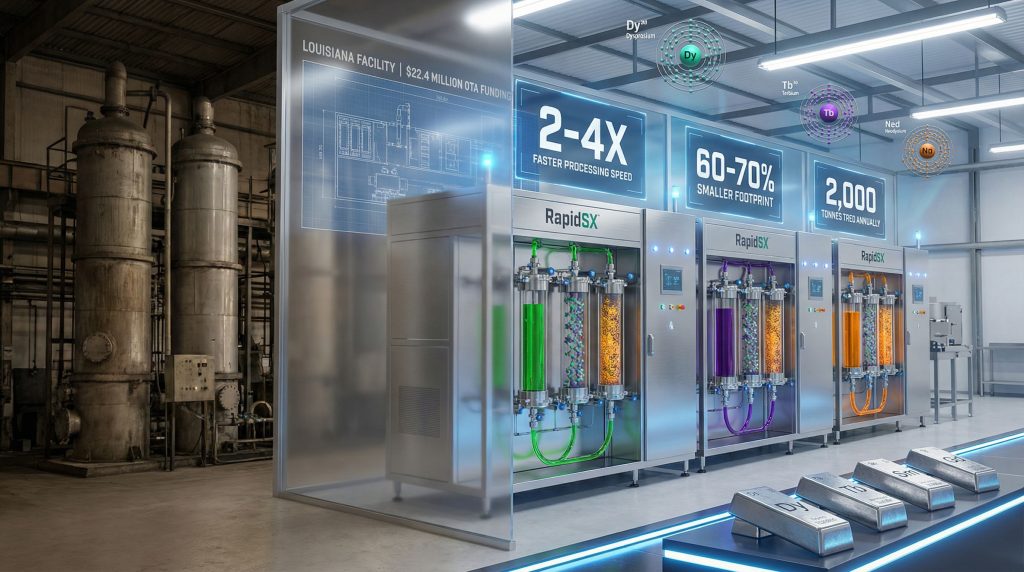
- Processing Speed Enhancement: Documented operational data indicates 2-4x faster throughput compared to conventional systems
- Facility Footprint Reduction: 60-70% smaller processing facilities through modular design
- Capital Efficiency: Phased deployment capability reducing initial investment requirements
- Process Control Integration: Advanced sensor networks enabling real-time chemistry optimisation
The modular architecture enables sequential machine deployment, where individual processing units operate in series to achieve target separation specifications. This approach contrasts sharply with traditional mega-facility construction that requires full upfront capital commitment before any revenue generation. Furthermore, this modular methodology aligns with broader mining industry innovation trends toward flexible, scalable processing solutions.
Operational Validation Results
Extensive testing at the Kingston Commercialisation and Demonstration Facility produced compelling performance data supporting commercial viability claims. The Phase 1 programme documented over 6,000 continuous operational hours under simulated commercial production conditions, generating more than 10,000 comparative data points against conventional solvent extraction methods.
Production Achievements:
- Multiple rare earth chloride products: PrNd, SmEuGd, individual Sm, Gd, Tb, and Dy compounds
- Thousands of litres of commercial-grade separated products
- Processing of realistic mixed rare earth oxide (MREO) feedstock materials
- Side-by-side performance validation against conventional CSX pilot plant
The comparative testing methodology strengthens confidence in reported performance improvements by eliminating variables that could skew results between different testing environments or feedstock compositions. Moreover, this validation approach demonstrates how data-driven operations are becoming essential for optimising complex processing systems.
Technical Innovation Framework
Beyond raw processing speed, RapidSX technology incorporates several design principles that address traditional industry challenges:
Equipment Standardisation: Utilisation of Commercial Off-The-Shelf (COTS) components enhances manufacturing scalability and reduces custom equipment dependencies that have historically complicated rare earth processing facility construction.
Process Chemistry Optimisation: While maintaining established solvent extraction chemistry, the system achieves faster chemical equilibrium through enhanced mixing and contact time optimisation within smaller processing volumes.
Automated Process Control: Integrated sensor networks and programmable logic controller (PLC) systems enable real-time process adjustments that maintain optimal separation parameters across varying feedstock compositions. This represents a significant advancement in automated process control applications within critical materials processing.
When big ASX news breaks, our subscribers know first
Why Are Military Applications Driving RapidSX Development?
Strategic Defence Considerations
The U.S. Department of Defense's $22.4 million Other Transaction Agreement (OTA) with Ucore reflects official recognition that domestic rare earth processing capability constitutes a national security imperative. Approximately 90-95% of global rare earth separation capacity remains concentrated in China, creating strategic vulnerability for defence applications requiring reliable access to separated rare earth products.
Critical Defence Elements:
- Dysprosium (Dy): Essential for high-temperature permanent magnets in advanced weapons systems, radar equipment, and electronic warfare technologies
- Terbium (Tb): Critical for phosphor applications in night vision equipment, imaging systems, and advanced sensor technologies
- Gadolinium (Gd): Required for neutron capture materials in nuclear reactor control systems and radiation shielding applications
The annual U.S. defence demand for heavy rare earth oxides is estimated at approximately 200-400 tonnes, representing a substantial market that currently depends entirely on foreign supply chains with potential geopolitical vulnerabilities. Consequently, the development of domestic processing capabilities directly supports critical minerals energy security objectives across both civilian and military applications.
OTA Programme Structure
The Other Transaction Agreement structure enables flexible, milestone-based funding that supports technology development through proven performance rather than traditional fixed-price contracting. This approach aligns military procurement with innovative technology development cycles whilst maintaining rigorous performance validation requirements.
Phase 1 Completion Milestones:
- Submission of Final Demonstration Report to U.S. Army Contracting Command – Orlando
- Technical-Economic Analysis (TEA) documenting commercial viability
- 6,000+ operational hours demonstrating process reliability
- Comparative performance database against conventional methods
Phase 2 Implementation: Initiated in May 2025 with 5 of 20 milestones completed as of February 2026, focusing on commercial-scale RapidSX machine deployment at the Louisiana Strategic Metals Complex.
Technology Transfer Protocol
The programme structure includes systematic knowledge transfer from the Kingston demonstration facility to the Louisiana commercial facility, ensuring replication of proven processes at industrial scale. This methodology reduces technical risk associated with scaling from demonstration to production whilst maintaining process optimisation capabilities developed during Phase 1 operations. Furthermore, this transfer protocol supports broader critical minerals reserve development strategies by demonstrating scalable processing technologies.
What Production Capabilities Will the Louisiana Facility Deliver?
Phase 1 Commercial Specifications
The Louisiana Strategic Metals Complex is designed to demonstrate commercial-scale rare earth separation using modular RapidSX technology deployment. Initial capacity targets indicate 2,500 tonnes Total Rare Earth Oxide (TREO) annual processing capability through sequential machine installation.
Target Product Portfolio:
| Product Type | Application Focus | Market Significance |
|---|---|---|
| PrNd Chlorides | Permanent magnet feedstock | Light rare earth commodity products |
| SmEuGd Blends | Specialised industrial applications | Medium rare earth value-added products |
| Individual Sm | High-temperature magnets | Strategic defence applications |
| Individual Gd | Medical and nuclear applications | Critical materials market |
| Individual Tb | Phosphor and advanced magnets | High-value heavy rare earth |
| Individual Dy | Permanent magnet enhancement | Strategic defence and clean energy |
Modular Expansion Strategy
The facility design enables incremental capacity additions aligned with market demand growth and capital availability. This approach contrasts with traditional all-or-nothing facility construction that requires full capacity investment before revenue generation.
Deployment Sequence:
- Initial RapidSX Machine: Hundreds of tonnes TREO capacity for market validation
- Sequential Additions: Step-wise capacity increases toward 2,500 tonne target
- Demand-Responsive Scaling: Additional modules based on customer qualification and supply agreements
The Ucore RapidSX technology commercialization plan emphasises this phased approach as crucial for managing both technical and financial risks whilst demonstrating commercial viability to potential customers and investors.
Quality Standards and Customer Validation
Commercial success depends on producing rare earth products meeting customer specifications across multiple industrial applications. The Phase 1 demonstration programme established baseline quality metrics for both chloride and oxide product forms, though detailed specifications await customer qualification processes.
Product Development Priorities:
- Commercial-grade chloride salts for downstream processing
- High-purity oxide compounds for specialised applications
- Customer-specific product specifications through qualification testing
- Regulatory compliance for environmental and safety standards
How Does the Kingston Demonstration Facility Validate Commercial Readiness?
Technical Validation Framework
The Kingston Commercialisation and Demonstration Facility provided crucial empirical data supporting commercial deployment decisions. Operating under simulated commercial conditions, the facility processed realistic MREO feedstock materials whilst maintaining detailed performance documentation.
Validation Metrics:
- Continuous Operations: 6,000+ hours of sustained processing
- Product Diversity: Multiple separated rare earth compounds produced
- Comparative Analysis: Direct performance comparison with conventional CSX technology
- Process Optimisation: Real-time chemistry adjustments and restart protocols
Scale-Up Confidence Indicators
The demonstration programme addressed critical questions regarding technology scalability and commercial viability. By processing tonnes of realistic feedstock materials rather than laboratory-scale samples, the programme generated confidence in commercial-scale deployment.
Commercial Readiness Evidence:
- Proven feedstock processing capability with heavy MREO compositions
- Documented equipment standardisation using COTS components
- Established operational protocols for process startup and optimisation
- Quantified performance advantages over conventional methods
Knowledge Transfer Validation
The systematic technology transfer from Kingston to Louisiana demonstrates process replicability, a crucial factor for commercial success. Technical documentation, operational procedures, and performance optimisation protocols developed during Phase 1 provide the foundation for commercial-scale implementation.
What Economic Advantages Does Modular Deployment Offer?
Capital Investment Strategy
Traditional rare earth processing facilities require massive upfront capital investment before generating any revenue, creating substantial financial risk and limiting access to capital markets. Modular deployment fundamentally alters this economic equation by enabling phased capacity additions aligned with market development.
Financial Risk Mitigation:
- Phased Capital Deployment: Sequential machine additions reduce initial investment requirements
- Earlier Revenue Generation: First modules can generate cash flow whilst additional capacity is under construction
- Market-Responsive Scaling: Capacity additions aligned with confirmed customer demand
- Technology Evolution Integration: Continuous improvement across sequential modules
Operational Cost Structure
The enhanced processing efficiency documented during Phase 1 testing translates into operational cost advantages that support competitive positioning against established suppliers. Energy consumption, labour requirements, and maintenance profiles all benefit from the optimised process architecture.
Cost Efficiency Factors:
- Energy Optimisation: Faster equilibrium chemistry reduces processing energy per tonne
- Automation Benefits: Reduced operational staffing through automated process control
- Maintenance Standardisation: Modular equipment design enables predictive maintenance programmes
- Waste Stream Minimisation: Enhanced separation efficiency reduces byproduct disposal costs
Which Rare Earth Elements Will Drive Initial Commercial Success?
Heavy Rare Earth Focus Areas
The Louisiana facility's emphasis on heavy rare earth processing addresses the most strategically critical segment of the rare earth market. Heavy rare earths command premium pricing whilst suffering from the most concentrated supply chains, creating optimal conditions for domestic processing success.
Strategic Element Priorities:
Dysprosium Applications:
- Permanent magnet enhancement for high-temperature environments
- Wind turbine generator magnets requiring exceptional performance
- Electric vehicle traction motors demanding efficiency and durability
- Defence applications in advanced weapons and radar systems
Terbium Applications:
- Phosphor technology for advanced imaging systems
- High-performance permanent magnets for specialised applications
- Fluorescent materials for security and defence applications
Gadolinium Applications:
- Medical imaging contrast agents and MRI enhancement
- Neutron capture materials for nuclear reactor control
- Specialised alloys for high-temperature industrial applications
Light-Medium Rare Earth Products
Whilst heavy rare earths offer the highest strategic value, the facility is designed to process the complete rare earth spectrum, enabling comprehensive product portfolios that serve diverse customer requirements.
Commodity Product Focus:
- PrNd Blends: Primary feedstock for permanent magnet manufacturing
- Individual Samarium: High-temperature magnet applications and specialised alloys
- Medium Rare Earth Blends: Industrial applications requiring specific element combinations
The next major ASX story will hit our subscribers first
What Timeline Challenges Could Impact Commercial Launch?
Technical Risk Factors
Despite successful Phase 1 validation, commercial deployment faces several technical challenges that could impact timeline execution. Scaling from demonstration to full production typically reveals process optimisation requirements not apparent during smaller-scale operations.
Critical Technical Considerations:
- Feedstock Variability: MREO supply chain consistency and composition standardisation
- Process Fine-Tuning: Optimisation for different ore compositions and customer specifications
- Equipment Integration: Seamless operation of multiple sequential RapidSX machines
- Quality Assurance: Consistent product specifications across varying operational conditions
Market Readiness Requirements
Commercial success depends on market acceptance beyond technical performance validation. Customer qualification processes, competitive positioning, and supply agreement negotiations represent crucial non-technical factors affecting launch timeline.
Market Development Challenges:
- Customer Qualification: End-user testing and approval of RapidSX-produced materials
- Competitive Pricing: Market positioning against established Chinese suppliers
- Supply Agreement Negotiations: Long-term offtake contracts providing revenue security
- Regulatory Compliance: Environmental permitting and operational approvals
Regulatory and Environmental Considerations
Rare earth processing involves complex environmental and safety regulations that require comprehensive compliance programmes. The Louisiana facility must navigate federal, state, and local regulatory requirements whilst maintaining operational efficiency. However, the Ucore RapidSX technology commercialization plan incorporates regulatory compliance as a fundamental design consideration rather than an afterthought.
How Will RapidSX Technology Impact Global Rare Earth Markets?
Supply Chain Diversification Impact
The successful commercialisation of modular rare earth processing technology could catalyse broader industry transformation by demonstrating viable alternatives to mega-facility concentration. This development potentially enables geographic diversification of processing capacity whilst reducing capital barriers to entry.
Strategic Market Implications:
- Geographic Distribution: North American processing capability reducing Chinese dependency
- Technology Licensing Opportunities: Potential international deployment in allied nations
- Innovation Catalyst: Competitive pressure spurring alternative technology development
- Strategic Reserve Building: Government stockpiling capabilities through domestic processing
Investment Sector Validation
Successful RapidSX commercialisation would validate modular processing approaches across critical materials sectors, potentially attracting capital to similar technology development programmes. This demonstration effect could accelerate innovation in lithium, cobalt, and other critical materials processing.
Capital Market Effects:
- Sector Credibility Enhancement: Proving alternative processing technologies commercially viable
- Investment Model Validation: Demonstrating scalable business models for critical materials
- Strategic Partnership Opportunities: Enabling downstream integration with manufacturers
- Technology Premium Recognition: Market valuation of processing innovation
What Broader Industry Transformation Could RapidSX Enable?
Processing Industry Evolution
The modular approach demonstrated by RapidSX technology represents a fundamental shift from traditional mining industry capital deployment models. Rather than requiring massive upfront facility construction, modular deployment enables incremental capacity additions aligned with market development and technological advancement.
Industry Structure Changes:
- Decentralised Processing Model: Moving away from single-point-of-failure mega-facilities
- Technology Standardisation: Modular approaches becoming industry best practice
- Environmental Impact Reduction: Smaller processing footprints and optimised waste streams
- Innovation Acceleration Cycles: Faster technology iteration and improvement implementation
Strategic Resource Security Enhancement
Beyond immediate commercial applications, successful modular rare earth processing could establish precedents for domestic critical materials security across multiple strategic elements. This development supports broader national security objectives whilst creating economic development opportunities.
Long-Term Strategic Benefits:
- National Security Enhancement: Domestic critical materials processing independence
- Regional Economic Development: Manufacturing job creation in strategic locations
- Technology Export Potential: Licensing opportunities supporting allied nation resource security
- Research and Development Advancement: Continued innovation in critical materials processing
Market Psychology and Investment Implications
The transition from demonstration to commercial operation represents a crucial inflection point for rare earth processing technology investment. Success or failure will significantly influence investor confidence in alternative processing technologies and modular deployment strategies across critical materials sectors.
Investment Climate Considerations:
Market participants are closely monitoring the commercial launch timeline and operational performance metrics. Early operational success could trigger substantial capital flows into similar technology development programmes, whilst delays or performance shortfalls might dampen investor enthusiasm for processing technology innovation. Recent developments at Ucore suggest continued progress toward commercial deployment despite inherent technical and market challenges.
The rare earth sector's historically volatile pricing environment adds complexity to commercial deployment timing. Companies must balance rapid market entry with operational optimisation to capture favourable pricing windows whilst establishing sustainable competitive positioning. In addition, mining industry publications highlight the broader industry interest in modular processing approaches as potential solutions to traditional capital-intensive development models.
Disclaimer: This analysis contains forward-looking statements regarding technology commercialisation, market development, and operational projections. Actual results may differ materially from projections due to technical, regulatory, market, or operational factors. Investors should conduct independent due diligence and consider multiple risk factors before making investment decisions. The rare earth processing sector involves substantial technical and commercial risks that could impact project timelines and financial performance.
Ready to Invest in the Next Major Mineral Discovery?
Discovery Alert instantly alerts investors to significant ASX mineral discoveries using its proprietary Discovery IQ model, turning complex mineral data into actionable insights. Understand why major mineral discoveries can lead to substantial market returns by exploring Discovery Alert's dedicated discoveries page, showcasing historic examples of exceptional outcomes, and begin your 14-day free trial today to position yourself ahead of the market.