May 22, 2026
The Policy Architecture of Decline: How Legislation Shapes Energy Futures
Energy policy decisions rarely occur in a vacuum. Across the past century, every major legislative intervention in the oil and gas sector, from nationalisation waves in the 1970s to liberalisation frameworks in the 1990s, has created ripple effects that persist for decades. The mechanics of how governments choose to constrain or enable fossil fuel development reveal far more about their long-term strategic intentions than any manifesto pledge. It is within this context that the UK ban on new North Sea oil and gas licences deserves careful analysis, not as a news event, but as a structural policy intervention with generational consequences.
When big ASX news breaks, our subscribers know first
The Legislative Architecture Behind the Energy Independence Bill
From Manifesto Pledge to Statute: How Labour Codified Its Position
The journey from electoral promise to enforceable law is rarely straightforward. Labour's 2024 manifesto included a commitment to halt all new exploration and drilling licences in the North Sea as part of its ambition to position Britain as a clean energy superpower by 2030. What distinguishes the Energy Independence Bill is that it converts this administrative position into a statutory prohibition, announced during the King's Speech at the state opening of Parliament.
This matters enormously from a legal standpoint. Administrative policies can be reversed by ministerial direction without parliamentary approval. Statute requires primary legislation to amend or repeal, meaning any future government seeking to overturn the ban would need to pass a new act through both Houses of Parliament. The political and procedural friction involved is substantially higher, creating deliberate institutional resistance to reversal.
What the Legislation Does and Does Not Cover
A critical distinction that is frequently lost in political debate concerns scope. The Energy Independence Bill targets future licensing activity, not existing production operations. Fields currently authorised and producing on the UK Continental Shelf are permitted to continue operating for the duration of their approved productive lifetimes.
Policy Clarification: The legislation targets new exploration and drilling licences only. Existing North Sea fields already in production are permitted to continue operating for the remainder of their approved lifetimes. No firm statutory phase-out date for current production has been legislated. This distinction is fundamental to understanding the policy's near-term versus long-term supply impact.
This structural feature means North Sea output will not drop abruptly. Instead, production will continue on a natural decline curve as existing fields mature and are decommissioned without replacement. The policy's full supply-side effect will therefore compound gradually over the next two to three decades rather than materialising immediately.
What Does the UK's Energy Mix Actually Look Like?
The 75% Problem: Fossil Fuels Still Dominate
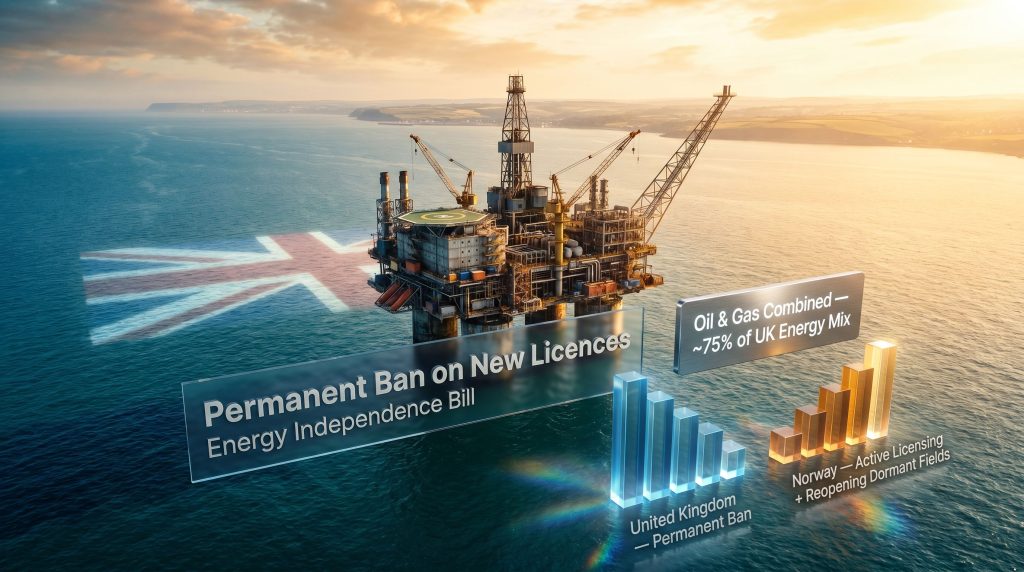
Understanding the policy's stakes requires an honest accounting of where Britain actually sources its energy. Oil and gas together account for approximately three-quarters of the UK's total energy consumption. While the electricity sector has made meaningful progress, with wind and solar now contributing roughly 29% of power generation, electricity itself represents only a portion of total final energy demand. Heating, industrial processes, aviation, and heavy freight remain deeply dependent on hydrocarbon inputs.
| Energy Source | Share of UK Energy Mix | Primary Supply Origin |
|---|---|---|
| Oil and Gas Combined | ~75% | Increasingly imported |
| Renewables | ~29% electricity share | Domestic (wind, solar) |
| North Sea Domestic Output | Declining trajectory | UK Continental Shelf |
| Imported Fossil Fuels | Growing share | Norway, Middle East, LNG |
The Import Substitution Paradox
One of the most analytically important critiques of the ban centres on what economists call the import substitution paradox. Reducing domestic extraction does not automatically reduce domestic consumption. British households and industries will continue purchasing oil and gas regardless of where it originates. If North Sea output declines without a corresponding reduction in demand, the difference is simply filled by imports. Furthermore, the broader effects on European gas prices must also be considered, as shifting UK supply dynamics ripple across interconnected markets.
Critical Insight: Opponents of the ban argue that reducing domestic extraction transfers the economic benefits of production, including jobs, tax receipts, and refining activity, to foreign exporters rather than improving the UK's environmental footprint. Proponents counter that the policy is explicitly designed to accelerate the demand-side transition, not merely manage supply-side dynamics.
The carbon accounting dimension adds further complexity. Liquefied natural gas (LNG) imported by tanker from the United States, Qatar, or Australia carries a significantly higher lifecycle carbon footprint than equivalent gas produced domestically, due to the energy-intensive liquefaction and regasification processes involved. This means the ban, if it accelerates import dependency rather than demand reduction, could paradoxically increase the UK's consumption-based emissions even as domestic extraction falls.
How Does the UK's Decision Compare to Other Producing Nations?
Norway's Contrasting Strategic Choice
The contrast with Norway is instructive and difficult to ignore given that both nations operate in the same geological basin. While Britain moves to cement a licensing prohibition into statute, Norway approved plans to reopen three gasfields that had remained dormant for decades. This was a direct policy response to the acute supply disruption caused by the closure of the Strait of Hormuz shipping lane during the Iran conflict. The Hormuz closure triggered crude oil price tensions to intensify sharply, with prices nearly doubling within a single month, creating an emergency supply calculus that Oslo and London answered in diametrically opposite ways.
| Country | Current Licensing Policy | Recent Direction |
|---|---|---|
| United Kingdom | Permanent ban on new licences (legislated) | Restrictive, accelerating |
| Norway | Active licensing plus dormant field reopening | Expansionary amid supply crisis |
| Netherlands | Phased reduction with security-driven exceptions | Mixed approach |
| Denmark | Limited new licensing activity | Cautious transition stance |
Global Significance Beyond Britain's Own Reserves
The UK's decision carries symbolic weight that exceeds its direct supply impact. Britain is among the most consequential mature-basin producers to move toward near-total cessation of new licensing. According to Oil Change International, climate advocacy organisations and policy analysts have observed that the decision functions as a potential legislative template for other mid-tier fossil fuel producers navigating the energy transition. Whether this precedent accelerates similar moves elsewhere, or triggers a competitive backlash from nations eager to capture the market share Britain vacates, remains an open question.
The Economic Stakes: Fiscal Exposure and Scotland's Industrial Base
Quantifying the Cost of Foregone Production
The fiscal dimension of the UK ban on new North Sea oil and gas licences is substantial. Without new licensing, the replacement pipeline for maturing fields disappears, progressively eroding the tax base generated by North Sea operations. This represents billions in foregone revenue over the coming decades, capital that would otherwise fund public services, infrastructure, or the energy transition itself. Critics, including Shadow Energy Secretary Claire Coutinho, have argued that the policy deepens foreign import reliance rather than strengthening the energy independence its title implies.
However, the North West Shelf extension debate in Australia demonstrates that mature-basin licensing decisions carry long-term economic consequences that extend well beyond any single electoral cycle, a parallel worth noting as Britain weighs its own fiscal trade-offs.
Scotland's Disproportionate Exposure
Scotland's economic relationship with North Sea operations is qualitatively different from the UK's national average. The offshore sector represents a concentrated cluster of high-value engineering expertise, subsea technology development, offshore logistics infrastructure, and specialist maritime services. Policy analysts have flagged that without a credible, legislated workforce transition framework, the ban risks stranding not just hydrocarbon reserves but also irreplaceable human capital developed over five decades of offshore operations.
Sector Insight: Scotland's North Sea workforce possesses specialist skills in areas including subsea intervention, pipeline engineering, and dynamic positioning that have limited direct equivalents in the renewables sector. The retraining pathway from offshore oil and gas to offshore wind exists but requires deliberate, funded facilitation to be effective at scale.
Is the Policy Fit for Purpose During a Global Supply Shock?
The Geopolitical Timing Problem
The Energy Independence Bill arrived at a moment of acute global supply disruption. The Strait of Hormuz closure following the Iran conflict removed a critical artery through which approximately 20% of global oil trade normally flows. The resulting price shock, with crude prices surging sharply within weeks, tested every importing nation's resilience and exposed the vulnerability of supply chains that depend on Middle Eastern passage.
Political pressure on the Labour government intensified rapidly. The US Ambassador to the UK used multiple public interviews to urge Britain to maximise its domestic reserve potential, a notable piece of diplomatic signalling. Both Reform UK and the Conservative Party committed explicitly to reversing the ban, citing the combination of lost tax receipts and heightened import vulnerability as their primary arguments. Consequently, the ongoing trade war oil markets turbulence has only amplified these concerns further.
- Shadow Energy Secretary Claire Coutinho characterised the policy as deepening foreign import reliance rather than achieving genuine independence
- The US Ambassador to the UK publicly urged Britain to maximise its domestic reserves across multiple high-profile interviews
- Reform UK and the Conservative Party both committed to reversing the ban on supply security grounds
- Norway, operating in the same North Sea basin, moved in the opposite direction, approving the reopening of three long-dormant gasfields during the same period
The next major ASX story will hit our subscribers first
What Business Leaders and Climate Groups Actually Think
A Counterintuitive Business Consensus
Perhaps the most surprising data point in this debate concerns business sentiment. Research by Uplift UK found that a majority of surveyed UK business leaders expressed support for ending new North Sea licensing. Notably, backing was particularly concentrated among energy-intensive industries and Scottish businesses, the very constituencies most exposed to higher energy costs and regional employment disruption. Supporters cited long-term energy cost stability and reduced exposure to volatile fossil fuel markets as the primary motivations behind their position.
This finding challenges the assumption that business opposition to the ban is monolithic. While the offshore supply chain and exploration sector clearly oppose the measure, the broader business community appears to hold a more nuanced view. As reported by the BBC, these operators are weighing short-term cost pressures against long-term structural exposure to fossil fuel price volatility, a calculation that does not yield a uniform answer.
Realistic Scenarios for UK Energy Security Through 2030
The policy's ultimate success or failure will depend heavily on execution speed and political continuity. Three distinct scenarios are worth examining:
| Scenario | Probability Driver | Key Risk Factor | Energy Security Outcome |
|---|---|---|---|
| A: Transition on Track | Renewables build-out accelerates at pace | Grid infrastructure bottlenecks | Reduced import exposure by 2030 |
| B: Transition Delayed | Policy execution gaps emerge | Workforce and capital shortfalls | Increased LNG and pipeline import reliance |
| C: Legislative Reversal | Political change after next general election | Regulatory uncertainty for investors | Short-term supply boost, long-term planning ambiguity |
Scenario B carries particular analytical weight. The UK's electricity grid infrastructure, including interconnection capacity, battery storage deployment, and transmission network upgrades, faces significant capital and planning constraints. If grid buildout lags behind generation capacity additions, the transition timeline slips, and import dependency deepens precisely during the period when new North Sea production would otherwise have been ramping up.
In addition, the global context matters considerably here. The oil price shock experienced by Canadian energy executives in 2025 illustrates how rapidly supply-side disruptions can translate into fiscal and industrial consequences for producing nations that lack policy flexibility.
Gaps the Legislation Leaves Unaddressed
The Energy Independence Bill, as described, contains several structural omissions that analysts have flagged as potentially significant:
- No firm phase-out date for existing production exists within the legislation, meaning the current production base continues under its own decline trajectory without a defined endpoint
- Workforce transition obligations are not mandated by the legislation itself, leaving the practical retraining pathway for offshore workers dependent on separate, unfunded policy commitments
- Import regulation remains entirely outside the bill's scope, meaning the legislation addresses the supply side of domestic production without any corresponding mechanism to manage demand or the carbon intensity of imported alternatives
Speculative Perspective: One underappreciated risk is that by creating permanent statutory certainty on the no-new-licences position, the legislation may also accelerate capital withdrawal from the existing production base sooner than the physical decline curve would otherwise dictate. Operators facing a definitive horizon with no future licensing upside may choose to monetise and exit existing assets earlier, compressing the production tail and accelerating the very import dependency the policy seeks to eventually eliminate.
Frequently Asked Questions: UK Ban on New North Sea Oil and Gas Licences
Does the ban affect oil and gas fields already in production?
No. The legislation targets future exploration and drilling licences only. Fields currently in production retain their existing authorisations and may continue operating for the remainder of their approved field lifetimes.
Can a future UK government reverse the ban?
Technically yes, but the statutory nature of the prohibition means reversal requires new primary legislation through Parliament, creating substantially higher political and procedural barriers than reversing an administrative policy position.
Will the ban reduce UK carbon emissions or shift them offshore?
This is contested. If import dependency increases, the lifecycle emissions associated with UK consumption may rise due to the higher carbon intensity of LNG shipping and regasification. Actual emission reductions depend on whether the ban successfully accelerates domestic demand reduction rather than simply redirecting supply sourcing.
What is the difference between the North Sea licensing ban and a full fossil fuel phase-out?
They are fundamentally different policy instruments. The licensing ban addresses future supply development only. A full phase-out would set a date by which all fossil fuel production and consumption must cease, requiring demand-side legislation, sector-by-sector decarbonisation mandates, and binding carbon budgets. No such comprehensive framework has been legislated alongside the Energy Independence Bill.
Key Takeaways
- The Energy Independence Bill converts Labour's 2024 manifesto commitment into statute, making the UK ban on new North Sea oil and gas licences legally binding rather than administratively reversible
- Existing fields are unaffected, meaning production continues on a natural decline trajectory rather than halting abruptly, but the replacement pipeline disappears entirely
- Fiscal and employment costs are real and concentrated, with Scotland's offshore industry facing structural pressure without a fully legislated workforce transition framework
- The geopolitical timing is deeply contested, with the ban arriving during acute global supply disruption tied to the Iran conflict and Strait of Hormuz closure
- The import substitution paradox means that reducing domestic production without reducing demand may increase the UK's consumption-based emissions and deepen exposure to global price volatility
- Business support is broader than expected, with survey data indicating majority backing among UK business leaders, including energy-intensive operators, on long-term cost stability grounds
- Legislative permanence cuts both ways, providing policy certainty for the energy transition while potentially accelerating capital withdrawal from the existing North Sea production base
This article is intended for informational purposes only and does not constitute financial, investment, or legal advice. Forward-looking statements and scenario projections involve inherent uncertainty and should not be relied upon as predictions of future outcomes.
Want To Track The Next Major Mineral Discovery Before The Market Does?
While the UK debates its energy future, the ASX continues to deliver significant mineral discoveries with the potential for substantial returns — and Discovery Alert's proprietary Discovery IQ model scans every ASX announcement in real time, instantly identifying high-potential opportunities across more than 30 commodities. Explore historic discoveries and their exceptional returns, then begin your 14-day free trial to position yourself ahead of the broader market.