July 18, 2026
The global energy landscape continues experiencing unprecedented fiscal pressures as governments worldwide grapple with balancing immediate revenue needs against long-term investment sustainability. Energy taxation regimes increasingly reflect complex political calculations involving climate commitments, economic competitiveness, and strategic resource management. These dynamics create particularly acute challenges for mature petroleum provinces where declining production intersects with evolving policy frameworks.
The UK North Sea windfall tax represents one of the most significant fiscal experiments in contemporary petroleum policy, testing whether emergency measures can transition into sustainable long-term frameworks without fundamentally undermining industrial viability. Current developments suggest this balance remains precarious, with substantial implications for energy security, employment, and investment allocation extending well beyond British waters. Furthermore, oil price stagnation and tariffs on global trade continue to influence market dynamics affecting these decisions.
Understanding the Energy Profits Levy Framework
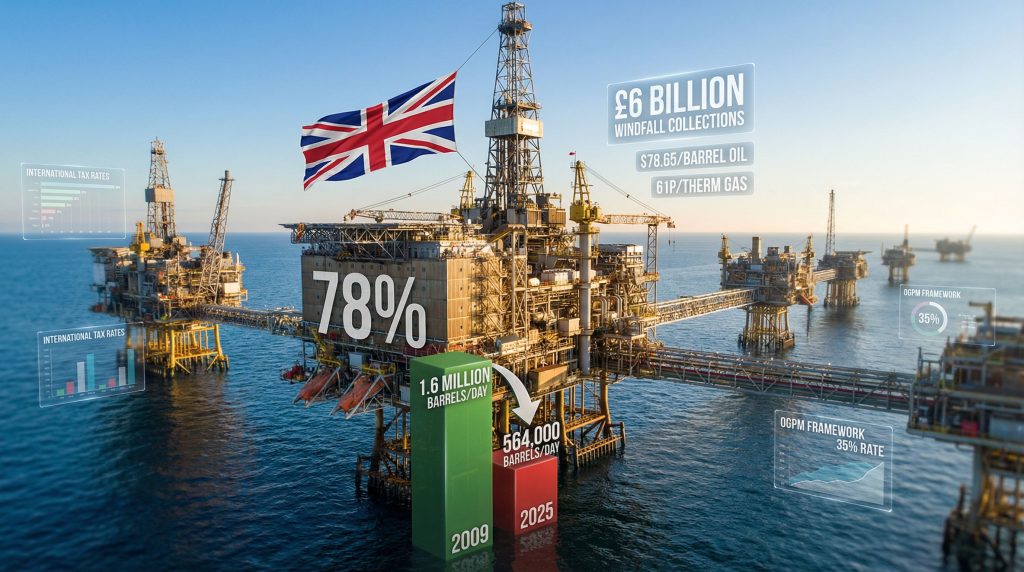
The UK North Sea windfall tax operates through a complex fiscal mechanism combining traditional corporate taxation with extraordinary profit levies designed to capture economic rents during periods of elevated commodity prices. The current 78% headline tax rate represents the cumulative impact of standard corporation tax (25%) plus the Energy Profits Levy surcharge (50%) on qualifying petroleum profits above specified thresholds.
This fiscal structure emerged from the emergency policy response following Russia's invasion of Ukraine in February 2022, when Brent crude prices exceeded $120 per barrel and European natural gas prices reached historically unprecedented levels. The Conservative government initially implemented a 25% Emergency Levy in May 2022, subsequently increased to the current 50% EPL rate through multiple extensions and adjustments.
Automatic Termination Mechanisms
The Energy Security Investment Mechanism (ESIM) establishes specific price thresholds designed to prevent the levy from undermining investment when commodity prices normalise. For the 2026-2027 financial year, these thresholds are set at $78.65 per barrel for crude oil and 61 pence per therm for natural gas, based on six-month average pricing calculations.
This automatic circuit-breaker mechanism reflects Treasury recognition that windfall taxation becomes counterproductive when applied to normal profit margins rather than extraordinary economic rents. The six-month averaging prevents premature termination during temporary price spikes while enabling genuine relief when structural price changes occur. Additionally, natural gas trends continue to influence these threshold calculations.
International Comparison Context
Comparative analysis reveals the UK's current petroleum taxation regime among the most aggressive globally:
| Country | Headline Tax Rate | Threshold Mechanism | Investment Allowances |
|---|---|---|---|
| UK (Current) | 78% | Price-based ESIM | Ring Fence Allowance |
| Norway | 78-90% | Production-based | Uplift provisions |
| Australia | Variable PRRT | Profitability-based | Capital allowances |
| Canada | 30-40% | Provincial variation | Depletion allowances |
This positioning places the UK at the upper end of international petroleum taxation while providing relatively limited investment incentive mechanisms compared to established petroleum tax jurisdictions. According to Oil Price analysis, this aggressive stance puts significant investment at risk.
When big ASX news breaks, our subscribers know first
Evolution from Emergency Response to Extended Policy
The transformation of the UK North Sea windfall tax from crisis response to extended fiscal policy reveals significant institutional and political dynamics affecting long-term energy strategy. Initial justification centred on capturing extraordinary profits during wartime commodity price disruption, but subsequent extensions reflect broader fiscal pressures and political calculations.
Timeline of Policy Development
The progression from emergency measure to extended framework demonstrates how temporary fiscal policies can acquire political momentum independent of their original justification:
- May 2022: Emergency Levy announced at 25% following Ukrainian invasion
- January 2023: Initial implementation with basic ESIM safeguards
- Autumn 2023: First extension through Conservative budget process
- Spring 2024: Rate increase to 40% amid continued high prices
- July 2024: Labour government assumption with policy continuation commitment
- Autumn 2024: Current 50% rate established through March 2030
Political Economy Considerations
Labour government policy continuation reflects the challenging intersection of climate ambitions, energy security concerns, and fiscal requirements. Treasury statements emphasise providing industry certainty while maintaining revenue generation capability, but this balance becomes increasingly difficult as production declines accelerate.
The November 2025 Autumn Budget decision to defer policy changes despite ongoing industry consultations suggests internal government disagreement regarding optimal timing and structure for any modifications. This deliberative pause indicates recognition that premature policy shifts could undermine credibility while maintaining current rates risks accelerating industrial contraction. In addition, discussions about the UK windfall tax continue at the highest levels of government.
Economic Impact Assessment and Production Decline Analysis
The economic consequences of maintaining elevated petroleum taxation rates extend beyond immediate revenue generation to encompass fundamental questions of industrial sustainability and energy security. Current production trends suggest the UK North Sea faces structural challenges that taxation policy significantly influences but cannot alone determine.
Production Decline Metrics
Official statistics demonstrate the severity of North Sea production contraction over recent decades:
| Year | Daily Production (Barrels) | Annual Decline Rate | Cumulative Change |
|---|---|---|---|
| 2009 | 1,600,000 | Baseline | 0% |
| 2015 | 1,000,000 | -8.5% | -37.5% |
| 2020 | 750,000 | -5.8% | -53.1% |
| 2025 | 564,000 | -5.6% | -64.8% |
| 2030 (Projected) | 380,000 | -8.2% | -76.3% |
This production trajectory reflects both natural field decline and reduced investment in new developments, with the windfall tax potentially accelerating decline rates through its impact on marginal project economics.
Employment Impact Analysis
Industry employment contraction demonstrates the immediate human cost of production decline acceleration. Harbour Energy's workforce reductions of over 600 positions since 2023 illustrate how operators respond to compressed profit margins through cost reduction rather than production optimisation.
Monthly job losses approaching 1,000 positions across the sector reflect both direct operator downsizing and supply chain contraction as activity levels decline. This employment impact extends beyond petroleum operations to encompass specialised engineering, logistics, and technical services concentrated in Scottish economic regions.
Investment Allocation Decisions
Capital expenditure patterns reveal how taxation uncertainty influences strategic resource allocation. Major operators increasingly prioritise international portfolio development over North Sea reinvestment, with several announcing formal strategic reviews of UK operations.
The estimated £15 billion in deferred North Sea investments represents both immediate project postponements and longer-term strategic shifts toward jurisdictions offering more competitive fiscal terms. This capital flight accelerates production decline while reducing technical innovation and skills development within the domestic petroleum sector. However, OPEC production impact decisions globally also affect investment flows.
Political Forces Shaping Policy Reconsideration
The UK North Sea windfall tax has become a significant political battleground reflecting broader tensions between environmental policy, economic pragmatism, and regional interests. Multiple political parties have adopted distinct positions that influence Treasury decision-making and industry expectations.
Multi-Party Political Positioning
Reform UK under Nigel Farage's leadership has pledged complete EPL abolition, positioning petroleum taxation as economic nationalism and competitiveness issue. This stance appeals to constituencies concerned about industrial decline and energy security vulnerability.
The Green Party advocates permanent windfall tax retention, viewing elevated petroleum taxation as climate policy tool encouraging faster energy transition. This position reflects environmental movement priorities for discouraging fossil fuel investment through fiscal mechanisms.
Scottish National Party concerns focus on employment protection and regional economic impact, recognising that North Sea decline disproportionately affects Scottish constituencies dependent on petroleum sector activity. This creates cross-party pressure for policy modification despite broader climate policy alignment.
Regional Economic Considerations
Scottish government warnings regarding energy security implications reflect broader concerns about industrial base preservation during energy transition. Aberdeen and surrounding regions face particular challenges as petroleum sector contraction affects specialised supply chains and technical expertise concentrations.
The tension between national climate policy and regional economic stability creates political pressure for graduated transition approaches rather than abrupt policy shifts. This dynamic influences Treasury deliberations regarding optimal timing and structure for any windfall tax modifications.
Parliamentary Oversight Mechanisms
House of Commons Energy Committee inquiries and written parliamentary questions demonstrate increasing legislative scrutiny of windfall tax impacts on investment, employment, and energy security. Cross-party membership creates pressure for evidence-based policy assessment rather than partisan positioning.
Select committee hearings have highlighted the complexity of balancing revenue generation, climate objectives, and economic competitiveness through taxation policy. These discussions inform broader public debate regarding optimal petroleum taxation approaches during energy transition.
Strategic Energy Security Implications
The intersection of windfall taxation policy with broader energy security considerations creates fundamental tensions in UK energy strategy. Domestic production decline acceleration occurs simultaneously with increased import dependence and geopolitical supply disruption risks.
Grid Infrastructure Optimisation Requirements
National Gas Transmission analysis emphasises the importance of optimising remaining domestic production capacity where economically and environmentally appropriate. This infrastructure perspective recognises that premature field abandonment creates stranded asset risks while reducing system flexibility.
The National Energy System Operator's warnings regarding import vulnerability reflect technical assessments of supply security under different domestic production scenarios. Reduced North Sea output increases reliance on LNG imports and pipeline supplies subject to geopolitical disruption.
Supply Diversification Challenges
Accelerated domestic production decline occurs amid broader European energy supply reorganisation following Russian supply disruption. This timing creates particular vulnerabilities as alternative supply chains remain under development and LNG market competition intensifies.
Strategic petroleum reserve considerations become more complex when domestic production provides diminished buffer capacity. Emergency response planning must account for import dependency scenarios while maintaining crisis response capability. Moreover, the broader renewable energy transformation adds complexity to energy security planning.
Analysing the 2030 Replacement Framework Options
Treasury planning for post-2030 petroleum taxation involves complex tradeoffs between predictability, competitiveness, and revenue generation. The proposed Oil and Gas Price Mechanism (OGPM) represents an attempt to maintain some windfall capture capability while providing greater investment certainty.
OGPM Structure and Thresholds
The proposed framework establishes a 35% rate on revenues above $90 per barrel oil threshold and 98 pence per therm gas trigger level, with inflation adjustments to 2030-31. These parameters attempt to capture genuine windfall profits while avoiding taxation of normal returns.
Price threshold setting requires careful calibration to ensure the mechanism activates during genuine profit windfalls rather than routine price volatility. The proposed levels reflect analysis of long-term price trends and operator cost structures in mature petroleum provinces.
International Competitiveness Assessment
Comparative analysis suggests the proposed OGPM would position UK petroleum taxation closer to international norms while retaining some windfall capture capability:
| Framework | Base Rate | Windfall Rate | Trigger Mechanism | Investment Incentives |
|---|---|---|---|---|
| Current EPL | 25% | 78% | Price thresholds | Limited allowances |
| Proposed OGPM | 25% | 60% | Higher thresholds | Enhanced allowances |
| Norway System | 22% | 78% | Production-based | Uplift provisions |
| Australia PRRT | 0% | 40% | Profit-based | Capital allowances |
This positioning would maintain UK petroleum taxation above baseline international levels while reducing the severity of windfall capture during price spikes.
Transition Risk Management
The shift from current EPL structure to OGPM framework involves significant transition risks regarding investment timing, operator expectations, and revenue predictability. Poorly managed transitions can create additional uncertainty undermining the intended policy benefits.
Industry consultation regarding OGPM parameters has emphasised the importance of clear implementation timelines and grandfathering provisions for existing investments. These technical considerations significantly influence the practical effectiveness of any replacement framework.
The next major ASX story will hit our subscribers first
Treasury Strategic Calculations and Revenue Dynamics
Chancellor Rachel Reeves faces complex strategic calculations balancing immediate fiscal requirements against long-term economic competitiveness and energy security considerations. Treasury analysis must account for dynamic interactions between taxation policy, investment decisions, and production outcomes.
Revenue Generation vs Investment Impact
Current EPL collections approaching £6 billion annually provide substantial Treasury revenue during a period of fiscal constraint. However, this immediate benefit must be weighed against potential long-term revenue losses from accelerated production decline and reduced corporate tax generation.
Economic modelling suggests that premature field abandonment creates negative feedback loops where reduced activity generates lower overall tax revenues despite higher marginal rates. This dynamic becomes particularly pronounced in mature petroleum provinces with declining production profiles.
Political Sustainability Analysis
Electoral considerations influence taxation policy sustainability across different political cycles. Labour government positioning requires balancing climate policy credibility with economic competence demonstrations, particularly regarding employment and energy security impacts.
Regional political dynamics in Scotland create additional constraints on windfall tax policy, as petroleum sector decline affects constituencies crucial to both Labour and SNP electoral prospects. This geographic concentration of economic impact amplifies political pressure for policy modification.
International Competitiveness Concerns
Treasury assessment must consider UK positioning relative to competing petroleum investment destinations. Fiscal terms comparison with Norway, Netherlands, and emerging provinces influences long-term capital allocation decisions by international operators.
The risk of accelerating UK petroleum sector decline relative to international benchmarks creates broader economic competitiveness concerns extending beyond immediate revenue generation. Skills attrition and supply chain contraction affect broader industrial capabilities relevant to energy transition.
Market Dynamics and Price Threshold Monitoring
Current oil and gas price environments significantly influence both automatic ESIM termination prospects and broader policy sustainability. Market volatility creates challenges for designing effective price-based policy mechanisms while maintaining predictable fiscal frameworks.
Price Trajectory Analysis
Brent crude prices trading in the $70-85 per barrel range approach ESIM termination thresholds, with six-month averaging mechanisms preventing immediate policy changes while maintaining termination possibility. Natural gas prices show greater volatility but generally trend below trigger levels.
Global supply-demand dynamics suggest continued price pressures from geopolitical uncertainty, OPEC+ production coordination, and energy transition demand patterns. These factors create ongoing uncertainty regarding automatic termination timing.
Volatility Impact on Policy Design
Price-based taxation mechanisms face inherent challenges from commodity market volatility that can create unintended policy consequences. Rapid price movements may trigger undesired terminations or extensions independent of underlying economic conditions.
Six-month averaging provides some volatility protection but may not prevent inappropriate policy responses to sustained price movements driven by temporary factors rather than fundamental supply-demand shifts.
Long-Term Energy Independence and Transition Coordination
The UK North Sea windfall tax debate occurs within broader questions of UK energy independence and managed transition to renewable energy systems. Policy coordination becomes crucial for optimising both near-term energy security and long-term decarbonisation objectives.
Domestic Production Sustainability
Remaining North Sea reserves face increasingly challenging economics under current taxation regimes, with many marginal fields approaching abandonment thresholds earlier than technically optimal. This acceleration creates stranded asset risks while reducing flexibility during energy transition.
Operator guidance suggests that maintaining current tax rates through 2030 would result in field abandonment decisions affecting approximately 40% of remaining technically recoverable reserves. These decisions create irreversible capacity losses that cannot be economically recovered during future supply disruptions.
Infrastructure Synergy Opportunities
Existing North Sea infrastructure provides crucial foundation for offshore wind development, carbon capture and storage projects, and hydrogen production initiatives. Premature petroleum sector contraction risks losing these synergies while increasing energy transition costs.
The technical expertise and supply chain capabilities developed through petroleum operations translate directly to renewable energy development and grid integration requirements. Skills attrition from taxation-driven industry decline affects broader energy transition capability.
Investment Decision Frameworks Under Policy Uncertainty
Industry adaptation to windfall tax uncertainty demonstrates how fiscal policy unpredictability affects capital allocation, workforce planning, and strategic positioning. These responses create feedback effects influencing broader economic outcomes beyond immediate tax revenue generation.
Capital Allocation Strategies
Major petroleum operators have adopted increasingly cautious approaches to UK North Sea investment, with capital expenditure decisions requiring higher return thresholds to compensate for taxation uncertainty. This risk premium effectively reduces the competitiveness of UK projects relative to international alternatives.
Portfolio optimisation strategies increasingly favour jurisdictions offering greater fiscal predictability, even where base taxation rates may be comparable. Uncertainty costs often exceed absolute tax level differences in operator investment decision frameworks.
Workforce Transition Planning
Industry workforce planning reflects expectations of continued sector contraction under current policy frameworks. Skills transfer initiatives to renewable energy sectors partially mitigate employment impacts but cannot fully replace specialised petroleum expertise.
The concentration of petroleum expertise in Scottish regions creates particular challenges for workforce transition, as alternative employment opportunities may require geographic relocation with associated social and economic costs.
Investment Decision Considerations:
- Risk-adjusted return requirements increase under taxation uncertainty
- Project timeline compression to reduce policy change exposure
- Technology deployment acceleration to improve cost competitiveness
- Supply chain diversification to reduce UK-specific dependencies
- Workforce development prioritisation in renewable energy capabilities
The UK North Sea windfall tax represents a critical test of whether emergency fiscal measures can successfully transition to sustainable long-term policy frameworks without undermining industrial viability. Current evidence suggests this balance remains precarious, with substantial implications extending beyond immediate revenue generation to encompass energy security, employment, and investment competitiveness.
Treasury deliberations regarding early termination reflect recognition that maintaining current taxation levels through 2030 risks accelerating industrial decline beyond levels consistent with broader energy strategy objectives. However, premature policy reversal creates different risks regarding fiscal credibility and climate policy consistency.
The optimal resolution likely involves graduated transition approaches that provide investment certainty while maintaining some windfall capture capability during genuine profit surge periods. The proposed OGPM framework represents one such approach, though successful implementation requires careful attention to threshold calibration, transition management, and industry consultation processes.
Disclaimer: This analysis contains forward-looking statements and projections based on current policy proposals and industry guidance. Actual outcomes may differ materially from projections due to policy changes, market volatility, and other factors beyond current assessment. Investment decisions should consider comprehensive risk evaluation and professional financial advice.
Looking for Energy Sector Investment Opportunities?
Discovery Alert's proprietary Discovery IQ model delivers real-time alerts on significant ASX mineral discoveries, including critical energy transition minerals, instantly empowering subscribers to identify actionable opportunities ahead of the broader market. Begin your 14-day free trial today at discoveryalert.com.au and secure your market-leading advantage in the evolving energy landscape.