
June 4, 2026
The Hidden Architecture of Fuel Prices: Why Britain Pays More When the Middle East Burns
Every time geopolitical tension erupts in the Persian Gulf, British motorists experience the consequences within days at their local forecourt. This is not coincidence. It is the predictable outcome of a pricing transmission mechanism that connects barrel prices traded in financial markets to the pence-per-litre figures displayed at roadside pumps. Understanding that mechanism, and the forces currently driving it, is essential context for anyone trying to make sense of why UK petrol prices hit their highest level since 2022 in May 2026.
The UK does not produce meaningful quantities of crude oil for domestic consumption. It imports the majority of its refined fuel, meaning wholesale costs are almost entirely determined by global benchmark prices, principally Brent crude. When Brent climbs sharply, UK fuel buyers face higher input costs within days, because the domestic fuel supply chain operates on short-term contract and spot market pricing rather than long-dated hedged positions that would smooth volatility over weeks or months.
When big ASX news breaks, our subscribers know first
From Barrel to Forecourt: How the Pricing Transmission Actually Works
The journey from a barrel of crude oil priced on international markets to the pence-per-litre figure at a UK pump involves several distinct stages, each adding cost and each responding to market conditions at different speeds.
- Crude oil is purchased at global benchmark prices, primarily Brent crude for UK-relevant supply chains.
- Refining converts crude into finished products including unleaded petrol and diesel, adding processing costs and margin.
- Wholesale rack rates are set by major oil companies and distributors, typically updating daily in response to crude and refined product spot prices.
- Fuel duty is applied as a flat rate per litre by the UK government, currently set at a level that includes a 5p reduction from the statutory baseline.
- VAT at 20% is then applied to the total of the wholesale cost plus duty, meaning consumers pay tax on tax.
- Retailer margin is added at the forecourt level, though this has historically been thin for petrol relative to diesel.
This structure means that when Brent crude moves sharply, the impact at the pump is typically visible within two to five business days. There is no significant buffer in the supply chain that delays pass-through. This is precisely why the latest escalation in the US-Iran conflict translated so rapidly into record pump prices for British drivers. Furthermore, crude oil price geopolitics play a central role in determining how quickly these increases materialise at UK forecourts.
The Numbers Behind the Surge: UK Fuel Prices in May 2026
The scale of the price increase since hostilities began is significant when viewed in raw terms.
| Fuel Type | Current Price (ppl) | Pre-Conflict Price (28 Feb) | Increase Since Conflict |
|---|---|---|---|
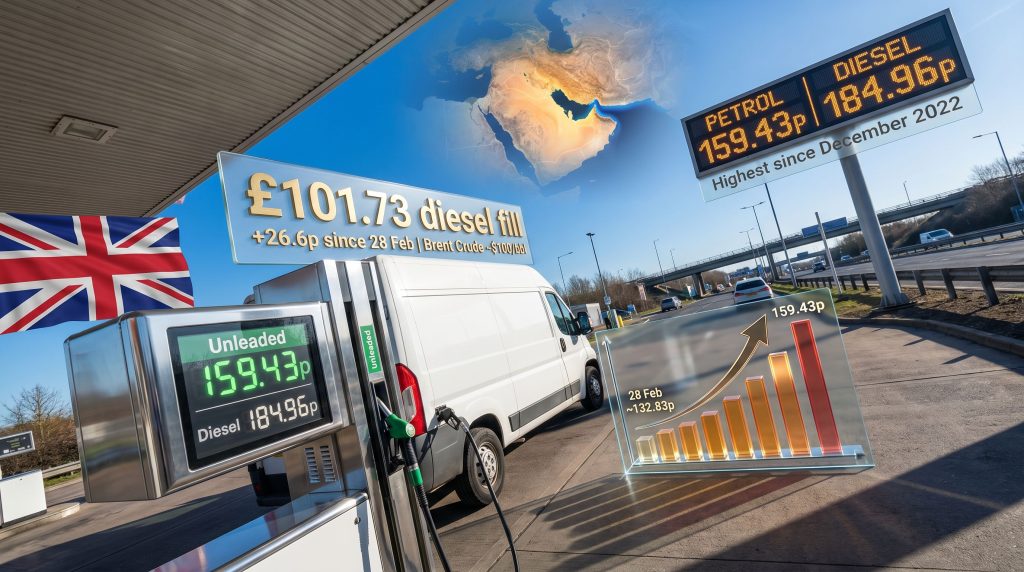
| Petrol (Unleaded) | 159.43p | ~132.83p | +26.6p |
| Diesel | 184.96p | ~161p (est.) | +~23p |
Source: RAC fuel price data, May 2026. Pre-conflict diesel estimate based on available RAC tracking data.
Several figures within this dataset deserve individual attention:
- At 159.43p per litre, petrol is now at its most expensive point since December 2022, a benchmark that represents the tail-end of the post-Ukraine energy price crisis.
- Diesel peaked at approximately 191.54p per litre in mid-April 2026, meaning the current level of 184.96p reflects around 6.58p of relief already absorbed since the peak.
- A standard 55-litre diesel fill now costs approximately £101.73, crossing the psychologically significant £100 barrier that carries outsized significance for commercial operators.
- The current petrol price remains well below the all-time UK record set in June 2022, when the convergence of post-pandemic demand recovery and the Russia-Ukraine war pushed average prices north of 190p per litre.
Context for drivers: The June 2022 record remains the benchmark for worst-case UK pump pricing. Current levels, while painful, represent approximately 30p per litre of headroom before that record is threatened. However, a full closure of the Strait of Hormuz could theoretically close that gap within weeks, according to scenario analysis from energy consultancy Rystad Energy, which has modelled oil prices potentially reaching $180 per barrel by August 2026 in a severe re-escalation scenario.
The Strait of Hormuz: Why a Single Waterway Holds British Pump Prices Hostage
The Strait of Hormuz is a navigational chokepoint approximately 33 kilometres wide at its narrowest point, connecting the Persian Gulf to the Gulf of Oman and the broader global oil market. Roughly 20% of the world's seaborne oil supply transits through this single waterway, including the majority of crude exports from Saudi Arabia, the UAE, Kuwait, Iraq, and Iran itself.
The UK has no domestic mechanism to substitute for a disruption of this scale. Unlike the United States, which has expanded its domestic shale production capacity substantially over the past decade, Britain is structurally dependent on imported refined petroleum products. Consequently, the US oil supply decline has added further complexity to the global supply picture, removing a potential buffer that might otherwise have softened the impact of Middle Eastern disruptions on UK pump prices.
A lesser-known dimension of Hormuz risk is the lag effect on regional production recovery. Kuwait has indicated that even after the waterway reopens, domestic oil output may require ten to twelve weeks to return to pre-disruption levels, as upstream infrastructure and logistics chains need time to restabilise. This means that even a ceasefire agreement does not produce an immediate normalisation of global oil supply, and by extension, UK pump prices could remain elevated for weeks after any formal cessation of hostilities.
Geopolitical Layers: Why a Ceasefire Mirage Made Markets More Volatile
One of the less intuitive aspects of the current oil market environment is that the brief period of optimism around a potential US-Iran ceasefire actually amplified subsequent price volatility rather than simply providing temporary relief.
When markets anticipate a resolution, traders adjust positions accordingly. Speculative short positions are built on the assumption that crude will fall further as tensions ease. When that optimism is then abruptly reversed, the unwinding of those positions creates a sharper upward price move than would have occurred without the initial rally. This dynamic, sometimes described in market literature as a short squeeze in the futures curve, contributed to the intraday reversal that saw crude prices surge back toward $100 per barrel. The broader oil volatility trends observed throughout 2025 established the conditions that made this kind of sharp reversal increasingly common.
Neil Wilson, investor strategist at Saxo Markets UK, noted that the rebound in oil prices reflected renewed US military activity around Iran and the Strait of Hormuz partially reversing the sharp crude oil decline seen on the preceding Monday. Wilson also highlighted that investor attention remains fixed on whether energy markets can stabilise before elevated oil prices begin feeding back into broader inflation expectations and government bond yields.
Several critical issues remain structurally unresolved and are keeping market participants cautious:
- Enriched uranium negotiations remain without a framework agreement
- Sanctions architecture continues to be undefined in terms of scope and duration
- Regional security guarantees from Gulf states have not been formalised
- Strait of Hormuz shipping normalisation has not been confirmed
The UK Government's Response: Is a Fuel Duty Extension Enough?
Chancellor Rachel Reeves confirmed an extension of the existing 5p fuel duty cut as part of a broader package of cost-of-living measures tied to economic disruption from the conflict. A senior cabinet minister also acknowledged that the economic aftershocks of the conflict are expected to persist for up to eight months after hostilities eventually cease, a timeframe that implies the government's policy response may need to extend well beyond any formal ceasefire.
| Policy Lever | Current Status | Potential Pump Price Impact |
|---|---|---|
| 5p Fuel Duty Cut (Extended) | Active | Modest, offsets roughly 3% of the current price increase |
| Windfall Tax on Fuel Retailers | Not implemented | Could reduce margin pass-through at forecourt level |
| Strategic Petroleum Reserve Release | Not announced | Could suppress wholesale costs on a temporary basis |
| VAT Reduction on Fuel | Not proposed | Would have a substantial consumer impact if enacted |
The 5p duty cut, while politically meaningful, represents a modest offset against a 26.6p per litre increase in petrol prices since the conflict began. Critics of the policy have pointed out that the tax framework itself amplifies price movements, since VAT is applied to the sum of wholesale cost and duty, meaning every crude oil price increase is effectively taxed a second time at the consumer level.
The next major ASX story will hit our subscribers first
The Van Driver Economy and Inflation Pass-Through
The crossing of the £100 per diesel fill threshold is more than a psychological milestone. It represents a meaningful operating cost increase for a segment of the UK workforce that has limited ability to absorb or hedge fuel cost volatility.
The UK operates one of Europe's largest fleets of light commercial vehicles. Sole traders, tradespeople, small delivery operators, and micro-businesses are disproportionately exposed to diesel price movements because:
- They cannot access corporate fuel hedging instruments available to larger logistics operators
- Their pricing to customers is typically fixed under contracts negotiated before the price surge
- Their margins are already compressed by broader inflationary pressures on materials and labour
- Many operate under self-employment arrangements that provide no institutional buffer against input cost spikes
Beyond the direct impact on commercial operators, sustained elevated fuel costs ripple through the broader consumer economy. The inflation and consumer prices dynamic becomes particularly acute when transport costs feed simultaneously into food distribution, logistics, and retail supply chains. Analysts monitoring UK gilt yields have noted sensitivity to energy price movements, with bond markets pricing in the possibility of a more persistent inflation cycle if fuel prices remain elevated through the summer driving season.
Three Scenarios for UK Petrol Prices: What Happens Next
The trajectory of pump prices from here depends almost entirely on geopolitical outcomes that remain genuinely uncertain. Three broad scenarios capture the range of plausible outcomes.
Scenario 1: Ceasefire and De-escalation
- Brent crude retreats toward the $80 to $85 per barrel range
- UK petrol prices could fall back toward 140p to 145p within four to six weeks
- Diesel relief would follow, though the structural price premium over petrol would persist
Scenario 2: Prolonged Stalemate
- Crude stabilises in the $95 to $105 range as tensions persist without resolution
- UK petrol prices remain elevated through the summer months
- Inflationary pressure on transport and logistics becomes embedded rather than transitory
Scenario 3: Full Hormuz Closure or Major Escalation
- Rystad Energy has modelled a scenario in which re-escalation drives crude toward $180 per barrel by August 2026
- At that level, UK petrol prices could approach or exceed the June 2022 all-time record
- Diesel could exceed 200p per litre for the first time
- At $130 per barrel, a 55-litre fill could cost approximately £11 to £13 more than at current levels
The oil price shock risks associated with Scenario 3 extend well beyond the forecourt, with potential knock-on effects for monetary policy, consumer confidence, and business investment across the UK economy.
Disclaimer: Scenario projections involving specific price levels are speculative in nature and should not be treated as financial advice or investment guidance. Energy price forecasting carries significant uncertainty, particularly during active geopolitical crises.
How UK Prices Compare Globally: A Structural Disadvantage
| Country | Approx. Petrol Price (GBP equiv., per litre) | Primary Pricing Factor |
|---|---|---|
| United Kingdom | 159.43p | High flat duty rate plus 20% VAT |
| Germany | ~155p | EU carbon pricing and national excise duty |
| France | ~148p | Historical government subsidy legacy |
| United States | ~80p | Lower tax base and domestic shale production |
| India | ~95p | Subsidised pricing framework |
Note: International comparisons are indicative estimates using approximate exchange rate conversions and may not reflect real-time conditions.
The UK's structurally higher fuel prices relative to the US reflect two durable disadvantages: a tax architecture that applies duty and VAT in sequence, and an absence of meaningful domestic crude production that could buffer supply shocks. The decline of UK refining capacity over the past decade has added a third layer of vulnerability, increasing dependence on imported refined products that are priced against global benchmarks with no domestic discount. UK diesel prices have tracked this structural weakness particularly clearly, having already hit their highest level since August 2024 before the current conflict-driven surge.
Key Indicators to Watch
For drivers, businesses, and investors trying to anticipate where UK pump prices head from here, the following market signals provide the most actionable forward visibility:
- Brent crude spot price on global futures exchanges, the primary input into UK wholesale rack rates
- RAC fuel price tracker, the most granular and timely source for UK retail petrol and diesel data
- UK gilt yields, currently at 4.86%, as a barometer of market expectations for inflation persistence and monetary policy response
- Progress on Hormuz ceasefire negotiations, particularly movement on the four unresolved structural issues identified by market analysts
- FTSE 100 energy sector performance, which historically leads broader market sentiment on supply stability
Frequently Asked Questions: UK Petrol Prices in 2026
Why are UK petrol prices so high right now?
Petrol prices have climbed to 159.43p per litre as of May 2026, their highest level since December 2022, driven by the return of crude oil prices toward $100 per barrel following renewed US military strikes connected to the ongoing conflict with Iran. The UK's dependence on imported refined fuel means global crude price movements translate almost directly into pump price changes.
How much has petrol risen since the conflict began?
Since 28 February, when the conflict began, average UK petrol prices have increased by approximately 26.6p per litre. Diesel has risen by around 23p per litre over the same period, with a 55-litre fill now costing over £100.
Will prices fall soon?
The outlook is directly tied to ceasefire negotiations between the US and Iran. A verified agreement that restores normal Strait of Hormuz shipping flows could bring prices back toward 140p to 145p within weeks. However, key issues including uranium enrichment, sanctions terms, and regional security remain unresolved as of the time of writing.
What has the government done?
Chancellor Rachel Reeves has extended the existing 5p fuel duty cut as part of a broader cost-of-living support package. However, this offset is modest relative to the scale of the price increase since the conflict began, and further policy measures have not yet been announced.
What was the UK's all-time petrol price record?
The all-time high for UK average petrol prices was recorded in June 2022, when the convergence of post-pandemic demand and the Russia-Ukraine energy shock pushed UK petrol prices hit their highest level above 190p per litre. Current levels remain below that record, though energy market analysts caution that further escalation in the Middle East could narrow that gap rapidly.
Want to Stay Ahead of the Commodity Shifts Driving Major Market Moves?
When geopolitical shocks send energy and resource prices surging, the investors best positioned are those with real-time intelligence on significant mineral discoveries before the broader market catches on. Discovery Alert's proprietary Discovery IQ model delivers instant ASX mineral discovery alerts, turning complex commodity data into actionable opportunities — explore historic discovery returns on the Discovery Alert discoveries page and begin your 14-day free trial to gain a market-leading edge.