
May 13, 2026
The Geology Beneath the Milestone: Why Ultra-Deep Shale Changes Everything
Most energy milestones are measured in barrels or cubic meters. The truly significant ones are measured in decades of failure before success. The history of unconventional gas development is littered with formations that were geologically promising but technically impenetrable, frontier plays that required not incremental improvement but wholesale reinvention of exploration and drilling methodology. Ultra-deep shale sits at this frontier, and for most of the past century, depths beyond 4,500 meters represented a practical ceiling for commercial shale gas extraction.
That ceiling has now been shattered. The approval of 235.687 billion cubic meters (Bcm) of proven geological reserves at the Sinopec Ziyang Dongfeng ultra-deep shale gas field in China's Sichuan Basin signals something more consequential than a single project milestone. It validates an entirely new category of recoverable resource that previously existed only in theoretical projections, and it establishes the technical precedent that other unexplored ultra-deep formations globally may now be assessed against.
When big ASX news breaks, our subscribers know first
What the Sinopec Ziyang Dongfeng Ultra-Deep Shale Gas Field Actually Is
Verified by China's Ministry of Natural Resources, the Sinopec Ziyang Dongfeng ultra-deep shale gas field represents the country's first ultra-deep shale play confirmed with proven reserves exceeding 100 Bcm, a threshold that carries both commercial and symbolic weight in Chinese energy policy.
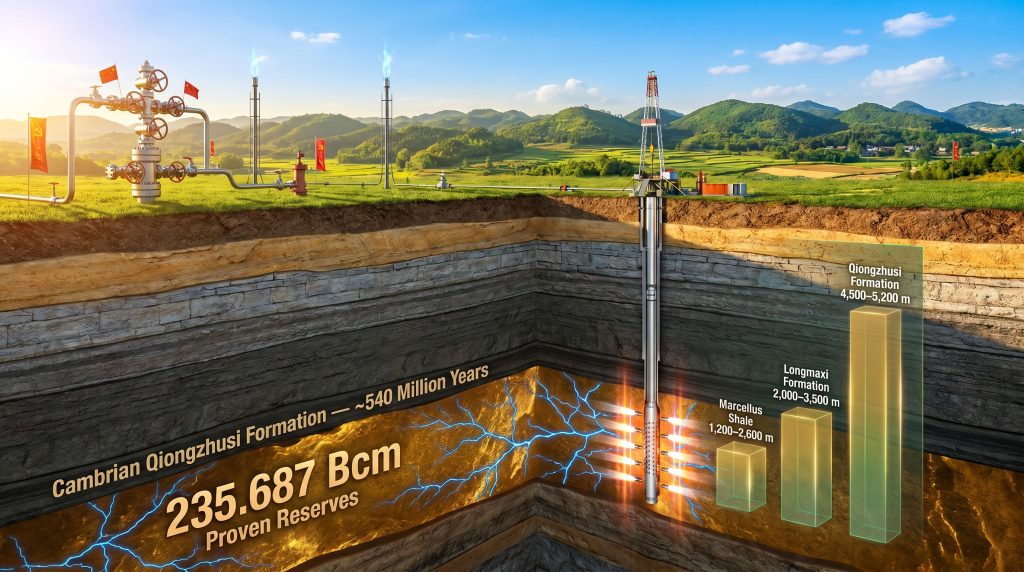
The field targets the Cambrian Qiongzhusi Formation, a geological unit approximately 540 million years old, buried beneath the Sichuan Basin at depths ranging from 4,500 meters to 5,200 meters. This age distinction is significant: the Qiongzhusi Formation is widely described as the world's oldest commercial shale layer, predating more familiar shale plays by hundreds of millions of years.
Field Snapshot: Key Metrics at a Glance
| Parameter | Detail |
|---|---|
| Proven Geological Reserves | 235.687 billion cubic meters (Bcm) |
| Reservoir Formation | Cambrian Qiongzhusi Formation |
| Formation Age | ~540 million years |
| Depth Range | 4,500 m to 5,200 m |
| Basin Location | Sichuan Basin, China |
| Reserve Approval Authority | China's Ministry of Natural Resources |
| Milestone Classification | China's first ultra-deep shale gas field exceeding 100 Bcm |
The reserve approval connects directly to Sinopec's broader "Project Deep Earth: Sichuan and Chongqing Natural Gas Base" initiative, a structured campaign to push Chinese shale gas development progressively deeper into the Earth's crust. Liu Wei, Director of Sinopec Southwest Petroleum Bureau, characterised the achievement as the culmination of over a decade of persistent effort, noting that this work has now produced a replicable technical pathway for expanding China's shale gas development frontier.
Why the Sichuan Basin's Cambrian Formation Is a Geological Frontier Unlike Any Other
The World's Oldest Commercial Shale Layer: What 540 Million Years Means for Reservoir Quality
To appreciate what makes the Qiongzhusi Formation unusual, it helps to understand how shale gas reservoirs form. Organic-rich marine sediments accumulate over millions of years, are buried under successive layers of rock, and are subjected to increasing temperature and pressure that converts organic matter into hydrocarbons. The deeper and longer this process runs, the more complete the conversion from organic material to thermogenic dry gas.
At 540 million years of age, the Cambrian Qiongzhusi Formation has undergone this maturation process across a timespan that dwarfs most commercial shale plays. The Marcellus Shale in the United States, one of the world's most productive shale formations, dates to approximately 390 million years ago. China's own Longmaxi Formation, which underpins the Fuling field, is approximately 440 million years old. The Qiongzhusi predates both by at least 100 million years.
This extreme thermal maturity implies a formation well within the dry gas window, meaning hydrocarbons have been subjected to temperatures and pressures sufficient for near-complete conversion to methane. The practical result is high-quality gas with minimal liquids content, which simplifies surface processing requirements. The theoretical result, now confirmed by reserve approval, is that ancient formations can accumulate and retain commercial gas volumes despite their age and depth.
Depth as a Double-Edged Variable: Pressure, Temperature, and Hydrocarbon Potential
At depths between 4,500 meters and 5,200 meters, reservoir conditions diverge fundamentally from those encountered at conventional shale depths. Hydrostatic pressures at these depths approximate 45 to 52 megapascals (MPa), and geothermal gradients place formation temperatures in the range of 120 to 150 degrees Celsius based on typical Sichuan Basin profiles. These conditions simultaneously create extraordinary resource potential and severe operational risk.
Ultra-deep reservoirs concentrate gas under pressures and temperatures that accelerate both hydrocarbon generation and, paradoxically, the mechanical complexity of extraction. The same thermodynamic forces that make these formations resource-rich are the forces that cause drilling equipment to fail, hydraulic fractures to propagate unpredictably, and seismic imaging to degrade.
The Sichuan Basin itself spans approximately 260,000 square kilometres and contains productive formations across a wide stratigraphic range. Its Cambrian section, however, had historically received less exploratory attention precisely because the depth and complexity of accessing it placed it beyond the operational envelope of conventional shale development programmes. The Ziyang Dongfeng approval changes that assessment fundamentally.
How the Qiongzhusi Formation Compares to Other Global Shale Plays
| Formation | Country | Depth Range | Age | Notable Scale |
|---|---|---|---|---|
| Cambrian Qiongzhusi (Ziyang Dongfeng) | China | 4,500–5,200 m | ~540 Ma | 235.687 Bcm proven |
| Marcellus Shale | USA | 1,200–2,600 m | ~390 Ma | Largest US shale play by production |
| Longmaxi Formation (Fuling) | China | 2,000–3,500 m | ~440 Ma | First Chinese commercial shale field |
| Barnett Shale | USA | 1,980–2,590 m | ~320 Ma | Pioneer US unconventional play |
The depth differential is striking. The shallowest formation in this comparison sits at roughly 1,200 meters maximum depth. The Ziyang Dongfeng field begins where most shale gas plays end. This is not an incremental advance; it is a categorical shift in what the industry considers accessible. Furthermore, Petroleum Australia's coverage of Sinopec's record highlights that this breakthrough has drawn significant international attention from operators assessing their own deep-formation inventories.
How Sinopec Unlocked a Formation That Resisted Exploration for Over a Decade
The Four Core Technical Barriers to Ultra-Deep Shale Development
The decade-long development timeline at Ziyang Dongfeng reflects the severity of the technical obstacles that had to be resolved before reserve quantification was possible. Four distinct barriers defined this challenge:
-
Reservoir ambiguity: Seismic imaging at extreme depths suffers from signal degradation caused by acoustic absorption, velocity variations, and high-pressure formation effects. Identifying gas-bearing zones with confidence at 5,000 meters requires substantially more advanced interpretation tools than those used at shallower depths.
-
Accumulation complexity: The Cambrian section has experienced multiple phases of burial, uplift, and re-burial across geological time. Gas migration pathways and trapping mechanisms in such an ancient, thermally complex system differ materially from younger, better-characterised formations.
-
Drilling mechanics: Rock hardness and formation instability at these depths accelerate bit wear at rates that make conventional polycrystalline diamond compact (PDC) bit programmes uneconomic. Wellbore integrity risks also increase substantially with both depth and temperature.
-
Extreme downhole conditions: Temperatures exceeding 120 degrees Celsius and pressures above 45 MPa push standard completion equipment beyond its rated operational envelope, requiring redesigned or purpose-built tools for ultra-deep deployments.
AI-Driven Geophysical Imaging: How Machine Learning Replaced Guesswork Underground
Sinopec's integration of artificial intelligence into geophysical interpretation workflows represents one of the most consequential technical decisions made during the field's development. AI in exploration has demonstrated its capacity to resolve ambiguities that conventional seismic interpretation techniques struggle to address, particularly at depths where signal quality degrades significantly.
Machine learning approaches applied to seismic data can detect subtle amplitude and frequency patterns associated with gas saturation that conventional interpretation methods miss. Neural networks trained on regional well log correlations can automate facies classification, identify fault geometries, and predict reservoir quality variations across the field. The result is a more reliable delineation of gas-bearing zones before the first well is drilled, reducing the exploration risk that had previously deterred deep Cambrian drilling programmes.
In addition, downhole geophysics played a critical supporting role, providing high-resolution subsurface data that complemented surface seismic surveys and enabled more precise well placement decisions across the ultra-deep target zone.
Ultra-Deep Hydraulic Fracturing: Engineering Fractures Under Extreme Confinement
Hydraulic fracturing at depths exceeding 4,500 meters is not simply a scaled-up version of shallow shale completions. The mechanics of fracture initiation, propagation, and proppant transport change substantially at ultra-deep conditions. Fracture gradients increase with depth, requiring higher pump pressures to initiate rock failure. Proppant selection must account for extreme closure stresses that can crush conventional ceramics or sand, potentially destroying fracture conductivity.
Fracture geometry at ultra-deep conditions also differs from shallow analogues. Elevated confining stresses compress fracture widths and reduce lateral extent, meaning that ultra-deep completions must compensate through higher proppant concentrations and optimised fluid systems to maintain productive fracture networks.
The performance trajectory demonstrated through Sinopec's test wells validates that these engineering challenges were progressively resolved. The Dongye Deep 1 Well, drilled to approximately 4,000 meters, produced a test rate of 310,000 cubic metres per day (m³/day). The subsequently drilled Dongye Deep 2 Well, reaching approximately 4,300 meters, achieved a test rate of 412,000 m³/day, representing a 33% improvement in demonstrated single-well peak production capacity despite operating at greater depth.
What 235 Bcm Actually Means: Translating Reserve Scale Into Real-World Impact
Reserve Volume in Context: Household Supply and National Significance
Abstract reserve volumes become meaningful only when translated into tangible units of energy supply. At a household consumption benchmark of 0.5 cubic metres per day, the single Dongye Deep 2 Well test rate of 412,000 m³/day would supply approximately 820,000 households simultaneously from one well alone.
At the national level, the significance of the Ziyang Dongfeng reserve base becomes even clearer when set against Chinese gas demand. China's annual natural gas consumption has been tracking in the range of approximately 370 billion cubic metres per year. The field's 235.687 Bcm of proven reserves therefore represents roughly 64% of China's total annual consumption, or the equivalent of approximately seven to eight months of the nation's entire gas demand met from a single field.
| Scale Metric | Value |
|---|---|
| Proven Reserves | 235.687 Bcm |
| Single Well Test Peak Rate (Dongye Deep 2) | 412,000 m³/day |
| Household Supply Equivalent (per well per day) | ~820,000 households |
| Proportion of China's Annual Gas Demand | ~64% |
| Equivalent Months of National Gas Supply | ~7–8 months |
Disclaimer: Household supply and national consumption equivalency calculations are illustrative estimates based on published benchmarks and publicly available consumption data. Actual field production profiles will differ based on development timing, infrastructure constraints, well count, and reservoir depletion dynamics. These figures should not be interpreted as production forecasts.
China's Natural Gas Supply Gap and Why Ultra-Deep Reserves Matter Now
China has been a net importer of liquefied natural gas (LNG) for many years, with import volumes rising steadily as domestic production struggled to match demand growth across residential, industrial, and power generation sectors. The development of large-scale domestic shale gas resources directly reduces this import dependence, with each additional Bcm of domestic supply potentially displacing imported LNG volumes and providing insulation against international pricing volatility.
The strategic calculus is straightforward: LNG import pricing is tied to global markets and subject to geopolitical supply risks that can disrupt supply chains with little warning. Domestic shale gas, once producing, is priced and contracted within China's own energy governance framework. Furthermore, US-China trade tensions have intensified Beijing's focus on energy self-sufficiency, making fields like Ziyang Dongfeng strategically valuable well beyond their reserve volumes alone.
Sinopec's Unconventional Gas Technology Ladder: From Fuling to the Cambrian Frontier
A Chronological Progression Through Depth and Complexity
The Ziyang Dongfeng achievement does not exist in isolation. It is the current endpoint of a deliberate, multi-decade programme of progressively deeper shale exploration and development by Sinopec, each stage building technical capability that enabled the next:
| Year | Milestone | Depth | Reserve Scale |
|---|---|---|---|
| 2012 | Fuling shale gas field commercial launch | ~2,000–3,500 m | First 10+ Bcm/yr capacity field in China |
| 2018 | Weirong shale gas field discovery | ~3,800 m | 100+ Bcm reserves |
| 2019 | Dongye Deep 1 Well fracturing breakthrough | 4,000+ m | 310,000 m³/day test rate |
| 2021 | Dongye Deep 2 Well production test | ~4,300 m | 412,000 m³/day test rate |
| 2025 | Yongchuan field reserve confirmation | Deep formation | 148.04 Bcm proven |
| 2025 | Hexingchang field reserve confirmation | Deep formation | 133.012 Bcm proven |
| 2026 | Ziyang Dongfeng official reserve approval | 4,500–5,200 m | 235.687 Bcm proven |
This progression reveals a deliberate capability-building strategy rather than opportunistic exploration. Each field provided technical learnings that fed directly into the development of the next, deeper play. The Fuling field established that Chinese shale could be commercially productive. Weirong and its contemporaries validated that deeper formations in the same basin were accessible. The Dongye Deep well series demonstrated that ultra-deep Cambrian shale could produce at commercially meaningful rates. Ziyang Dongfeng converts those demonstrations into an approved reserve base.
What a Replicable Technical Pathway Signals for Future Exploration
Liu Wei's characterisation of the Ziyang Dongfeng development as producing a replicable pathway carries significant forward-looking implications. A replicable pathway implies that the technical system developed for this field — combining AI-assisted geophysical interpretation with ultra-deep drilling and completion methodologies — can be systematically applied to other Cambrian shale targets within the Sichuan Basin. Consequently, 3D geological modelling will likely play an increasingly central role in identifying analogous deep-formation targets across other Chinese basins where similar structural conditions exist.
The Sichuan Basin contains substantial acreage where Cambrian section depth and structural conditions may mirror those at Ziyang Dongfeng. If the technical system is genuinely transferable, the addressable ultra-deep resource base in China could be substantially larger than current proved reserve inventories suggest. This remains a speculative inference, and actual exploration outcomes will depend on local geological conditions, economic thresholds, and development priorities, but the precedent is now established.
The next major ASX story will hit our subscribers first
Geopolitical and Energy Security Dimensions of China's Ultra-Deep Shale Capability
Domestic Production as a Structural Response to Import Dependency
China's unconventional gas strategy, of which Ziyang Dongfeng represents the leading edge, reflects a structural policy response to a fundamental energy security challenge. Despite being one of the world's largest natural gas consumers, China has historically relied on pipeline imports from Central Asia and Russia, combined with growing LNG procurement from global markets, to bridge the gap between domestic production and domestic demand.
Large-scale domestic shale gas development changes this supply calculus. Proved reserves of the scale confirmed at Ziyang Dongfeng, combined with earlier approvals at Yongchuan (148.04 Bcm), Hexingchang (133.012 Bcm), and Fuling (over 800 Bcm total), represent a domestic resource base that can underpin decades of incremental production growth without reliance on foreign supply.
The Competitive Dimension: Where China's Ultra-Deep Capability Now Stands Globally
No other country has yet commercialised a shale gas field at comparable depths with proven reserves exceeding 100 Bcm. The United States shale revolution, which transformed global energy markets from the mid-2000s onwards, was built predominantly on formations at depths between 1,500 metres and 3,500 metres. The technical infrastructure, regulatory frameworks, and commercial models underpinning American shale development are largely calibrated to these depth ranges.
China's demonstrated capability at 4,500 to 5,200 metres therefore represents a genuine technical frontier advancement with few direct international precedents. This positions Sinopec, and by extension China's broader state energy sector, as the current global leaders in ultra-deep shale gas exploration and production technology. Research published via open-access geological literature has begun to document the specific reservoir characterisation methodologies that underpinned this breakthrough, providing a technical foundation for peer review and international knowledge transfer.
Technical and Operational Challenges That Remain at Scale
From Exploration Success to Production Ramp-Up: The Commercialisation Gap
Reserve approval and commercial production at scale are distinct milestones separated by a substantial operational gap. Converting 235.687 Bcm of proven reserves into flowing production requires drilling a significant number of wells across the field area, each subject to the same ultra-deep technical challenges that required a decade of R&D to address. Well costs at these depths are substantially higher than at shallower shale plays, which affects the economics of field development sequencing and capital deployment timing.
It is important to note that reserve approval does not guarantee near-term production ramp-up. Development timelines, capital expenditure requirements, and infrastructure constraints will all influence the pace at which proven reserves are converted into production volumes. Investors and analysts should treat reserve volumes as long-term resource indicators rather than near-term production forecasts.
Infrastructure Constraints in the Sichuan Basin: Pipeline Capacity and Processing
The Sichuan Basin's existing pipeline and gas processing infrastructure was largely designed around the production profiles of shallower fields like Fuling. Ultra-deep shale wells producing at rates exceeding 400,000 m³/day per well generate gas streams that require integration into gathering, compression, and transmission systems potentially not yet scaled for the volumes implied by full field development. Midstream capacity development typically lags well drilling programmes, creating temporary production bottlenecks during field ramp-up phases.
Environmental and Regulatory Considerations for Ultra-Deep Fracturing Operations
Ultra-deep hydraulic fracturing operations in the Sichuan Basin occur in a seismically active region, a factor that requires careful operational monitoring and regulatory compliance. The basin's complex fault systems mean that injection operations must be managed with attention to induced seismicity risks, and regulatory frameworks governing water usage, wastewater disposal, and fracturing fluid composition apply to ultra-deep operations as they do to shallower completions.
Frequently Asked Questions: Sinopec Ziyang Dongfeng Shale Gas Field
What makes Ziyang Dongfeng different from China's other shale gas fields?
Ziyang Dongfeng targets the Cambrian Qiongzhusi Formation at depths between 4,500 metres and 5,200 metres, making it significantly deeper than China's other commercial shale plays. This depth profile required the development of entirely new exploration and completion technologies and resulted in the first Chinese ultra-deep shale field with proven reserves exceeding 100 Bcm.
What is the Cambrian Qiongzhusi Formation and why is it significant?
The Qiongzhusi Formation is a Cambrian-age marine shale unit approximately 540 million years old, situated within the Sichuan Basin. Its extreme age and deep burial have produced high levels of thermal maturity, making it a dry gas system with strong resource potential. It is described as the world's oldest commercial shale layer.
How deep is the Ziyang Dongfeng shale gas field?
The productive reservoir sits between 4,500 metres and 5,200 metres below surface, placing it substantially deeper than other major Chinese shale plays such as the Fuling field (2,000 to 3,500 metres) and the Weirong field (approximately 3,800 metres).
What role did artificial intelligence play in the field's development?
Sinopec integrated AI into geophysical imaging workflows to improve reservoir characterisation and gas detection accuracy at depths where conventional seismic interpretation techniques produce degraded resolution. Machine learning-assisted interpretation allowed more reliable identification of gas-bearing zones before drilling, reducing subsurface uncertainty.
What is the proven reserve volume at Ziyang Dongfeng?
China's Ministry of Natural Resources approved 235.687 billion cubic metres (Bcm) of proven geological reserves, qualifying the field as the nation's first ultra-deep shale gas field to exceed the 100 Bcm threshold.
How does this discovery contribute to China's energy security goals?
Large domestic shale gas reserves reduce China's dependence on imported LNG and pipeline gas, providing a domestic supply base that is insulated from international price volatility and geopolitical supply disruptions. Ziyang Dongfeng adds meaningfully to China's total proved shale gas reserve inventory alongside earlier approvals at Fuling, Weirong, Yongchuan, and Hexingchang.
Key Takeaways: The Strategic and Technical Significance of China's First Ultra-Deep Shale Giant
What This Discovery Validates About Deep-Formation Exploration Economics
The Ziyang Dongfeng reserve approval answers a question that has hung over ultra-deep shale exploration for years: whether the cost and complexity of accessing formations below 4,500 metres can be justified by the resource volumes available. With 235.687 Bcm of proven reserves now confirmed, the economic case for sustained ultra-deep development is substantially strengthened, provided that per-well production rates remain in the ranges demonstrated by the Dongye Deep test wells.
The demonstrated progression from 310,000 m³/day at Dongye Deep 1 to 412,000 m³/day at Dongye Deep 2 suggests that technical learning translated directly into production performance improvement, a pattern consistent with the experience curve dynamics observed during earlier phases of Chinese shale development at Fuling and Weirong.
The Broader Lesson for Global Unconventional Gas Operators
The Ziyang Dongfeng approval demonstrates that ultra-deep shale formations previously dismissed as technically unviable can be commercially unlocked through sustained, proprietary R&D investment, a precedent with implications for unexplored deep-formation plays across Central Asia, the Middle East, and beyond.
For global operators assessing deep-formation exploration portfolios, the Sinopec Ziyang Dongfeng ultra-deep shale gas field provides the industry's most compelling evidence to date that the 4,500-metre barrier is an engineering constraint, not a geological one. The technologies developed to unlock the Cambrian Qiongzhusi Formation will ultimately be assessed not only by the reserves they confirmed in the Sichuan Basin, but by the exploration programmes they enable everywhere else.
This article is intended for informational purposes only and does not constitute financial advice. Readers seeking further technical context on China's shale gas development trajectory and ultra-deep drilling advances may find value in upstream industry reporting from World Oil at worldoil.com.
Want to Position Yourself Ahead of the Next Major Resource Discovery?
Discovery Alert's proprietary Discovery IQ model delivers real-time alerts on significant ASX mineral discoveries, instantly transforming complex geological data into actionable investment insights — explore historic examples of exceptional discovery returns to understand the scale of opportunity, then begin your 14-day free trial to gain a market-leading edge.