June 10, 2026
Global energy security increasingly depends on discoveries that exist in some of Earth's most challenging environments. Ultra-deepwater oil exploration represents the industry's highest-stakes investment category, where individual wells can cost hundreds of millions of dollars and single discoveries can reshape entire supply chains. As conventional reserves face natural decline curves and accessible resources diminish, operators are pushing technological boundaries to access hydrocarbons in water depths that were considered impossible just decades ago.
The mathematics driving this shift are stark. With global energy demand projected to grow substantially through mid-century while existing production assets face inevitable decline, the industry confronts what analysts describe as an unprecedented supply gap requiring transformational exploration success to bridge. Furthermore, OPEC oil market influence and oil price movements continue to shape investment decisions in this high-stakes sector.
Technical Specifications of Ultra-Deepwater Operations
Ultra-deepwater oil exploration operates beyond the 1,500-meter water depth threshold, distinguishing it from conventional deepwater operations that typically function between 300 and 1,500 meters. These projects frequently involve total drilling depths exceeding 30,000 feet below sea level, creating engineering challenges that demand specialised technological solutions.
The operational environment requires floating production systems including semisubmersibles, floating production storage and offloading vessels (FPSOs), and tension-leg platforms. Each platform type offers distinct advantages for different reservoir characteristics and environmental conditions. Subsea blowout preventers must function reliably at extreme depths where traditional surface-controlled systems become impractical.
Advanced Platform Technologies Required
Remotely operated vehicles (ROVs) serve as the primary interface between surface operations and subsea equipment, performing tasks ranging from routine maintenance to emergency intervention. Smart well control systems integrate real-time data monitoring with automated pressure management, enabling operators to respond rapidly to changing reservoir conditions.
The complexity of these systems reflects the unforgiving nature of ultra-deepwater oil exploration environments. Equipment failures that might represent minor inconveniences in shallow water operations can escalate to project-threatening emergencies when occurring at extreme depths with limited intervention capabilities. However, advances in AI in drilling operations are revolutionising how companies approach these technical challenges.
When big ASX news breaks, our subscribers know first
Economic Fundamentals Driving Ultra-Deepwater Investment
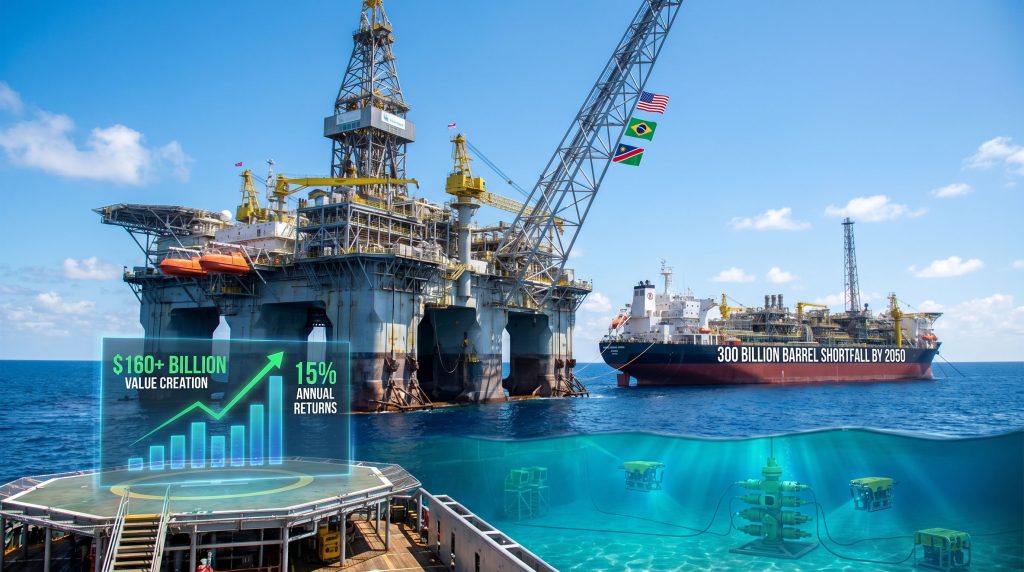
Wood Mackenzie's analysis reveals a 300-billion-barrel supply gap projected by 2050, with currently producing and sanctioned fields supplying only approximately 700 billion barrels through mid-century. This fundamental supply-demand imbalance creates powerful economic incentives for ultra-deepwater oil exploration despite the inherent risks and capital requirements involved.
Production from existing assets faces a projected 40% decline between 2025 and 2040, accelerating the urgency for discovering new reserves. In addition, US oil production decline concerns add further pressure to explore alternative sources. Exploration spending has maintained relative stability at approximately $19 billion annually between 2021 and 2025, demonstrating industry commitment to frontier exploration despite rising operational costs.
Investment Returns and Value Creation
| Investment Factor | Performance Metric |
|---|---|
| Average Annual Returns | 15% (double-digit) |
| Value Creation (2015-2025) | $160+ billion at $65/bbl Brent |
| Annual Exploration Spending | $19 billion (2021-2025 average) |
| Break-even Costs | $35-50/barrel (major discoveries) |
The economics of ultra-deepwater oil exploration depend heavily on discovery size and reservoir quality. While individual wells represent substantial capital commitments, successful discoveries can generate returns measured in billions of dollars over multi-decade production periods.
Global Regional Leadership in Ultra-Deepwater Activity
Seven major oil companies, alongside national oil companies including Petrobras, PETRONAS, and Türkiye's TPAO, currently lead ultra-deepwater oil exploration activities in water depths exceeding 1,500 meters. Recent exploration success in Guyana, Brazil, West Africa, and Southeast Asia provides the foundation for expanded drilling campaigns, with 23 high-impact wells identified for 2026.
Primary Exploration Hotspots
- Gulf of Mexico: Hosts over 3,400 deepwater wells with annual investment reaching $35 billion
- South America: Guyana's discoveries by ExxonMobil and Brazil's Petrobras-led developments
- West Africa: Breakthrough discoveries in Namibia through TotalEnergies/Shell/GALP partnerships
- Southeast Asia: PETRONAS-led regional initiatives expanding frontier exploration
Each region presents distinct geological characteristics and operational challenges. The Gulf of Mexico offers mature infrastructure and regulatory frameworks, while frontier regions like Namibia provide access to largely unexplored basins with significant discovery potential. Consequently, ultra-deepwater operations are becoming increasingly vital for meeting global energy demands.
Emerging Frontier Markets
Beyond established basins, ultra-deepwater oil exploration targets include the Eastern Mediterranean, Uruguay's continental shelf, and East African deepwater prospects. These frontier areas represent higher geological risk but offer the possibility of substantial reserve additions in regions with limited previous exploration activity.
The strategic importance of regional diversification extends beyond geological risk management. Political stability, regulatory frameworks, and infrastructure development all influence project economics and timeline predictability in ultra-deepwater oil exploration ventures.
High-Pressure, High-Temperature Operational Challenges
Ultra-deepwater oil exploration frequently encounters high-pressure, high-temperature (HPHT) reservoir conditions that multiply operational complexity and safety risks. Pressure conditions can reach 14,000 PSIG, while reservoir temperatures often exceed 190°F, creating extreme operating environments that demand specialised engineering solutions.
Blowout risks in HPHT environments are approximately six times higher than in shallow water operations, necessitating enhanced safety protocols and emergency response capabilities. The combination of extreme depth and harsh reservoir conditions creates compounding risk factors that require comprehensive mitigation strategies.
Technological Solutions for HPHT Management
- Enhanced seismic imaging enables improved reservoir characterisation before drilling commences
- Subsea systems designed specifically for heavy crude production and extreme pressure conditions
- Artificial lift technologies accommodate unconsolidated reservoirs and pressure depletion scenarios
- Advanced metallurgy and materials science applications for extreme environment equipment reliability
These technological advances represent significant capital investments in research and development, with benefits extending beyond individual projects to broader industry capability enhancement. The lessons learned from HPHT ultra-deepwater oil exploration contribute to improved operational safety and efficiency across multiple project types.
Risk-Reward Dynamics in Ultra-Deepwater Exploration
Andrew Latham from Wood Mackenzie captured the essence of ultra-deepwater oil exploration economics when he noted that the first four major wells tracked in 2026 came in dry, emphasising that while players understand the risks, successful single discoveries can generate many billions in value creation.
"The first four major wells tracked in 2026 came in dry, emphasising that while players understand the risks, successful single discoveries can generate many billions in value creation." – Andrew Latham, Wood Mackenzie
Success Rate Analysis and Portfolio Strategy
The identification of 23 high-impact wells for 2026 represents deliberate portfolio construction designed to balance risk across multiple geological settings and operator partnerships. This diversification strategy acknowledges that individual well success rates remain unpredictable despite technological advances.
Risk mitigation approaches include:
- Geographic diversification across proven and frontier basins
- Partnership structures sharing technical expertise and financial exposure
- Advanced seismic and geological analysis reducing pre-drill uncertainty
- Staged exploration programmes allowing early termination of unsuccessful prospects
The portfolio approach recognises that ultra-deepwater oil exploration success depends on overall programme performance rather than individual well outcomes, with successful discoveries typically generating sufficient returns to offset multiple dry holes. However, oil price crash risks continue to influence investment strategies across the sector.
Comparative Analysis: Ultra-Deepwater vs. Alternative Energy Investments
Ultra-deepwater oil exploration projects typically require $5-15 billion in capital commitments with 7-10 year timelines from discovery to first production. This investment profile contrasts sharply with shale development opportunities requiring $100-500 million over 6-12 month development cycles, and renewable energy projects demanding $1-5 billion over 2-5 year construction periods.
| Investment Type | Capital Requirements | Timeline to Production | Risk Profile |
|—|—|—|
| Ultra-Deepwater | $5-15 billion | 7-10 years | High risk, high reward |
| Shale Development | $100-500 million | 6-12 months | Moderate risk, quick returns |
| Renewable Energy | $1-5 billion | 2-5 years | Lower risk, regulated returns |
Strategic Value Beyond Financial Returns
The 20-30 year productive life of successful ultra-deepwater oil exploration projects provides long-term supply chain stability that shorter-cycle investments cannot match. Energy security contributions become particularly valuable for importing nations seeking to reduce dependence on politically unstable supply sources.
Technology advancement spillovers from ultra-deepwater oil exploration contribute to broader offshore engineering capabilities, including renewable energy development, subsea mining, and deepwater infrastructure projects. These secondary benefits justify continued investment even when direct project returns face competitive pressure.
The next major ASX story will hit our subscribers first
Environmental and Regulatory Framework Evolution
Post-Deepwater Horizon safety enhancements fundamentally transformed ultra-deepwater oil exploration regulatory requirements and operational protocols. Enhanced blowout prevention systems, improved emergency response capabilities, and rigorous pre-drilling safety assessments now define industry standards for ultra-deepwater operations.
Approximately 79% of Gulf of Mexico leases issued since 2016 target deep and ultra-deepwater zones, reflecting both regulatory confidence in improved safety protocols and industry focus on high-impact exploration targets in proven basins.
Environmental Impact Management Considerations
- Spill containment complexity increases exponentially with water depth and distance from shore
- Carbon footprint considerations influence project economics and regulatory approval processes
- Marine ecosystem protection measures require extensive environmental impact assessments
- Emergency response infrastructure must accommodate extreme depth intervention requirements
The regulatory framework continues evolving as ultra-deepwater oil exploration pushes into previously inaccessible areas. International cooperation on safety standards and environmental protection becomes increasingly important as frontier exploration expands into transboundary marine areas.
Industry Leadership and Partnership Structures
ExxonMobil's Guyana success story demonstrates how ultra-deepwater oil exploration can transform both company portfolios and national economies. Shell and TotalEnergies' Namibian partnerships illustrate the collaborative approach required for frontier basin exploration where technical expertise and financial risk sharing become essential success factors.
National Oil Company Participation
- Petrobras: Brazil's deepwater expertise leadership and technology development initiatives
- PETRONAS: Southeast Asian regional coordination and technical advancement
- Qatar Energy: International partnership strategies expanding global footprint
Chevron's Gulf of Mexico operational excellence provides the benchmark for ultra-deepwater oil exploration efficiency and safety performance. These major operator experiences create industry-wide knowledge sharing that improves overall sector performance and risk management capabilities.
Partnership structures typically combine international oil company technical expertise with national oil company regional knowledge and government relationship management. This collaborative approach distributes both financial exposure and technical risk while ensuring local capability development.
Future Technology and Investment Outlook
Autonomous drilling systems and artificial intelligence-powered decision making represent the next frontier in ultra-deepwater oil exploration technology advancement. Enhanced subsea processing capabilities will reduce dependence on surface facilities while improving environmental monitoring and emergency response systems.
Market Projection and Investment Trends
Projected exploration spending through 2030 reflects continued industry commitment to ultra-deepwater oil exploration despite energy transition pressures. New basin opening potential in frontier markets offers discovery opportunities that could significantly impact global supply balances.
Integration with energy transition strategies increasingly influences ultra-deepwater oil exploration project design and carbon management approaches. Operators must balance traditional project economics with evolving environmental, social, and governance (ESG) requirements that affect access to capital and regulatory approval processes.
The future of ultra-deepwater oil exploration depends on successful technology advancement, continued discovery success in frontier basins, and effective integration with broader energy transition objectives. While individual project risks remain substantial, the fundamental supply-demand dynamics driving industry investment appear likely to persist through the next decade.
Investment decisions involving ultra-deepwater oil exploration carry substantial risks including geological uncertainty, technological challenges, regulatory changes, and market volatility. This analysis is for informational purposes only and should not be considered investment advice.
Looking for the Next Big Energy Discovery?
Ultra-deepwater oil exploration's potential for billion-dollar discoveries mirrors the transformational impact of major mineral finds on the ASX, where investors who identify significant discoveries early can achieve exceptional returns. Discovery Alert's dedicated discoveries page showcases how major mineral discoveries have historically generated substantial market returns, whilst the service's proprietary Discovery IQ model provides real-time alerts on significant ASX mineral discoveries, ensuring subscribers stay ahead of the market with actionable investment opportunities.