June 16, 2026
The Equipment Procurement Logic Reshaping Underground Gold Mining in Western Australia
When a single underground mining contract generates enough equipment demand to fill a purpose-built fleet of 23 machines worth tens of millions of dollars, it tells a story that extends well beyond the transaction itself. It speaks to the maturation of a mining project, the capital commitments being made by contractors ahead of first production, and the competitive dynamics that now define how original equipment manufacturers win large-scale underground work. The Barminco Bellevue Gold deal with Sandvik sits at the intersection of all three forces, and understanding it requires looking at the structural conditions that made it possible.
When big ASX news breaks, our subscribers know first
Why Fleet Procurement Decisions Are Made Earlier Than Ever
There is a lesser-known operational reality in underground hard rock mining that rarely surfaces in public commentary: the global supply chain for specialised underground equipment operates on long lead times, and in periods of elevated mining activity, those lead times can stretch significantly. This dynamic has fundamentally changed when procurement decisions get made.
Historically, underground contractors would finalise equipment orders weeks or months after a contract was awarded. Today, the window between contract award and required mobilisation is too narrow to absorb manufacturing and delivery delays. This has pushed procurement decisions to the contract award stage itself, creating a situation where equipment suppliers are effectively competing alongside the contractor during the tender process.
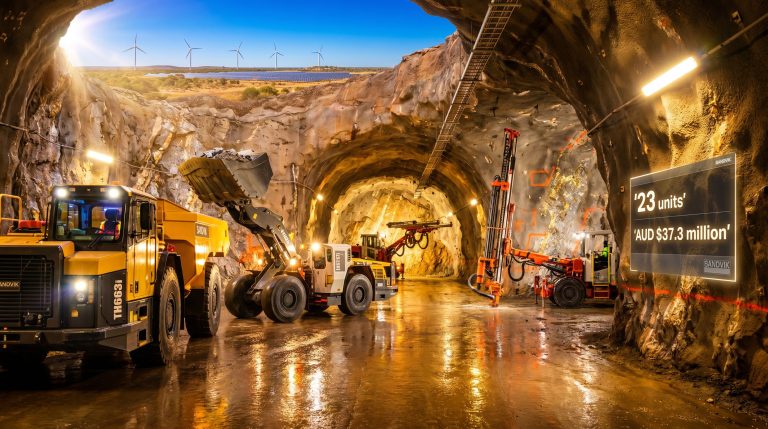
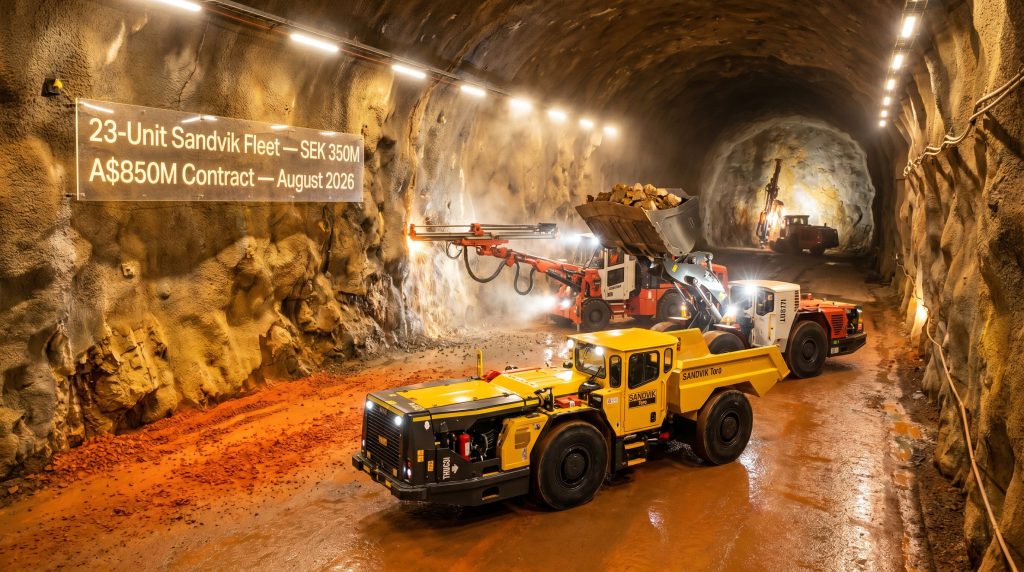
For the Barminco Bellevue Gold deal with Sandvik, this dynamic is clearly visible. The contract was structured around an August 2026 commencement date, and the fleet order was confirmed in a way that reflects deliberate forward planning. Securing a 23-unit fleet from a single OEM requires coordination across multiple machine classes, spare parts kits, and services agreements, none of which can be assembled quickly in a supply-constrained market.
Industry Insight: In periods of strong mining activity, lead times for large underground trucks and production drill rigs can extend to 12 months or more. Contractors that lock in equipment commitments at contract award stage gain a significant operational advantage over competitors that wait.
A Technical Look at the 23-Unit Fleet and What Each Machine Class Delivers
The composition of the fleet selected for the Bellevue Gold underground operation reflects a deliberate systems-level approach to underground production, rather than individual machine selection. Each equipment class serves a distinct function in the underground mining cycle, and their combined deployment creates an integrated operation capable of advancing development and producing ore simultaneously.
| Equipment Type | Model | Units | Primary Function |
|---|---|---|---|
| Underground Trucks | Toro TH663i | 7 | Ore and waste haulage in decline operations |
| Underground Loaders (LHDs) | Toro LH517i | 6 | Stope mucking and material handling |
| Longhole Drills | Sandvik DL432i | 5 | Production drilling in stoping blocks |
| Development Drills | DD422i | 5 | Face advance in declines and levels |
| Total Fleet | 23 Units |
The agreement also covers rock tools, parts kits, and ongoing services support across the contract term.
Development Drilling: The Critical Path Machine
In underground hard rock mining, development speed is the critical path variable. Until sufficient lateral development has been completed, including decline advance, level drives, and cross-cuts, production stoping cannot begin at scale. The DD422i development drill selected for Bellevue Gold is a twin-boom jumbo designed specifically for rapid face advance in confined underground headings.
The importance of this machine class is often underappreciated by those outside the industry. Development metres drilled per shift directly determines how quickly new mining areas become accessible, which in turn governs when production drilling and stoping can begin. Early in a contract, development drill utilisation is arguably the single most important operational metric.
Longhole Drilling: Where Automation Changes the Productivity Equation
The Sandvik DL432i longhole drill represents a more technically sophisticated element of the fleet. Longhole production drilling involves drilling rings of blast holes into ore blocks from dedicated drill drives, with each hole potentially extending 20 to 50 metres or more depending on the stope geometry. Accuracy at depth is critical because deviations in hole trajectory reduce fragmentation quality, complicate charging, and can result in poor blast outcomes that damage surrounding rock.
The DL432i incorporates automated rod handling and hole navigation features that improve accuracy while reducing the physical demands on operators. Critically, automated longhole drills can maintain consistent performance across extended shifts without the fatigue-related accuracy degradation that affects manual drilling. For mine operators targeting consistent stope throughput, this translates directly into more predictable ore flow.
Load and Haul: Balancing the Underground Material Movement System
The selection of 6 Toro LH517i loaders paired with 7 Toro TH663i trucks reflects deliberate load-and-haul system design. In underground operations, mismatches between loader bucket capacity and truck payload create idle time at both ends of the cycle. The LH517i is a mid-to-large loader capable of filling a TH663i truck in a small number of bucket passes, which minimises exchange time at the drawpoint and maximises truck utilisation.
Using matched equipment from the same OEM also simplifies maintenance scheduling. Both machine families share service intervals, tooling requirements, and in some cases, common components, reducing the parts inventory burden on underground maintenance teams operating in remote or constrained workshop environments.
The Financial Scale of the Barminco Bellevue Gold and Sandvik Arrangement
The equipment order placed by Barminco with Sandvik carries a value of approximately SEK 350 million, equivalent to roughly US$37 million. This figure encompasses the 23-unit capital equipment package along with associated rock tools, spare parts, and services support provisions across the fleet life. According to Sandvik's official announcement, the order represents one of the more significant single-contract fleet commitments in the Australian underground sector in recent years.
The underlying contract that justifies this fleet spend is substantial. Barminco's underground mining services agreement at Bellevue Gold is valued at approximately A$850 million over four years, with an optional one-year extension. At that contract scale, the equipment investment represents a calculated capital deployment designed to generate the operational throughput needed to meet production targets and achieve contract margin.
Scale Context: An A$850 million, four-year underground contract in the Western Australian gold sector places Bellevue Gold firmly within the upper tier of active underground development projects in the country. The contract value reflects the depth and scale of the ore system being mined, not merely the duration of the engagement.
Sandvik's Expanding Footprint Across Underground Fleet Markets
The Barminco Bellevue Gold deal with Sandvik represents one element of a broader pattern of large fleet awards being secured by the Swedish OEM across multiple geographies. Furthermore, understanding this context helps explain why single-OEM fleet solutions are increasingly being chosen over mixed-supplier approaches. This trend also mirrors the broader Sandvik equipment deal momentum playing out across Southeast Asia, where similar fleet consolidation strategies are gaining traction.
| Project or Client | Equipment Supplied | Approximate Scale | Location |
|---|---|---|---|
| Bellevue Gold / Barminco | 23-unit mixed fleet | SEK ~350 million | WA, Australia |
| Byrnecut | 5 AutoMine systems | Multiple sites | Australia and Namibia |
| Zimplats | 28 pieces of underground equipment | Q3 CY25 to Q2 CY26 deliveries | Zimbabwe |
The Zimplats contract is particularly instructive. That order covers 12 Toro LH209L loaders, six DD211L development jumbos, five DS211L-V bolters, three Toro TH545i trucks, and two TH430L trucks across the Ngezi mines in Zimbabwe's Hartley Geological Complex. The structure of that deal mirrors the Bellevue arrangement in one important respect: it packages capital equipment with parts and services kits designed to support long-term performance, rather than a simple transactional equipment sale.
This services integration is a critical commercial evolution in underground equipment supply. When OEMs bundle long-term parts and maintenance support into fleet agreements, they transform a capital equipment sale into an ongoing service relationship. For mine operators and contractors, this reduces maintenance risk and provides cost certainty. For OEMs, it creates recurring revenue streams with high retention characteristics.
The Bellevue Gold Project: Understanding the Underground Orebody Context
The Bellevue Gold Project occupies a historically significant position within Western Australia's Goldfields region. The project area hosts a high-grade underground orebody that underwent decades of historical mining before being redeveloped under modern exploration and resource definition programs. In addition, the project's revival is part of the wider wave of underground gold expansion activity reshaping the Australian Goldfields landscape.
What makes Bellevue technically notable from a mining method perspective is the combination of high gold grades and complex orebody geometry that characterises many of the mineralised structures. High-grade underground gold orebodies of this type typically require selective mining methods that prioritise grade control over brute-force bulk extraction. This is partly why the drill fleet selection places emphasis on both development speed and production drilling accuracy, because in high-grade selective operations, the cost of diluting ore with low-grade waste rock is measured directly in recovered gold ounces.
| Project Parameter | Detail |
|---|---|
| Location | Goldfields Region, Western Australia |
| Mining Method | Underground hard rock |
| Contract Value | A$850 million over four years plus one-year option |
| Operations Commencement | August 2026 |
| Fleet Units | 23 |
| Equipment Supplier | Sandvik (Toro and Sandvik brands) |
| Fleet Order Value | Approximately SEK 350 million (US$37 million) |
The next major ASX story will hit our subscribers first
Contractor-Led Fleet Procurement: A Structural Shift in How Underground Mines Get Built
One of the more strategically significant aspects of the Barminco Bellevue Gold and Sandvik arrangement is what it reveals about the evolving relationship between mine owners, contractors, and equipment suppliers. Traditionally, owner-operators procured and owned their own underground fleets, with contractors providing labour and supervision. The contractor-owned fleet model inverts this structure.
Under a contractor-owned fleet arrangement, the mining contractor assumes the capital cost and depreciation risk of the equipment, in exchange for a contract structure that allows recovery of those costs across the contract term. For mine owners, particularly those in the mid-tier gold sector where capital discipline is important, this model reduces upfront infrastructure spending and transfers equipment obsolescence risk to the contractor.
For Perenti, Barminco's parent company listed on the ASX under the ticker PRN, deploying a purpose-built A$37 million fleet into a four-year contract generating A$850 million in revenue represents a capital efficiency outcome that compares favourably with many alternative capital deployment options available to the group. This contractor-led model is, furthermore, becoming a defining feature of mining industry consolidation as larger groups absorb more of the capital risk on behalf of mine owners.
Investor Note: This article contains forward-looking references to contract revenues and fleet deployment timelines. Actual outcomes may differ from current expectations based on operational, geotechnical, and market factors. This content is informational in nature and does not constitute financial advice.
What Drives Single-OEM Fleet Selection at This Scale
Fleet standardisation decisions at the scale of the Barminco Bellevue Gold Sandvik deal are rarely made on the basis of individual machine performance alone. The operational logic behind concentrating a 23-unit fleet with a single supplier involves several compounding advantages. Drilling programs at similar projects have demonstrated that equipment homogeneity consistently reduces mobilisation risk in the critical early phases of underground operations.
-
Parts inventory consolidation: A standardised fleet reduces the number of distinct part numbers held in underground stores, freeing capital and reducing the risk of production stoppages caused by parts unavailability for an obscure component of a minor supplier's machine.
-
Operator training efficiency: Training underground operators and technicians on a single equipment family significantly reduces the total training investment and improves competency depth per person.
-
Service agreement integration: A single OEM can offer a unified services agreement that covers scheduled maintenance, emergency response, and component exchange across the full fleet, simplifying contract administration and accountability.
-
Technology ecosystem cohesion: As automation and remote monitoring capabilities become more important in underground operations, fleet homogeneity enables more effective deployment of connected technology platforms, including equipment telemetry, predictive maintenance systems, and eventually autonomous functions.
Consequently, the Barminco Bellevue Gold deal with Sandvik exemplifies how large-scale underground fleet procurement has matured from a transactional purchasing exercise into a strategic partnership decision that shapes operational performance for the full duration of a multiyear mining contract. As reported by Mining Magazine, this arrangement is being closely watched across the sector as a benchmark for how future large-fleet underground contracts may be structured.
Ready to Identify the Next Major ASX Mining Discovery Before the Market Does?
Discovery Alert's proprietary Discovery IQ model delivers real-time alerts on significant ASX mineral discoveries — instantly converting complex mining data into actionable investment insights for both short-term traders and long-term investors. Explore Discovery Alert's discoveries page to see how historic finds have generated substantial returns, and begin your 14-day free trial today to position yourself ahead of the broader market.