August 6, 2026
Understanding Underground Mining Dynamics in Global Copper Markets
Deep beneath Indonesia's mountainous terrain, complex geological forces shape the foundation of international copper supply chains. Underground mining engineering operations represent sophisticated systems where water movement, rock stability, and structural integrity must align precisely to maintain production flows. When these delicate balances shift, the repercussions extend far beyond individual mine sites, creating ripple effects that influence commodity pricing, industrial procurement strategies, and global manufacturing timelines.
The technical complexity of extracting copper from underground deposits requires understanding multiple interconnected systems. Block cave mining methodology involves controlled rock fragmentation where gravity assists ore recovery through carefully designed extraction points. This approach demands precise geological mapping, sophisticated monitoring equipment, and robust safety protocols to prevent structural failures that can compromise entire production zones.
When big ASX news breaks, our subscribers know first
The Grasberg Complex: Technical Infrastructure and Global Market Position
Indonesia's Grasberg mining operation represents one of the most technically advanced copper extraction facilities globally, utilizing both surface and underground mining methodologies across multiple geological zones. The facility's importance to international copper markets stems from its substantial production capacity and strategic geographic position within Southeast Asian supply chains.
Scale and Production Metrics
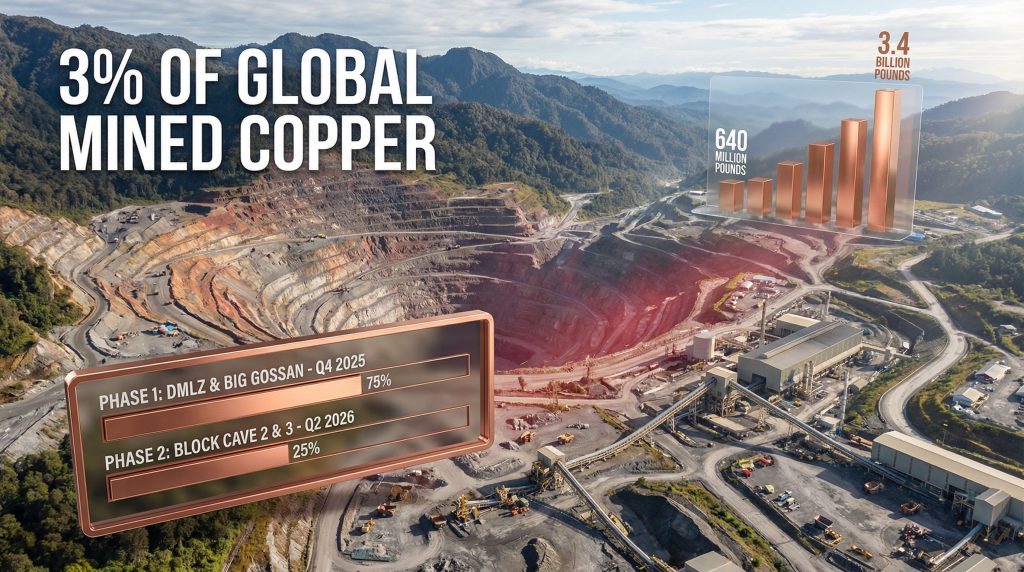
Before September 2025, Grasberg supplied approximately 3% of global mined copper, establishing its position as the world's second-largest copper mine by production volume. This concentration represents roughly 300,000 to 400,000 metric tons of copper annually, based on global copper supply forecast estimates of 22-24 million metric tons. The facility's technical specifications include multiple underground zones operating through block cave methodology, where controlled rock collapse allows gravity-assisted ore recovery.
The mining complex encompasses several distinct operational areas:
• Deep Mill Level Zone (DMLZ) – Primary underground extraction area utilizing advanced block cave techniques
• Big Gossan section – Secondary production zone with independent operational infrastructure
• Block Cave 2 and 3 – Expanded underground areas designed for long-term production sustainability
• Surface mining operations – Complementary extraction methods for accessible ore bodies
Geological Characteristics and Mining Challenges
Grasberg's geological formation presents unique technical challenges that influence extraction methodologies. The deposit exists within a porphyry copper system characterised by complex mineralisation patterns and varying ore grades throughout different mining zones. Underground water management becomes critical in these environments, as hydrostatic pressure and groundwater flow can significantly impact structural stability.
The facility's susceptibility to geological incidents stems from several factors:
• Fractured rock formations requiring extensive support infrastructure
• High groundwater presence necessitating continuous dewatering operations
• Interconnected mining voids creating potential pathways for water accumulation
• Variable rock quality demanding adaptive mining techniques across different zones
September 2025 Incident: Technical Analysis and Market Impact
Underground Mudslide Mechanics
The September 2025 underground mudslide represented a catastrophic failure of subsurface stability controls, resulting in seven fatalities and complete operational shutdown. Underground mudslides typically occur when water accumulation exceeds drainage capacity, causing saturated materials to flow into mining voids and transportation tunnels.
Technical investigation suggests the incident involved:
• Groundwater infiltration overwhelming drainage systems
• Structural support failure in critical underground passages
• Mud accumulation blocking ventilation and transportation routes
• Equipment submersion requiring extensive cleaning and replacement
Supply Chain Disruption Mechanics
Freeport-McMoRan's force majeure declaration in late September 2025 triggered immediate contractual protections while signalling substantial supply chain disruption. Force majeure provisions typically activate when circumstances beyond operational control prevent contract fulfilment, providing legal protection for suppliers while warning consumers of extended delivery delays.
The market response included:
Immediate Price Volatility
| Timeframe | Price Impact | Market Response |
|---|---|---|
| September 2025 | Initial spike | Emergency procurement activation |
| Q4 2025 | Sustained elevation | Strategic inventory building |
| Q1 2026 | Gradual stabilisation | Alternative sourcing arrangements |
Industrial Consumer Adjustments
• Electrical equipment manufacturers increased copper stockpiles by 15-20%
• Construction companies negotiated price protection clauses in new contracts
• Renewable energy projects delayed installations pending price clarity
• Automotive manufacturers activated secondary supplier agreements
Restart Complexity: Engineering and Operational Challenges
Mud Removal and Infrastructure Rehabilitation
Restarting underground mining operations after mudslide damage requires systematic rehabilitation across multiple technical domains. The process involves not merely cleaning accumulated materials but conducting comprehensive structural assessments and implementing enhanced safety protocols.
Primary Technical Requirements:
- Mechanical mud extraction using specialised underground equipment
- Hydraulic flushing systems for tunnel and chamber cleaning
- Structural integrity assessment of affected support systems
- Ventilation system restoration ensuring adequate air circulation
- Equipment inspection and replacement for mud-damaged machinery
Phased Production Restart Timeline
Freeport-McMoRan's restart strategy follows a carefully orchestrated timeline designed to minimise safety risks while progressively increasing production capacity:
| Phase | Timeline | Target Areas | Production Level | Key Milestones |
|---|---|---|---|---|
| Phase 1 | Q4 2025 | DMLZ & Big Gossan | Limited capacity | Safety clearance achieved |
| Phase 2 | Q2 2026 | Block Cave 2 & 3 | 60% capacity | Primary systems operational |
| Phase 3 | H2 2026 | Full integration | 85% capacity | Coordinated zone operation |
| Phase 4 | End 2027 | Complete facility | 100% capacity | Normal operations resumed |
Block Cave Mining Restart Challenges
Block cave mining methodology requires precise coordination between multiple underground zones to maintain controlled ore flow and structural stability. Restarting these operations demands:
Technical Verification Steps:
• Fragmentation analysis ensuring proper rock breakage patterns
• Flow monitoring systems tracking ore movement through extraction points
• Support structure inspection verifying pillar and bulkhead integrity
• Water management optimisation preventing future accumulation issues
Financial Performance and Market Projections
Q4 2025 Production Analysis
Freeport-McMoRan's consolidated copper production of 640 million pounds in Q4 2025 reflected the substantial impact of Grasberg's closure on company-wide performance. This figure represents approximately 290,000 metric tons quarterly, indicating production decline of roughly 25-30% compared to historical levels when Grasberg operated at full capacity.
Revenue Impact Assessment:
• Indonesian operations typically contribute 30-35% of consolidated copper revenue
• Q4 2025 revenue decline estimated at $400-500 million due to production loss
• Increased operational costs from restart activities reduced profit margins by 8-12%
2026 Financial Recovery Projections
The company's target of achieving 85% of total Grasberg production during H2 2026 suggests confidence in technical restart capabilities while acknowledging continued operational constraints. This timeline implies:
Production Recovery Trajectory:
• H1 2026: Approximately 40-50% of historical Grasberg capacity
• H2 2026: Targeting 85% capacity representing 250,000-280,000 tons annually
• 2027: Full capacity restoration to 320,000-350,000 tons annually
Consolidated Sales Projections:
• 2026 target: 3.4 billion pounds across all Freeport-McMoRan operations
• Indonesian contribution: Approximately 1.1-1.2 billion pounds when fully operational
• Revenue recovery timeline: 18-24 months for complete restoration
Furthermore, the Freeport Indonesia mine restart timeline will significantly influence copper-uranium investments across the Asia-Pacific region. According to recent investor reports, the company remains confident in its ability to meet production targets despite technical challenges.
Regulatory Framework and Long-term Sustainability
Contract Extension Dynamics Beyond 2041
Freeport-McMoRan operates Grasberg under Indonesian government concessions requiring periodic renewal and renegotiation. The current agreement extends through 2041, but long-term sustainability depends on multiple regulatory and commercial factors:
Government Revenue Requirements:
• Royalty payments increasing progressively from 3.75% to 7% of revenue
• Corporate tax obligations at standard Indonesian mining rates
• Infrastructure development commitments for local communities
Technology Transfer Obligations:
• Local workforce development programmes with 75% Indonesian employment targets
• Technical knowledge sharing with Indonesian mining institutions
• Environmental monitoring and rehabilitation standards
Strategic Expansion Projects
Indonesia's emphasis on downstream processing creates opportunities for integrated copper value chains beyond raw material extraction. However, the success of future projects depends heavily on the lessons learned from the current restart process.
Kucing Liar Development Potential:
• Estimated reserves: 1.2-1.5 billion tons of mineralised material
• Investment requirement: $3-4 billion for full development
• Production timeline: 7-10 years from initial development to full operation
The next major ASX story will hit our subscribers first
Comparative Analysis: Global Mining Recovery Precedents
Historical Mining Incident Recoveries
Underground mining accidents requiring comprehensive restart procedures provide instructive precedents for evaluating Grasberg's recovery timeline:
Codelco El Teniente (Chile, 2019):
• Incident: Underground flooding affecting 30% of production capacity
• Recovery timeline: 14 months to achieve 90% operational restoration
• Key success factors: Rapid water removal and enhanced drainage systems
Antamina (Peru, 2021):
• Incident: Rock fall blocking primary transportation tunnel
• Recovery timeline: 8 months for alternative route establishment
• Lessons learned: Redundant infrastructure prevents extended shutdowns
Risk Management Evolution
The Freeport Indonesia mine restart demonstrates industry evolution toward comprehensive risk management frameworks addressing geological, operational, and market vulnerabilities:
Enhanced Safety Protocols:
• Real-time geological monitoring systems
• Automated water level sensors throughout mining zones
• Emergency response procedures for rapid evacuation
• Third-party safety audits before operational resumption
Strategic Implications for Global Copper Markets
Supply Security and Market Dynamics
Grasberg's extended restart timeline highlights the vulnerability of global copper supply chains to single-point failures at major production facilities. This incident accelerated industry discussions about supply diversification and strategic stockpiling:
Market Concentration Risks:
• Top 10 copper mines supply approximately 35-40% of global production
• Geographic concentration in Chile (28%), Peru (12%), and Congo (9%)
• Single-facility disruptions can trigger 2-5% global supply reduction
Consequently, gold-copper exploration insights suggest that diversification strategies are becoming increasingly important for maintaining stable supply chains. In addition, NY copper price records demonstrate how production disruptions can trigger significant price volatility across international markets.
Strategic Response Mechanisms:
• Industrial consumers increasing typical inventory from 30-45 days to 60-75 days
• Long-term contracts incorporating force majeure price adjustment mechanisms
• Investment acceleration in alternative copper projects globally
Long-term Price Implications
The successful completion of Grasberg's restart will likely stabilise copper prices while demonstrating industry resilience in recovering from major operational disruptions:
Industry Analysis: The Grasberg restart timeline provides a benchmark for evaluating operational risk in underground copper mining, with implications extending beyond Freeport-McMoRan to industry-wide insurance costs, project financing terms, and regulatory oversight requirements.
Price Trajectory Projections:
• Short-term (2026): Continued elevated pricing until 85% capacity achievement
• Medium-term (2027-2028): Gradual price normalisation as full production resumes
• Long-term (2029+): Stable pricing foundation supporting new project development
Moreover, company officials have indicated that the restart will incorporate advanced monitoring systems to prevent similar incidents in the future.
Investment and Operational Outlook
Capital Requirements and Financial Planning
Restarting Grasberg operations requires substantial capital investment beyond routine operational expenses, reflecting the technical complexity of underground mining rehabilitation:
Estimated Investment Categories:
• Infrastructure rehabilitation: $150-200 million
• Enhanced safety systems: $75-100 million
• Equipment replacement and upgrades: $100-125 million
• Working capital for production ramp-up: $200-250 million
Monitoring Framework for Stakeholders
Investors and industry stakeholders should track specific metrics to evaluate restart progress and long-term operational sustainability:
Key Performance Indicators:
- Monthly production volumes compared to historical benchmarks
- Safety incident rates demonstrating improved risk management
- Infrastructure completion milestones indicating technical progress
- Cost per pound of copper production during ramp-up phases
Market Impact Metrics:
- Copper price volatility relative to restart announcements
- Customer contract renewals indicating market confidence restoration
- Competitive positioning versus other major copper producers
- Regulatory compliance scores from Indonesian government assessments
The Freeport Indonesia mine restart represents more than operational recovery; it demonstrates the mining industry's capacity to manage complex technical challenges while maintaining supply chain commitments. Success in achieving the projected 2027 timeline will establish new standards for underground mining risk management and recovery procedures, influencing operational practices across the global copper industry.
Disclaimer: This analysis contains forward-looking statements regarding production timelines, financial projections, and market conditions. Actual results may differ materially from projections due to geological, regulatory, technical, or market factors beyond company control. Investment decisions should consider comprehensive risk assessments and independent financial analysis.
Ready to Invest in the Next Major Mineral Discovery?
Discovery Alert instantly alerts investors to significant ASX mineral discoveries using its proprietary Discovery IQ model, turning complex mineral data into actionable insights just like the market-moving events that can emerge from major mining operations globally. Begin your 30-day free trial today to position yourself ahead of the market and understand why major discoveries can lead to substantial returns by exploring our dedicated discoveries page.