June 2, 2026
The Geology of Scarcity: Why High-Grade Uranium Assets Are Becoming Impossible to Replicate
In the global minerals industry, grade is the most irreplaceable attribute a deposit can possess. For uranium, that principle applies with extraordinary force. The geological conditions that produce ultra-high-grade uranium mineralisation are extraordinarily rare, confined to a handful of unconformity-type deposits in Canada's Athabasca Basin. These ancient sandstone sequences overlie Precambrian basement rocks in a configuration that has concentrated uranium ore to grades orders of magnitude above the global average.
This geological reality shapes everything downstream: operating costs, reserve valuations, social licence requirements, and, critically, the strategic decisions of the companies that control these assets. When Cameco and Orano Canada acquire TEPCO's Cigar Lake interest, it was this underlying scarcity logic that drove the transaction, not short-term market timing.
When big ASX news breaks, our subscribers know first
The Strategic Logic Behind Uranium Joint Venture Consolidation in 2026
Why Western Uranium Producers Are Tightening Control Over Tier-One Assets
The global nuclear energy sector is entering a period of structural expansion not seen since the 1970s. Reactor construction commitments across Europe, Asia, and North America are accelerating, and utilities are increasingly focused on securing long-term uranium supply from politically stable, operationally reliable jurisdictions. This shift in utility procurement behaviour is placing a scarcity premium on licensed, permitted uranium operations that are already producing at scale.
Against this backdrop, the decision by Cameco and Orano Canada to acquire TEPCO's Cigar Lake interest reflects a deliberate strategy of deepening control over one of the world's most productive and highest-grade uranium operations. Ownership consolidation in an established joint venture does more than increase production entitlements. It reduces exposure to minority partner exits, eliminates the risk of operational misalignment between joint venture participants, and strengthens the acquiring companies' capacity to commit to long-term uranium supply agreements with utility customers.
For investors, the key dynamic to understand is that Cameco's CEO Tim Gitzel has characterised assets such as Cigar Lake as scarce, licensed, and permitted — a combination he views as essential to supporting global ambitions around nuclear energy expansion. The emphasis on permitting is particularly significant. The regulatory pathway to bringing a new high-grade uranium mine into production in Canada is measured in decades, not years. This means that increasing ownership in an already-operating asset is, from a strategic standpoint, far more efficient than attempting to develop a replacement. Furthermore, uranium investment strategies that focus on tier-one assets with long operational runways are increasingly favoured by institutional capital.
What the TEPCO Exit Signals About Japanese Utility Strategy
TEPCO Resources' divestment from the Cigar Lake Joint Venture is a strategically significant moment that reflects broader changes in how Japanese utilities approach upstream uranium exposure. For decades, Japanese power companies used equity stakes in overseas uranium mines as a primary mechanism for supply security, treating direct ownership as a hedge against spot market volatility and geopolitical disruption to supply chains.
The aftermath of the Fukushima Daiichi accident in 2011 fundamentally altered the financial and operational calculus for Japanese utilities. TEPCO, as the operator of the Fukushima plant, bore the most severe financial consequences of any entity in the global nuclear industry, and the company has been engaged in a prolonged asset restructuring process ever since. The Cigar Lake divestment is consistent with a broader strategic retreat from equity-based upstream exposure, with Japanese utilities increasingly favouring long-term procurement contracts over direct mine ownership.
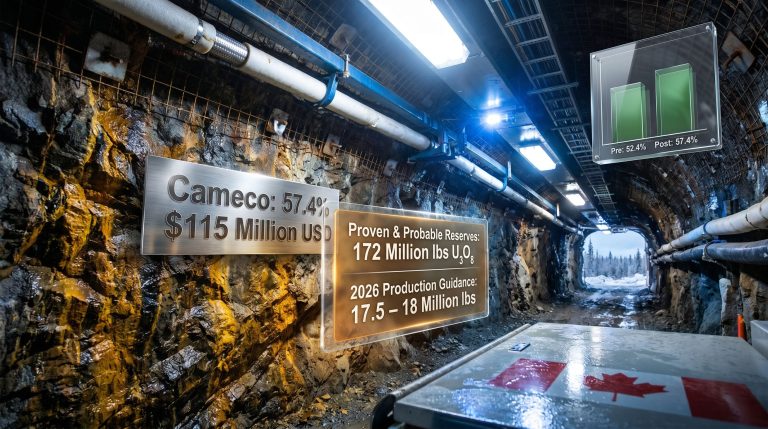
This shift effectively transfers a strategically scarce asset from a passive minority holder with limited operational influence to two producers with active production mandates and deep technical expertise in Athabasca Basin uranium mining. According to Cameco's official announcement, the transaction structure reflects a mature joint venture process: Cameco's proportional share of the purchase price sits at approximately C$115.75 million (roughly US$83.71 million), subject to standard closing adjustments, with completion anticipated in Q3 2026 pending regulatory review.
What Is the Cigar Lake Joint Venture? A Structural Overview
Ownership Composition Before and After the Transaction
The Cigar Lake Joint Venture is one of the most consequential uranium ownership structures in the world. The transaction reshapes that structure as follows:
| Partner | Pre-Transaction Stake | Post-Transaction Stake | Change |
|---|---|---|---|
| Cameco | 54.547% | 57.418% | +2.871% |
| Orano Canada | 40.453% | 42.582% | +2.129% |
| TEPCO Resources | 5.000% | 0.000% | -5.000% |
Cameco serves as the mine operator, and the operation is located in northern Saskatchewan, Canada, approximately 660 kilometres north of Saskatoon. Following completion, the Cigar Lake Joint Venture transitions from a three-party arrangement to a bilateral structure between the two largest Western uranium producers, eliminating the complexity that minority partner arrangements invariably introduce into capital allocation decisions and operational planning.
A History of Incremental Ownership Consolidation
The 2026 acquisition is not the first instance of ownership consolidation at Cigar Lake. A prior adjustment to ownership occurred in 2022, at which point TEPCO retained its 5% interest. The current transaction completes what has been a multi-year process of concentrating control in the hands of the two partners with direct production responsibilities. This pattern of incremental consolidation reveals a deliberate long-term positioning strategy — one that prioritises operational coherence and capital efficiency over the theoretical benefits of a broader partner base.
How Significant Is Cigar Lake as a Global Uranium Asset?
Reserve and Resource Profile: By the Numbers
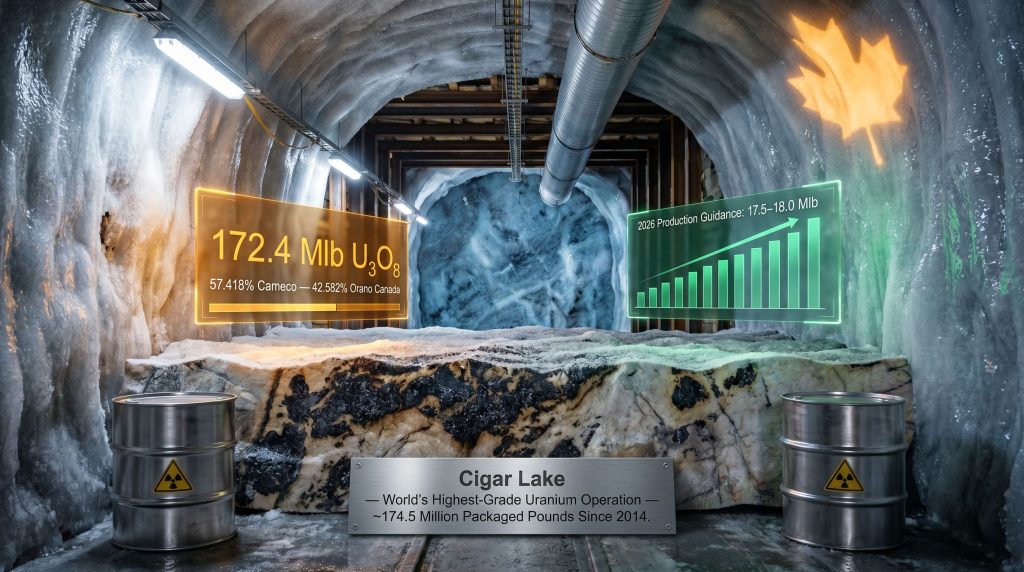
As of 31 December 2025, Cigar Lake holds an estimated 172.4 million pounds (Mlb) of triuranium octoxide (U₃O₈) in proven and probable (2P) reserves, positioning it among the most reserve-rich uranium operations currently in active production globally.
The full resource picture, on a 100% project basis, breaks down as follows:
- Proven and probable reserves: 172.4 Mlb U₃O₈
- Measured and indicated resources: approximately 26.3 Mlb
- Inferred resources: approximately 20.0 Mlb
- Cumulative production since 2014 commissioning: approximately 174.5 million packaged pounds
- 2026 full-project production guidance: 17.5 to 18.0 Mlb of uranium concentrate
The cumulative production figure is particularly striking. Since beginning operations in 2014, Cigar Lake has already delivered more uranium in concentrate form than its current total 2P reserve base — a reflection of how reserve estimates are updated and reclassified over time as geological confidence improves and mining progresses through the ore body. In addition, when considering the largest uranium mines by output, Cigar Lake consistently ranks near the very top.
What Makes Cigar Lake a Tier-One Uranium Operation?
Several attributes combine to place Cigar Lake in a category occupied by very few mines anywhere in the world:
-
Ore grade: Cigar Lake consistently produces the highest-grade uranium ore of any operating mine globally. Grade is measured as the percentage of uranium oxide in the ore, and Cigar Lake's grades are multiple times higher than those found at conventional uranium operations. This grade advantage directly translates into lower processing costs per pound of uranium produced.
-
Freeze mining methodology: The Cigar Lake ore body sits within an unconsolidated, water-saturated host rock, which means conventional hard-rock mining methods would be impractical and unsafe. The mine uses a technique called ground freezing, in which a network of freeze pipes chills the surrounding rock and ground to create a frozen, stable working environment. This methodology is highly specialised and represents a significant barrier to operational replication by competitors.
-
Cost structure: The combination of ultra-high grades and the freeze mining approach places Cigar Lake at the lower end of the global uranium cost curve. Cameco's CEO has described the operation as safe, reliable, and cost-effective — a characterisation that reflects its structural advantage over lower-grade, higher-cost uranium producers worldwide.
-
Regulatory standing: Cigar Lake holds a full operating licence and all required permits. In Canada's regulatory environment, achieving this status for a major uranium operation requires years of environmental assessment, community consultation, and safety review. Licensed, operational assets are therefore extraordinarily difficult to replicate from scratch.
Understanding Unconformity-Type Uranium Deposits
For readers less familiar with uranium geology, it is worth understanding why the Athabasca Basin produces uranium of such exceptional grade. Unconformity-type deposits form at or near the boundary between ancient Proterozoic sandstone and older basement rocks — a geological interface known as the unconformity. Hydrothermal fluids carrying dissolved uranium migrate through fractures and faults, then precipitate uranium minerals when they encounter chemically reducing conditions at this boundary.
Over geological time, these processes can concentrate uranium to grades of 15% to 20% U₃O₈ or higher, compared to a global average closer to 0.1% for many conventional uranium operations. Cigar Lake's ore body is a product of this exceptionally rare geological configuration. Moreover, the global uranium reserves picture highlights just how concentrated high-grade deposits truly are, with the Athabasca Basin accounting for a disproportionate share of the world's most economically significant uranium resources.
What Is the CLExt Development Program and Why Does It Matter?
Extending Cigar Lake's Operational Horizon to 2036
Current mining activity at Cigar Lake is concentrated in the zone designated CLMain. As this primary mining area is progressively depleted, the Cigar Lake Extension program — known as CLExt — has been designed to maintain production continuity by developing adjacent mineralisation. The CLExt program targets operations through to 2036, effectively extending the asset's productive life by approximately a decade beyond what CLMain alone could sustain.
Planned capital investments under the CLExt program include:
- Installation of a dedicated freeze pad
- Development of freeze distribution systems to extend the ground-freezing network into new mining areas
- Expansion of underground infrastructure to access the extension zone
The technical complexity of this investment is significant. Establishing freeze infrastructure for a new mining zone requires the installation of new refrigeration capacity, the drilling of freeze hole arrays, and the commissioning of distribution networks capable of maintaining the thermally stable conditions that safe mining at Cigar Lake demands. The lead time for this type of infrastructure is measured in years, which means Cameco and Orano are already investing capital ahead of the eventual depletion of CLMain.
Why Mine Life Extension Is a Critical Value Driver in Uranium M&A
From a financial perspective, the CLExt program transforms the character of this acquisition. A 5% stake purchased today does not merely represent an entitlement to near-term production from CLMain. It represents a proportional interest in a development program that extends the asset's production profile to 2036 and beyond. This distinction is material to valuation.
Key investor insight: In uranium M&A, the value of a licensed, high-grade operation is not simply a function of current production. It is a function of mine life certainty. An asset with a confirmed operational runway to 2036 commands a structurally different valuation than one facing depletion within five years.
For Cameco and Orano, increasing their respective ownership stakes immediately before the CLExt ramp-up begins amplifies the return on the capital they will commit to that programme. Every percentage point of additional ownership translates directly into a larger share of the production volumes and cash flows that CLExt will eventually generate.
How Does This Deal Reshape the Uranium Supply Landscape?
Consolidation Dynamics in the Athabasca Basin
The Cigar Lake transaction fits within a broader pattern of ownership consolidation that has been unfolding across the Athabasca Basin over recent years. Canada's premier uranium-producing region has seen a steady migration of equity interests toward the two dominant Western producers — a trend driven by the same logic of operational efficiency and supply security that underpins this specific deal.
With TEPCO's exit, the Cigar Lake Joint Venture is now structured as a bilateral arrangement. This simplification has practical consequences for how the joint venture operates day to day. Decision-making processes that previously required three-party alignment now involve only two partners with closely aligned strategic interests, reducing the potential for disagreements over capital allocation, production rates, or development timelines.
Indigenous Community Partnerships as a Structural Operational Factor
One dimension of Cigar Lake's operational success that is frequently underappreciated in financial analysis is the depth of its relationships with neighbouring Indigenous communities. Cameco's CEO has publicly stated that the mine's achievements would not be possible without the contributions of these communities, whose members provide critical workforce and supply chain support through structured partnership arrangements.
This is not a peripheral consideration. In northern Saskatchewan, Indigenous community engagement is deeply embedded in the operational and social licence framework for uranium mining. Regulators, investors, and rating agencies increasingly view these partnerships as a prerequisite for long-term operational continuity rather than an optional ESG add-on. The strength and maturity of these relationships at Cigar Lake represents a reputational and operational asset that is genuinely difficult to replicate at a new greenfield development.
Uranium Market Implications: Supply Security in a Tightening Environment
Uranium market volatility remains a key consideration for utilities and investors alike, and the consolidation at Cigar Lake carries meaningful implications across several dimensions:
| Market Factor | Implication of the Cigar Lake Consolidation |
|---|---|
| Global uranium demand growth | Increased ownership by active producers aligns production capacity with rising utility procurement needs |
| Western supply chain security | Reduces reliance on uranium supply from geopolitically uncertain jurisdictions |
| Long-term contract underwriting | Higher equity entitlements improve Cameco's ability to commit to fixed-volume supply agreements with utility customers |
| Junior uranium developer valuations | Reinforces the scarcity premium commanded by licensed, permitted, high-grade assets |
| Japanese utility sector restructuring | Signals an industry-wide shift from equity-based upstream exposure toward contract-based procurement models |
It is worth noting that global uranium demand projections carry inherent uncertainty, and readers should treat forward-looking supply and demand assessments as analytical frameworks rather than confirmed outcomes. Uranium markets are influenced by reactor construction timelines, energy policy changes, and geopolitical factors — all of which are subject to revision.
The next major ASX story will hit our subscribers first
Frequently Asked Questions: Cameco and Orano Canada Acquire TEPCO's Cigar Lake Interest
What exactly did Cameco and Orano Canada acquire?
Cameco and Orano Canada jointly agreed to purchase the entirety of TEPCO Resources' 5% participating interest in the Cigar Lake Joint Venture. The stake was divided proportionally between the two buyers, with Cameco acquiring 2.871% and Orano Canada acquiring 2.129% of the total project interest.
How much did Cameco pay for its portion?
Cameco's share of the purchase price is approximately C$115.75 million (roughly US$83.71 million), subject to customary closing adjustments that may alter the final figure.
When will the transaction close?
Completion is anticipated in the third quarter of 2026, subject to regulatory approval and standard closing conditions.
What are the new ownership percentages?
Following completion, Cameco will hold 57.418% and Orano Canada will hold 42.582% of the Cigar Lake Joint Venture, with TEPCO Resources holding no further interest.
What is the CLExt programme?
The Cigar Lake Extension programme is a capital development initiative designed to extend mine operations beyond the current CLMain zone, targeting continued production through to 2036. Key investments include freeze pad installation, freeze distribution system development, and underground infrastructure expansion.
Why does the freeze mining methodology matter?
The Cigar Lake ore body is hosted in unconsolidated, water-saturated rock that cannot be safely mined using conventional hard-rock techniques. Ground freezing artificially stabilises the ore zone by chilling surrounding material to sub-zero temperatures, creating a frozen working environment. This methodology is highly specialised, technically demanding, and represents a significant barrier to competition that cannot simply be acquired off the shelf.
Key Takeaways: What the Cigar Lake Ownership Consolidation Tells Us
-
Geological scarcity drives strategic premiums: The willingness of Cameco and Orano to pay a combined premium for a 5% interest reflects the fundamental difficulty of replicating Cigar Lake's geological, regulatory, and operational profile anywhere in the world.
-
Western producer consolidation is a deliberate, multi-year strategy: This transaction is the latest step in a pattern of incremental ownership consolidation that has been unfolding since at least 2022. The two dominant Western uranium producers are systematically deepening their control over the Athabasca Basin's most productive assets.
-
TEPCO's exit marks a structural shift in Japanese utility procurement: The transition away from direct equity participation in overseas uranium mines toward contract-based supply models is a significant development for how uranium supply security is managed at the utility level globally.
-
Mine life extension transforms the deal's value profile: The CLExt programme's target operational horizon of 2036 means this acquisition is not a near-term production play. It is a long-duration strategic asset purchase with capital appreciation characteristics tied to the extension programme's eventual output.
-
Indigenous partnerships are an embedded operational factor, not a peripheral one: Community engagement at Cigar Lake is woven into the mine's licence to operate, workforce capacity, and supply chain resilience. It is a structural component of the asset's value, not an optional add-on.
-
The freeze mining barrier is underappreciated by generalist investors: The technical complexity and capital intensity of ground-freezing infrastructure creates an operational moat that is rarely discussed in mainstream analysis. Those investing in uranium at the producer level should understand why this methodology means Cigar Lake cannot simply be replicated elsewhere, even if similarly graded geology were discovered.
This article is intended for informational purposes only and does not constitute financial advice. Uranium market projections, production forecasts, and transaction timelines are subject to change based on regulatory outcomes, market conditions, and operational factors. Readers should conduct their own due diligence before making any investment decisions.
Want to Stay Ahead of the Next Major Mineral Discovery on the ASX?
Discovery Alert's proprietary Discovery IQ model delivers real-time alerts the moment significant ASX mineral discoveries are announced, transforming complex geological and commodity data into clear, actionable investment insights for both short-term traders and long-term investors. Explore how historic discoveries have generated substantial returns by visiting Discovery Alert's dedicated discoveries page, and begin your 14-day free trial today to position yourself ahead of the broader market.