August 3, 2026
The Invisible Chokepoint: Why Uranium Conversion Is America's Most Overlooked Energy Security Problem
The global nuclear energy sector is experiencing a structural transformation. Electricity demand driven by artificial intelligence infrastructure, data centre expansion, and large-scale electrification programmes is colliding with a growing consensus that carbon-free baseload power is non-negotiable. Reactor construction pipelines are expanding across the United States, Europe, and Asia. Yet the intense focus on reactor technology and uranium mining often obscures a quieter, more technically demanding vulnerability sitting in the middle of the nuclear fuel cycle: conversion.
Understanding why Texas A&M uranium conversion research has attracted serious attention from both the nuclear fuel industry and energy security analysts requires first appreciating just how structurally fragile this segment of the fuel chain has become. Furthermore, the uranium supply challenges facing the broader market make this research all the more timely.
When big ASX news breaks, our subscribers know first
The Nuclear Fuel Cycle and the Conversion Bottleneck
Most discussions of nuclear energy focus on two endpoints: uranium mining and reactor operations. The intermediate steps receive far less public scrutiny, yet they represent some of the most technically specialised and geographically concentrated activities in the entire energy sector.
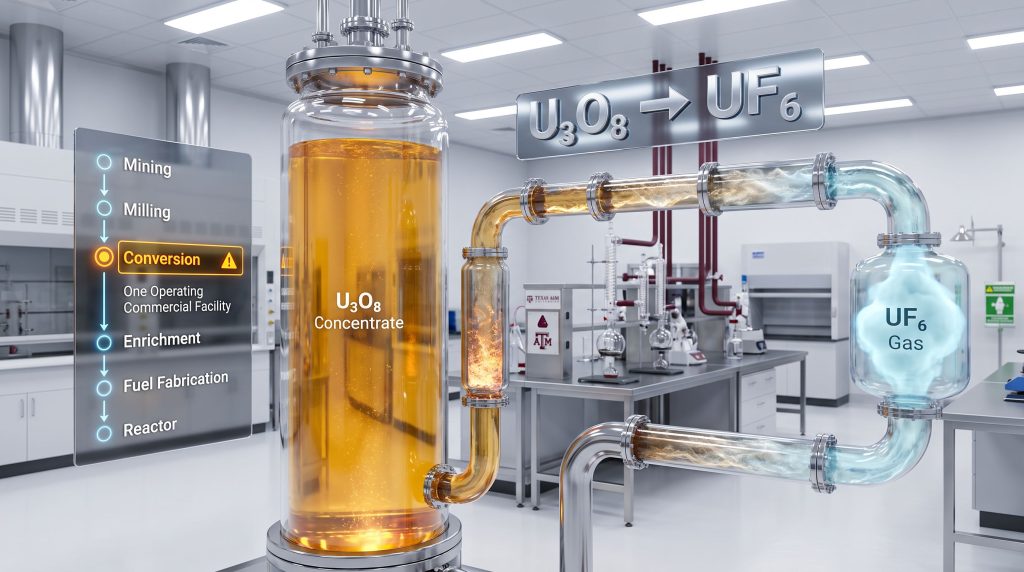
The fuel cycle follows a defined sequence:
- Uranium ore is extracted through conventional or in-situ recovery mining methods.
- Ore is processed at a mill to produce uranium oxide concentrate, commonly known as yellowcake (U₃O₈).
- Yellowcake undergoes chemical conversion into uranium hexafluoride (UF₆).
- UF₆ is fed into centrifuge enrichment facilities where the concentration of the fissile U-235 isotope is increased.
- Enriched uranium is fabricated into fuel assemblies.
- Fuel assemblies are loaded into reactors for power generation.
Conversion sits at step three, but its importance is disproportionate to the attention it receives. Without high-purity UF₆, the entire downstream chain stalls. Enrichment centrifuges are precision instruments engineered to nanometre tolerances, and chemical impurities in UF₆ feedstock can cause catastrophic mechanical failures. This means the purity specification for conversion output is not merely a quality preference; it is an engineering imperative.
America's Single Point of Failure
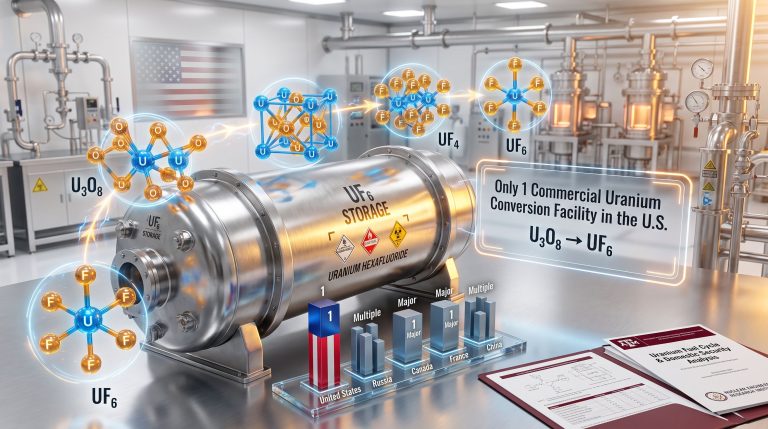
The structural exposure in U.S. conversion capacity is stark. The country currently operates only one commercial-scale uranium conversion facility: the Metropolis Works plant in Illinois, operated by Honeywell under the ConverDyn brand. That facility has experienced operational interruptions over recent years, including a suspension of operations that lasted from 2017 to 2023, leaving the United States entirely reliant on foreign conversion services during that period.
| Fuel Cycle Stage | U.S. Domestic Capacity | Dependency Risk Level |
|---|---|---|
| Uranium Mining | Growing but limited | Moderate |
| Conversion (U₃O₈ to UF₆) | One operating facility | Critical |
| Enrichment | Partial domestic capacity | High |
| Fuel Fabrication | Multiple facilities | Low to Moderate |
The United States possesses significant uranium ore resources and a growing mining sector, yet the single conversion step creates a structural chokepoint that renders upstream mining capacity commercially incomplete without foreign processing support.
Historically, Western utilities filled this gap through contracts with Russian state nuclear enterprise Rosatom via its subsidiary TENEX, as well as with Canadian operator Cameco and French company Orano. The geopolitical realignments of recent years, however, have fundamentally changed the risk calculus attached to those dependencies. Consequently, the US ban on Russian uranium has further accelerated the urgency of building domestic conversion capability.
The TEES and Quantum Leap Energy Research Agreement
The Texas A&M Engineering Experiment Station (TEES) has entered into a formal research agreement with Quantum Leap Energy (QLE) to advance and de-risk the commercial production of high-purity uranium hexafluoride. This partnership brings together one of the largest applied research institutions in the United States with an emerging commercial operator targeting the conversion segment directly.
TEES functions as the applied research arm of the Texas A&M University System. Its mandate is not purely academic. The station has a long track record of translating controlled laboratory findings into commercially deployable engineering processes, and its involvement in this programme signals an orientation toward practical scale-up rather than theoretical chemistry alone.
Quantum Leap Energy: Filling the Commercial Gap
QLE is an Austin, Texas-based company operating as a subsidiary of ASP Isotopes, a broader isotope enrichment platform with applications spanning nuclear energy, nuclear medicine, and semiconductor manufacturing. QLE's specific strategic focus is the uranium conversion segment of the fuel cycle, targeting the structural gap between domestic yellowcake production and the enrichment facilities that require UF₆ feedstock to operate.
The positioning of QLE within the ASP Isotopes corporate structure is notable. ASP Isotopes is simultaneously developing isotope separation capabilities across multiple sectors, meaning QLE's conversion technology development occurs within an organisation that already possesses deep process chemistry and centrifuge-related technical expertise. This cross-pollination of knowledge across isotope applications represents an underappreciated competitive advantage in conversion process development. For further context, the research agreement announcement outlines the full scope of the collaboration.
What the Research Actually Involves: Technical Scope and Methodology
The core scientific challenge in uranium conversion is not simply transforming one chemical compound into another. It is doing so at a level of purity, yield consistency, and process efficiency that can support commercial-scale economics and downstream enrichment requirements.
The Chemistry of Yellowcake-to-UF₆ Conversion
Yellowcake (U₃O₈) must pass through a multi-stage fluorination process to produce uranium hexafluoride. The reaction pathway involves controlled exposure to fluorinating agents under precisely managed temperature and pressure conditions. The challenges include:
- Achieving consistently high UF₆ purity to meet enrichment facility specifications and avoid centrifuge degradation.
- Controlling reaction kinetics to maximise uranium yield per unit of feedstock processed.
- Managing the highly corrosive and reactive nature of fluorine chemistry in an industrial process context.
- Characterising thermodynamic parameters across varying feedstock qualities, since yellowcake composition can differ meaningfully depending on the mine source and milling process.
That last point carries strategic weight. Different uranium deposits and milling methods produce yellowcake with varying impurity profiles. A robust conversion process must be capable of handling this variability without compromising UF₆ purity, which makes comprehensive physicochemical data collection across feedstock types an essential component of the research programme.
Physicochemical Data Collection as a De-Risking Strategy
The TEES-QLE collaboration is structured around systematic collection of physicochemical data on the reaction pathways involved in UF₆ production. This data will feed into process modelling frameworks and engineering design tools that will underpin future commercial facility planning.
In commercial nuclear development, the concept of de-risking operates across three distinct dimensions:
- Technical de-risking establishes that a process produces measurable, reproducible results at laboratory scale with performance characteristics that can be mathematically extrapolated to larger systems.
- Economic de-risking generates cost, yield, and throughput data that enables financial modelling rigorous enough to support investor due diligence and capital allocation decisions.
- Regulatory de-risking builds a documented evidence base that can anchor future licensing applications with the Nuclear Regulatory Commission (NRC), demonstrating process safety and operational consistency.
This research programme is a laboratory-scale investigation, not a commercial production facility. The pathway from validated process data to an operating conversion plant involves additional engineering, regulatory, and financing milestones that extend well beyond the current agreement's scope.
Why Domestic UF₆ Production Is Urgent Now
The timing of this research initiative intersects with multiple converging pressures on the nuclear fuel supply chain. Indeed, the broader uranium market dynamics make the case for domestic conversion capacity more compelling than at any point in recent decades.
Geopolitical Realignment and Supply Chain Risk
Russia's TENEX has historically supplied a material share of global conversion services to Western utilities. Sanctions measures and energy security reviews following geopolitical disruptions have prompted Western governments and utilities to reassess the wisdom of sustained reliance on Russian conversion capacity. The urgency of diversification has accelerated accordingly.
France's Orano and Canada's Cameco offer alternatives, but global conversion capacity is tightly concentrated across a small number of facilities, and demand growth projections tied to the nuclear renaissance are beginning to pressure available supply. Analysts tracking the uranium supply-demand volatility have noted that contracted capacity could tighten meaningfully within this decade as new reactor commitments materialise into actual fuel procurement requirements.
Advanced Reactor Demand and HALEU Requirements
The emergence of small modular reactors (SMRs) and Generation IV advanced reactor designs introduces an additional complexity. Several next-generation reactor concepts require High-Assay Low-Enriched Uranium (HALEU), which demands enrichment to between 5% and 20% U-235 concentration rather than the approximately 3-5% typical of conventional light-water reactor fuel. HALEU production requires UF₆ feedstock of exceptional purity, placing even greater technical demands on the conversion step.
A domestic conversion pathway capable of producing high-purity UF₆ from varied yellowcake feedstocks would therefore serve both the existing light-water reactor fleet and the emerging advanced reactor pipeline simultaneously.
The Supply Chain Logic Visualised
U.S. Uranium Mining Output
         ↓
Yellowcake (U₃O₈) Production at Mill
         ↓
[CONVERSION] U₃O₈ → UF₆  ← Current Bottleneck
         ↓
Enrichment: UF₆ → Enriched UF₆
         ↓
Fuel Fabrication into Assemblies
         ↓
Reactor Deployment and Power Generation
Every tonne of domestic uranium ore that reaches the yellowcake stage but cannot be converted domestically represents a supply chain dependency that must be resolved through foreign commercial relationships, each carrying its own geopolitical and logistical risk.
Academic-Industry Collaboration as a Commercialisation Model
The TEES-QLE structure mirrors a broader trend across the nuclear technology development ecosystem. University research institutions increasingly serve as technical de-risking partners for emerging commercial nuclear technologies, providing credentialed scientific rigour, access to specialised laboratory infrastructure, and a measured pace of evidence generation that satisfies both investor and regulatory scrutiny.
Similar collaboration models have been deployed across SMR development programmes, advanced fuel form research including TRISO particle fuels, and nuclear waste processing technology. The commercial logic is straightforward: generating credible technical data through an academic partnership costs a fraction of piloting the same experiments within a commercial facility subject to full regulatory oversight, while producing outputs that carry scientific credibility with regulators and institutional investors alike.
Comparative Landscape: U.S. Conversion Capacity
| Initiative | Institution or Operator | Focus Area | Current Stage |
|---|---|---|---|
| TEES-QLE Agreement | Texas A&M / Quantum Leap Energy | UF₆ conversion R&D | Laboratory and de-risking |
| Metropolis Works (ConverDyn) | Honeywell / ConverDyn | Commercial UF₆ production | Operational |
| Orano | French state-linked operator | International conversion services | Operational |
| Cameco | Canadian commercial operator | International conversion services | Operational |
The next major ASX story will hit our subscribers first
Development Milestones and What to Watch
For those tracking this programme, the development pathway from laboratory research to commercial scale involves a staged series of deliverables and decision points.
Near-term research outputs expected from the TEES-QLE collaboration include:
- Characterisation of reaction kinetics across multiple feedstock compositions.
- Thermodynamic parameter datasets for the UF₆ production pathway.
- Identification of optimal operating conditions including temperature ranges, pressure parameters, and fluorine source specifications.
- Process simulation models capable of informing pilot-scale equipment design.
Medium-term commercial development would logically progress through:
- Transition from bench-scale validated models to pilot plant engineering design.
- Regulatory engagement with the NRC to establish a licensing pathway for a commercial conversion facility.
- Capital formation activities by QLE and ASP Isotopes to fund scale-up infrastructure.
Long-term strategic outcomes, if the commercialisation pathway succeeds, include the addition of a second domestic U.S. UF₆ conversion facility, materially reducing the concentration risk currently embodied in a single operational plant. Technologies developed through Texas A&M uranium conversion research may also carry applications in HALEU production pathways, extending their relevance beyond the existing reactor fleet.
Frequently Asked Questions
Why does uranium need to be converted to UF₆ before enrichment?
Uranium hexafluoride transitions to a gaseous state at relatively modest temperatures, making it compatible with the gas centrifuge technology used in modern enrichment facilities. Yellowcake in its oxide form cannot be fed directly into centrifuges. The conversion step is therefore a physical and chemical prerequisite for enrichment, not merely an optional processing stage.
What makes high purity so critical in UF₆ production?
Enrichment centrifuges operate at extremely high rotational speeds under precise mechanical tolerances. Chemical impurities in UF₆ can react with centrifuge components, causing corrosion and mechanical failure. Cascade contamination events, where a single impurity source propagates through interconnected centrifuge banks, can take entire enrichment facilities offline. Purity standards for UF₆ are therefore set to protect not just fuel quality but the physical integrity of expensive enrichment infrastructure.
Is Texas A&M building a uranium conversion facility?
The Texas A&M Engineering Experiment Station is conducting laboratory-scale research under a structured research agreement. Any commercial production facility would be a separate undertaking by Quantum Leap Energy, subject to independent regulatory approvals, site selection, financing, and construction processes that are entirely distinct from the current research programme.
How does this relate to the broader nuclear energy policy environment?
Legislative frameworks such as the ADVANCE Act have elevated domestic nuclear fuel cycle capacity as a national energy security priority. These policy frameworks create a supportive regulatory environment for domestic conversion development, though no specific government funding or project designation for the TEES-QLE programme has been confirmed in publicly available sources.
Key Takeaways
- Texas A&M uranium conversion research addresses the single most concentrated structural vulnerability in the U.S. nuclear fuel supply chain.
- QLE's position within the ASP Isotopes platform brings cross-sector isotope processing expertise to a technically demanding conversion challenge.
- The physicochemical data collection methodology represents a disciplined, capital-efficient approach to commercial de-risking that mirrors best practice across the broader nuclear technology development sector.
- High-purity UF₆ production capability has strategic relevance for both the existing light-water reactor fleet and the emerging advanced reactor and HALEU demand pipeline.
- Success in this programme would represent a meaningful step toward a genuinely sovereign U.S. nuclear fuel supply chain, reducing dependence on the small number of foreign operators who currently dominate conversion capacity globally.
Disclaimer: This article contains forward-looking statements and projections regarding nuclear fuel cycle development, commercial scale-up timelines, and market dynamics. These involve inherent uncertainties and should not be interpreted as investment advice. Readers conducting investment research are encouraged to consult independent financial and technical advisors. The commercialisation pathway described involves regulatory, financial, and engineering milestones that have not yet been completed.
Want to Stay Ahead of the Next Major Uranium Discovery on the ASX?
Discovery Alert's proprietary Discovery IQ model delivers real-time alerts on significant ASX mineral discoveries — including uranium — instantly translating complex data into actionable investment insights for both short-term traders and long-term investors. Explore historic examples of major mineral discoveries and their returns on Discovery Alert's dedicated discoveries page, and begin your 14-day free trial today to position yourself ahead of the broader market.